Bookshelf wealth lookbook
CategoriesInterior Design

True trends always answer a need

As TikTok and other platforms become increasingly flooded with home-styling ideas, Michelle Ogundehin shares advice on how to navigate changing trends in the era of ubiquitous social media.


Newspaper journalists are often keen for a quote on “the latest trends”. What do I think of polka dots? What about red paint: hot right now, non? It depends. Or recently, what could I say about the TikTok trend “bookshelf wealth”? Hmmm, interesting.

Obviously, just because images of a lot of spotty things have been cobbled together by someone on Instagram, or an influencer declares in breathless tones that poppy has surpassed magnolia in the paint stakes, does not make it universally true. But this is not to flagellate the notion of “trends” per se – the stylistic movements that visualise our cultural climate can be genuinely intriguing.

Here-today-over-tomorrow fads can be noxious

True trends always answer a need. Emerging from an alchemy of desire, available resources, and cultural resonance, they have the power to make visible unspoken truths. However, the here-today-over-tomorrow fads can be noxious. The thing is, true trends don’t occur in a vacuum; you can always trace their roots. In short, no roots = no relevance = fad. And I’ll come back to the bookshelves.

Alternatively, it’s called marketing. Because someone, somewhere will make money from you feeling compelled to throw out your perfectly good cushion, frock, phone, or sofa to replace it with a newer, more “on-trend”, faster, smaller, prettier, or any other adjective you care to insert here, model.

Social media platform-time is bought to advance the cause and propel the message. Whether it has staying power though, is entirely another matter. This is where the aforementioned relevance and roots come in.

Arguably there are moments when it seems as if one creative camp has agreed on a singular approach. The spring special April issues of the fashion magazines collectively trill that “it’s all about pastels!” But is it? Or did the picture desks just pull together all the sugary-coloured images from across the collections of 20 different designers and call it a moment?

After all, it’s habitual for colours to lighten in the spring and darken as we approach winter. More of note would be if everyone went grey for April. But that probably wouldn’t make for an uplifting (ie sales-savvy) coverline.

It’s the same in interiors. When I was editor-in-chief of ELLE Decoration, occasionally I’d receive a letter from a disgruntled reader bemoaning the season’s hot new look. Why had it changed from last month’s look, which they loved?

As consumers and designers, we must self-interrogate

My reply was always the same: my job is to show you what’s out there, your job is to decide what you like, and then stick to it. Or change if you want to. But the key is that it’s your choice. What I always wanted to add was: and don’t devolve the responsibility for your taste!

It’s also true that there used to be a bit of a journalistic mantra that went along the lines of: one’s an oddity, two’s a coincidence, but three’s a trend! So, if three of a similar thing plopped into the inbox, then it was worth looking into.

However, the follow-up question is always: why? Why is this happening? Is there anything behind it? Just because something is new doesn’t make it news. And, crucially, is it adding anything to the cultural conversation?

I think this latter point is ever more relevant today. It can no longer be justified to create for the sake of it (that is arguably the purpose of art). Instead, as consumers and designers, we must self-interrogate.

Has this product genuinely improved the models that precede it by using less resources, demanding less energy, eradicating plastic, and thus being less likely to end up as waste? If not, then why make it?

That aside, sometimes a “trend” reflects more of a mood than a whole “moment”. Take the unexpected red “trend”. We could post-rationalise this as being rooted simply in a feeling of dark times drawing us to colour. It makes us happier.

Engaging your own inner critic becomes ever more vital

On the other hand, red is a deeply emotive hue, one of the most visible of the spectrum, thus a colour that intrinsically demands our attention. This is why it’s used for both stop and sale signs. We’re literally hardwired to see it. So, is this a verifiable trend, or merely the power of colour theory? Maybe it doesn’t matter?

However, when considering social-media trends, we generally only see more of what we think we already like. This is fine when we’re talking pops of colour, a lot less so regarding deep fakes deliberately designed to thwart opinions.

Bottom line, engaging your own inner critic becomes ever more vital. The platforms will always deliver a constant stream of fodder, but to paraphrase the inimitable Coco Chanel: content is what’s out there – but it’s up to you to choose what to believe.

Now back to those bookshelves. The images themselves are irrelevant. If someone was to go out and buy books by the metre to “get the look” then they’ve missed the point entirely; let’s not reduce the notion of home to a mere backdrop – it should be your personalised space from which to thrive.

Thus, to me, “bookshelf wealth” is the visual expression of the authenticity that we’re currently craving in a world that appears to have gone right royally tits up. Homes with shelves bursting with well-read tomes, curiosities and the talismans of life, however quirky, are an antidote to the virtual.

It dwells firmly in the tactile and tangible world of the analogue as so beautifully depicted recently in Wim Wenders’ latest film, Perfect Days, wherein the main protagonist lives contentedly in his chosen world of flip phones, cassette tapes and simple routine.

Stop the press! A trend that reflects the rejection of the maelstrom of modern life

It’s about honouring yourself, your journey, your interests, and proudly displaying it all. It stands on the shoulders of the movements we’ve seen already towards fermenting, knitting, and baking sourdough. It’s about truth-telling and slowing-down; renovating not relocating; ditching the work/spend cycle and stepping off the consumer conveyor belt.

It’s not so much a look as a potent signifier of a shifting of priorities. It’s back-to-basics and living on a human-needs-first scale, as an antidote to the prevalent norm of life being voraciously consumed at technological pace to maximise productivity for someone else.

Stop the press! A trend that reflects the rejection of the maelstrom of modern life, indicating long-term thinking and emotional evolution to be the way forward. That may not make for a super snappy soundbite, but it certainly bodes better for our future than crimson walls, or polka dots.

Michelle Ogundehin is a thought leader on interiors, trends, style and wellbeing. Originally trained as an architect and the former editor-in-chief of ELLE Decoration UK, she is the head judge on the BBC’s Interior Design Masters, and the author of Happy Inside: How to Harness the Power of Home for Health and Happiness, a guide to living well. She is also a regular contributor to publications including Vogue Living, FT How to Spend It magazine and Dezeen.

The photo, showing House M by Studio Vaaro, is by Scott Norsworthy.

Dezeen In Depth
If you enjoy reading Dezeen’s interviews, opinions and features, subscribe to Dezeen In Depth. Sent on the last Friday of each month, this newsletter provides a single place to read about the design and architecture stories behind the headlines.
Reference

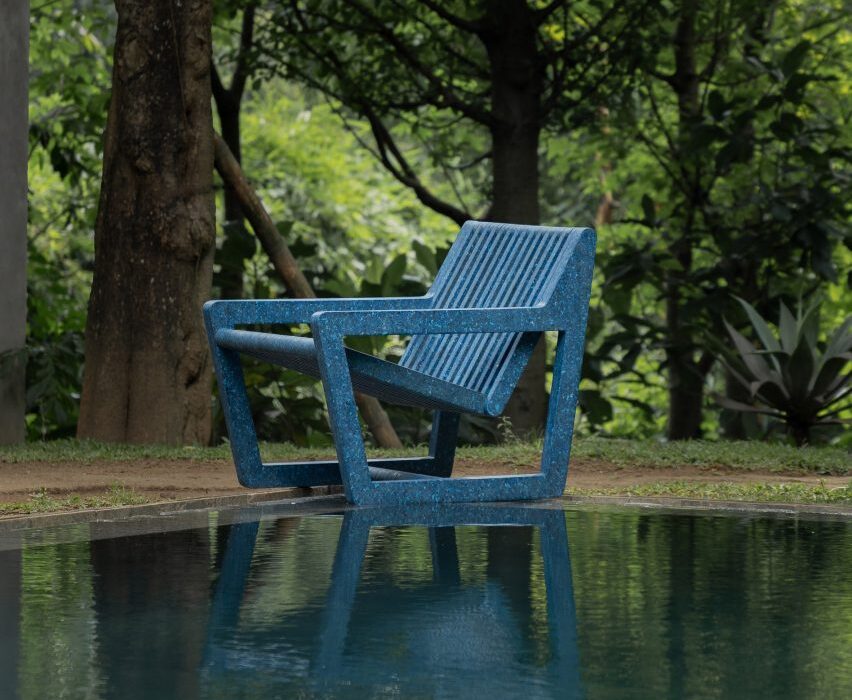
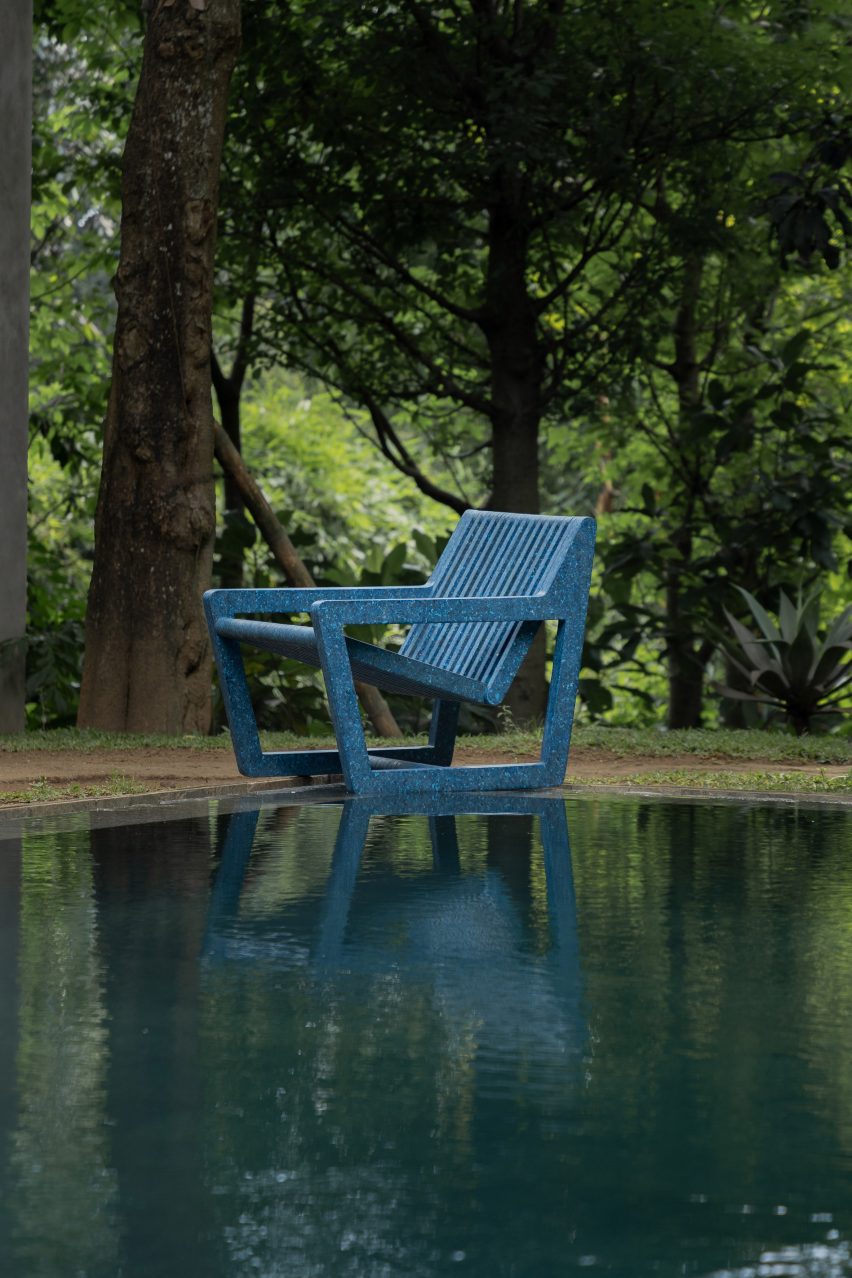
Blue Ombak chair next to a pool
CategoriesSustainable News

Sungai Watch chair consists of 2,000 plastic bags from Bali’s rivers

Indonesian non-profit Sungai Watch has unveiled the debut furniture launch from its design studio Sungai Design, aimed at creating useful products from the mountains of plastic waste that it fishes from Bali’s rivers every day.

The Ombak lounge chair, created in collaboration with American designer Mike Russek, is made using a sheet material produced entirely from discarded plastic bags, with around 2,000 needed for every chair.

The bags are collected by Sungai Watch, which is on a mission to eliminate ocean plastic pollution using its own system of floating barriers to capture the waste as it flows along Indonesia’s rivers.

Blue Ombak chair next to a poolBlue Ombak chair next to a pool
Sungai design has launched its first-ever product

Since its inception three years ago, the organisation has installed 270 barriers and collected more than 1.8 million kilograms of plastic, resulting in a huge stockpile of material.

Plastic bags are the most frequently collected item and also the least sought after in terms of future value, which led the team to focus on creating a product collection using this readily available resource.

“Collecting and amassing plastic waste solves one part of the problem of plastic pollution, the second challenge is what to actually do with all of this plastic,” said Kelly Bencheghib, who co-founded Sungai Watch with her brothers Sam and Gary.

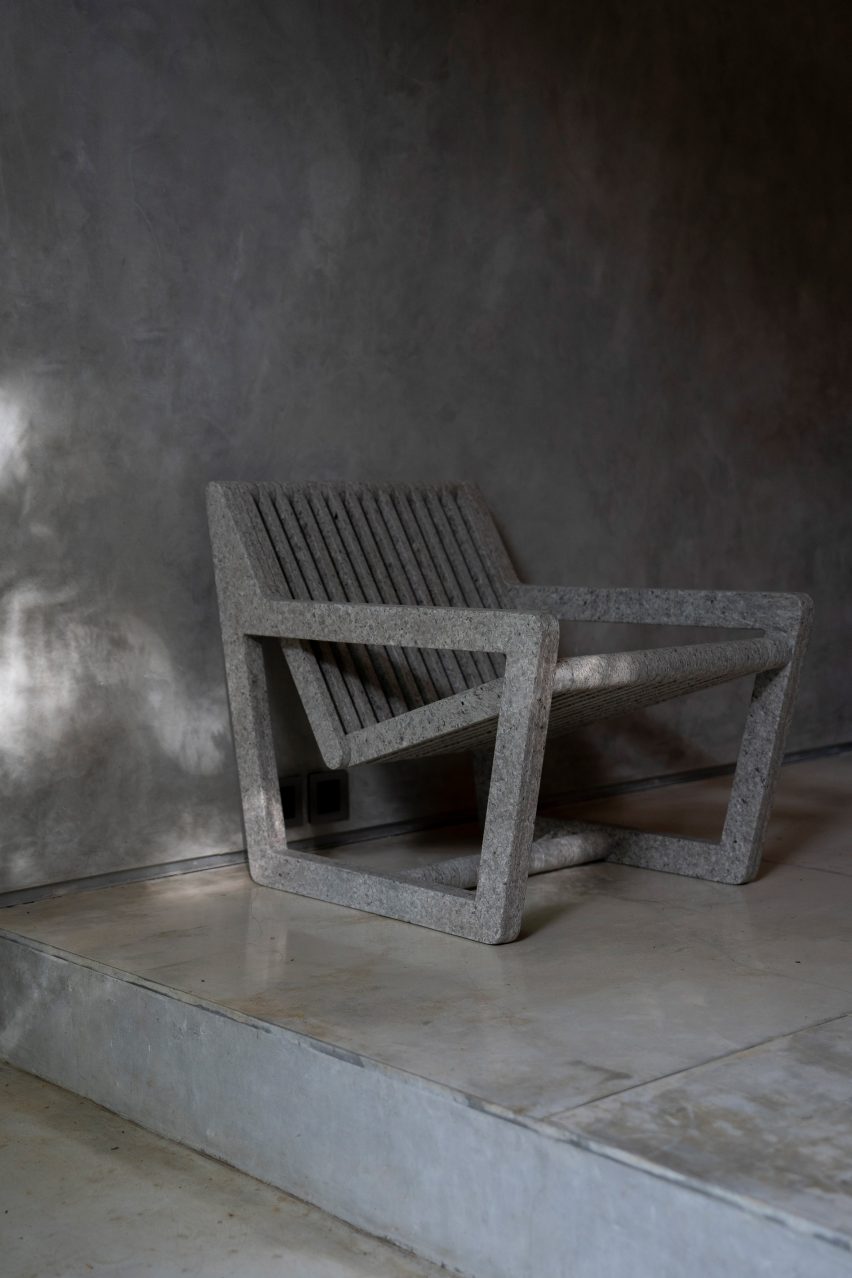
White chair by Sungai Design on a concrete backdropWhite chair by Sungai Design on a concrete backdrop
The Ombak lounge chair is made from discarded plastic bags

“As we collected hundreds of thousands of kilograms of plastics, we started to look at plastic as an excellent source material for everyday products we all need and use, from furniture to small goods to even art,” she added.

Sungai Design has created two variations of the Ombak lounge chair – with and without armrests – manufactured in Bali using processes that aim to minimise waste during production.

The plastic bags are thoroughly washed to remove any impurities before being shredded and heat-pressed to form hard, durable sheets.

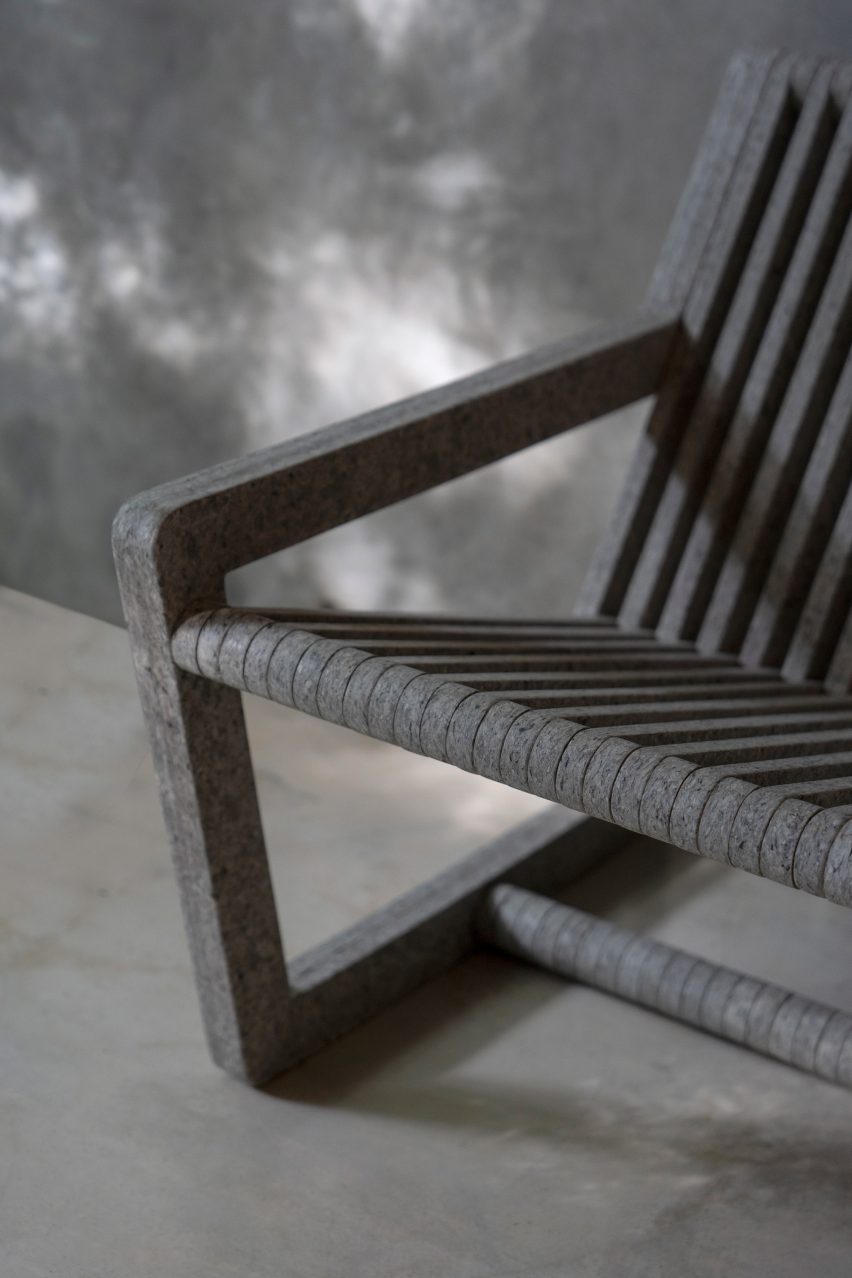
Close-up of white Ombak chairClose-up of white Ombak chair
The bags are heat-pressed to form sheets

Precision CNC cutting machinery is used to carve out the different components, which are carefully shaped to minimise material use and leave no offcuts.

The panels are connected by a concealed metal structure, resulting in a pure and visually lightweight form with a simple slatted construction.

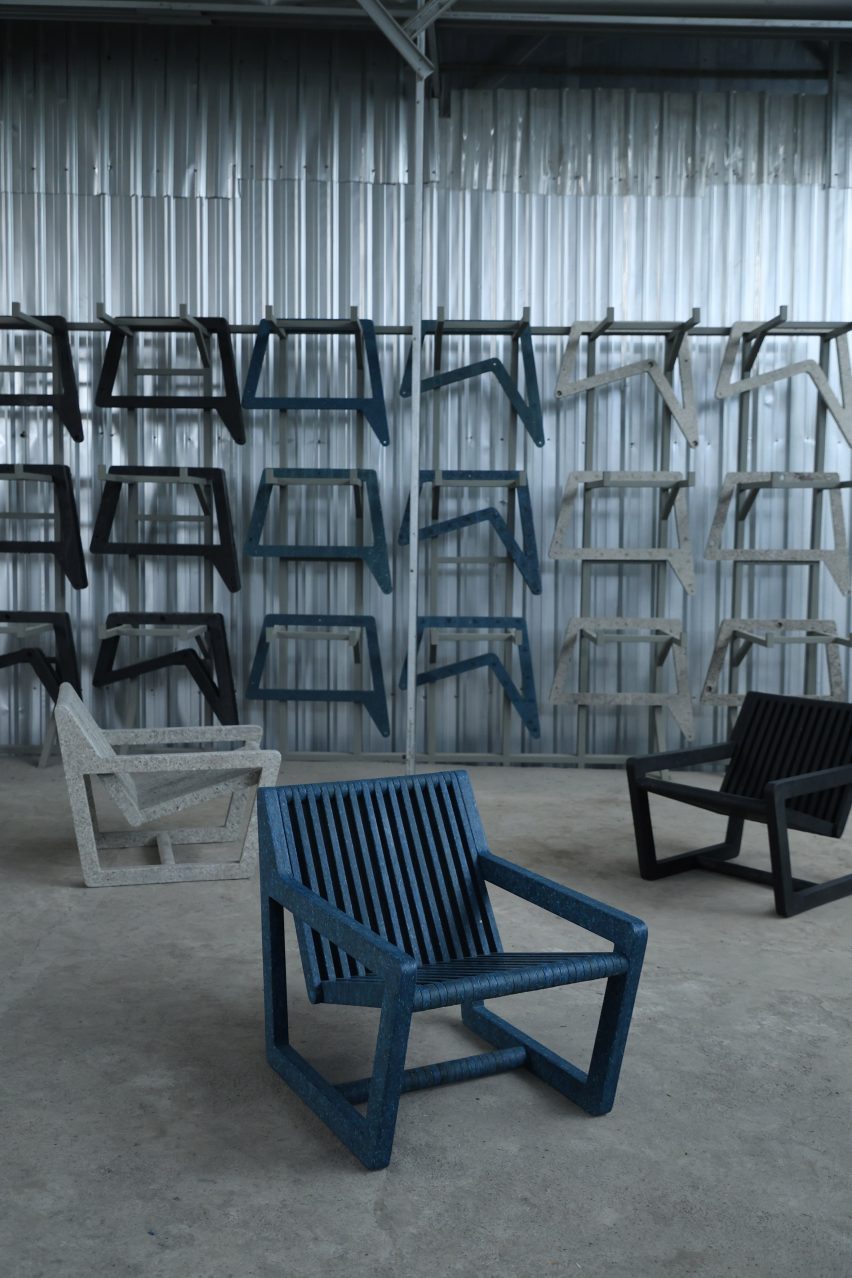
Although the design is available in three distinct colourways – Granite Black, Ocean Blue and Concrete White – the upcycling process produces slight variations in the tone and texture of the material, meaning each chair has a unique quality.

Ombak means wave in Indonesian and the name references Sungai Design’s commitment to cleaning up rivers and oceans.

In line with this aim, Sundai Design has pledged to minimise its carbon footprint and put in place processes to audit and track the sources of the plastic used in its products.

The company is planning to release other products using the same material and, as a social enterprises, will donate part of its revenue to Sungai Watch to further the project as it seeks to clean up rivers in Indonesia and beyond.

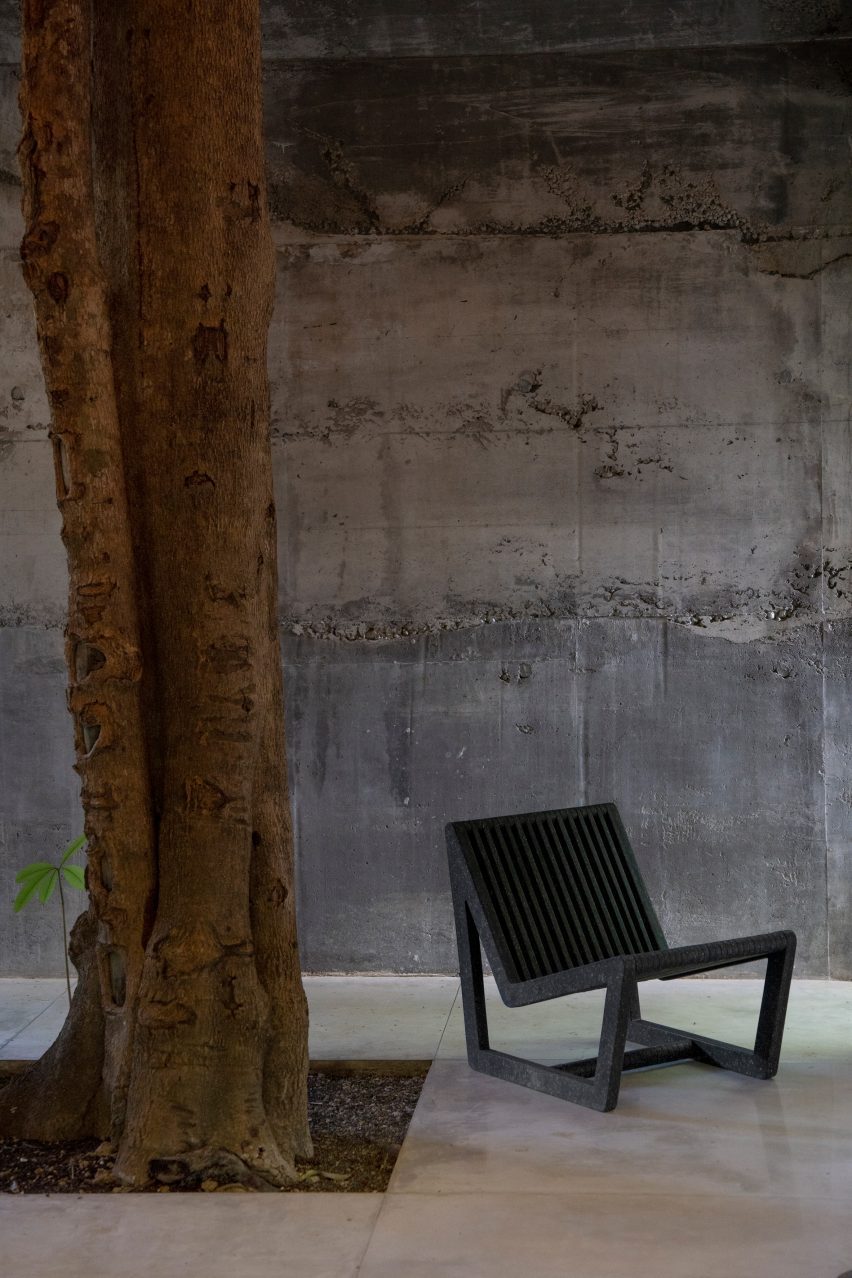
Black chair by Sungai Design next to a treeBlack chair by Sungai Design next to a tree
The chair was designed to minimise material use and leave no offcuts

“There is so much potential with this material,” added Sam Bencheghib. “When you choose a chair from our collection, you’re not just selecting a piece of furniture; you’re embracing the transformation from waste to a beautiful, functional piece of art that has found its place in your home.”

Every year, Indonesia accounts for 1.3 million of the eight million tonnes of plastic that end up in our oceans, making it one of the world’s worst marine polluters.

Other attempts at collecting this waste and finding new uses for it have come from design studio Space Available, which set up a circular design museum with a recycling station and facade made of 200,000 plastic bottles in Bali in 2022.

White, blue and black Ombak chairs with armrests by Sungai DesignWhite, blue and black Ombak chairs with armrests by Sungai Design
The chair is available in three colours

The studio also teamed up with DJ Peggy Gou turn rubbish collected from streets and waterways in Indonesia into a chair with an integrated vinyl shelf.

“The trash is just everywhere, in the streets and rivers,” Space Available founder Daniel Mitchell told Dezeen.

“It’s not the fault of the people, there’s just very little structural support, waste collection or education,” he added. “Households are left to dispose of their own waste and most ends up in rivers or being burned.”

Reference

Rendering of a toothbrush on a white backdrop from Seymour Powell's Un-Made concept
CategoriesSustainable News

Toothbrush pops open for recycling in Seymourpowell’s Un-Made concept

British design studio Seymourpowell has put cheap electronic goods under the spotlight with Un-Made, a project imagining four possible ways to design for quick disassembly and recycling.

As part of the project, Seymourpowell devised four automated disassembly mechanism concepts using an electric toothbrush as an example for their animated graphics.

Each of the mechanisms could be built into a product during manufacturing and then activated in a factory at the end of the item’s life.

Rendering of a toothbrush on a white backdrop from Seymour Powell's Un-Made conceptRendering of a toothbrush on a white backdrop from Seymour Powell's Un-Made concept
Un-Made suggests automated disassembly mechanisms for an electric toothbrush

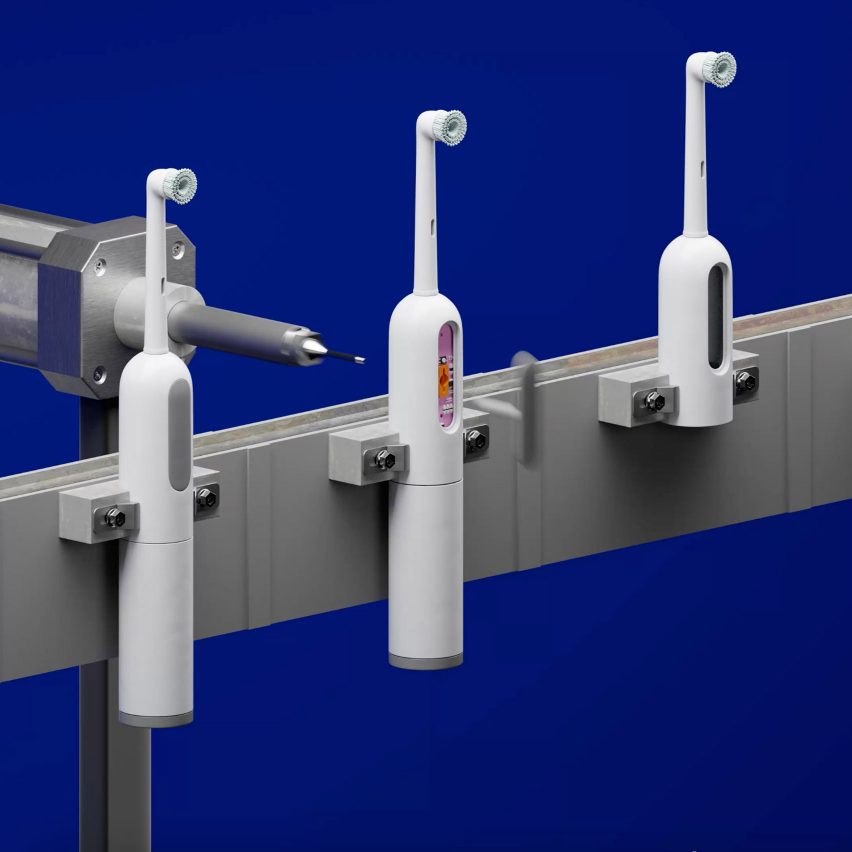
The first Un-Made concept is a pin mechanism. Similar to the action of opening a SIM card slot on a smartphone, it involves poking a pin into a small, sealed pinhole on the rear of the product to release the internal components.

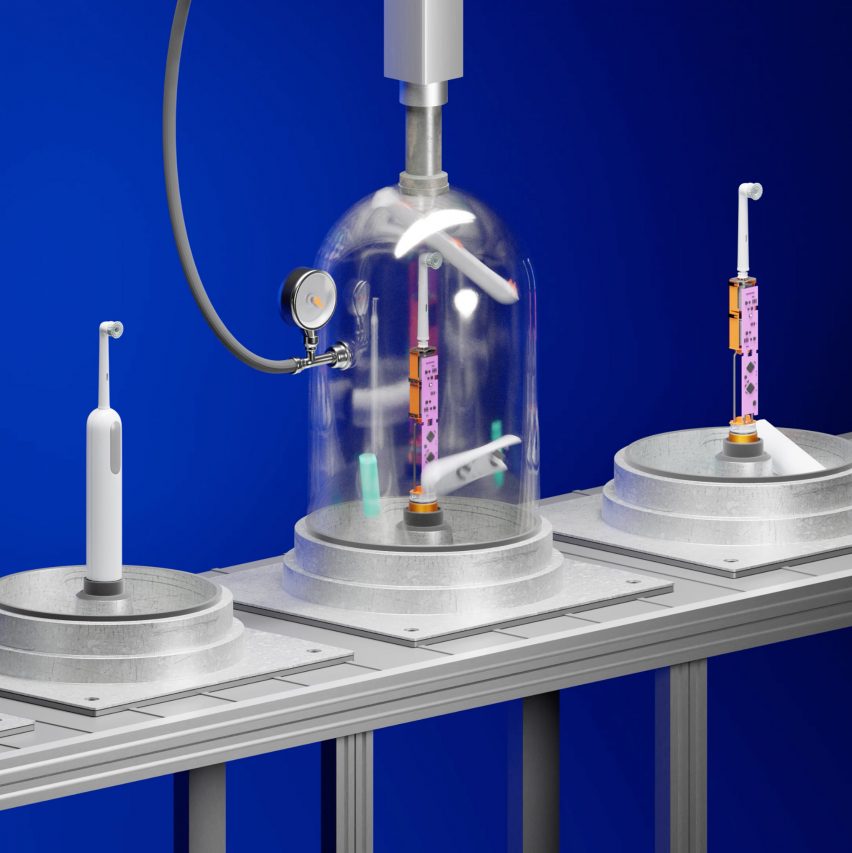
The second concept is a vacuum mechanism. It involves placing the product into a vacuum, causing closed cell foams and air-sealed features within it to expand and bust the external housing open.

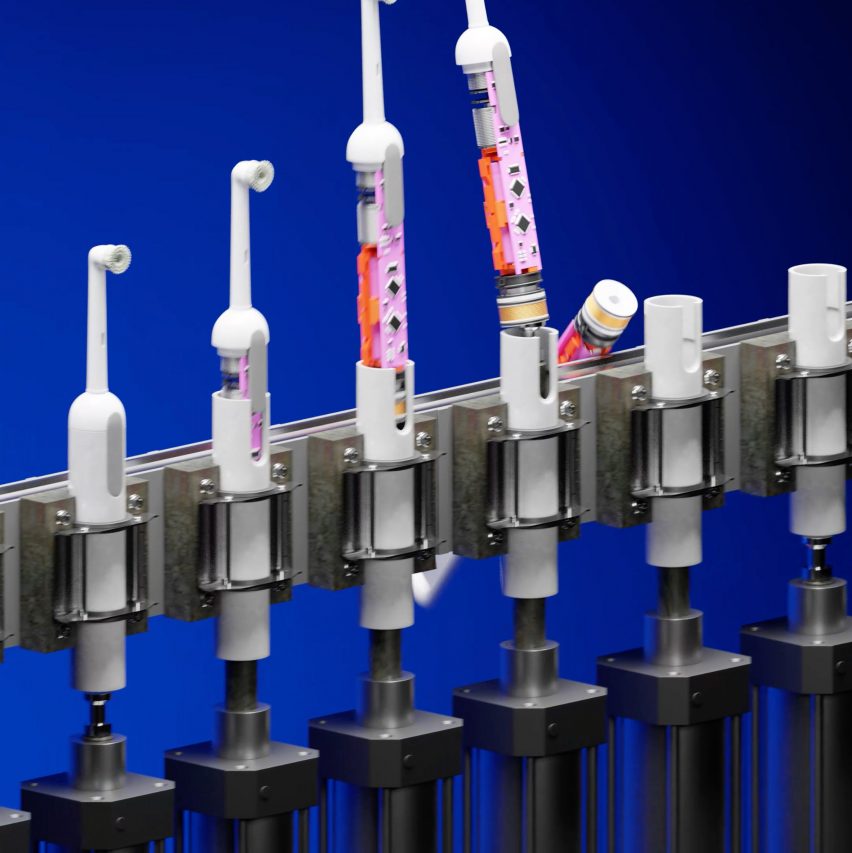
Third, there is a piston mechanism that works by pushing a piston through a cap on the bottom of a device and forcing all of the internal components upwards until they emerge through the top.

3D graphic showing a conveyer belt of electric toothbrushes being disassembled in Seymour Powell's Un-Made concept3D graphic showing a conveyer belt of electric toothbrushes being disassembled in Seymour Powell's Un-Made concept
The first concept includes a pin-triggered release mechanism

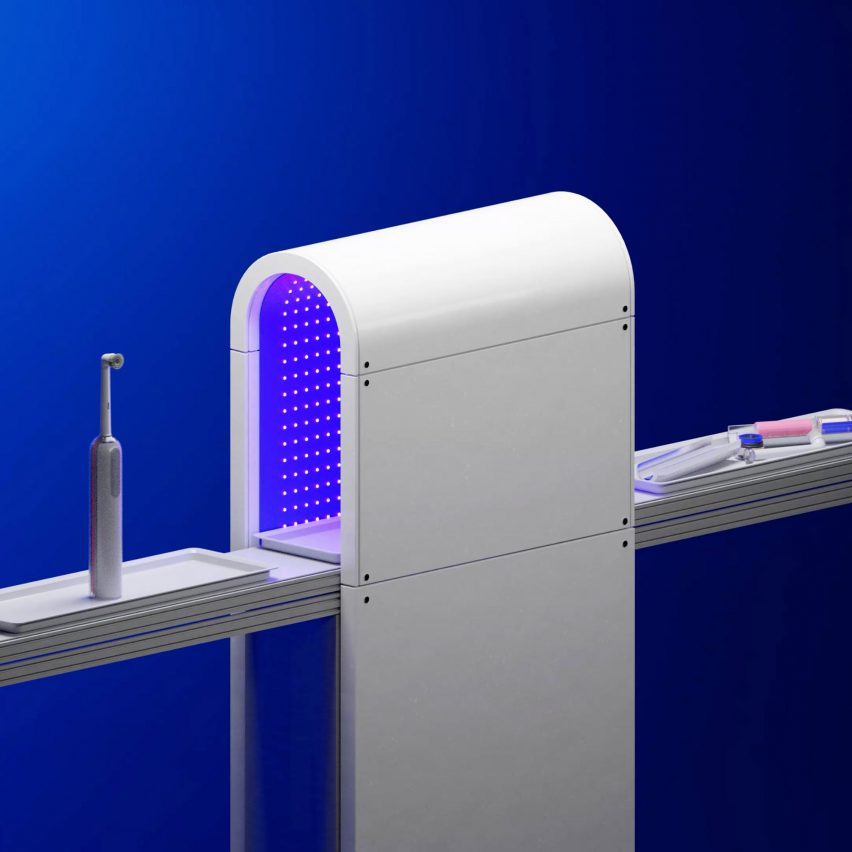
The final concept involves using UV glue – a type of adhesive that deactivates under ultraviolet light. In this concept, the product is placed into a specially lit chamber to release the clamshell construction.

The Un-Made project was led by Eddie Hamilton, a senior industrial designer at Seymourpowell, who was driven to make the work after researching what electric toothbrush to buy for himself.

“Inevitably I went for the cheap one, at which point Amazon smugly pointed out they’d sold 10k+ of that model last month alone,” said Hamilton.

3D graphic of a series of electric toothbrushes on a conveyer belt. The one on the left is whole, the one in the middle is having its casing stripped from it under a clear dome, and the one on the right has its interior components exposed3D graphic of a series of electric toothbrushes on a conveyer belt. The one on the left is whole, the one in the middle is having its casing stripped from it under a clear dome, and the one on the right has its interior components exposed
Another mechanism uses a vacuum to burst open the product’s external housing

“As an industrial designer, I spend time obsessing over the product I’m working on, typically thinking of it in isolation,” he added.

“But one thing I occasionally fail to remember or adequately picture is the true scale of that product once manufactured. 10,000 units sold per month seems vast.”

Using Amazon’s bestsellers list, Hamilton ascertained that fabric shavers, steam irons, wireless doorbells, wireless computer mice, digital tyre inflators and USB-C adaptors were all items selling in their thousands each month, at a price of less than £20.

While designing products so they can be repaired is important, the associated expense may not be something that customers can justify for small items sold at this price point, Hamilton said.

“Even if we change societal attitudes, the bottom line is whether you should open that cheap toothbrush to replace a failing battery when you only paid £24.99 for it two years ago,” he said.

“I’m optimistic for some product categories to get the ball rolling, namely expensive and bulky items. But I’m also a realist that we need alternative strategies adjacent to repair. This is where we must design for disassembly.”

In Hamilton’s view, disassembly and recycling is a worthy “next best option” to repair for cheaper objects, as it keeps the materials in a circular material flow.

3D graphic showing a conveyer belt of electric toothbrushes being disassembled by a piston mechanism pushing their internal components out from the bottom to the top of the casing from Seymour Powell's Un-Made concept3D graphic showing a conveyer belt of electric toothbrushes being disassembled by a piston mechanism pushing their internal components out from the bottom to the top of the casing from Seymour Powell's Un-Made concept
The piston mechanism disassembles a product by pushing its components up and out

The Un-Made design team took inspiration from Agency of Design’s Design Out Waste project, which looked at three strategies for keeping a toaster out of landfill. But they particularly wanted to explore just how efficient the disassembly process could be made through automation.

The cheaper and easier the process, they say, the more motivation there is for companies to pursue this approach and recover the components and materials inside their devices.

“A huge part of the reason e-waste ends up in landfill is because of product complexity and the inherent challenges involved in their disassembly,” Seymourpowell lead designer Alex Pearce told Dezeen.

“To date, because e-waste has been considered too time-consuming and costly to disassemble – there has been no (commercial) incentive strong enough to make it a viable option.”

3D graphic showing a conveyer belt of electric toothbrushes going into a purple-lit tunnel and emerging on the other side in pieces3D graphic showing a conveyer belt of electric toothbrushes going into a purple-lit tunnel and emerging on the other side in pieces
The fourth Un-Made concept uses UV light to dissolve the glue holding the device together

The materials inside even cheap devices are valuable, Pearce points out, particularly when there are supply shortages or when it comes to rare-earth minerals.

“When you consider that more gold exists within a ton of e-waste than within a ton of gold ore dug from the ground, a straightforward economic imperative becomes clear for companies who are able to recover and reuse these materials,” said Pearce.

Seymourpowell imagines disassembly taking place either at the manufacturer’s facilities following a take-back procedure, or potentially at a public recycling centre if disassembly processes have been sufficiently standardised.

The London-based studio is known for its innovative product and transport designs, as well as concepts that challenge current norms. Recent projects from the studio have included the two-in-one reusable Bottlecup and a spaceship cabin for Virgin Galactic.

Reference