Portuguese practice AB+AC Architects has designed a multifunctional wellness centre in Lisbon that doubles up as an artists’ residence.
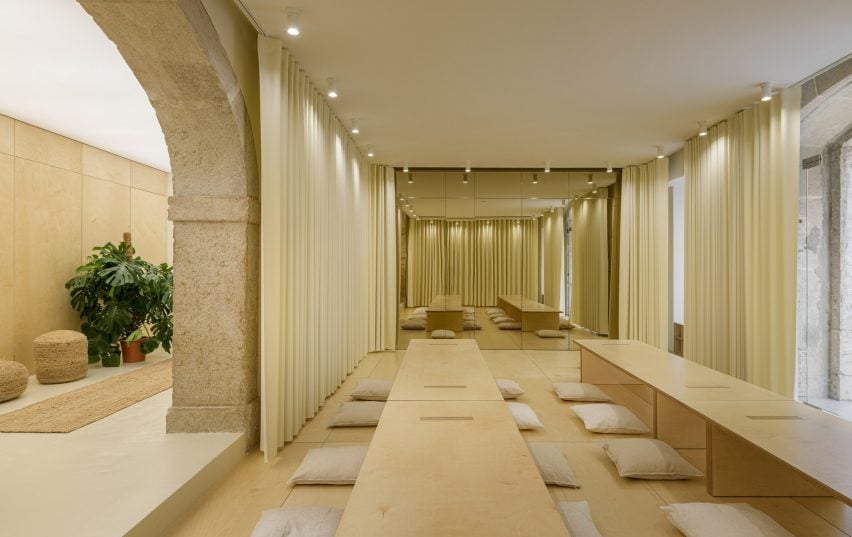
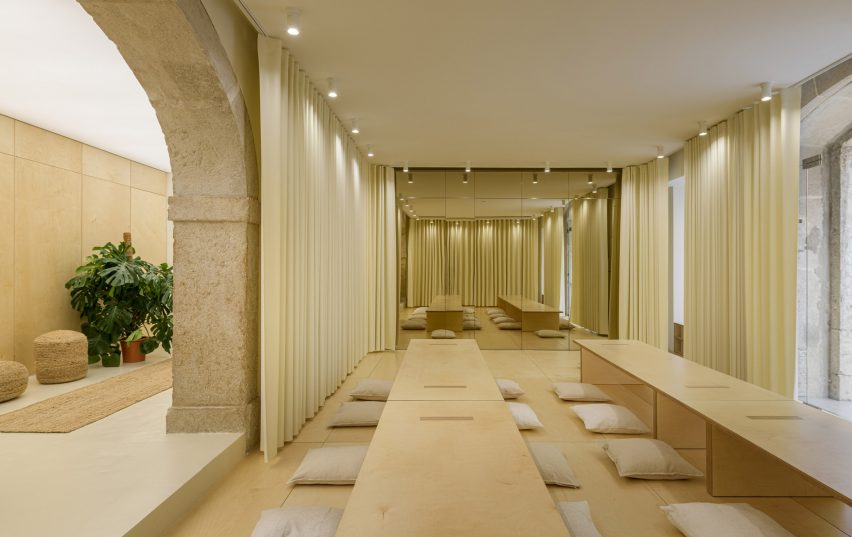
The Open Hearts wellness centre is arranged around one large room, which AB+AC Architects refers to as the shala. This Sanskrit term refers to the idea of home but also, in the context of yoga, a place where people can learn and practise together.
The Open Hearts centre is orientated around a curtained room known as the shala
As well as yoga classes, this adaptable space will host everything from breathwork classes and sound baths to meditation sessions, film screenings, dining experiences and creative writing workshops.
Running around the periphery of the shala are floor-to-ceiling curtains crafted from white vegan leather, which can be drawn to keep the room out of view from the bustling street outdoors.
At the front of the room, a wall of gold-tinted mirrors conceals a series of storage compartments. When an event is being held, the room can also be temporarily dressed with floor cushions and long birchwood tables.
Behind the shala is the artists’ residence
“Normally, when a design is very flexible, there is a risk of ending up with a very generic or sterile space, as if the only way to address adaptability is through non-specific design,” explained AB+AC Architects.
“We knew that creating a neutral mood that could accommodate a variety of programs would not be stimulating, so we decided that the centre had to be able to evoke different emotions based on the function occurring at that given moment.”
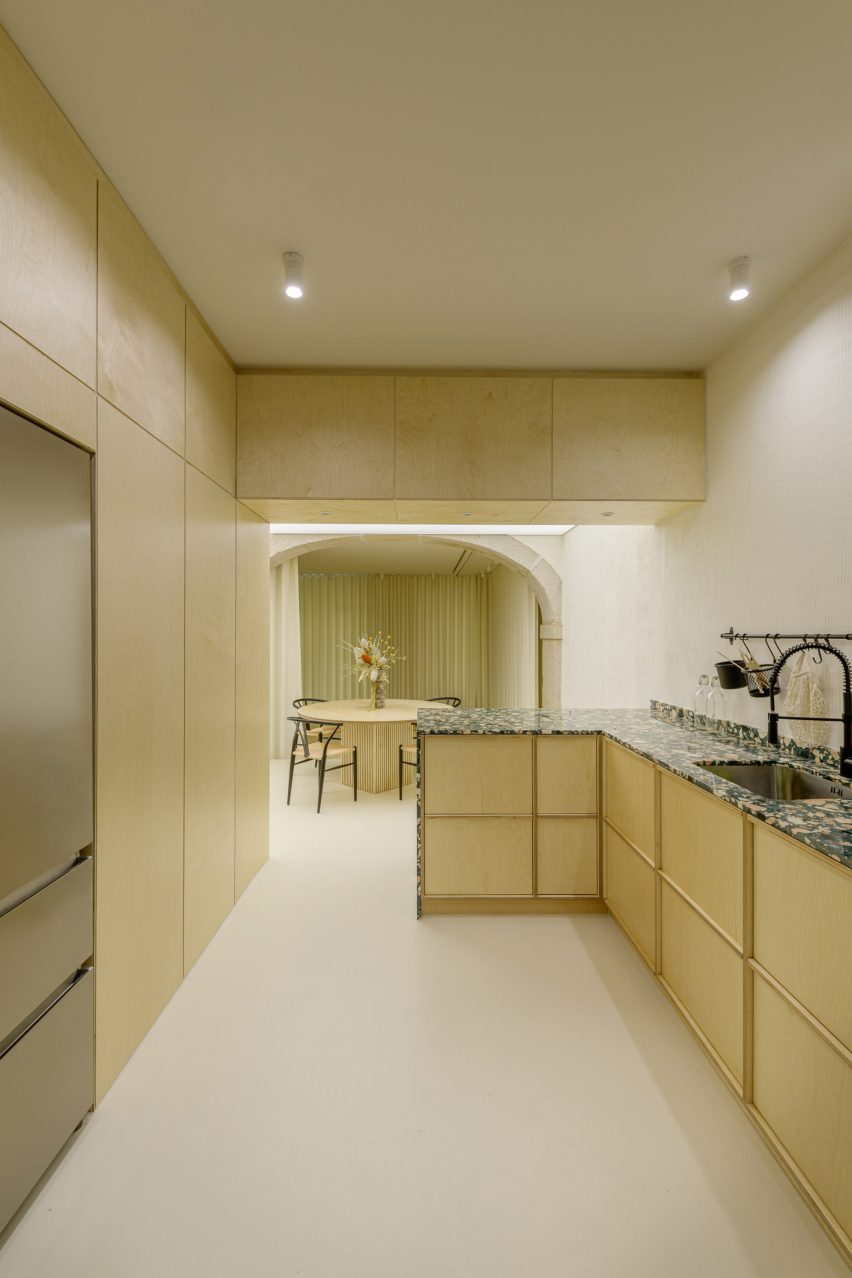
This includes a dining room and bespoke kitchen
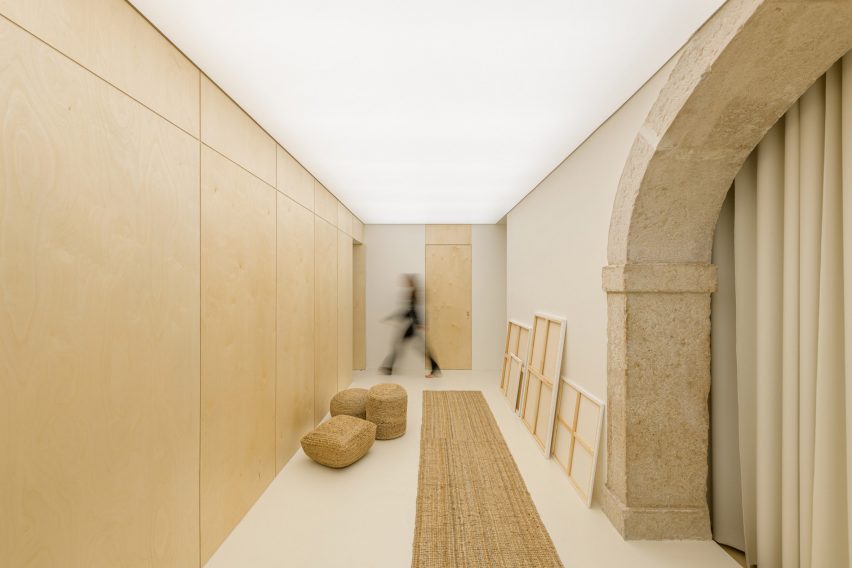
A grand limestone archway to the side of the shala grants access to the artists’ residence, which is entered via a narrow lounge area.
The room is topped with a light-up ceiling that measures eight metres long and, when the artist is hosting an exhibition, washes their work in a complementary glow.
Next up is a small dining area and a custom-made kitchen suite featuring wooden cabinetry and a terrazzo-style countertop.
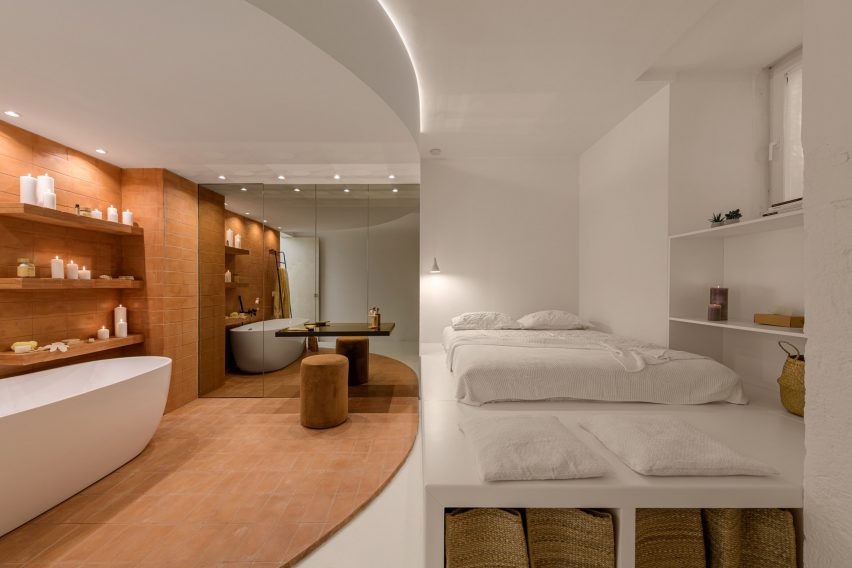
Surfaces in the adjacent bedroom are painted a crisp shade of white while the corner dedicated to the bathroom – complete with a freestanding tub – is clad in distinctive terracotta tiles.
The same gold-tinged mirrors from the shala are used here to help disguise the toilet.
A terracotta-tiled bathroom contrasts with the white walls of the bedroom
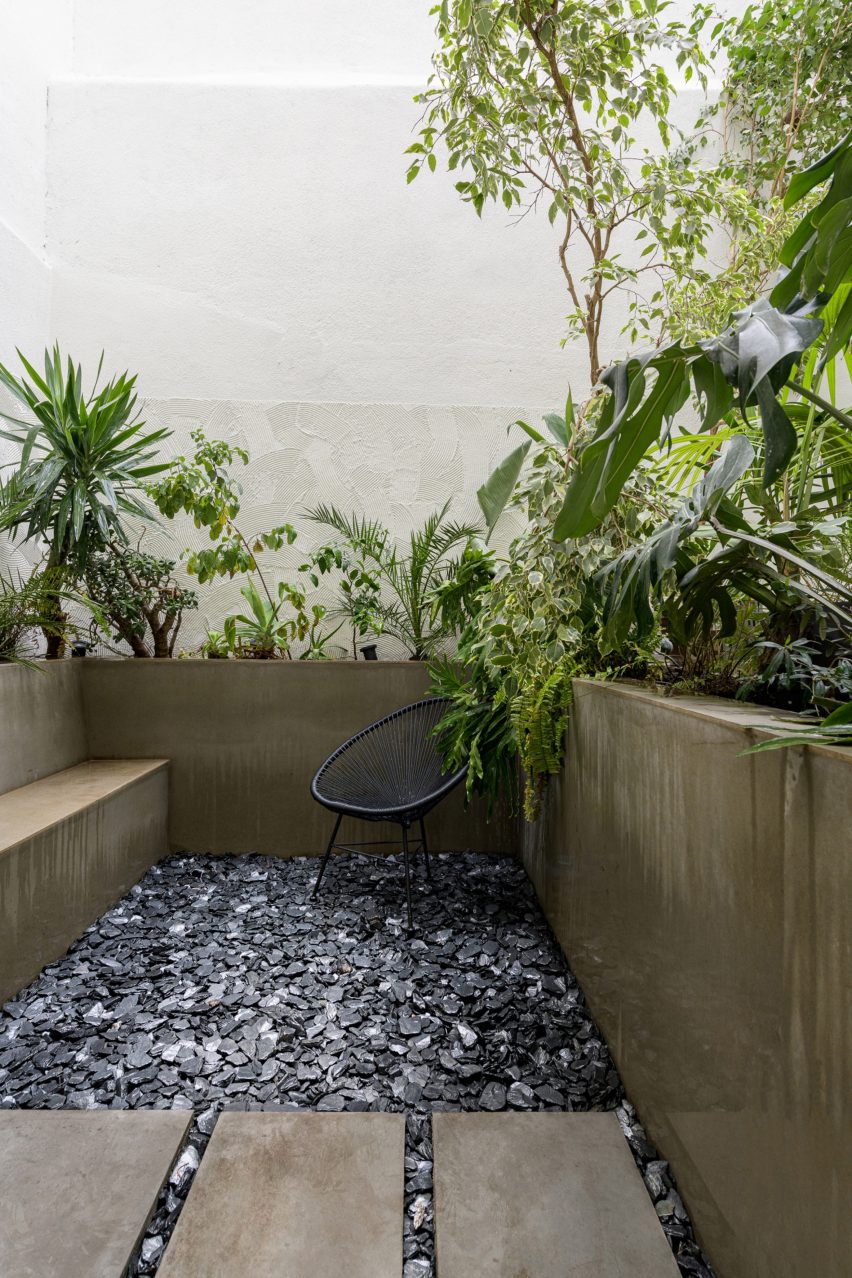
Should the resident artist want some fresh air, they can head outside to the small private patio.
Here, a concrete planter that winds around the edge of the space is overspilling with leafy tropical plants, while volcanic stone pebbles are scattered over the floor.
Foliage lines the private outdoor patio of the artists’ residence
Open Hearts Lisbon has been shortlisted in the civic and cultural interior category of this year’s Dezeen Awards.
Other projects in the running include a cow shed-turned-library, a historic cinema in Berlin and the world’s first multi-storey skatepark.
London studio Macdonald Wright Architects has created the low-energy and heavily insulated Library House on an infill plot in Hackney.
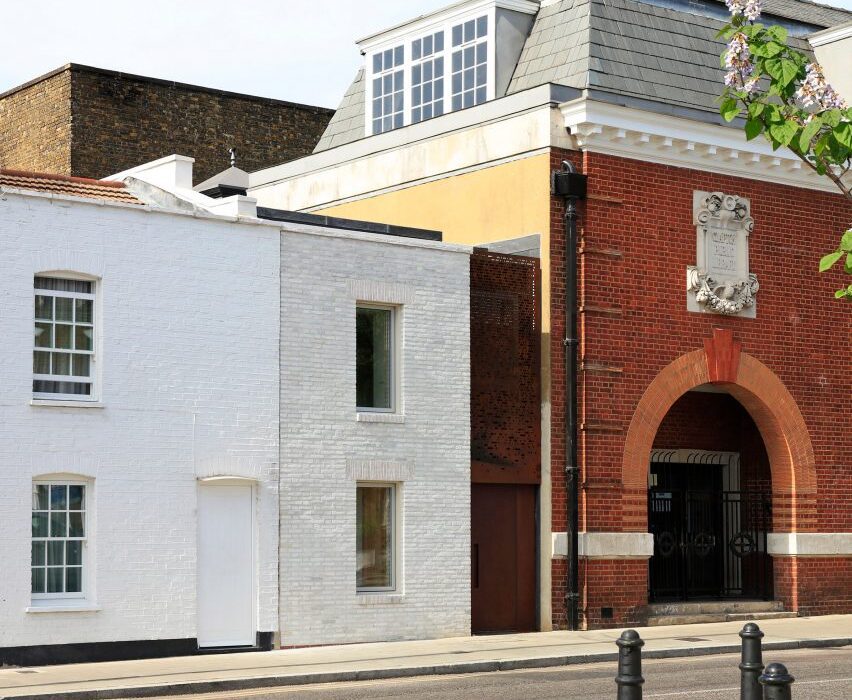
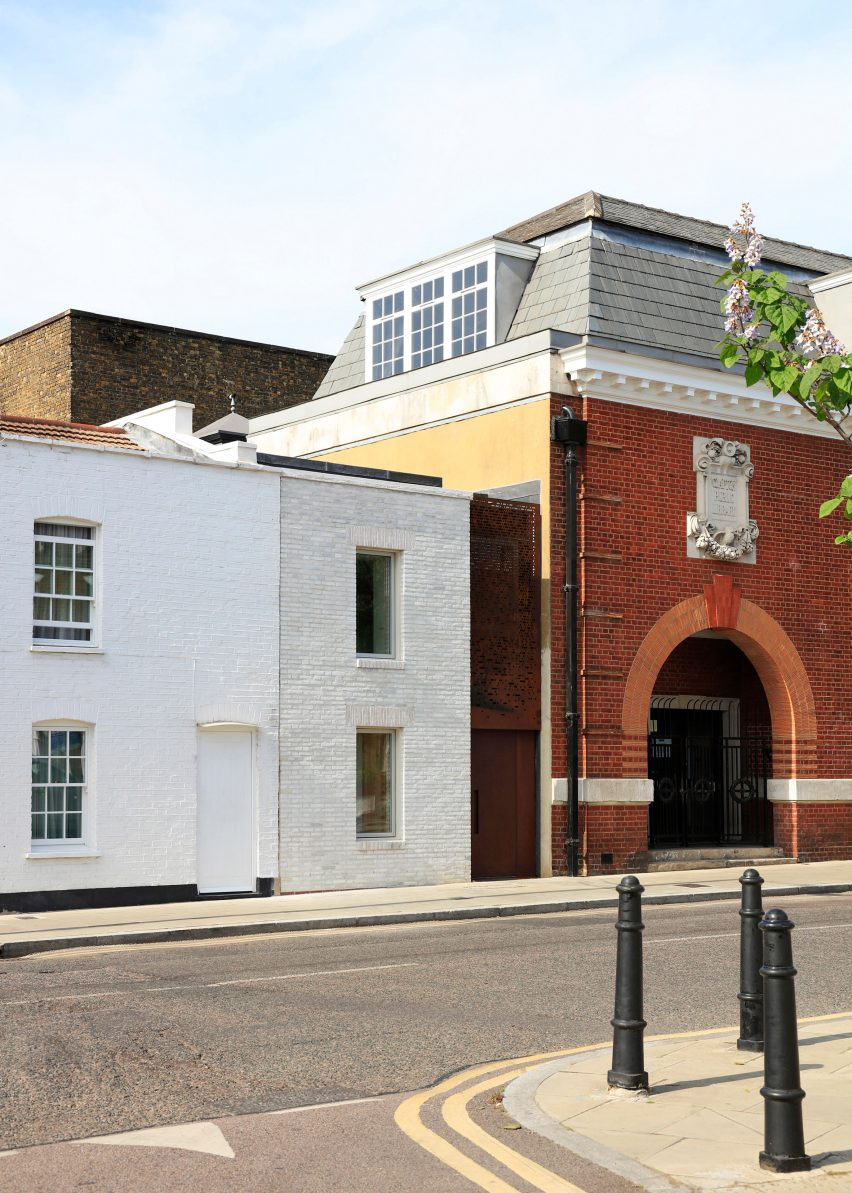
Designed as a rental property for studio founder James Macdonald Wright, the two-storey home was built on a four-metre-wide plot, which was previously used as a junkyard adjacent to the listed Clapton Library.
Macdonald Wright Architects has created a house on an infill plot in Hackney
The aim of the project was to demonstrate how an affordable, low-energy house could be created using simple yet robust materials.
Macdonald Wright Architects wanted to use the opportunity to study the energy performance of the home, which has the same footprint as “the average UK dwelling”, to inform its future projects.
The standard focuses on using simple techniques and technologies to reduce the operational carbon dioxide emissions of a building by 70 per cent when compared to the average UK structure of the same size and typology.
The material palette was chosen to be simple yet robust
“We selected the AECB route over Passivhaus because it offered a more practical and affordable route to achieving excellent performance,” the studio’s founder told Dezeen.
“The AECB Building Standard is aimed at those wishing to create high-performance buildings using widely available technology,” Macdonald Wright explained.
Douglas fir and spruce detailing features throughout
This standard was met by creating a heavily insulated external envelope for the dwelling, teamed with a Passivhaus-rated front door and triple glazed windows and roof lights.
To retain heat, the house also makes use of mechanical ventilation with heat recovery (MVHR). It achieves an airtightness of 1.3 [email protected], which is significantly less than UK building regulations that require airtightness of 10 [email protected] or less. This refers to the number of air changes per hour at a pressure difference of 50 pascals.
All the windows are triple glazed
The dwelling is complete with an electric boiler for top-up heating and a photovoltaic array, from which surplus electricity is supplied to the national grid.
Since completion, the house has been occupied by private tenants. However, the electricity bill has been monitored and paid for by Macdonald Wright Architects.
The studio has calculated that the “operational energy for heating the house is a tenth of the requirement of a new build house under current building standards”.
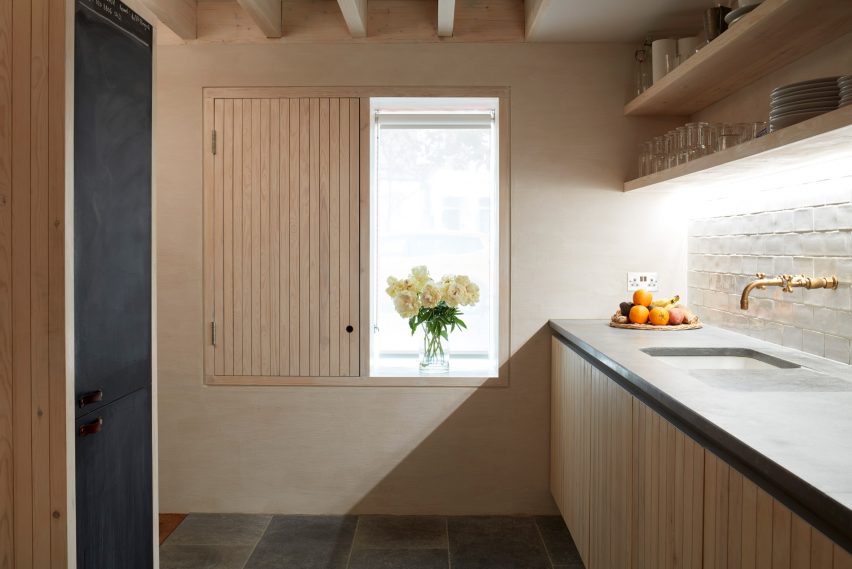
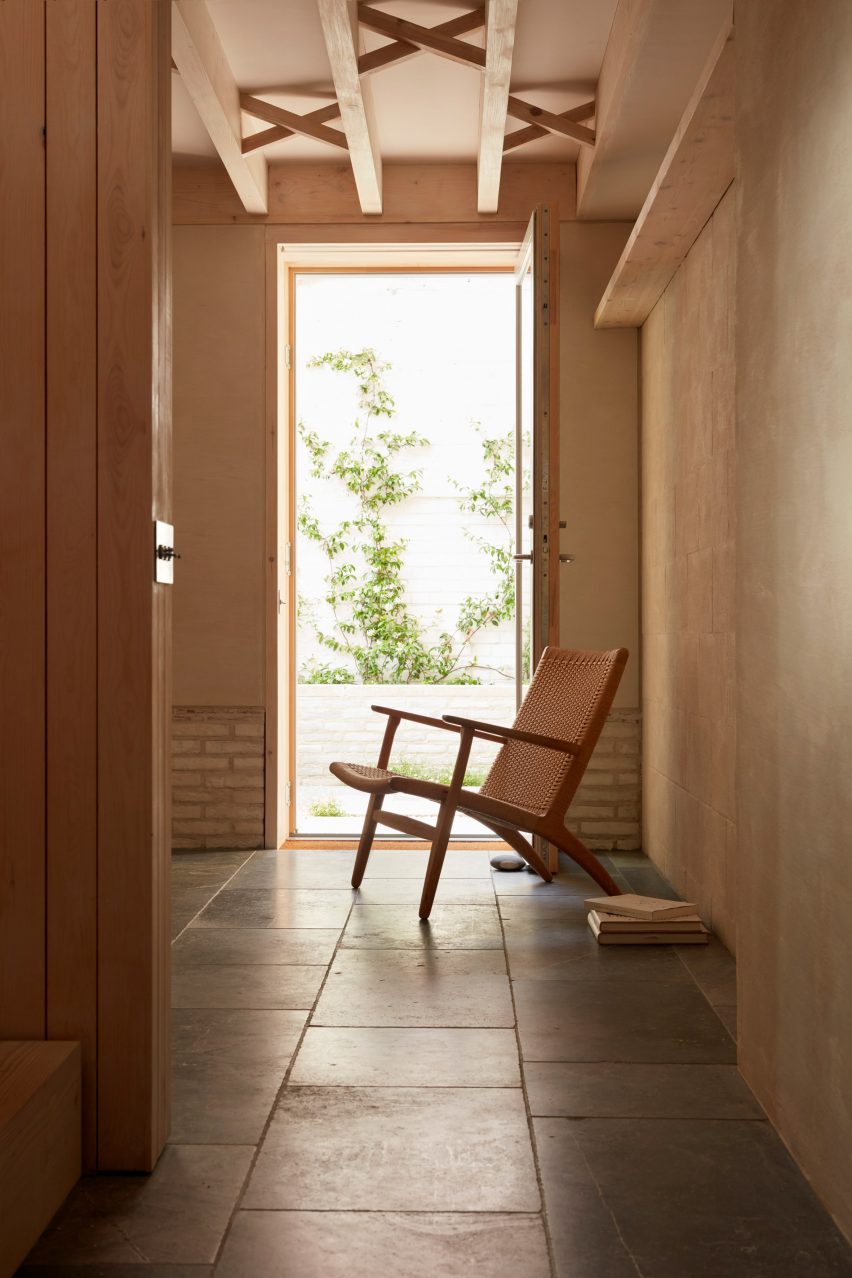
Blue Lias stone is used as flooring
Visually, the Library House is designed to mirror the proportions, styles and details of the neighbouring red brick library and a row of white cottages.
Lime-pointed white brickwork is teamed with a russet-hued Corten steel panel outside, which incorporates the front door and perforated solar shading for the first floor.
The russet-hued front door is Passivhaus-rated
Materials used throughout Library House were selected to minimise the need for maintenance and reduce the embodied-carbon footprint of the dwelling.
This includes the use of Porotherm clay block party walls and timber structure, along with internal finishes such as Blue Lias stone flooring sourced and sustainably sourced douglas fir and spruce detailing.
Internally, walls are predominantly finished in a parge coat, trowelled over the Porotherm clay blockwork for a textured finish that also contributes to the home’s high airtightness.
Macdonald Wright Architects hopes that the Library House will become a “scalable prototype” and inform its future projects at various scales.
Porotherm clay blocks are used on party walls
“Each project we complete informs the next,” Macdonald Wright explained. “The use of Porotherm block and Larsen Truss has helped us develop techniques of external envelope construction we are now developing in larger scale designs.”
“By focusing on the build quality, airtightness and thermal performance of the external envelope construction we can reduce the overall cost of building to higher levels of sustainability,” he continued.
Corten steel functions as solar shading
Another recently completed low-energy house on Dezeen is the Devon Passivhaus, which McLean Quinlan nestled into a sloped walled garden of an old English country house.
The building’s envelope performs to the highly energy-efficient Passivhaus standard, achieved using substantial amounts of insulation and triple glazing throughout.
Rooflights feature throughout the house
Macdonald Wright founded his eponymous studio in east London in 2005. Another notable project by the studio is the Caring Wood country house in Kent, which won the 2017 RIBA House of the Year.
Designed in collaboration with architect Niall Maxwell, the dwelling is topped with chimney-like roofs and provides a residence for three generations of the same family.
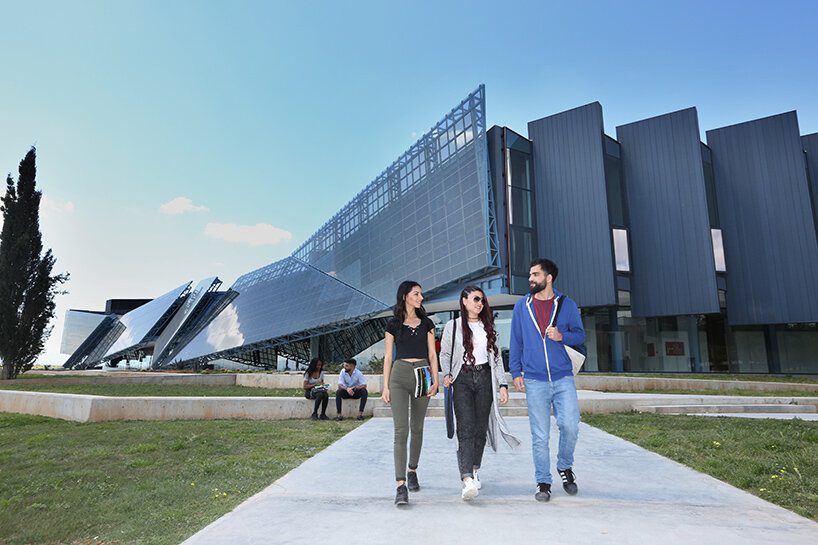
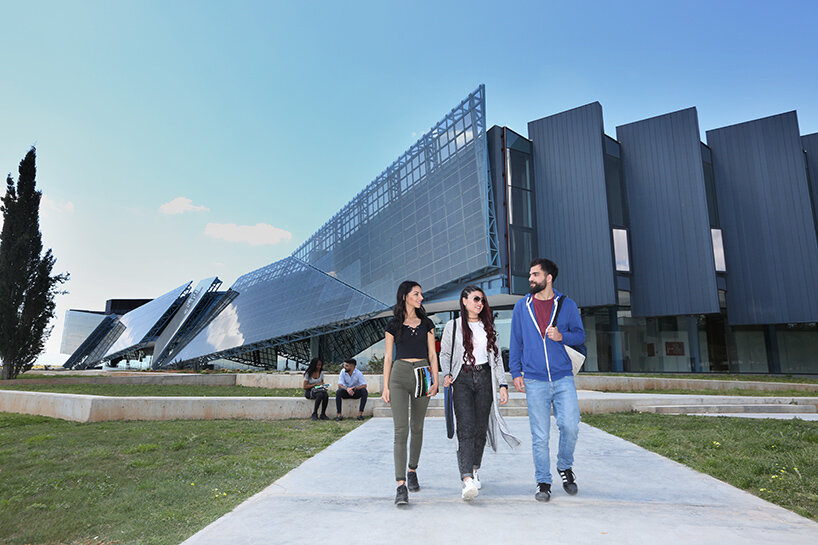
Saffet Kaya Architects, a practice based in both Cyprus and the UK, has built a Science and Technology Center for the Cyprus International University in Nicosia. The project has introduced twenty-two classrooms and thirty-three research laboratories to accommodate thirteen separate fields of engineering on the campus.
While many of these spaces are highly specialized for their field, the center can simultaneously host non-engineering courses, lending a highly efficient use of the space. With this cross-disciplinary programming, the space is a collaborative learning hub which promotes interactions between students across departments.
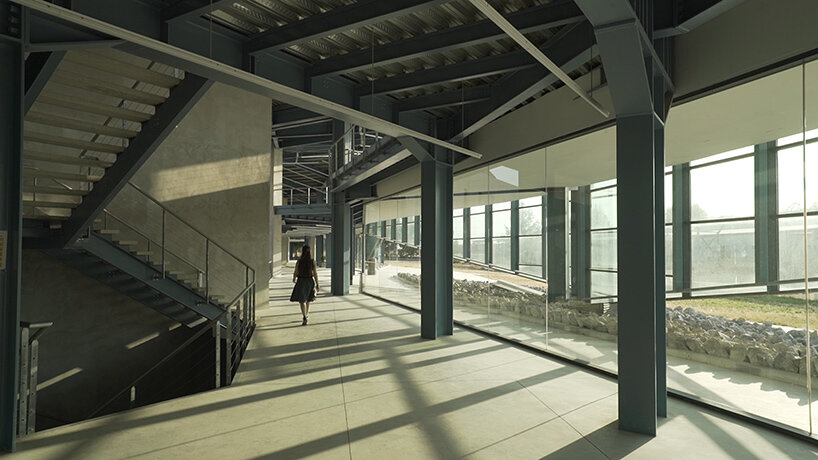
The team at Saffet Kaya Architects designs its Science and Technology Center in Cyprus with respect for its environment — both with its orientation within the site, and with its forward-thinking technological systems. The architects organize the building across only two levels, keeping a low-lying presence in order to minimize its presence among the Cyprus International University campus. ‘The silhouette of the building is proportionate to its surroundings and is in harmony with its environment,’ explains the team. Inside, the building opens up into three levels, with a full story embedded underground.
The ground level hosts multi-purpose classrooms, while the administration, faculty, and IT laboratories are located on the first floor. Meanwhile, specialized experimental laboratories are located along the lower level. These underground spaces still benefit from natural light and ventilation with access to sunken courtyards.
the efficient design by saffet kaya architects
Multi-purpose classrooms are strategically located at ground level, meeting the demands of different departments including students arriving from other faculties. The Administration, Faculty, and IT Laboratories are located on the first floor, establishing a formal setup, whilst specialist experimental labs are situated at the lower ground level but still benefit from natural light and ventilation with access to sunken courtyards.
The group explains: ‘It is also possible to passively ventilate the internal spaces throughout both day and night time from each façade, allowing outside air to enter the space through courtyards and external surfaces. The enclosed spaces are equipped with controlled façade openings with a high-level automation system and thermal solar chimneys acting as ventilation shafts located at opposite sides of the rooms along the corridors, to provide natural cross ventilation, enabling energy saving and enhanced sustainability.
‘Each façade elevation is independent from the other in design, and new technologies such as thermal chimneys and building-integrated photovoltaics (BIPV) were used for the first time.’
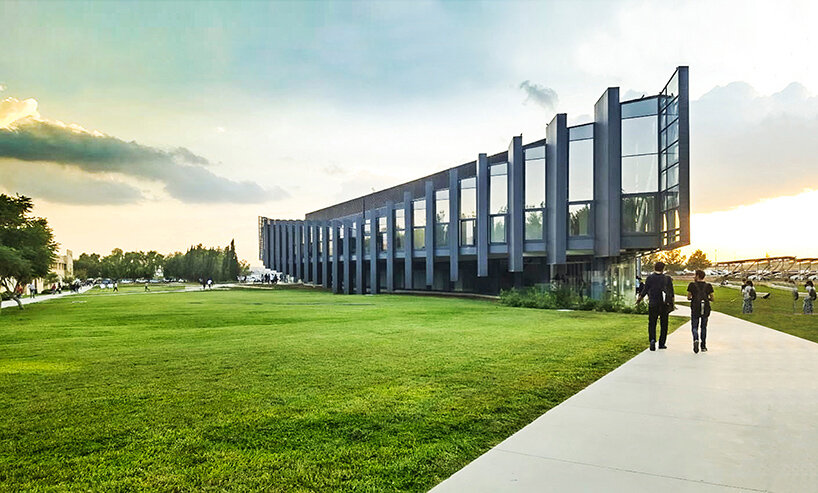
each facade is unique, designed according to contextual parameters
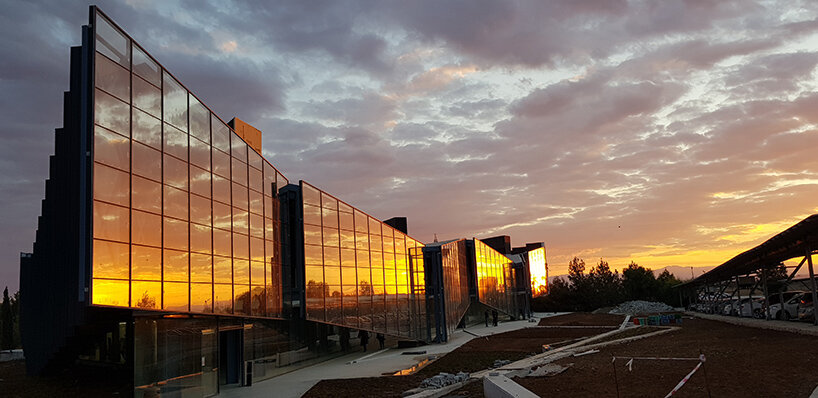
The team continues, describing the performance of the building: ‘The south façade of the building is angled and fully clad with second-generation thin film BIPV panels to maximize solar gain. The north facade, which does not have any direct sunlight, is clad with an all-glass structure allowing natural light in, whilst providing an X-ray effect revealing the skeleton of the building. The east and west façades are aluminum-clad and have louvered openings that are angled to prevent direct solar radiation.
‘The introduction of thermal chimneys for natural ventilation, photovoltaic panels for solar gain, and the steel structure with lighter and longer structural spans in composition with a solid concrete structure, are all novel and unconventional architectural design solutions and methodologies in this region. Treating every façade differently by taking contextual parameters into consideration and introducing different transparency are also new experimentations.’
thermal chimneys are integrated for natural ventilation the structure, mechanical ducts, wiring, and tectonics are left exposed
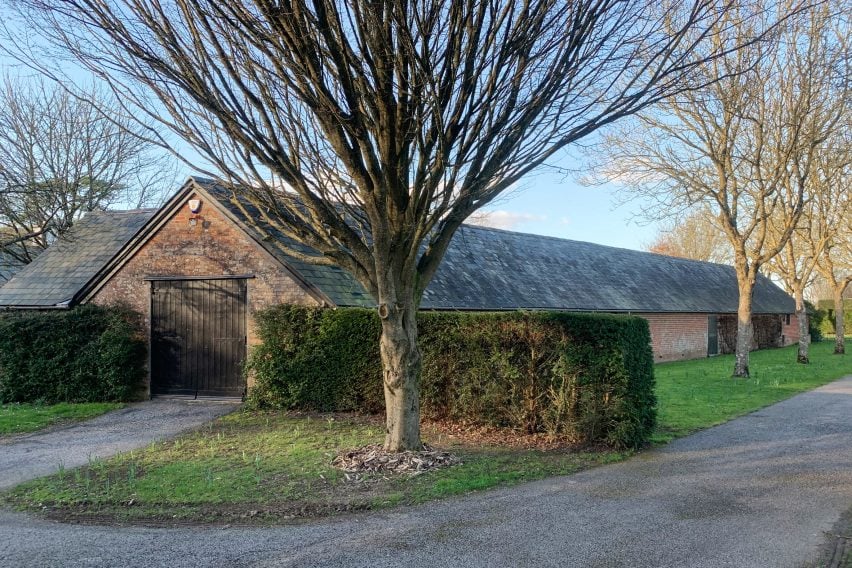
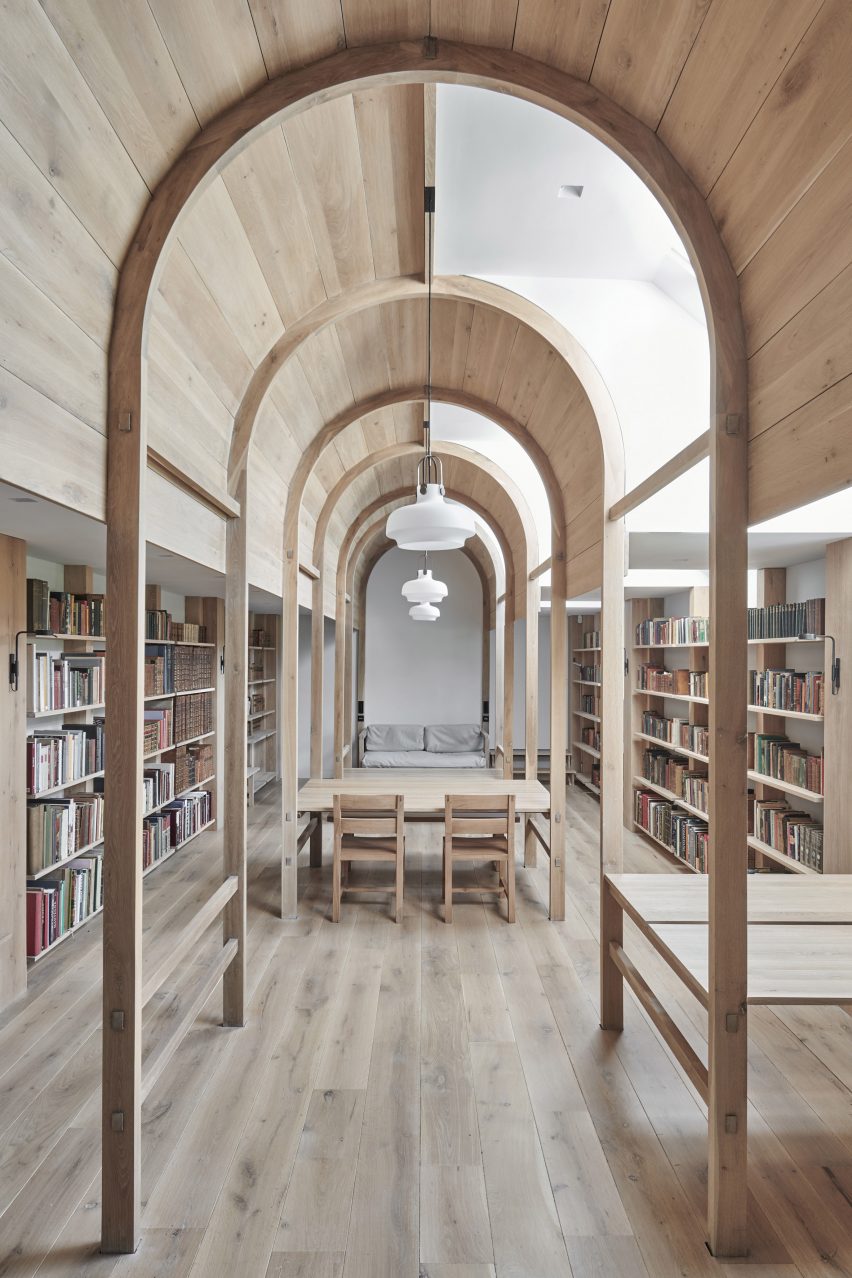
London studio Crawshaw Architects has transformed a former cow shed in Dorset into a library and office, organised around a wooden, barrel-vaulted arcade that references the client’s collection of books on classical Palladian architecture.
The Stanbridge Mill Library, which has been shortlisted in the civic and cultural interiors category of Dezeen Awards 2022, occupies one of several outbuildings of a Georgian farmhouse on a grade II-listed farm.
Crawshaw Architects has overhauled a former cow shed in Dorset
The narrow, gabled brick shed was originally built to house Standbridge Mill Farm’s cows but had stood neglected for over forty years, used as storage for gardening equipment and farm machinery.
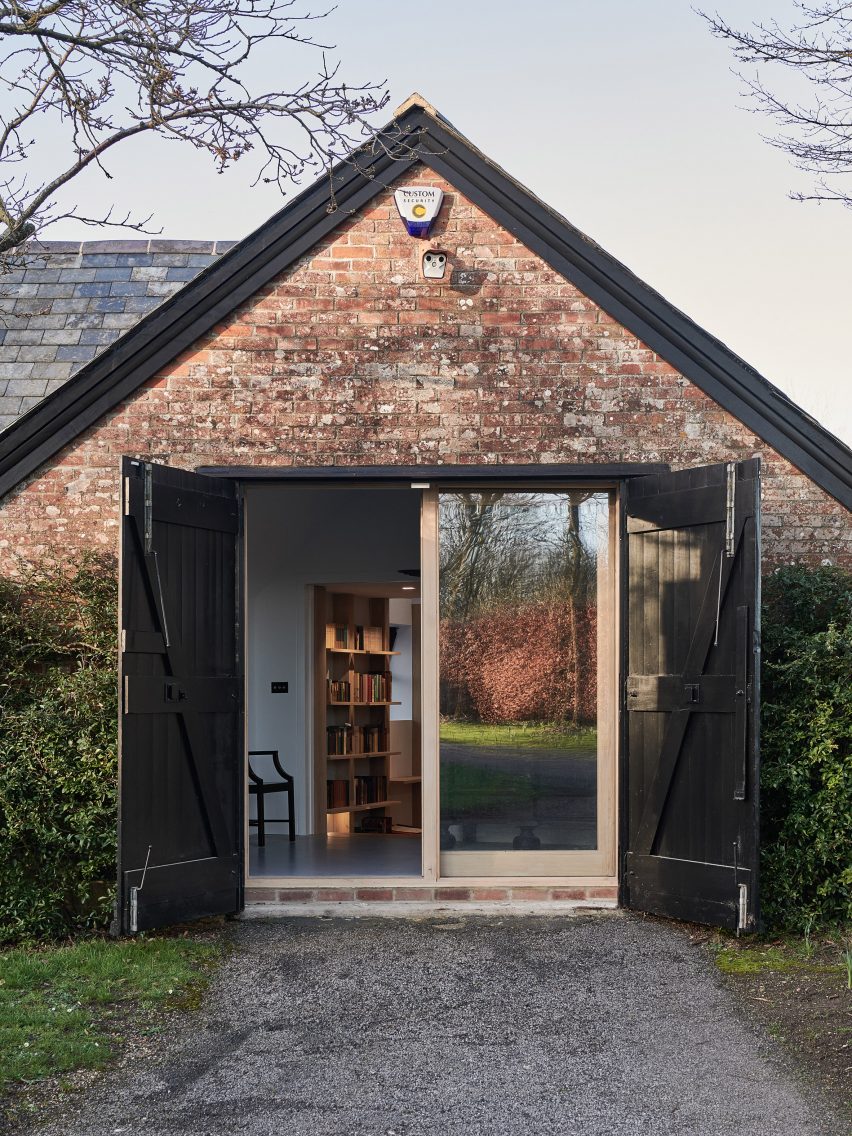
Looking to give the building a new purpose while maintaining its existing character, Crawshaw Architects made only small structural interventions, replacing two of its original roof trusses with portal frames that open up the interior.
The studio has transformed it into a library and office
“While a decisive transformation of the interior was called for, we felt that the original use of the building needed to be part of the story,” explained the studio.
Stanbridge Mill Library’s focal point is a central “nave”, which is filled with seating areas covered by a wooden barrel vault and slotted between two narrow aisles lined by bookshelves. This plan references classical architectural forms, which are the focus of many of the client’s books.
The Stanbridge Mill Library is organised around a barrel-vaulted arcade
Pale, solid oak has been used for the floor, shelving, storage and the central vault, half of which is covered with planks and the other half left open to allow in light from new skylights.
“The high nave and pair of aisles are in the form of a classical library, but are set out in the register of the original building using the materials and construction techniques of traditional farm carpentry and metalwork,” explained Crawshaw Architects.
The office occupies the northern end of the building
“The vault, columns, shelves, tables and seating are made of the same solid oak planks and sections, deliberately selected to show knots and natural blemishes,” the studio continued.
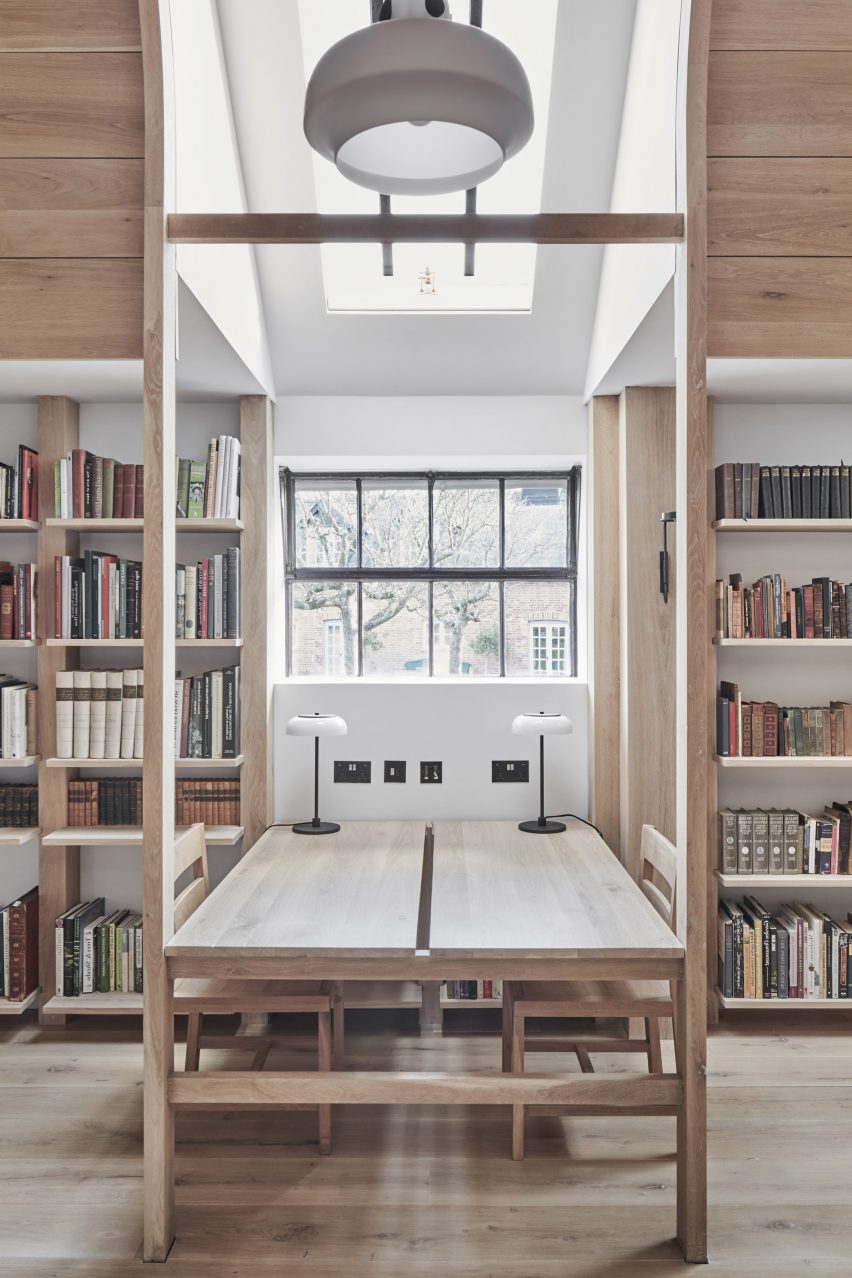
Desks are organised to take advantage of light from the windows and are illuminated at night by large pendants suspended from the vault.
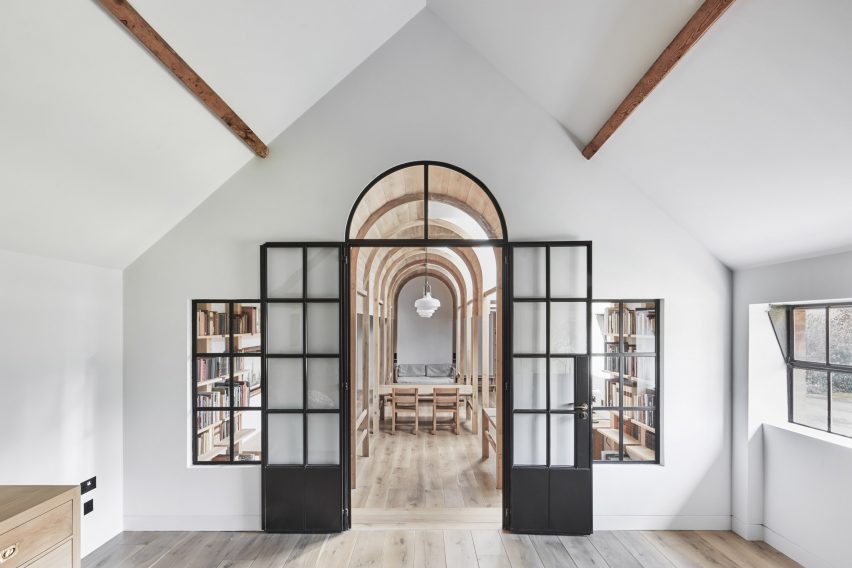
The office space occupies the northern end of the building underneath an original roof truss, which is separated from the library by an arched glass door and windows that frame views through the nave and aisles.
To the south of Stanbridge Mill Library, a dog-leg in the plan is occupied by a small kitchen, positioned opposite a bathroom and a small lobby area.
Pale solid oak has been used throughout
Stanbridge Mill Library features in the civic and cultural interior category of Dezeen Awards 2022 alongside the renovation of the Groote Museum in Amsterdam by Merk X.
Another project on the shortlist is the interior of F51 Skate Park in Folkestone by Hollaway Studio, which won the public vote for the same category.
Architizer is thrilled to announce that the 11th Annual A+Awards is officially open for entries! With an Early Entry Deadline of November 4th, 2022, the clock is ticking — get started on your submission today.
As the boomer generation grows old and cultural norms for caring for the elderly shift, retirement homes become increasingly important in our society. When we think of elderly care homes, a sterile and despondent image often comes to mind, one that typically lacks vitality, life and community. Retirement and nursing homes are complex spaces that facilitate a variety of tasks and undertakings. They do not only serve as living spaces; they are medical centers, social domains and spiritual places too. And such multiplex environments have proven to be complex design undertakings.
The architectural field plays an intrinsic role in the betterment of retirement communities. Through careful planning, a deep understanding of the elderly’s needs and a commitment to fostering community, elderly care homes can become places that nurture vibrant lifestyles for their aging population.
Encouraging Movement Through Accessible Floor Plans
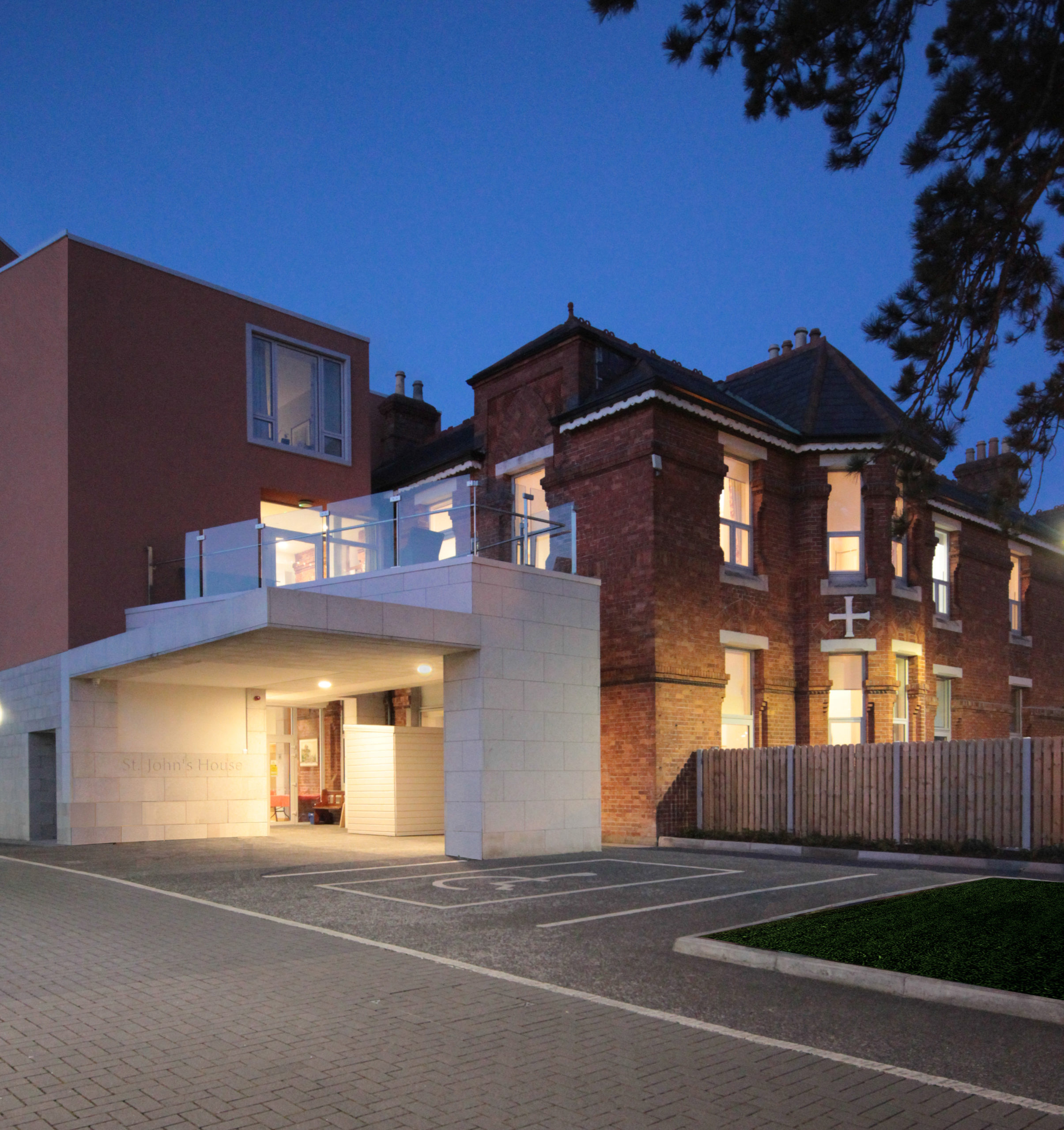
St John’s House Nursing Home by FKL architects, Dublin, Ireland, 2021
Physical mobility decreases with age, and it is imperative that elderly homes both limit and encourage movement. There is a fine line between accessible circulation and inaccessible movement, and architects can help encourage movement through well-devised and safe floor plans. The St John’s Nursing Home in Dublin, Ireland is a space that responds to elderly needs.
This renovation completely reconfigured its amenities in order to best serve its residents. The site’s original chapel was located in an inaccessible and non-central spot. The chapel was then relocated from its former position to a central spot that leads onto an external, enclosed structure. Centralizing this place of worship within the home makes for easier movement and as a result, encourages residents to engage in moments of devotion.
St John’s House Nursing Home by FKL architects, Dublin, Ireland, 2021.
At St John’s Nursing Home, a sheltered promenade was created to join the new building with the existing structure. Covered pathways are ideal for elderly residents as they encourage outdoor movement while protecting residents from extreme weather, such as heavy rainfall, which could cause slippery conditions.
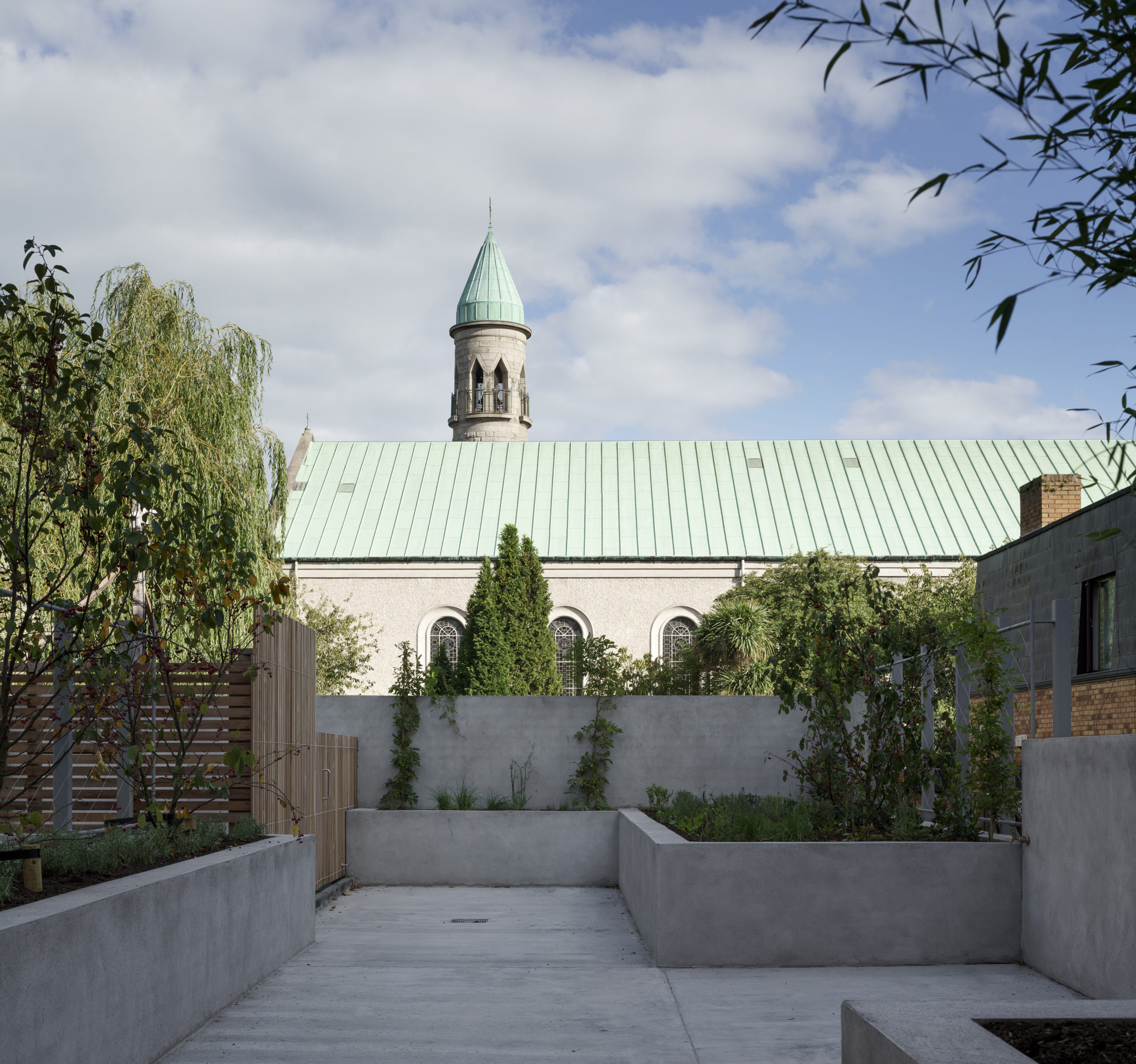
Moreover, herbs, vegetables and fruits were planted in the outdoor gardens, which create active outdoor spaces where residents can engage their senses through scents, textures and taste. The home’s interior design was carefully placed and boasts contrasting colors in order to remain accessible for residents with cognitive impairments. Thus, creating a space for accessible circulation and healthy movement.
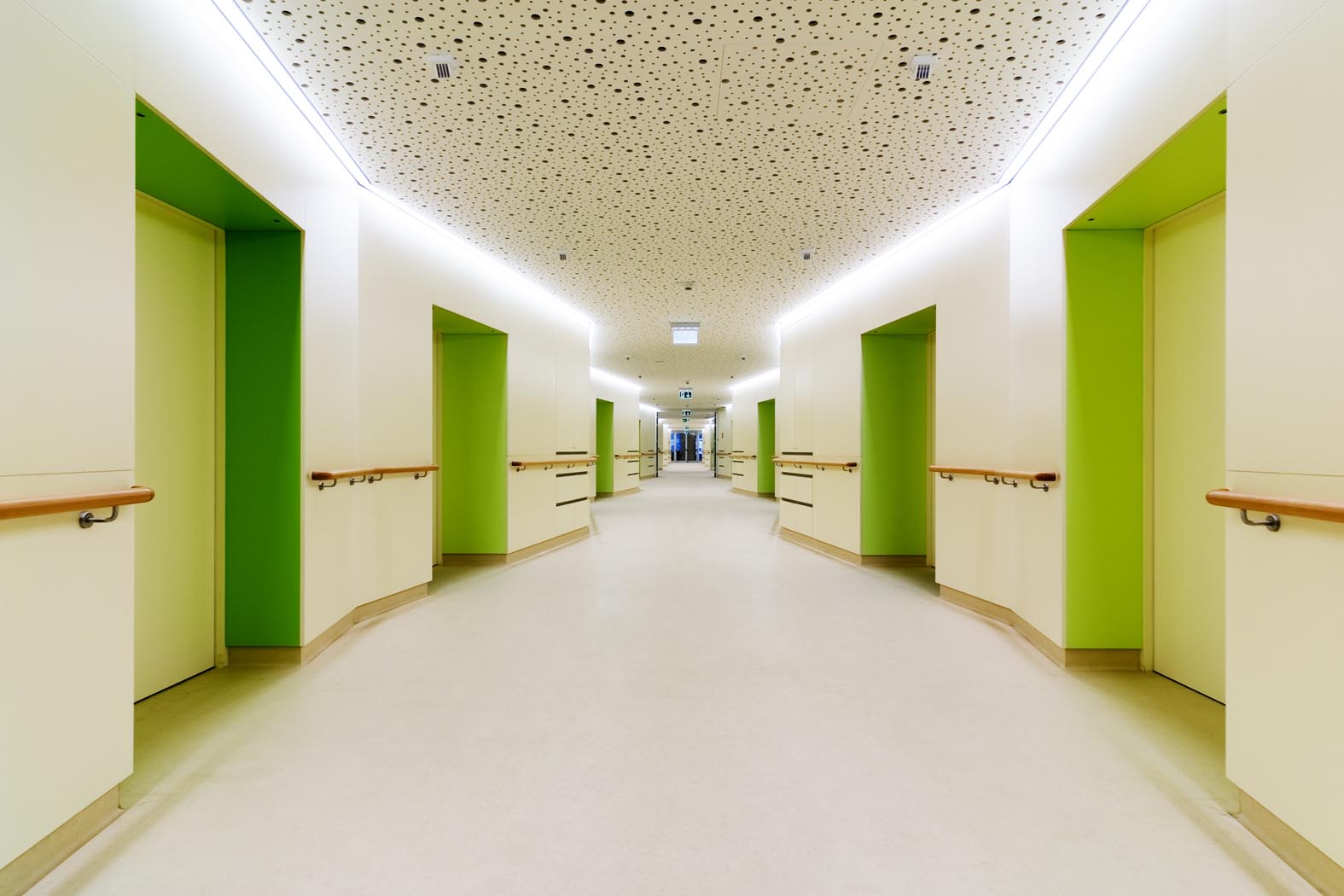
The Hainburg Nursing Home in Austria is another great example of accessible and tactical design. Inside, niches were implemented in front of each resident’s bedroom door, and thus turn the hallways into active spaces for circulation and gathering that are an extension of residents’ rooms. The interior surfaces are demarcated by their materiality: laminate and linoleum and wooden floors. Meanwhile, contrary to the anonymous and bland exteriors that lend a medical air to many nursing homes, this Austrian project is sheathed in a pattern of colored diamond-shaped Eternit-shingles, offering a unique expression of identity for the place that residents call home; which brings me to my next point.
Steering Away from Sterile Environments
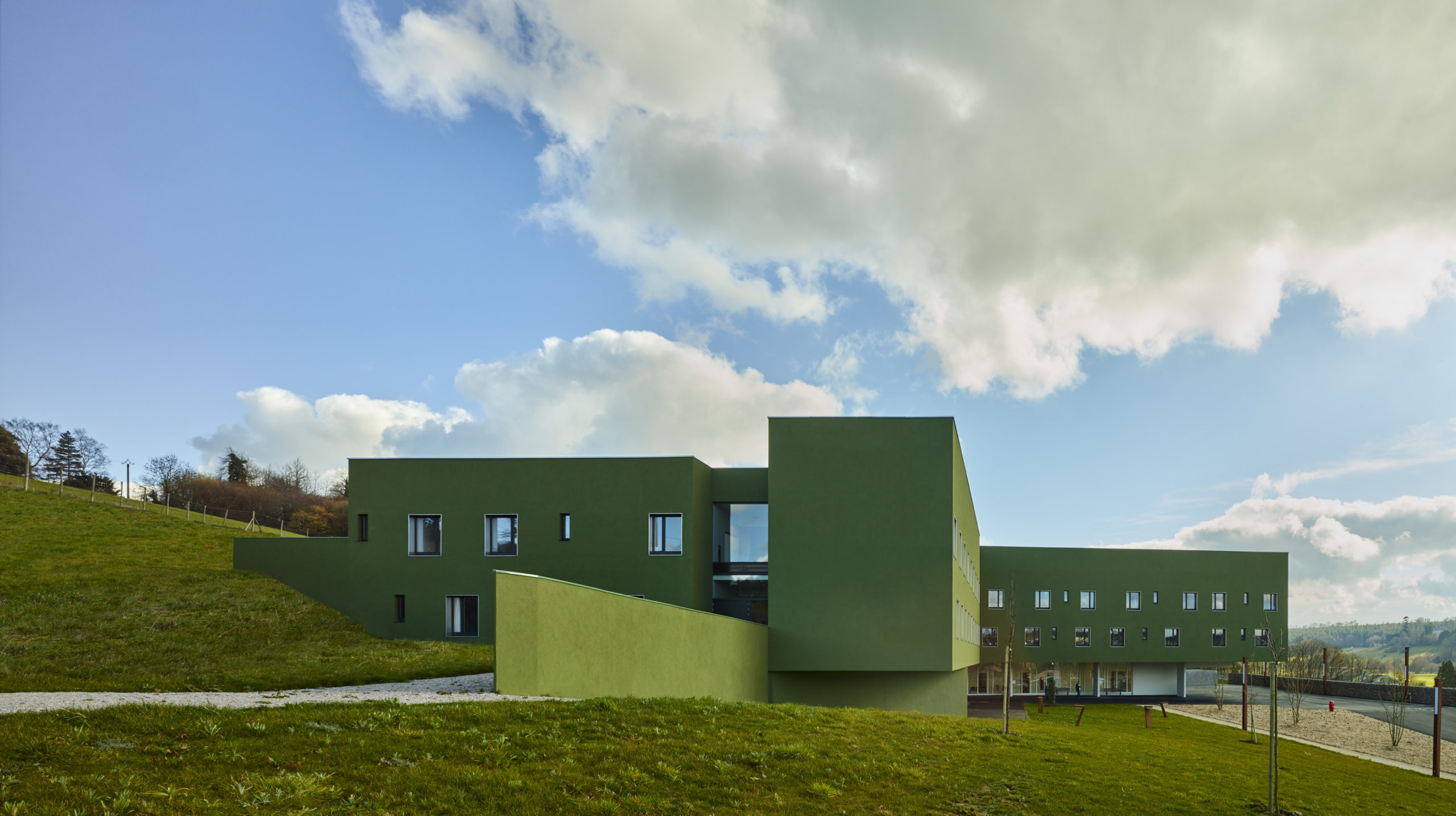
Home for Dependent Elderly People and Nursing Home by Dominique Coulon & Associés, Orbec, France. Photos by Eugeni Pons
Homes for the elderly encompass much more than a simple place to eat and rest. These spaces are typically equipped with large medical teams made up of doctors and nurses. More often than not, a pragmatic reality takes precedence over design creativity and as a result, sterile spaces are erected.
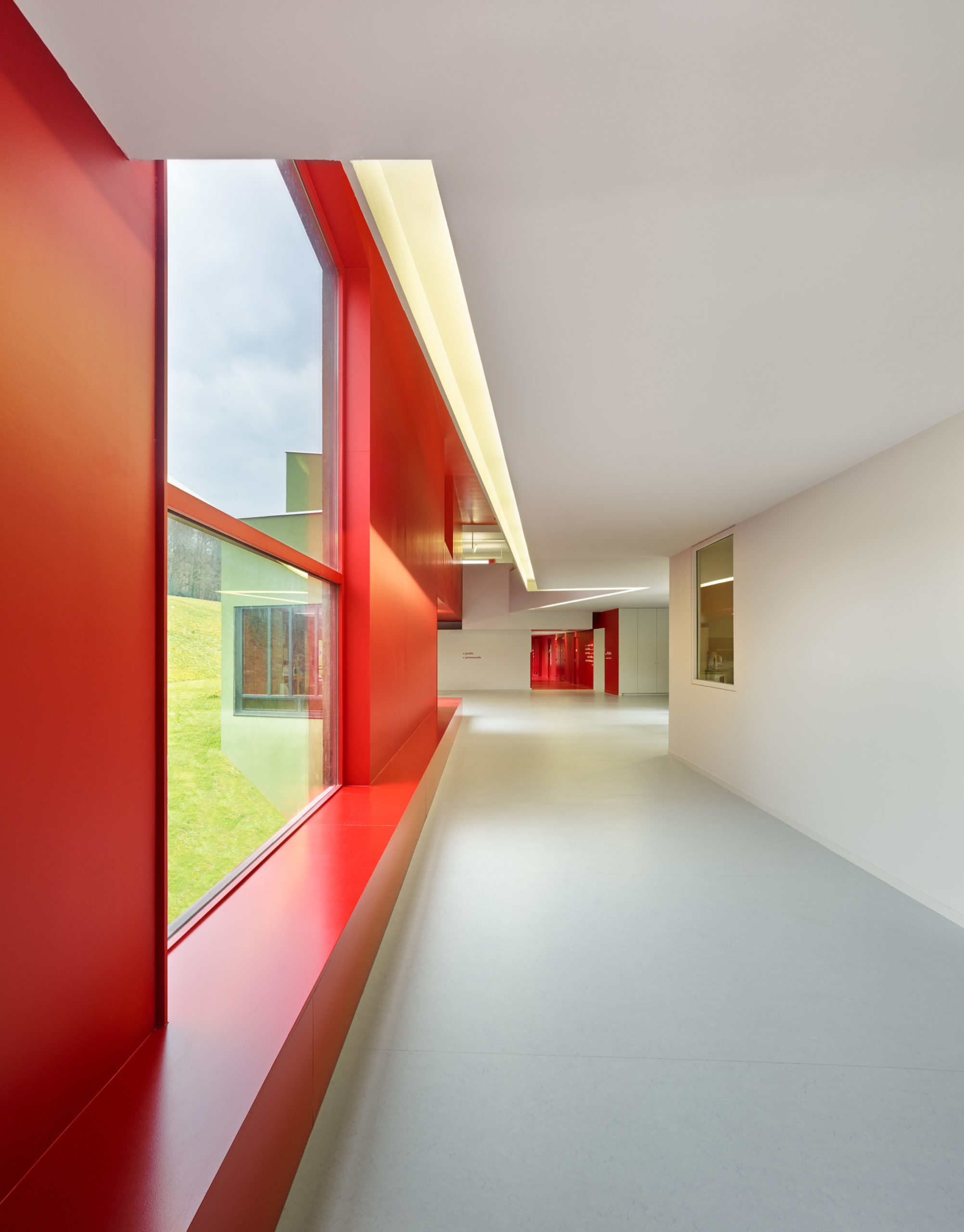
However, there are ways to ensure that a caregiver’s work can be performed without a hitch while creating inviting and dynamic spaces. The simplest way to do so is through color. The Home for Dependent Eledery People and Nursing Home in Orbec, France chose unconventional colors for its design. The interior hallways are painted with a bright red and crisp white color, steering away from conventional medical palettes. Even the exterior’s green façade makes for an inviting space and connects the center to the surrounding landscape.
St Brieuc’s Elderly Establishment by Nomade Architectes, Saint-Brieuc, France | Photo by Mathieu Ducros
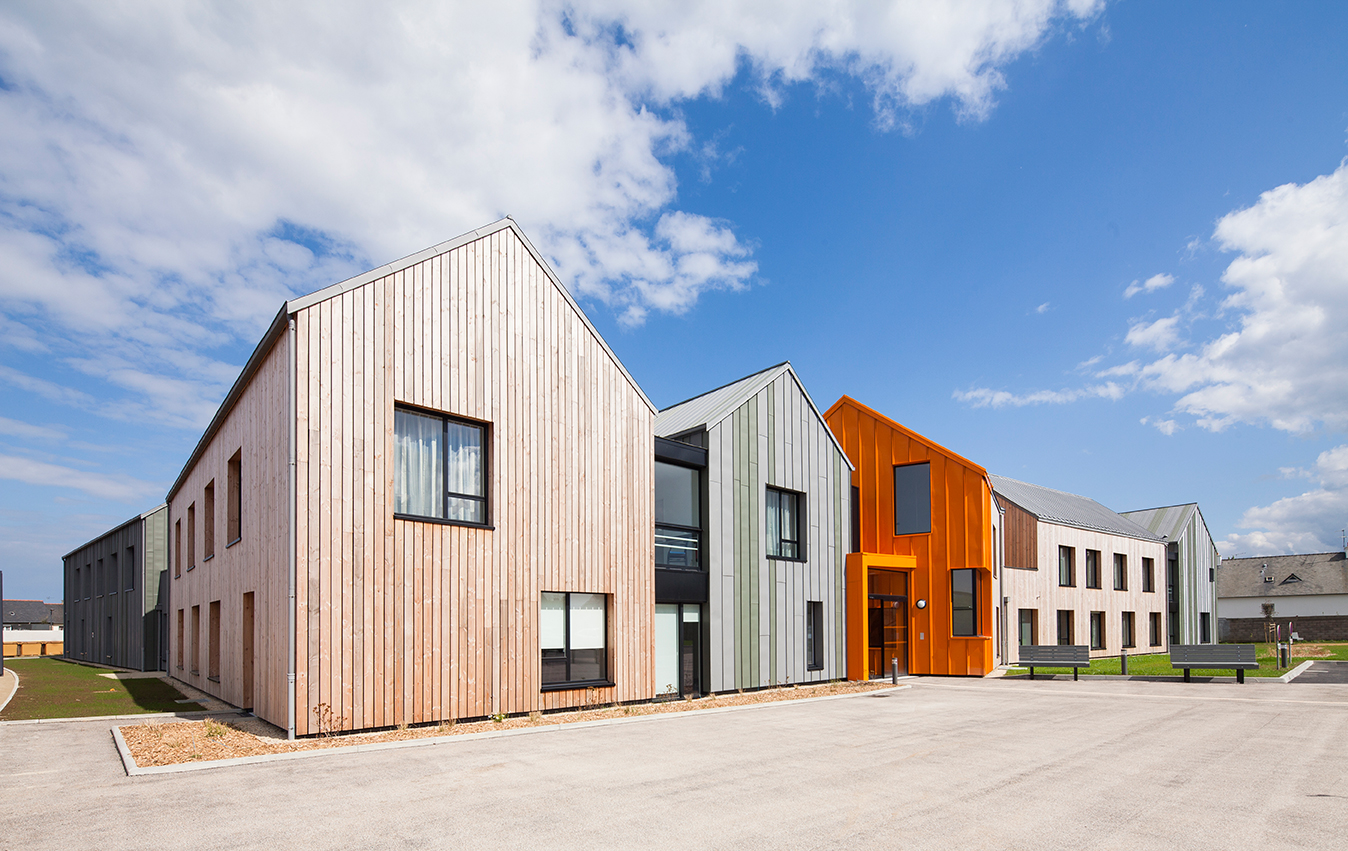
This bold use of color can be seen in additional homes, including the St Brieuc’s Elderly Establishment in France, which boasts a colorful interior and exterior purposefully done to energize the space. The design respects the area’s residential nature by breaking the program into nine small blocks and borrowing traditional architectural codes, such as double-pitched roof. The array of materials and color further differentiate units of the housing, reinforcing a sense of individuality for the residents in the community.
Encouraging Autonomy Through Separated Public and Private Spaces
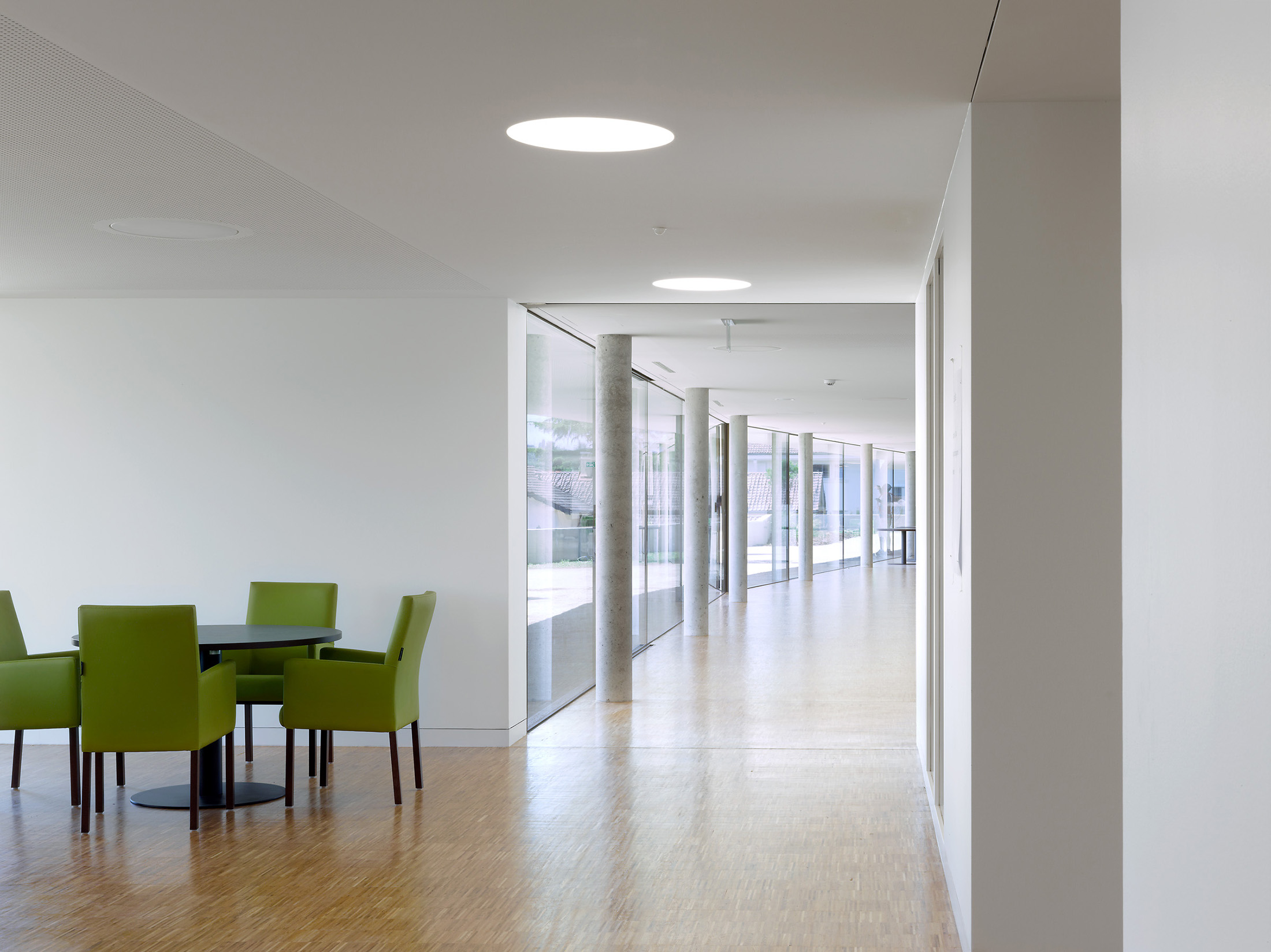
Indeed, balancing autonomy and independence can be a challenge when designing an old folk’s home, especially when most residents require assistance from staff. Separating public and private spaces in order to encourage independence — while not compromising community and efficient care — is key. The Old People’s and Nursing Home in Rolle, Switzerland finds a perfect balance between public and private spaces. Residents’ bedrooms are located on the upper floors while the main level is reserved for communal areas. Additional common spaces are added to upper floors, which encourages private gatherings and therefore, allow residents to socialize on their own terms.
Old People’s and Nursing Home, Rolle by PIERRE-ALAIN DUPRAZ ARCHITECTE ETS FAS, Rolle, Switzerland, 2015.
Hospitality-Based Design
Some designers have approached the architecture of a senior’s home similarly to that of a hospitality space. The Nursing Home in Sceaux was informed by hotel designs and mimics a similar aesthetic through its thematic spaces. This home has three pronounced gardens, all of which boast a unique theme and create exploratory spaces for residents to discover.
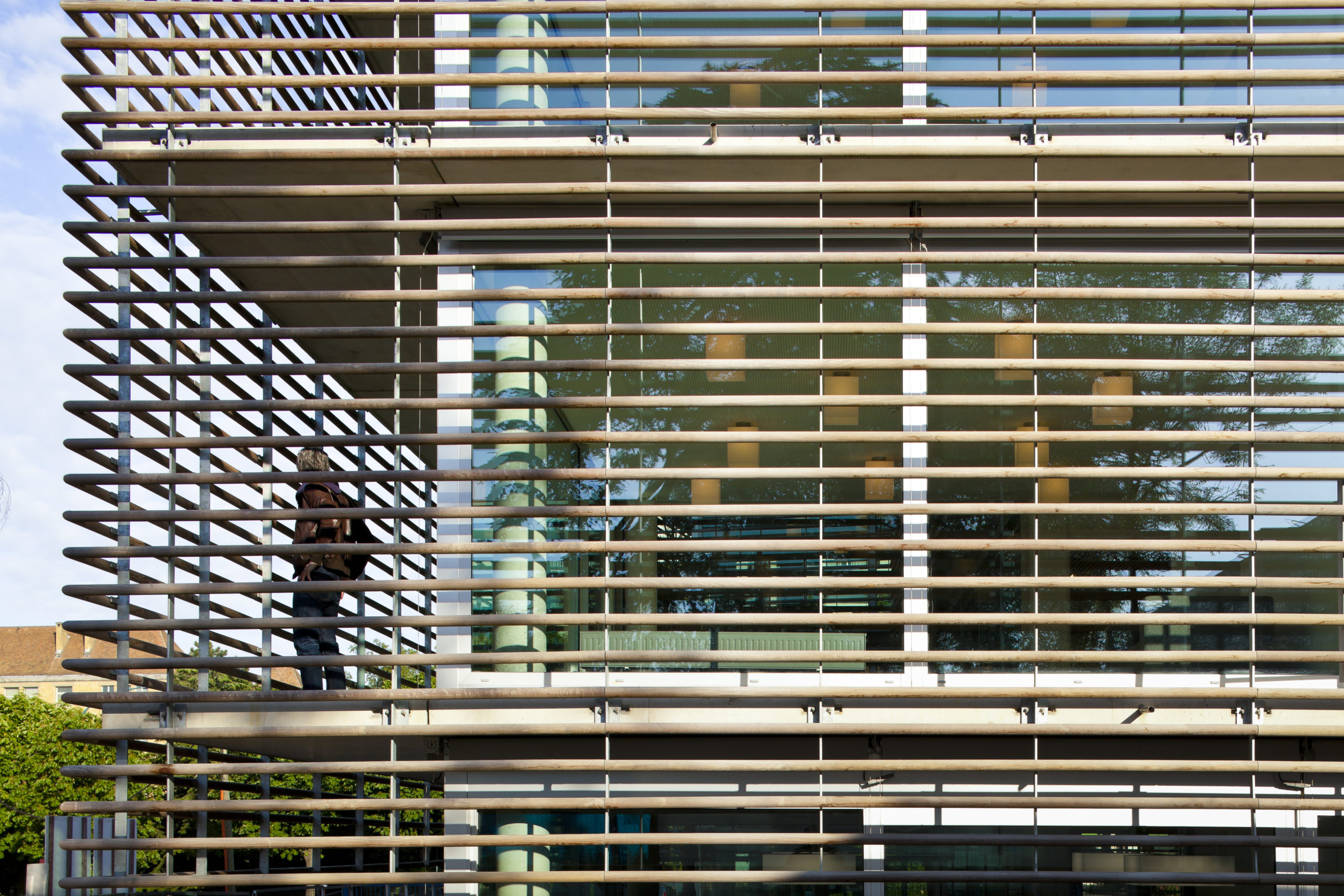
Dining, lounging and media rooms are all separated to further encourage movement and exploration — just like one would in a hotel. Moreover, the entire façade is wrapped by wooden logs which create an enclosed passageway and provides an environment completely atypical of a nursing home but still safe for the elderly.
Nursing Home in Sceaux by Philippe Dubus Architectes, Sceaux, France, 2013.
Hospitality-influenced design is equally see at the St Brieuc’s Eldery Establishment (mentioned earlier in this article) which has an in-house hair salon and delineated family reception area. These sorts of hospitality-focused spaces bridge the gap between the home and the outside world by providing a sense of ‘normal’ living. Residents can engage in mundane tasks such as visiting the hairdresser and hosting family.
Improved Areas for Staff and Caregivers
As important as it is to consider the residents’ needs when designing spaces for the elderly, it is equally paramount to take into consideration the very people that make these spaces possible — the staff. Caregivers have arguably one of the most challenging jobs and it is critical they are well-considered when designing nursing homes and retirement residences. Delineating clear environments where staff can perform their work, as well as look after themselves, help create an environment ideal for growing old.
Architizer is thrilled to announce that the 11th Annual A+Awards is officially open for entries! With an Early Entry Deadline of November 4th, 2022, the clock is ticking — get started on your submission today.
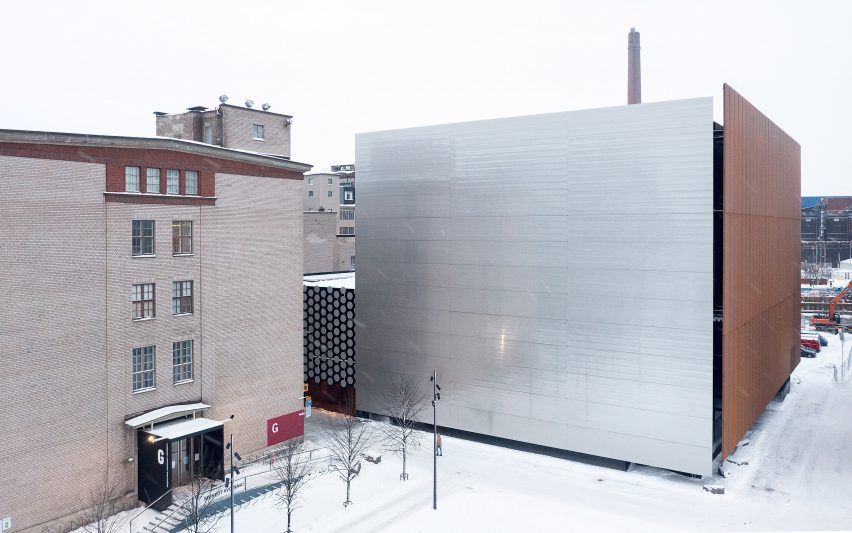
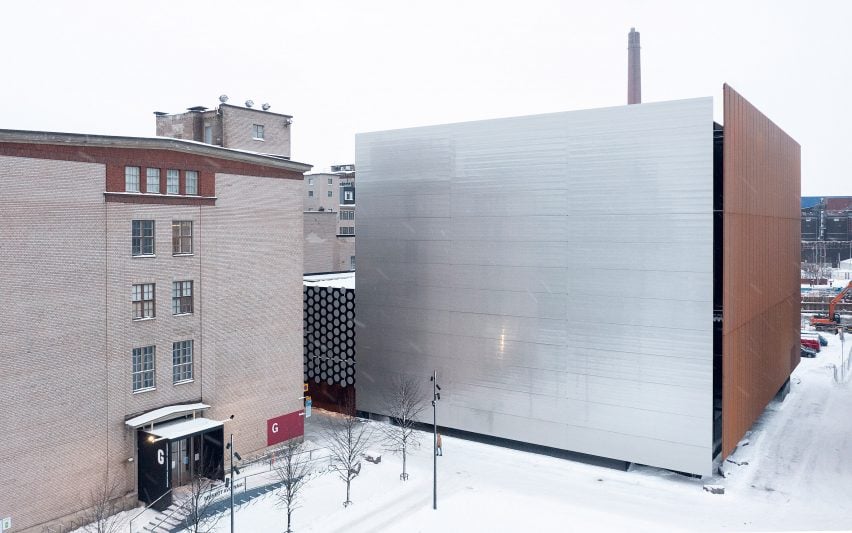
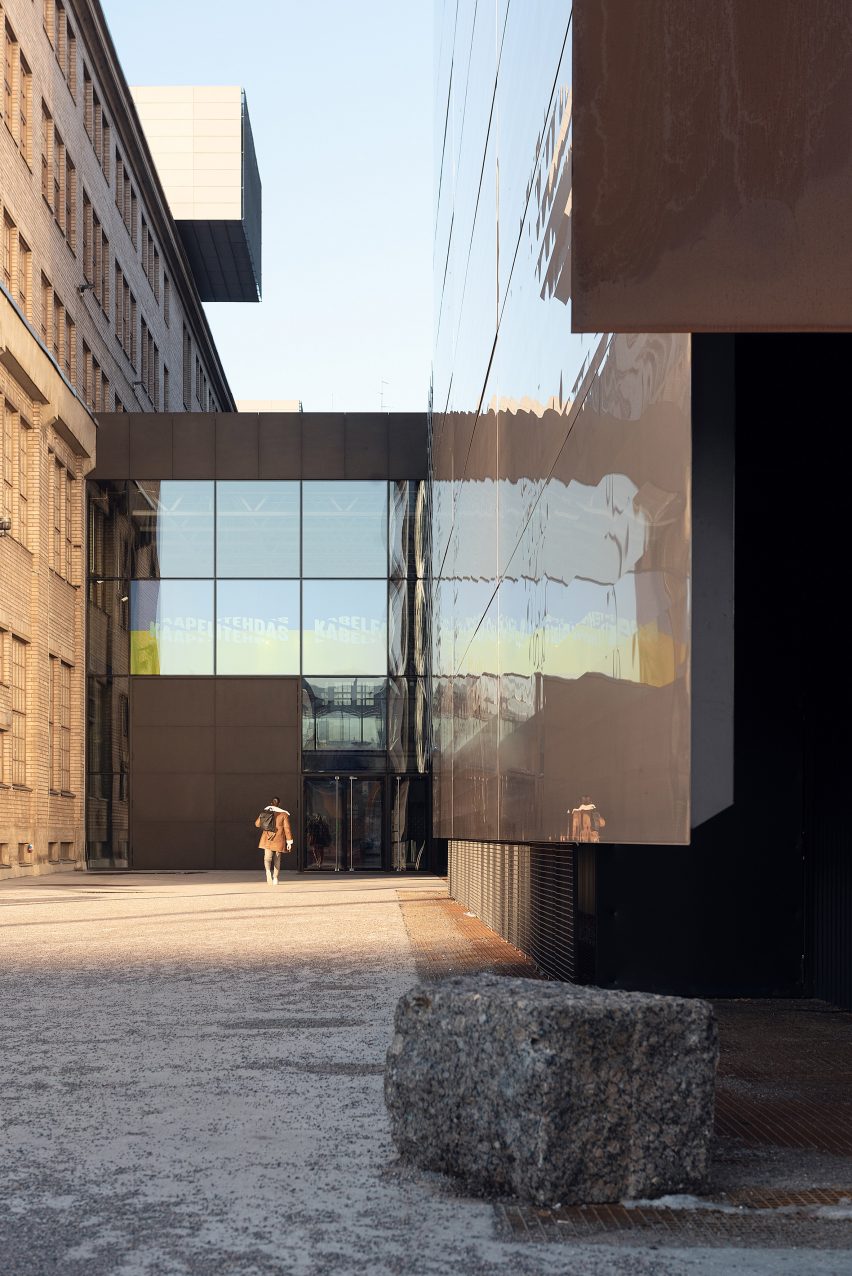
A large steel-clad cube encloses the Dance House in Helsinki, which local architecture studios JKMM and ILO architects have created by converting and extending part of a former cable factory.
Providing over 7,000 square metres of space, the Dance House forms part of a wider redevelopment of the old industrial building that was acquired by the city in 1991 to create the Kaapelitehdas, or Cable Factory, which is Helsinki’s largest cultural centre.
JKMM and ILO architects have created the Dance House. Photo is by Hannu Rytky
JKMM and ILO architects were tasked with reconfiguring part of the existing structure while adding new spaces to its eastern end, housed inside a steel-clad cuboid informed by the “gravity, lightness and weight” of dance.
“The Dance House adds a striking contemporary layer to the history of the former factory and its surroundings,” said JKMM.
The centre occupies part of a former cable factory
“The new and old are placed in contrast, but also in dialogue with each other. Together, the Dance House and the Cable Factory create a meaningful destination and a revived neighbourhood,” JKMM continued.
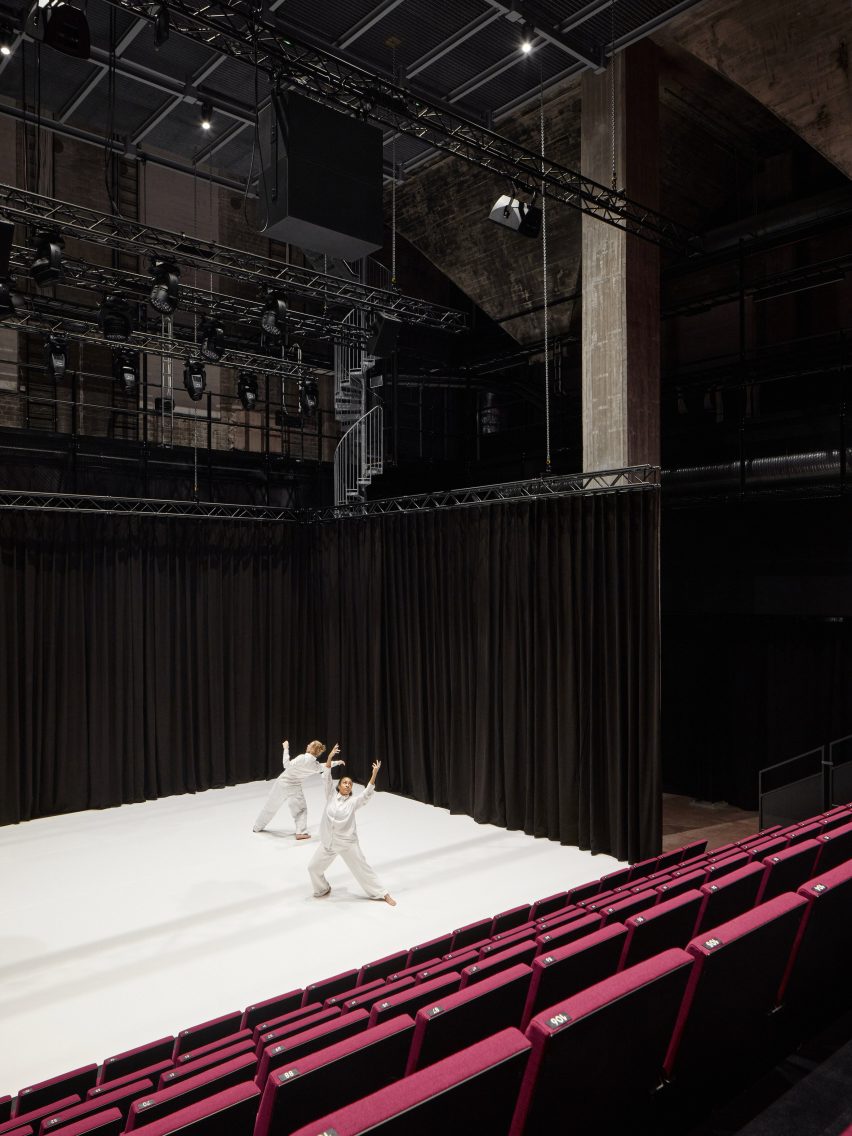
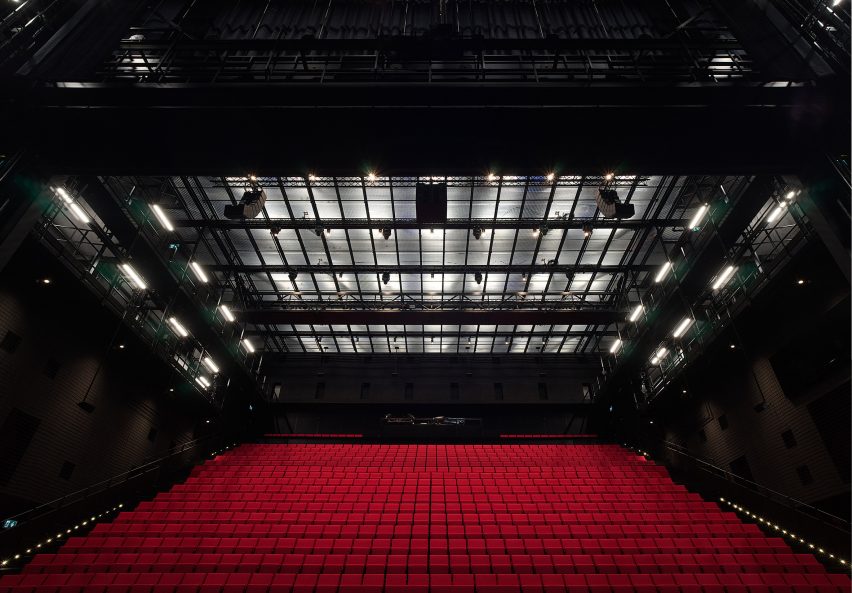
Inside are two black-box dance studios. One of them is housed in the Cable Factory’s redesigned Pannu Hall, which now seats up to 400 people, and the second is the new 1,000-seat Erkko Hall – the largest dance performance space in the Nordic countries.
Metal clads the exterior of the building
These two performance spaces sit on either side of an entrance lobby, which connects to an enclosed street-like space between two existing facades, described by JKMM as a “glass courtyard”.
An underground club, cloakroom facilities, restaurant, rehearsal and back-of-house spaces are organised across the building’s five levels, with all of the circulation spaces designed to have the potential to be used for performance.
“All the public spaces in the Dance House have been designed with performance in mind,” explained JKMM’s project architect Harri Lindberg.
“It is possible for dance to take over, for example, the entire Cable Factory for the duration of a performance,” he continued.
An entrance links to an enclosed street-like space. Photo is by Hannu Rytky
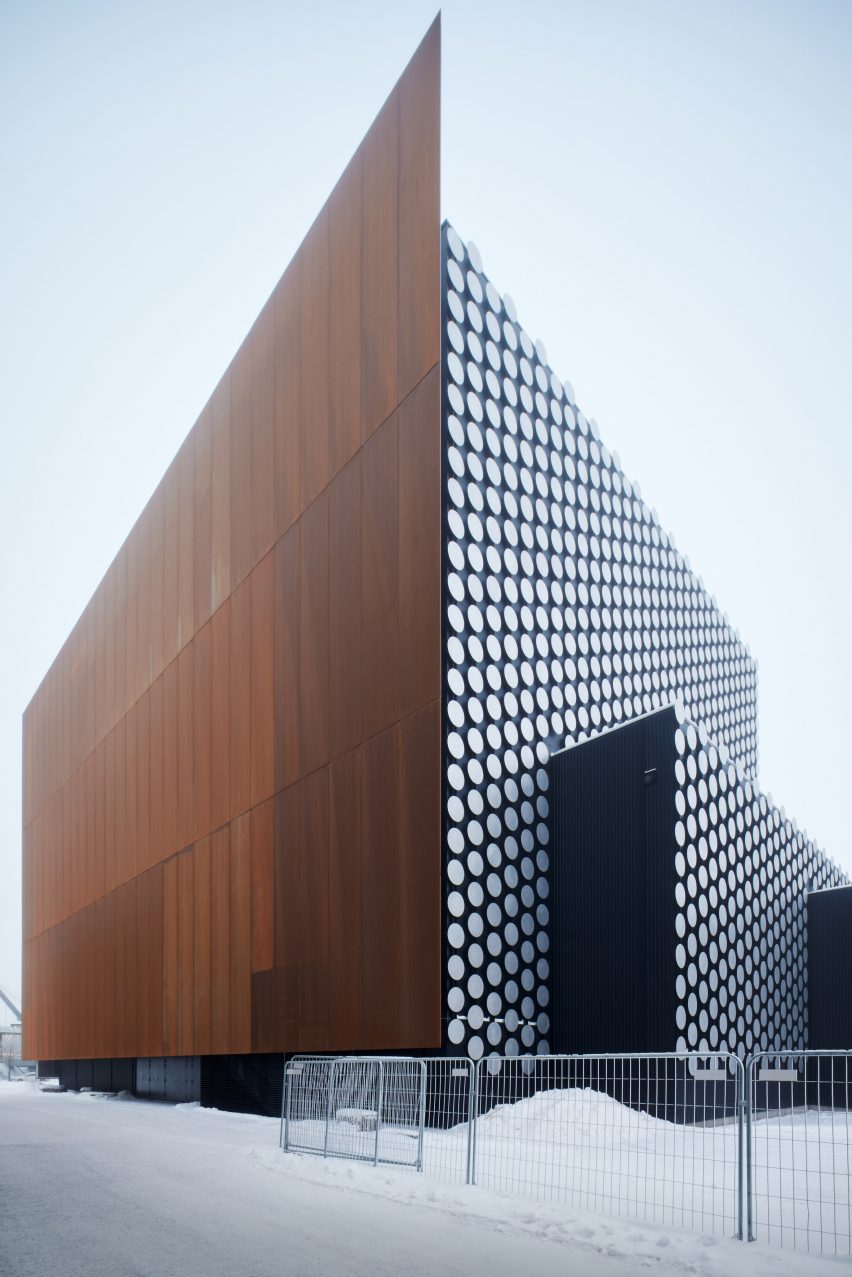
Large steel panels, one of them highly reflective and one weathered, form the facade of the extension, hung slightly above the ground and at different levels to give the effect of them shifting away from one another.
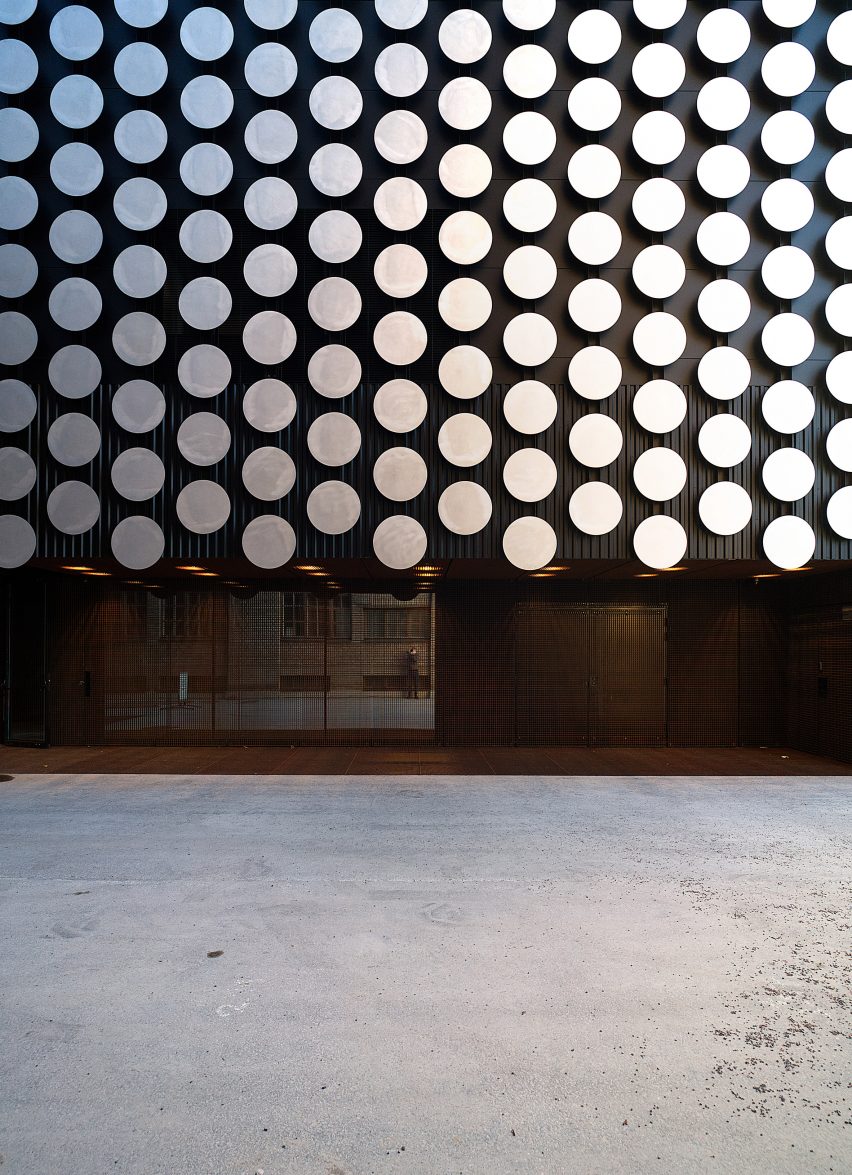
On the building’s north elevation facing a nearby park, the stacked levels have been covered in hundreds of small aluminium discs, designed to create an “abstract rhythm” against the sky.
There are two black-box dance studios. Photo is by Tuomas Uusheimo
“Dance deals with gravity, lightness, and the weight of the human body,” explained JKMM.
“The ‘floating’ metal facades were custom designed by using laser welding technology, to create bespoke sandwich panels with the biggest possible surface,” it continued.
“Dance performers also create illusions. The light, satin-like steel surface can be transformed with light, becoming part of the scenery of dance events.”
It has the largest dance performance space in the Nordic countries
Inside, robust materials such as raw steel and concrete have been chosen to complement the existing structure of the former factory.
JKKM recently incorporated heritage structures into another of its designs in the Finnish capital, creating a new home for the University of Arts Helsinki that partially occupies an old soap factory and silo building.
The photography is by Peter Vuorenrinne unless stated otherwise.
Emma Walshaw is the founder of First In Architecture and Detail Library. She has written a number of books aiming to facilitate a better understanding of construction and detailing. First In Architecture is a website providing resources and guides for architects and students.
Level thresholds can be very difficult to detail, with many standard details always showing a 150 mm step between the finished floor level and external ground level. However, level thresholds provide a future-proof solution to an aging population and ensure a building can be used and visited by everyone. They are also a very aesthetic solution to bridging the gap between indoors and outdoors.
Level thresholds are also a legal requirement for new build housing in the UK. This means that all external doors, front, rear and side, plus any sliding, bifold, French or terrace doors, must provide a level entrance and exit. Although it is not a building regulation requirement in renovation projects, some councils may require level thresholds as a planning condition within extensive renovation projects.
Below we look at key considerations when designing level thresholds to ensure water does not enter the building.
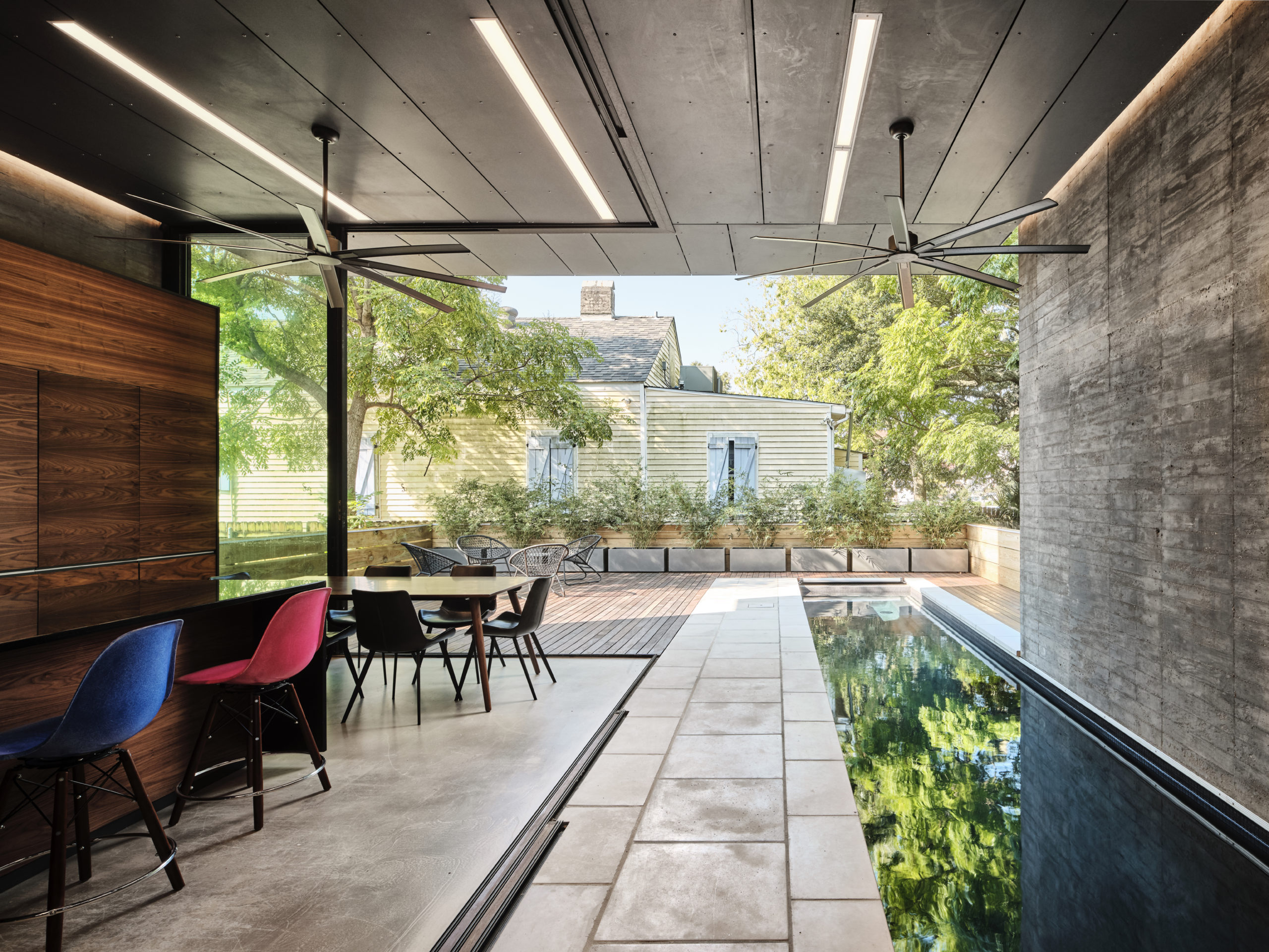
Bienville House by Nathan Fell Architecture, New Orleans, LA, United States
Accessible / Level Threshold
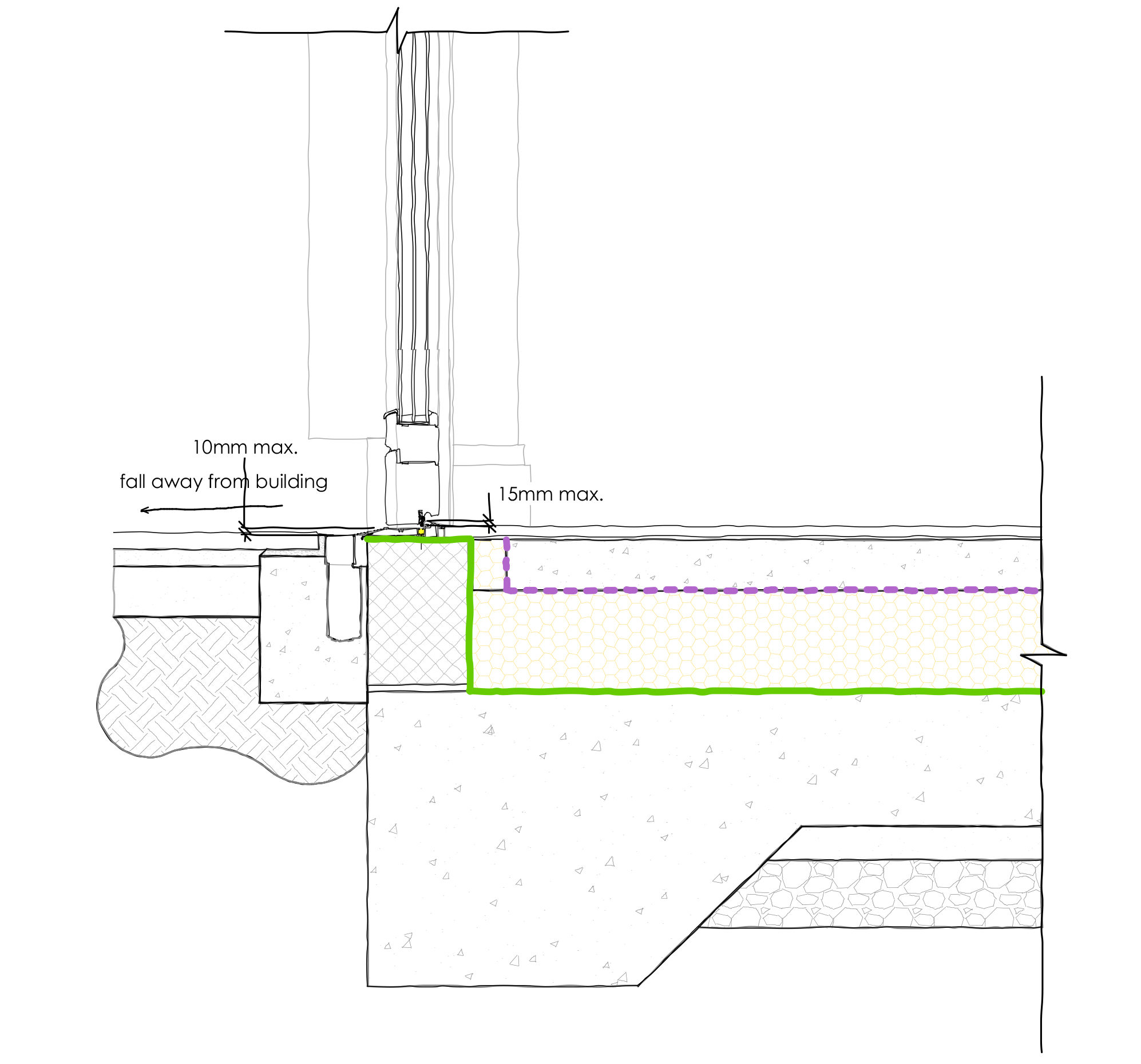
An accessible threshold is defined as a threshold this is level or, if raised, has a total height of not more than 15 mm, a minimum number of upstands and slopes and with any upstands higher than 5 mm chamfered.
Building Regulation Requirements
For single new build properties, Building Regulation Part M4(1) and M4(2) must be met. This requires all access to the dwelling to be step free, including the entrance, garden and any terraces. For larger developments or flats, the local council may require 10% of units to meet Building Regulations Part M4(3), meaning the unit is fully adaptable to a wheelchair user.
Whilst these Building Regulations do not need to be met in the case of an extension, some Local Authorities, Building Control and/or Approved Inspectors may require the need to meet Part M4(1) within a planning approval condition, requiring entrances and exits to the house to be accessible.
Ground Floor Thresholds
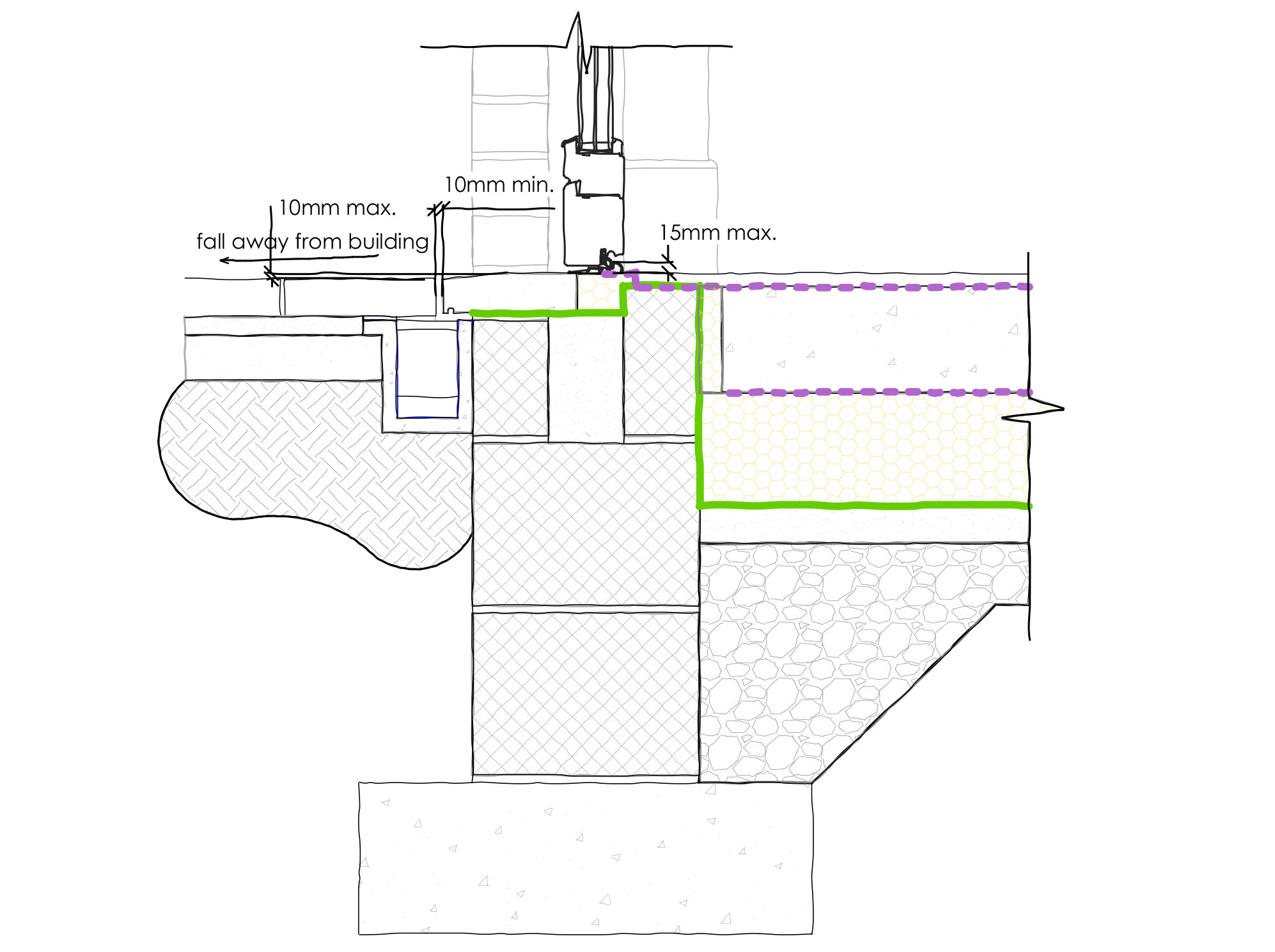
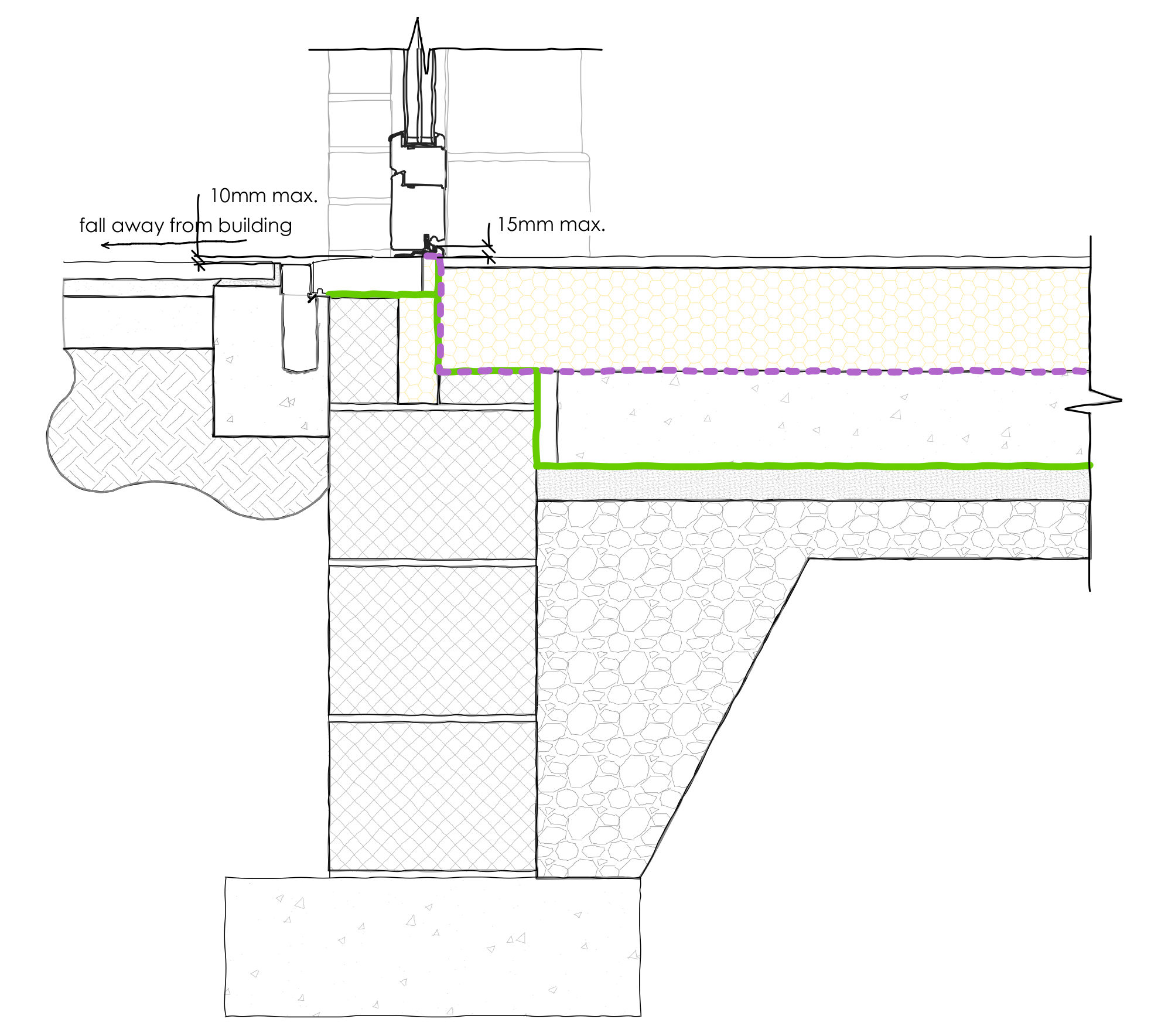
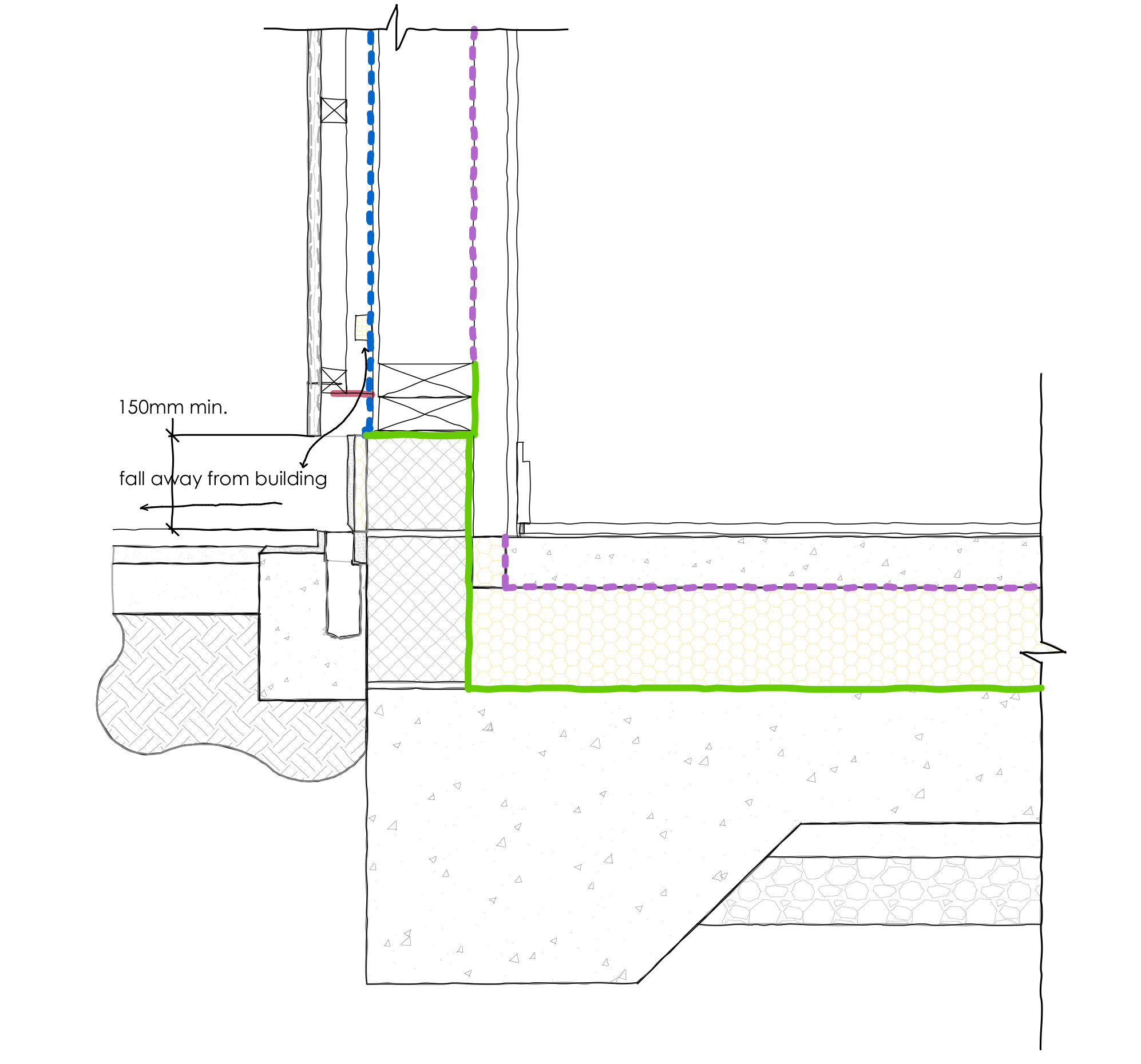
LHS – In-situ concrete threshold drain built under the sill and pavers, pavers to be removable or inspection hatch to be provided at either end of the drain for cleaning and maintenance.
RHS – Aluminum threshold drain installed between pavers and sill with removable grill for inspection, drain with low level water entry of water infiltration between drain and sill.
There are various ways of designing a level threshold based on aesthetic, cost, structure, site conditions and location. However, there are a number of key features that all level thresholds should take into account.
Door — When specifying a door to be used in a level threshold, most manufacturers will state if the system is compliant with Part M of the Building Regulations. This guarantees that the element you step over is no more than a maximum 15 mm in height with no upstands of more than 5mm. Most sliding door manufactures provide frames with a completely level base frame. However, it is important to check the base frame of elements such as front and rear doors, especially in timber, as these will need special aluminum thresholds to be fully accessible.
Threshold Drainage — This is a building regulations requirement when designing this type of threshold. A drain can be installed between the sill and external landscaping flush with the level floor or hidden under the finishes. Many door manufacturers will even be able to provide a threshold drain for the door system chosen. This will help drain away any water near the drain as well as water which hits the door or glass and drains through the frame.
Threshold drain designed to clip into the aluminum sliding door system to drain both surface rain and rain hitting the glass and filtering through the window frame.
Waterproofing — Damp proof membranes should be draped up the door or window frame system at the point of the threshold. Water should be moved away from the threshold, by sloping eternal finishes away from the drain. To either side of the threshold, the damp proof course should be minimum of 150mm above ground level.
Key Points To Remember
The threshold — including the door frame — should not be more than 15 mm in height overall. Of these 15 mm, there should be a minimum number of upstands and slopes, with any upstands higher than 5 mm chamfered.
If the threshold is exposed to wind driven rain the landing can be up to 10 mm below the level of the sill if the sill is rounded or chamfered.
The external landing should have a fall ratio of between 1:40 and 1:60.
Ensure all water falls away from the doorway in a single direction.
Build a drainage channel between the landing and the threshold.
Ensure the channel discharges to a drainage system or land drainage such as a soakaway.
Timber Frame Key Considerations
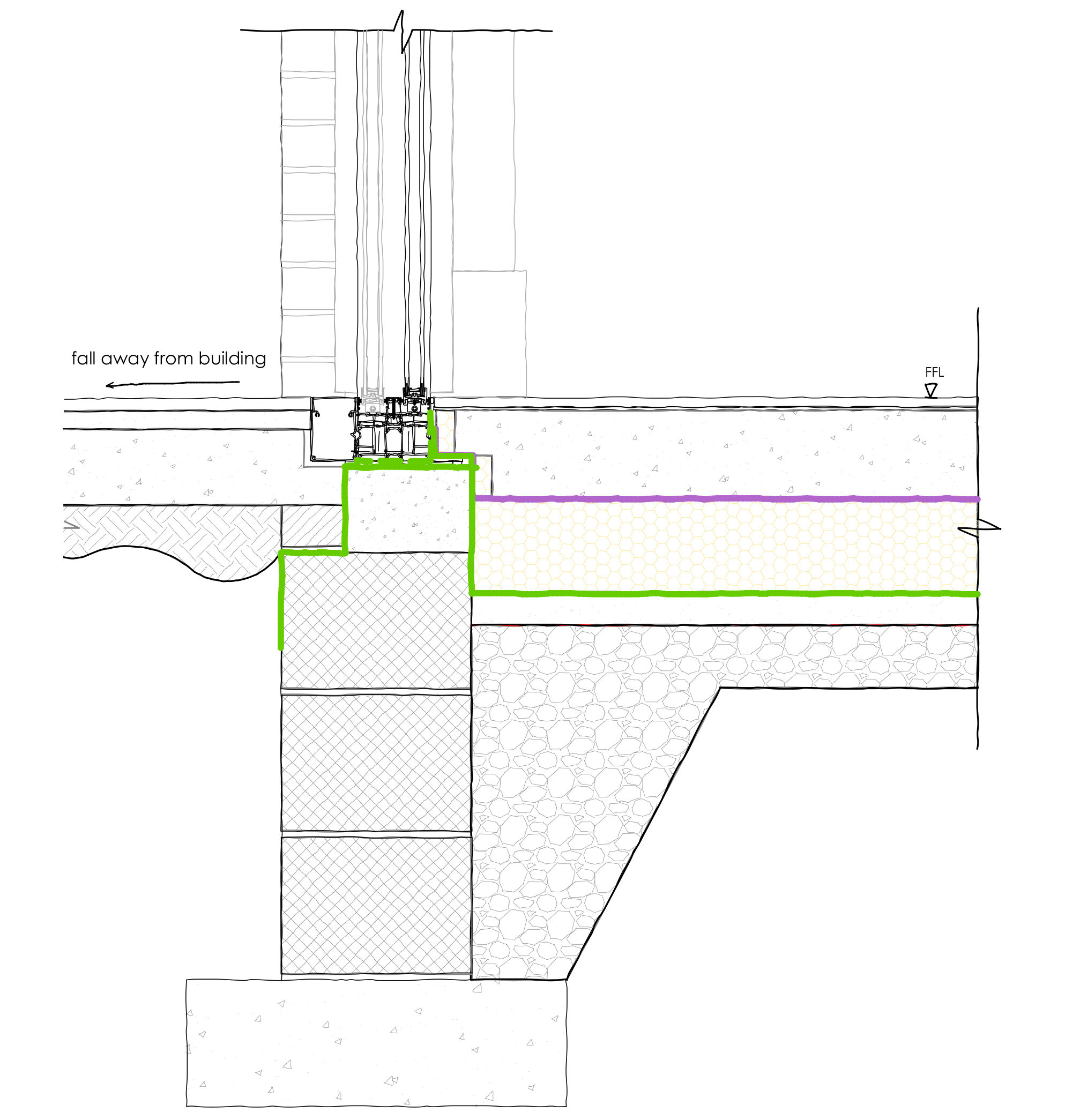
LHS – Timber frame construction either side of threshold showing concrete slab construction and raised foundation blocks 150 mm above finished floor level, with threshold drain.
RHS – Level threshold with drain
Usually when designing for a timber frame structure, the timber frame should begin 150 mm above the ground level. This concept should be maintained when the ground level externally is level with the internal finish floor level. All the same considerations as above should be taken to account as well as the foundation or timber structure being raised 150 mm above the external ground level, usually 150 mm higher than the internal finished floor level.
Raised Terrace
Another way of preventing water ingress at this critical junction is to use a raised terrace such as paving slabs on pedestals. Whilst this is the best option if you have a raised terrace area, it is also used when the garden level is lower that your internal ground floor level, such as with a beam and block construction. Further details can be found in the following section.
Level Balcony and Terrace Thresholds
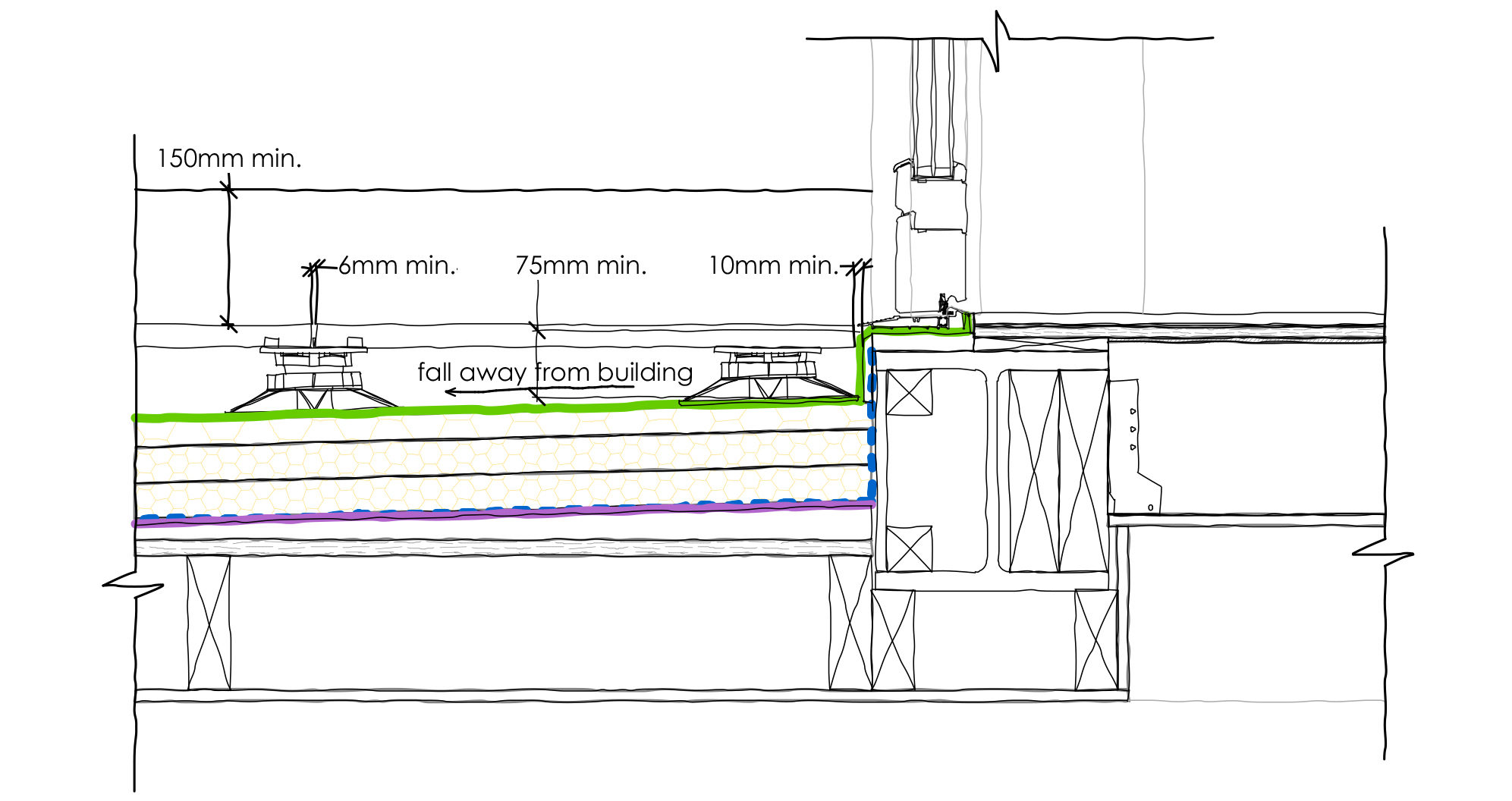
When designing a level threshold onto a raised terrace or balcony, even more care needs to be taken to assure that water does not enter the building fabric.
When creating a level threshold over a heated space, care needs to be taken when setting the internal finish floor level and ceiling level to allow for the new insulation. Many people opt for vacuum insulation to this area to allow for a reduced terrace build-up.
Adjustable pedestals can be used to bridge the gap between the level pavers or timber deck with the sloped flat roof. The gaps between the deck material is also key in allowing the water to drain through to the roof and the roof outlet.
Key Points To Remember
The threshold including door frame should not be more than 15mm in height overall. Of these 15mm, there should be a minimum number of upstands and slopes, with any upstands higher than 5mm chamfered.
The gap between door sill and paving or timber to be a minimum of 10mm.
The gap between paving or timber to be a minimum of 6mm.
Flat roof to have 1:40 falls for a 1:80 minimum built slope.
Ensure all water falls away from the doorway in a single direction.
Build a drainage outlet on the opposite side of the flat roof to the threshold.
Ensure the flat roof has an overflow.
Ensure all waterproofing has a minimum of 75mm upstand under the threshold.
Provide a minimum 150mm waterproofing upstand to sides such as brickwork.
Bienville House by Nathan Fell Architecture, New Orleans, LA, United States
Resources
If you want more inspiration on level thresholds, detailing and precedents, be sure to follow Detail Library on Pinterest where we have lots of examples.
Top image: Canyon Run by Migration Studios, Concept
The Fourth Annual One Drawing Challenge is open for entries! Architecture’s most popular drawing competition is back and bigger than ever, including larger prizes. Get started on your submissionand hurry — the Main Entry Deadline of October 21st is fast-approaching.
workshop architects melds traditional + modern design
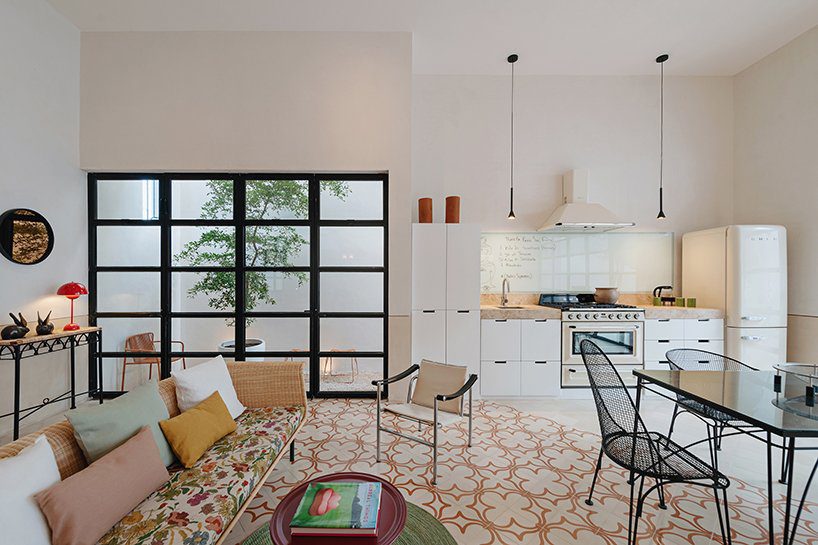
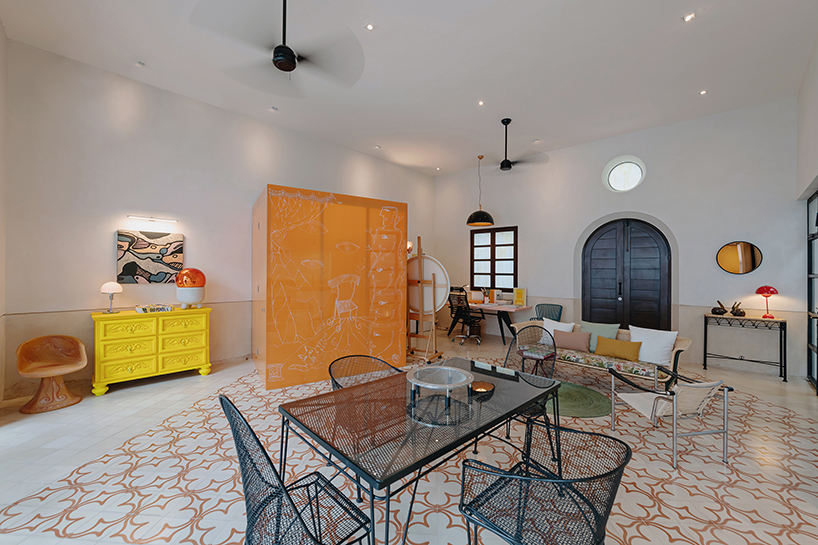
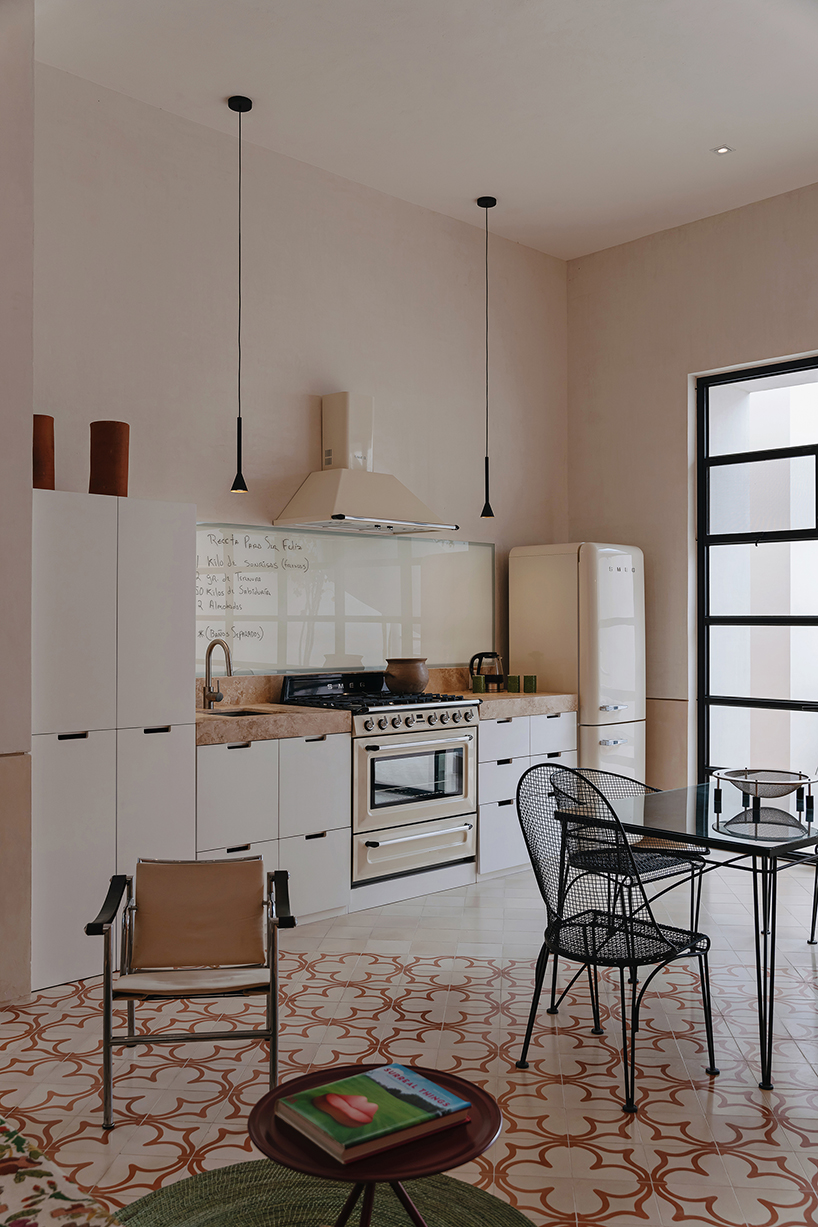
In a historic neighborhood in the Mexican city of Mérida, Workshop Architects’ ‘Studiolo’ is a traditional yet eclectic home-studio which fuses juxtaposing elements of Yucatecan colonial architecture and 20th-century Italian modernism. A celebration of vibrancy, risk-taking, and iconic design elements, the space serves as a residence and studio for Mexican artists David Serrano and Robert Willson, and perfectly encapsulates both their personal and professional personalities. The loft-style interior is characterized by a simplistic spatiality, enlivened by iconic furnishings and decor including an LC1 Le Corbusier armchair, and vibrant statement elements such as a bright orange bathroom ‘cubicle’ which doubles as a canvas.
all images courtesy of Workshop Architects
an eclectic home-studio in historic Mérida
The space is modeled after the traditional Italian ‘studiolo’ which during the Renaissance era served as a lavishly decorated palace chamber where owners could retire to read, study and write in privacy. Similarly, Workshop Architects’ ‘Studiolo’ provides its residing artist duo with a place to not only live, relax and socialize, but also to work on their pieces and meet with collectors, gallery owners, and colleagues. Beyond the minimalist, pristine white façade inspired by Italian architect Gio Ponti, the loft-style interior conjures a vibrant and idiosyncratic fusion of historical Yucatecan colonial elements with modernist aesthetics which reflect the duo’s practise with 20th-century pieces in their LA Gallery ‘Downtown’.
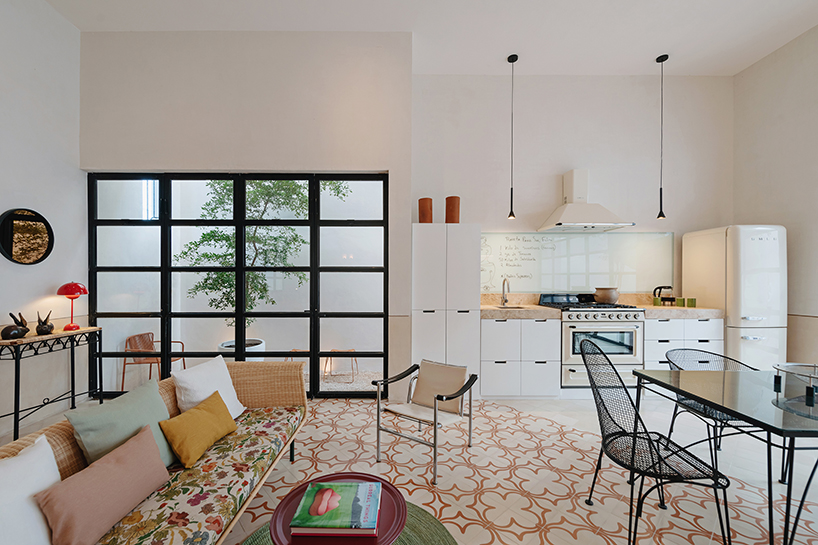
In a vibrant and eclectic display, the architects utilize traditional materials in contemporary ways. Along the floor, Yucatecan pasta tile rugs are reinterpreted and randomly ‘thrown’ as if they were fabric rugs, rather than precisely fitted into the space. Different shades of chukum coat the interior walls, their velvety textures and natural tones exuding a sense of dynamism and depth through the space. The windows are made with black ironwork and transparent glass alluding to functionalist architecture and connecting the interior spaces to the gardens, generating cross ventilation.
the loft-style interior is characterized by a simplistic spatiality
infusing iconic modernist design elements from the 20th-century
Workshop Architects enlivens the simplistic spatiality with bold sparks of color and iconic design elements. On the open plan ground floor living area, furnishings include a Jean Prouvé style table in the work area, an LC1 chair by Le Corbusier and a Verner Panton lamp in the living room, vintage pieces from the 1940s by Woodard in the dining room, and SMEG appliances and a lamp by Wilhelm Wagenfeld in the kitchen. Floating in space, an orange glass cube emerges as an unexpected element, doubling as a half bathroom and a canvas for drawing and experimenting.
In the monochromatic rear garden, a statement pink Roly Poly chair by Faye Toogood sits beside a black pool that recalls the architecture of Mies van der Rohe. A subtle yet sculptural staircase elegantly winds to unite the communal ground floor space with the private bedroom upstairs. The bed floats in the center of the space beside a Gio Ponti lamp, angled to overlook the patio and terrace. The space also includes a wet room, walk in closet and laundry room.
Yucatecan pasta tile rugs are reinterpreted and randomly ‘thrown’ as if they were fabric rugs
The United Nations has written a set of “principles for sustainable and inclusive urban design and architecture” for architects to sign up to called the San Marino Declaration, which architect Norman Foster is set to launch.
Set to be ratified in the republic of San Marino next month, the declaration outlines a set of standards that architects and other built environment professionals should adhere to.
Declaration is Hippocratic oath for architects
“Next month I’m going going to be launching a United Nations declaration, which is the equivalent of the oath that physicians in ancient Greece undertook to uphold ethical standards,” Foster + Partners founder Foster told Dezeen, referencing the Hippocratic oath.
“In a way, it’s a condensation of the Sustainable Development Goals, which were also developed by the United Nations.”
Written by the Bureau of the Committee on Urban Development, Housing and Land Management, the San Marino Declaration will ask architects and other built environment professionals to agree to uphold a series of “principles for sustainable and inclusive urban design and architecture in support of sustainable, safe, healthy, socially inclusive, climate-neutral and circular homes, urban infrastructure and cities”.
Architects hold “key to a more sustainable future”
Signatories to the declaration would agree to design buildings and cities “in a way that limits the use of energy, uses only sustainable energy sources, reuses rainwater and limits the use of other natural resources”, as well as using recycled materials where possible.
The principles would also require architects to “respect the identity and cultural heritage of places and buildings”.
Originally focused on architects, Foster encouraged the writers to expand the reach to include all those involved in the built environment, who are described in the draft declaration as holding “the key to a more sustainable and inclusive urban future”.
“I’ve consciously encouraged the United Nations, who’ve grasped the idea that we should not just be inviting architects and engineers to sign up to this declaration,” said Foster.
“It should extend to city managers, politicians, developers, builders, everyone, everybody who’s involved, who is empowered to sign up to this declaration.”
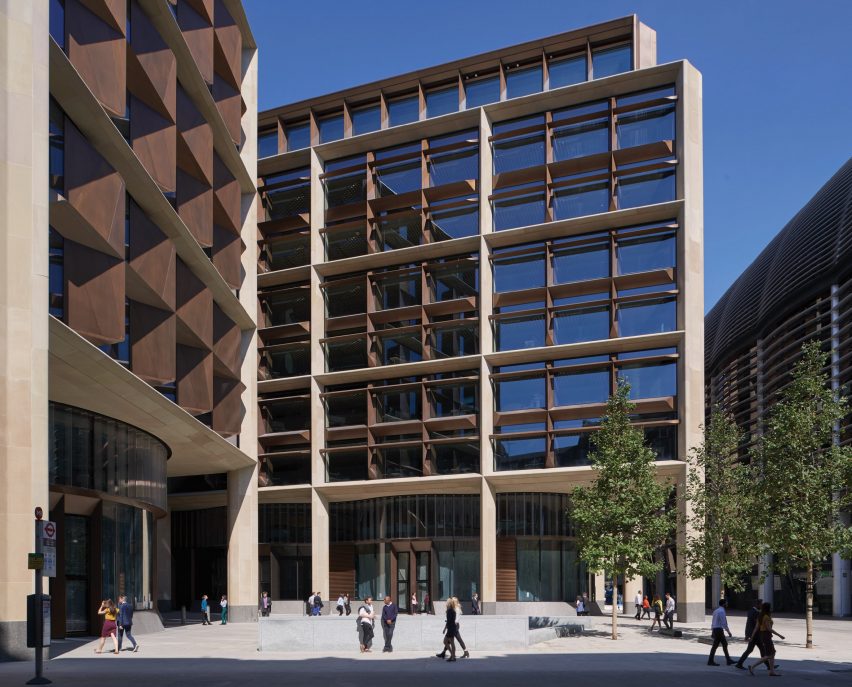
Norman Foster (top) will present the Bloomberg HQ (above) at the launch of the declaration
He will also be showcasing the renovation of the Reichstag in Berlin “as a recycled building” and his firm’s Stirling Prize-winning Bloomberg HQ “as a new building”.
Foster has been criticised in the past for his stance on the sustainability of aviation projects. His studio, Foster + Partners, was one of the founding signaries of the Architects Declare manifesto alongside 16 other high-profile UK studios. However, it withdrew from the climate change action group, stating that aviation needs “the most sustainable buildings”.
The United Nations is increasingly focusing on the built environment as a key sector that is causing climate change, alongside more well-known culprits like transport and energy.
The UN’s 26th annual climate conference COP26 addressed carbon emissions from buildings for the first time last November during a dedicated half-day, while the Intergovernmental Panel on Climate Change (IPCC) dedicated two entire chapters to buildings and cities in its most recent report.
While this makes architects and other built environment professionals crucial actors in the fight against climate change, the UK’s champion for COP26 told Dezeen last year that they are “one of the least well-represented businesses” in the UN’s net-zero push so far.
Below are the UN’s principles for sustainable and inclusive urban design and architecture:
People-centrality, social responsibility and inclusivity: urban planning, design and architecture need to foster and support social responsibility and integrate diversity and equality through due consideration of the needs of individuals and households across all races, age groups, gender, cultures, abilities and income levels, including intergenerational planning.
Cultural identity, values and heritage: urban planning, design and architecture should respect the identity and cultural heritage of places and buildings as well as the cultural values and traditions of communities.
Resource efficiency and circularity: every city, urban infrastructure and building should be designed in a way that limits the use of energy, uses only sustainable energy sources, reuses rainwater and limits the use of other natural resources and reduces resource losses.
In addition, every city, urban infrastructure and building should, to the extent possible, by design: use recycled materials; reuse and requalify spaces; reduce the production of waste reuse water; and encourage food production through urban agriculture, orchards and food forests.
Safety and health: every city, urban infrastructure and building should be based on internationally recognised quality standards as well as safety standards for workers and citizens, including fire safety.
Homes should provide a comfortable, safe and healthy living space, while cities and urban spaces should be designed with the imperatives of ensuring the safety and health of citizens; providing safe and sustainable mobility systems, including rail, road, inland waterways as well as walking and meeting spaces, green areas and urban forests that are accessible to all. Port cities need to ensure that port facilities are up to international transport and safety standards.
Respect for nature and natural systems and processes: every city, urban infrastructure and building should be designed in a way that limits its impact on the ecosystem of surrounding spaces, including by respecting plants, animals, and other organisms, as well as weather and natural habitats.
This implies conducting ex-ante environmental impact assessments, allowing spaces for biodiversity and using natural materials as well as low impact production assembling and dismantling processes.
Climate neutrality: cities, urban infrastructure and buildings should be designed and requalified to minimize the associated climate footprint, by adopting creative solutions that reduce pollution and energy use; phase out unsustainable mobility systems; use modern, energy-efficient, climate-neutral systems; and integrate green energy generation systems in city designs and buildings.
People-smartness: technology and smart information and communications technology solutions should be used to improve liveability, including the most socially disadvantaged, bolster transparency and curb corruption.
Resilience, durability, functionality and foresight: city and architectural design should support solutions that make homes, buildings and urban spaces resilient to natural disasters, especially those caused by climate change, including hurricanes, droughts and wildfires, flooding and high winds; and making buildings and infrastructures durable and flexible, incorporating spatial adaptability to accommodate new conditions and usages over time.
Affordability and accessibility: cities and homes need to be affordable and accessible to all citizens. Designers need to keep this factor in mind and design high-quality environments for meeting the needs of all citizens.
Inter-disciplinary cooperation and networking: cities and urban spaces should be designed to foster cohabitation, community engagement, solidarity and social cohesion taking into account the needs of citizens across all races, age groups, gender, cultures, abilities and income levels;
Engagement: consultation with and participation of the local communities is essential for any urban project, including small, medium and large-scale projects. Continuous engagement with various stakeholders, including longitudinal research, will foster trust, ensure responsiveness to the needs of all citizens, and consolidate shared ownership of the city’s future.
Architizer Journal is reader-supported. When you buy through links on our site, we may earn an affiliate commission. Learn more.
Visual storytelling is no easy endeavor, especially when it comes to capturing the built environment. Yet, with the ever-ubiquitous range of 21st-century technologies connecting people with buildings worldwide, architectural photography and filmography have never been more fruitful or thrilling. With diverse backgrounds and expertise, more photographers and filmmakers are gravitating to the architectural profession than ever, taking buildings as their subjects.
At the same time, more and more architects and their firms are taking advantage of their privileged access to construction sites and the accessibility of high-quality photography equipment available to the general public. Indeed, some of the most successful architectural films and photographs harness photography to tell compelling stories about the building process and their built products. With the help of advanced technology and equipment, architects and photographers are bringing the built environment to life in entirely new ways. Listed below are three new products released this year, all particularly well-suited for architectural photographers, filmmakers and designers alike.
Fujifilm’s X-H2S Mirrorless Camera Body is designed to smoothen the photo-taking and filmmaking process. Considered to be the company’s most capable video and still hybrid, this device comes with incredible sensors and improved image support thanks to its X-Processor 5 and X-Trans CMOS 5S sensor.
The device boasts an increased memory capacity with a high-speed burst shooting capability ranging up to 30fps for over 1000 frames. Its refined autofocus now produces a cleaner and more focused shot through its prediction algorithm that can easily capture moving objects, especially in low-contrast and difficult conditions. This feature is especially useful for filmmakers who from time to time face unpredictable weather and environmental situations that make it challenging to capture the true essence of a site.
When it comes to architectural photography, each image maker has their own set of preferences. Some like to contextualize the image using the human form, and others prefer letting the design speak for itself. The X-H2S’s new subject-detection autofocus is capable of automatically detecting a broad range of subjects in an image. Whether it be passing by vehicles or pedestrians, this camera is capable of accurately focusing-in on smaller subjects who may be using the space, thus allowing the photographer to focus on the framing the building and the overall composition without having to preoccupy themselves with such variables.
The Fujifilm X-H2S moves with the architectural photographer at all times of the day. The device supports HEIF image format and delivers 10-bit image quality in files 30% smaller than standard JPEGs. This is especially useful for those who would like to have high-quality images directly after shooting. The device’s X-Trans sensor tightly controls shutter effects and helps produce a natural-looking recording which allows the architectural design to speak for itself. Designed to keep up with the brilliant imaginations of architectural image makers, the device can internally record up to 90 minutes of footage using a single battery.
Best camera for architects to enhance their social media presence
A challenge architectural filmmakers often face is framing the perfect shot right at the get-go, and the X3 camera poses a simple solution to this problem. This device is designed to shoot first and frame after, meaning users can simply mount the camera, click record and reframe after. The X3 camera is connected with the brand’s AI-powered Insta360 app, which comes complete with numerous reframing tools and direct upload capabilities. Therefore, filmmakers can simply upload their video and edit directly on the app. Once edited, the video can be directly uploaded through the app onto social media. The X3 is a one-stop shop for architecture firms looking for simple ways to create high-quality content for their media presence.
In addition, the Insta360 X3 camera comes with a first-person view mode that allows users to film from their perspective while not compromising resolution or quality. This is a particularly useful tool for those filming interior spaces or hoping to capture the essence of a structure from the human perspective. Equally, the new HDR mode makes filming in difficult lighting conditions that much easier through its stabilizing and shadow-enhancing features. So much of the built environment is found in non-ideal shooting environments, and so a device like X3 — one that can work in difficult conditions — is extremely useful to architectural image makers.
The X3 is designed for creatives and comes with an array of filming options. This device is perfect for designers hoping to create original videos for their social media. For example, designers can use the 8k quality timelapse feature to capture the progression of a structure throughout time. The Insta360 X3 – Waterproof 360 Action Camera comes with powerful 360 capture, reframing capabilities and an advanced AI system.
Best camera for architects to capture large projects and bird’s-eye views
The DJI Mini 3 Pro (DJI RC) is a small and lightweight drone designed for any environment. This foldable device can capture detail with 4K/60fps video and 48 MP photos. As architects lean on social media more and more to promote their firms, producing ready-to-post videos is key. The DJI Mini Pro offers an easy solution for designers through its True Vertical Shooting feature, which produces social media-ready shots and recordings.
The drone is capable of flying for up to 34 minutes, which is ideal when capturing large projects like condominium development or campus renovations. Moreover, its tri-directional obstacle sensing ensures the drone video is not compromised by unexpected objects in the air. Due to its small size of less than 249 g, the Mini 3 Pro does not require registration in most countries, which eliminates an additional step and lets Mini 3 Pro owners get straight to flying.
For more laptops and workstation recommendations for architects, checkout 15 Top Laptops for Architects and Designers, and watch out for more in our Tech for Architects series, coming soon.

 images courtesy Saffet Kaya Architects |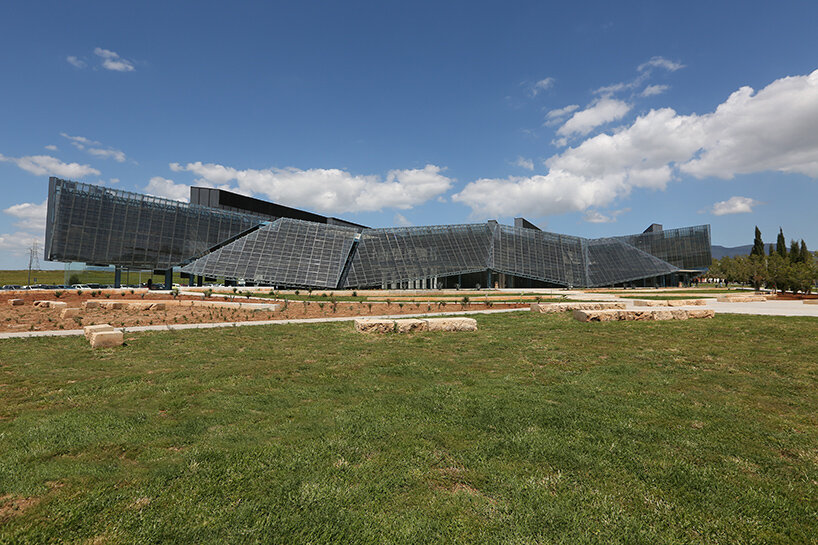

 When designing a level threshold onto a raised terrace or balcony, even more care needs to be taken to assure that water does not enter the building fabric.