Indoor playground in Tel Aviv designed by Sarit Shani Hay
CategoriesInterior Design

Sarit Shani Hay references the outdoors to design indoor playground

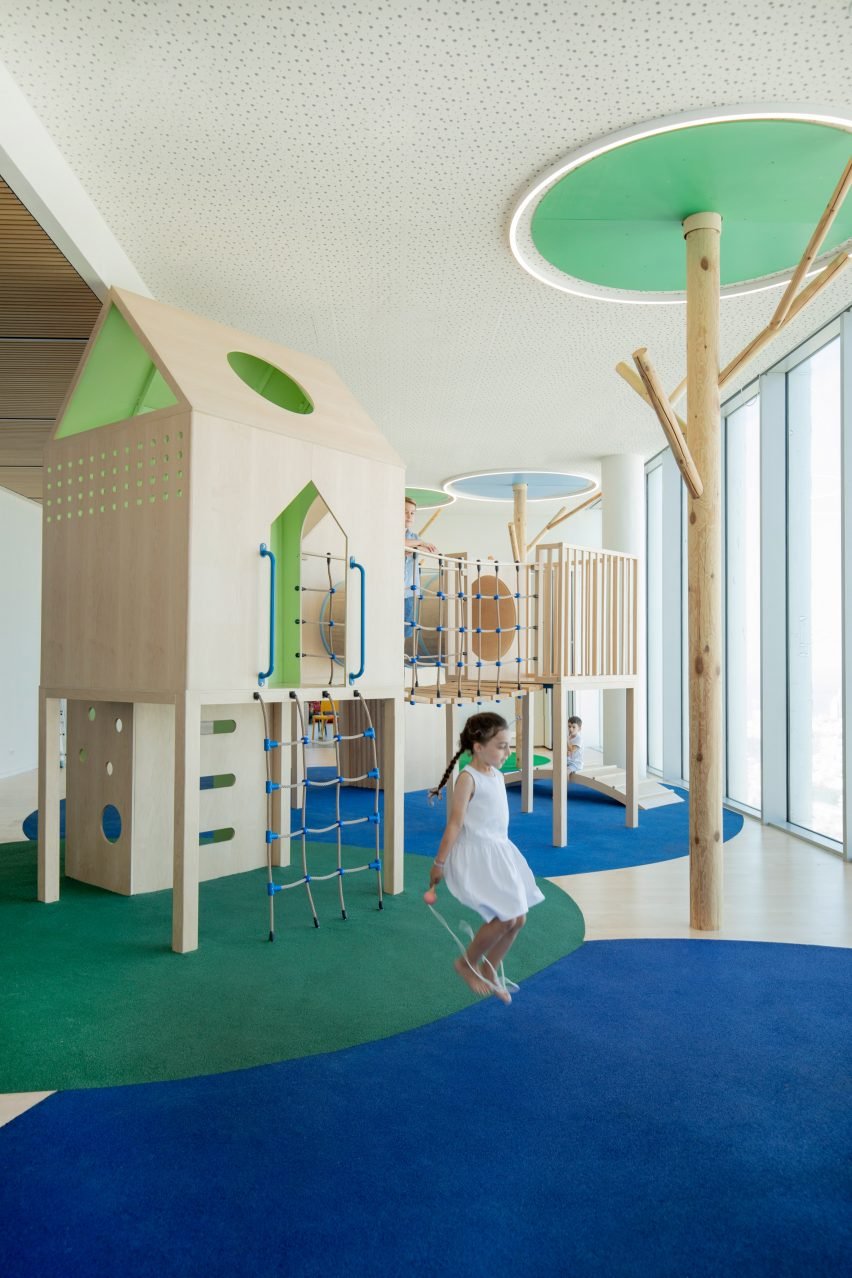
Tree-like columns and other nature-inspired details feature in this indoor playground, which design studio Sarit Shani Hay has created for the children of employees at an Israeli software company.

The playground is set on the 15th floor of a skyscraper, surrounded by floor-to-ceiling glass windows that provide uninterrupted views across the city of Tel Aviv.

Indoor playground in Tel Aviv designed by Sarit Shani Hay
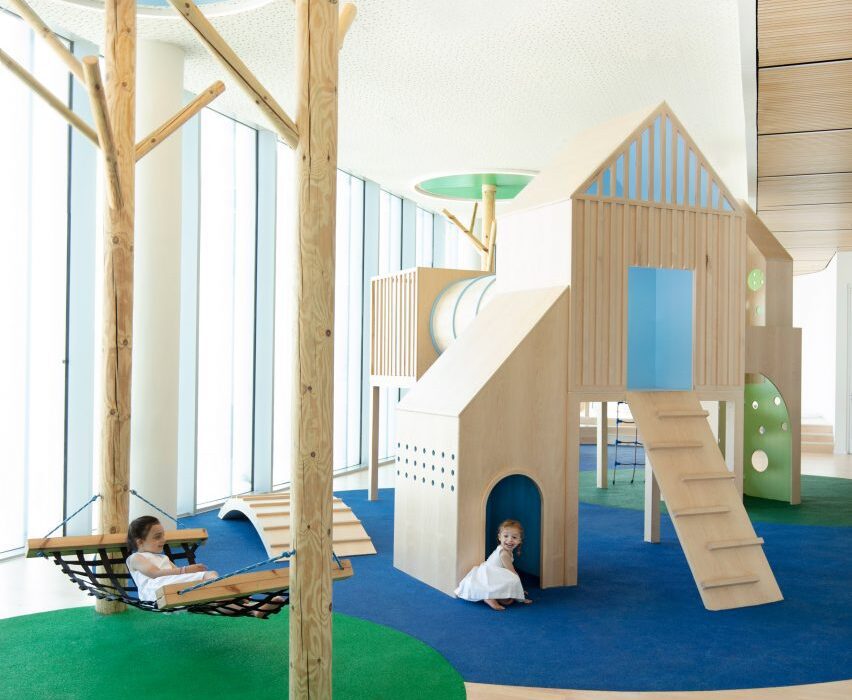
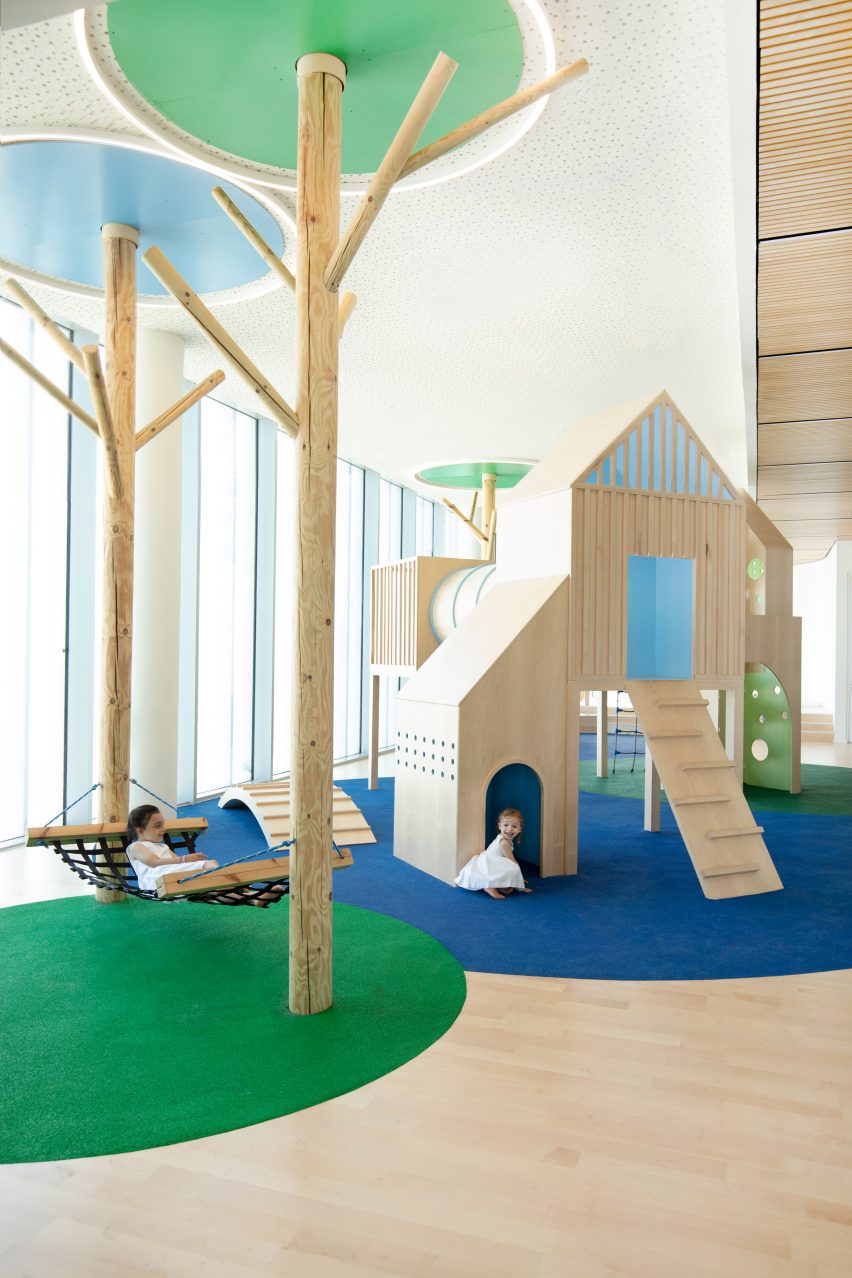
Tree-like plywood columns can be seen throughout the playroom

Despite this urban setting, Sarit Shani Hay wanted the space to “emphasise closeness to nature” and subtly incorporate biophilic design principles.

The studio has therefore made reference to the outdoors throughout the scheme.

Indoor playground in Tel Aviv designed by Sarit Shani Hay
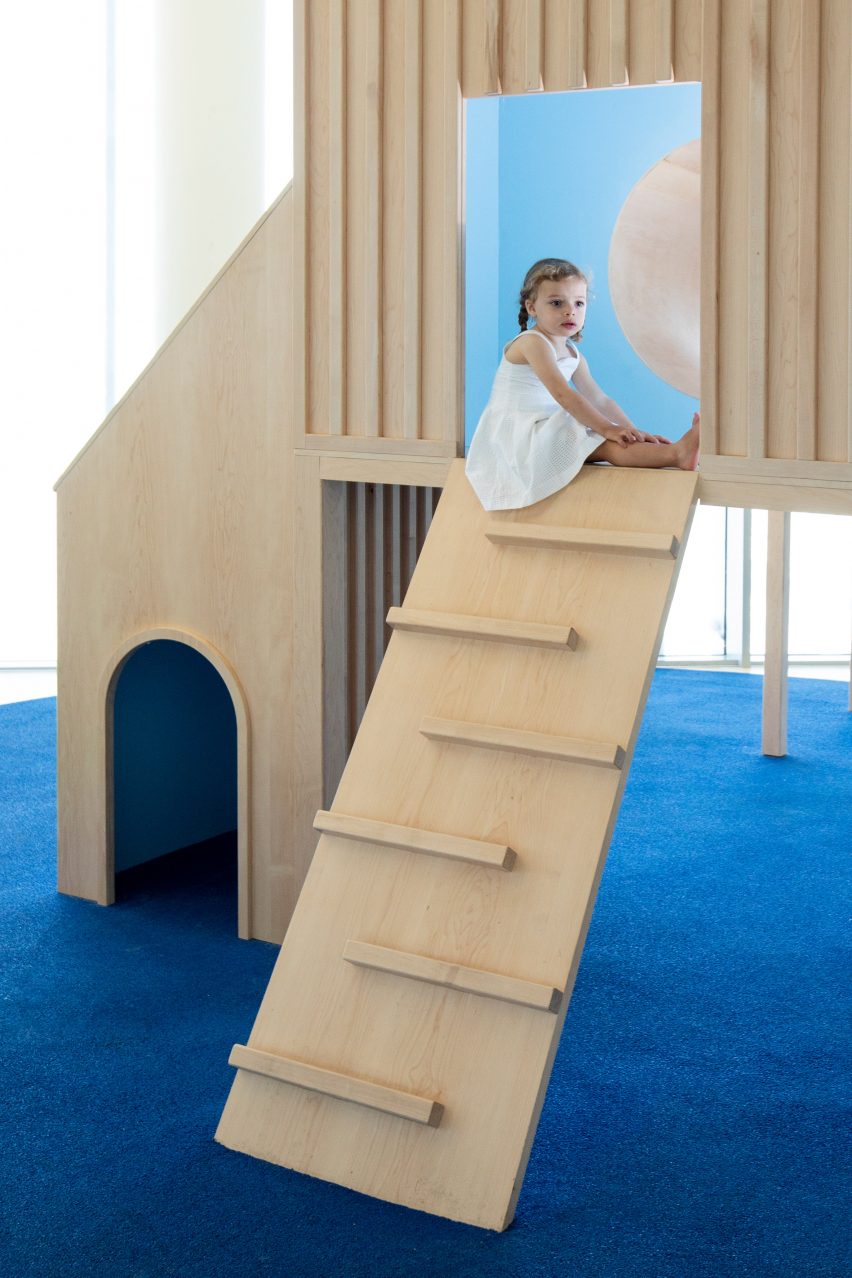
Plywood has been used to create other elements in the room, like the playhouses

Huge, round pieces of sea blue and forest-green carpet have been set into the floor. Circular panels in the same blue and green hues have also been put on the ceiling, bordered by LED tube lights.

Parts of the floor that are not covered with carpet have been overlaid with plywood or rubber to account for shock absorption.

Indoor playground in Tel Aviv designed by Sarit Shani Hay
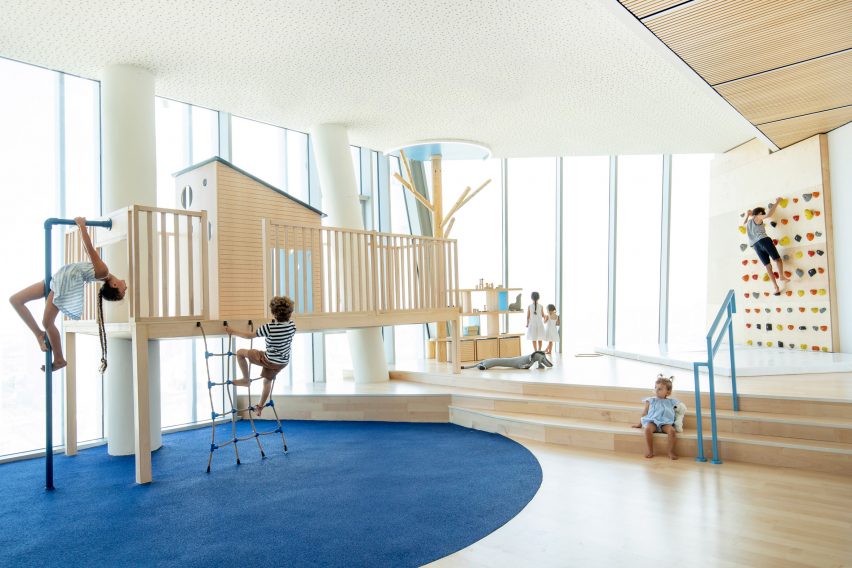
The playhouses include features such as ramps and secret nooks

A series of tall plywood “trees” with spindly branches have been dotted across the room; a couple of them suspend a swinging hammock, while another supports a gridded toy shelf.

Plywood was also used to make house-shaped volumes for the children to play in.

Each of these volumes includes playful interactive features such as ramps, tunnels, rope ladders, sliding poles and secretive nooks.

The children also have the option of using a climbing wall at the rear of the room, which has different-coloured footholds.

Indoor playground in Tel Aviv designed by Sarit Shani Hay
Sea blue and forest-green carpet has been laid across the floor

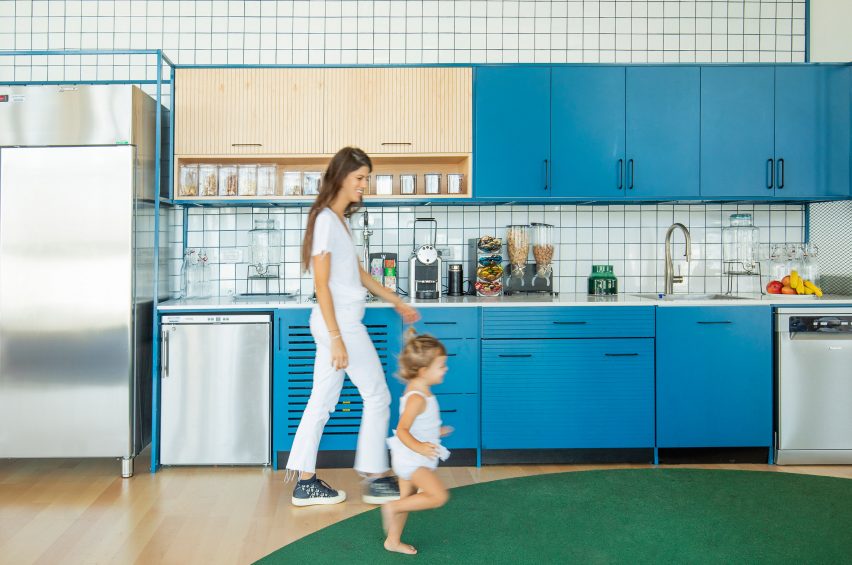
The project also saw Sarit Shani Hay create a small kitchen where the children can wash their hands and have snacks prepared for them. This space was finished with sea-blue cabinetry and a gridded tile splashback.

The indoor playground also features a small cafe area, where employees can enjoy their lunch breaks whilst being close to their children.

Indoor playground in Tel Aviv designed by Sarit Shani Hay
A similar colour palette has been applied in the kitchen

Playgrounds are increasingly offering more than just swing sets and slides. Architecture studio KWY.studio created a play area for a park in Billund, Denmark that includes pink marble sculptures.

Artist Mike Hewson has also designed a public playground in Melbourne that features giant boulders on wheels, encouraging children to climb and explore intuitively.

The photography is by Roni Cnaani.


Project credits:

Design: Sarit Shani Hay
Lead designer: Adi Levy Harari

Reference

© Architectural Engineering Consultants
CategoriesArchitecture

Let the Light In: Maximizing Natural Light in the Design of Oudong Residence

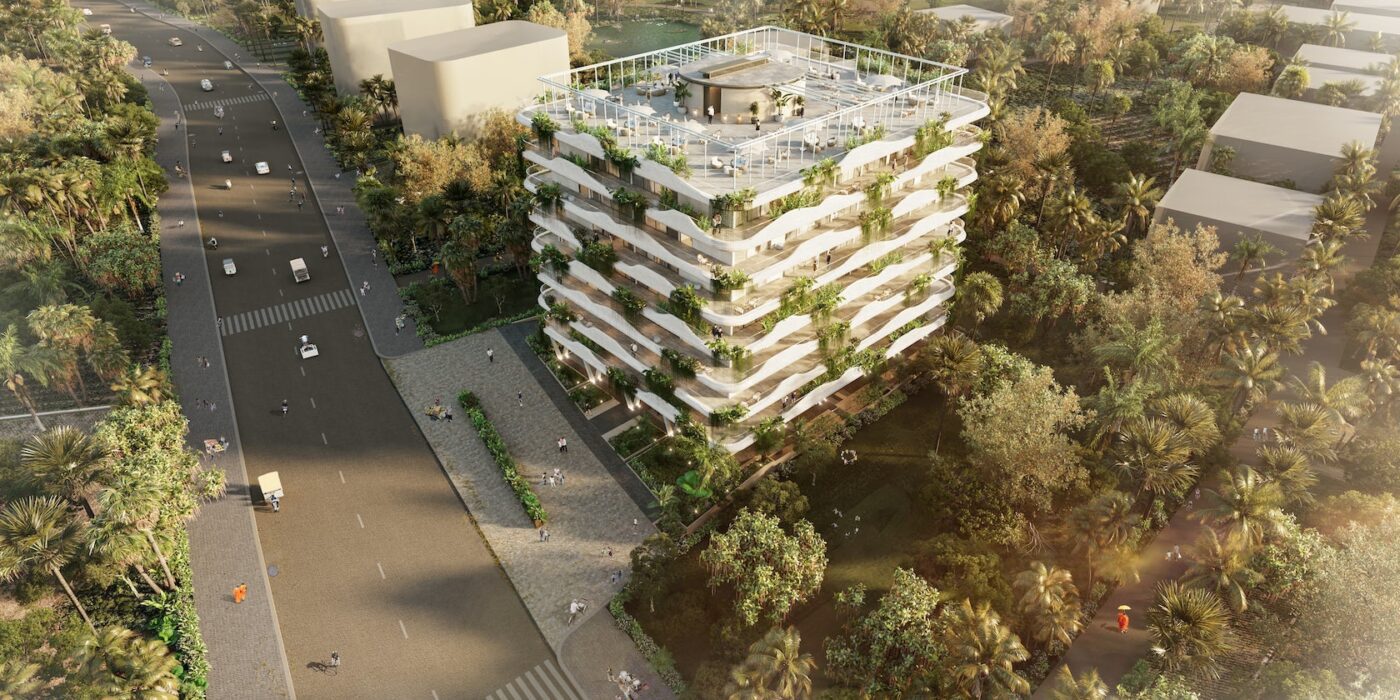
Oudong Residence – aims to combine functionality with artistic flair, creating living spaces that are both functional and visually appealing. Drawing inspiration from a unified composition of textures inspired by nature itself, and cultural influences, the creative vision for this particular residence emphasizes sustainability, innovative use of materials, and a seamless integration of indoor and outdoor spaces. The project brief outlines the key requirements and objectives for the residence, with a strong focus on maximizing natural light, ensuring energy efficiency, and fostering a sense of community among the occupants. Furthermore, the design aims to be adaptable to the evolving needs of the residents, reflecting a dynamic and modern approach to residential architecture.

Architizer chatted with Alessandro Mangano, Partner at Architectural Engineering Consultants, to learn more about this project.

Architizer: What inspired the initial concept for your design?

Alessandro Mangano: The initial concept for the residential design was inspired by the desire to create a harmonious balance between modern living and nature. Drawing upon elements from various architectural styles, the design seeks to establish a seamless connection with the surrounding environment, while ensuring functionality and comfort for its inhabitants. The use of sustainable materials and energy-efficient technologies further reflects our commitment to preserving the ecosystem and promoting a greener future. Ultimately, this architectural concept aims to provide a haven where residents can enjoy the best of both worlds – contemporary living in tune with nature’s grace.

© Architectural Engineering Consultants

© Architectural Engineering Consultants

This project won in the 10th Annual A+Awards! What do you believe are the standout components that made your project win?

One of the key factors that contributed to the success of our project was the exceptional collaboration and communication among team members. This enabled us to leverage individual expertise and skills to move the project forward effectively. Another standout component was our dedication to continuous improvement and adaptability. By constantly assessing our progress and adapting our strategy, we were able to overcome challenges and ensure the timely delivery of a high-quality project.

© Architectural Engineering Consultants

© Architectural Engineering Consultants

What was the greatest design challenge you faced during the project, and how did you navigate it?

The greatest design challenge we faced during the project was effectively balancing aesthetics with functionality. Understanding the importance of incorporating visually appealing elements while maintaining the project’s core purpose was crucial to its success. To navigate this challenge, we fostered open communication among team members to ensure we understood their expectations and goals. Additionally, we incorporated iterative design processes, allowing for continuous adjustments and improvements while keeping both aspects in harmony.

© Architectural Engineering Consultants

© Architectural Engineering Consultants

How did the context of your project — environmental, social or cultural — influence your design?

The Cambodian context of the project had a significant impact on the design process, particularly in regards to the environmental, and cultural factors. The diverse ecosystems near the outskirts of Phnon Penh city, required us to carefully consider the environmental impact of our design, ensuring that it would support sustainable development in the region. Moreover, we incorporated elements into our design, to feel a deeper connection to the space while also respecting the traditions of the community. Lastly, we accounted for the social dynamics within the Khmer societies, emphasizing elements that encourage communal interactions and emphasizing harmony with the natural environment.

© Architectural Engineering Consultants

© Architectural Engineering Consultants

© Architectural Engineering Consultants

© Architectural Engineering Consultants

© Architectural Engineering Consultants

© Architectural Engineering Consultants

© Architectural Engineering Consultants

© Architectural Engineering Consultants

For more on the Oudong Residence, please visit the in-depth project page on Architizer.

Oudong Residence Gallery

Reference

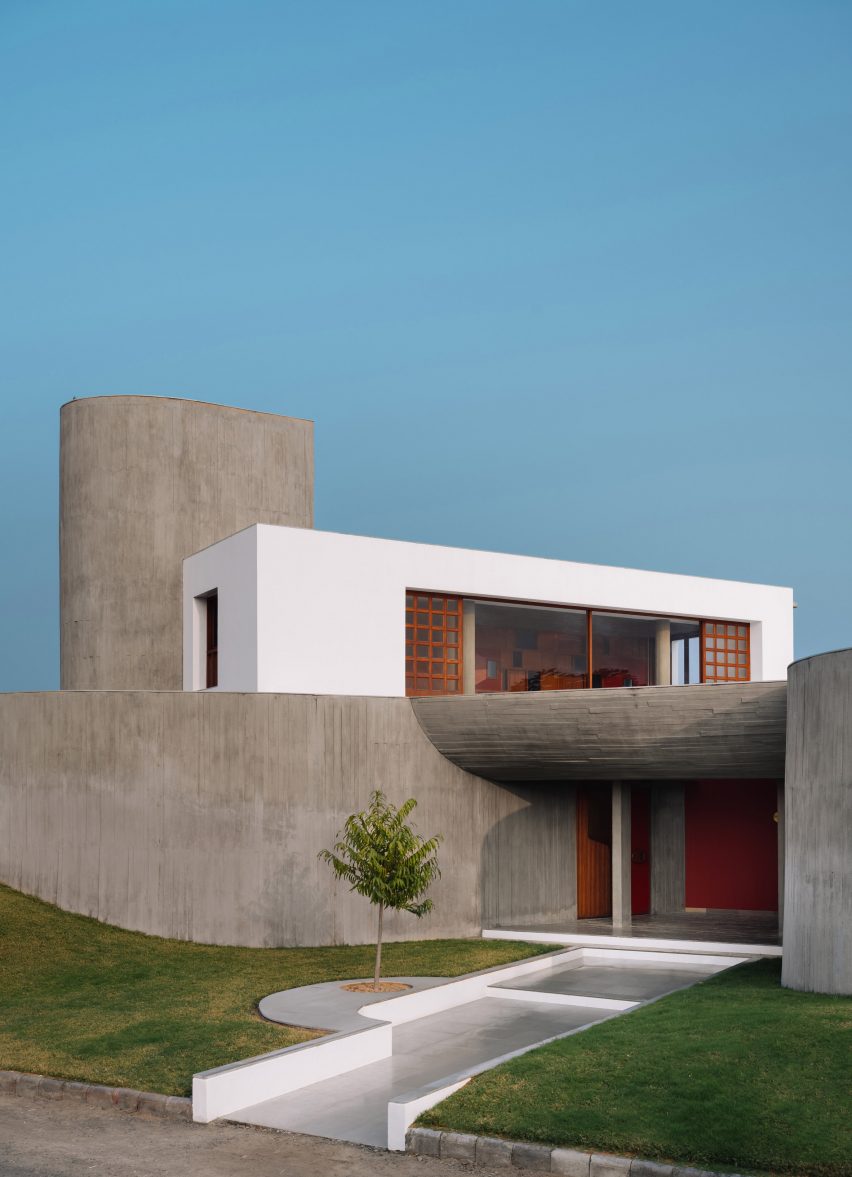
Entrance to the concrete Enclosure house by Design Ni Dukan with concrete canopy and grass lawn
CategoriesArchitecture

Design Ni Dukaan builds “citadel-like” concrete house in India

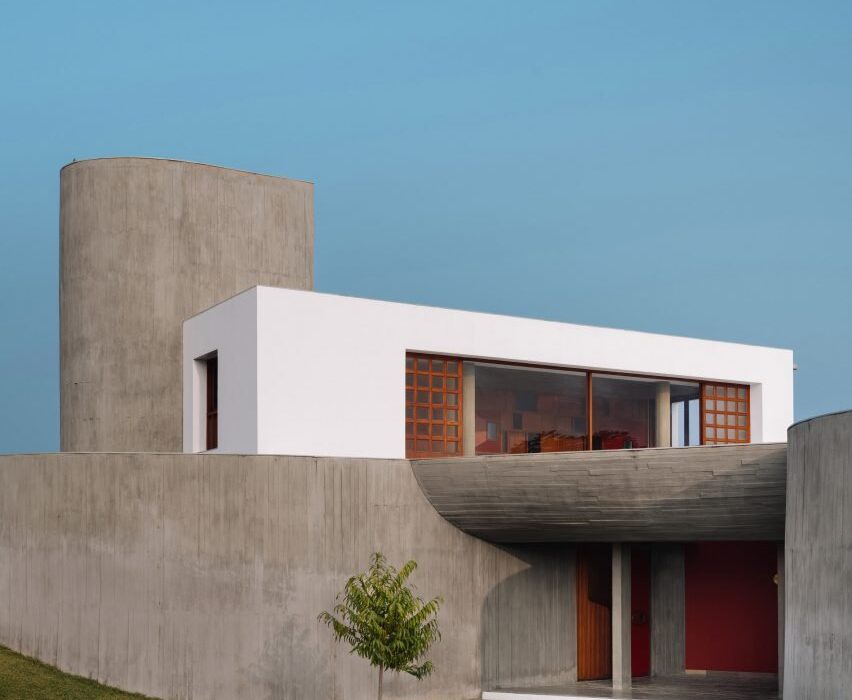
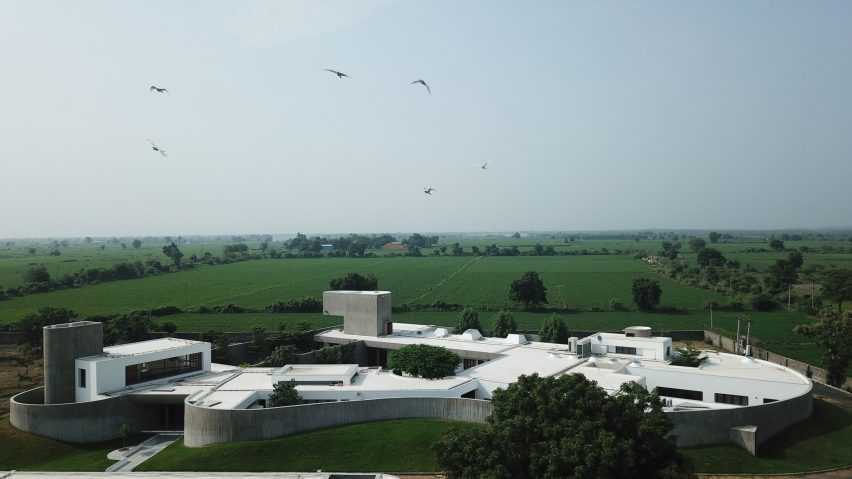
Multidisciplinary studio Design ni Dukaan has completed a house in Gujarat, India, with a board-formed concrete exterior walls that wrap the home and define courtyard spaces.

Located on a remote site in the municipality of Himmatnagar, the studio designed the undulating enclosing walls as a “second skin” informed by the spaces within.

Entrance to the concrete Enclosure house by Design Ni Dukan with concrete canopy and grass lawn
Board-formed concrete walls wrap the home

“Situated on a mound, the citadel-like compound is bound by peripheral walls comprising two curved and two straight surfaces that are disjointed at their intersections to create points of entry or subtle exits into the adjacent landscape,” said Design ni Dukaan.

“In the absence of a strong context, we relied on the client’s brief to inspire the design, but his complete disinterest in how the house would look from the outside prompted us to question the very basis of built forms,” it continued. “This caused a shift in our perception that resulted in an inside-out approach to the design, wherein the experience of space from within took precedence over the external form.”

Wide shot of the exterior of the Enclosure concrete house complex by Design Ni Dukaan
The enclosing wall curves towards the main entrance

Two concrete walls curve towards a main entrance that is covered by a concrete canopy and leads to a central courtyard space.

The kitchen, formal living and dining room, secondary kitchen and dining room, two main bedroom suites and three additional bedroom suites are arranged around this central open space.

Set back from the courtyard are two additional bedroom suites, a gym and a lounge room next to an outdoor swimming pool.

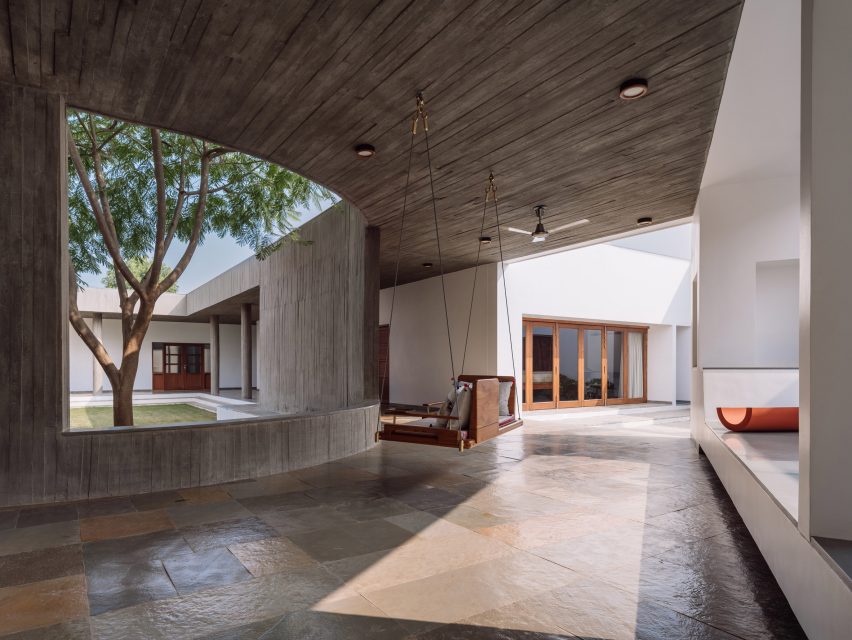
Covered concrete walkway with a swing seat in front of an opening the the wall that overlooks a courtyard
A covered walkway separates interior spaces from the outdoor courtyard

A covered walkway creates a buffer between the outdoor courtyard and indoor spaces, protecting the interior from the harsh tropical sun and hot winds while letting in natural light and ventilation.

Design ni Dukaan added “frames” throughout the home, including a swing seat placed by a large opening that overlooks the courtyard.

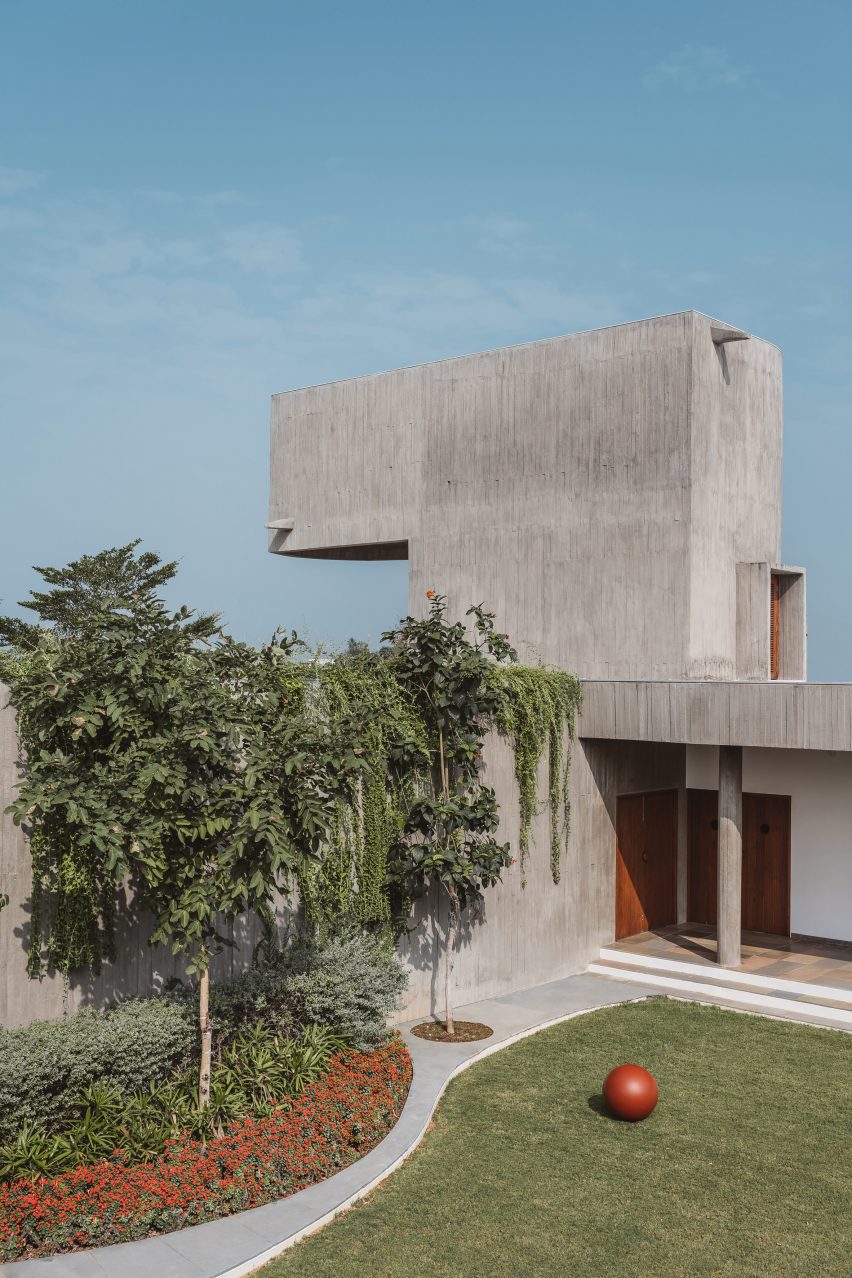
At three points in the home, volumes rise above the height of the enclosing wall to second-floor level and accommodate an artist’s loft, attic room for the family’s grandson and a water tank.

“We imagined them as three sentinels in conversation, floating above a seamless sea of green once the vegetation had reclaimed the concrete,” said Design ni Dukaan.

A grass lawn and trees surrounded by a concrete home
Greenery was added to complement the concrete

The studio merged indoor and outdoor spaces using a material palette of textured concrete, white-plastered walls, Kota stone and greenery.

“When the vegetation eventually grows over this backdrop of grey, the boundaries between inside and outside will further dissolve and diminish any notion of form,” said Design ni Dukaan.

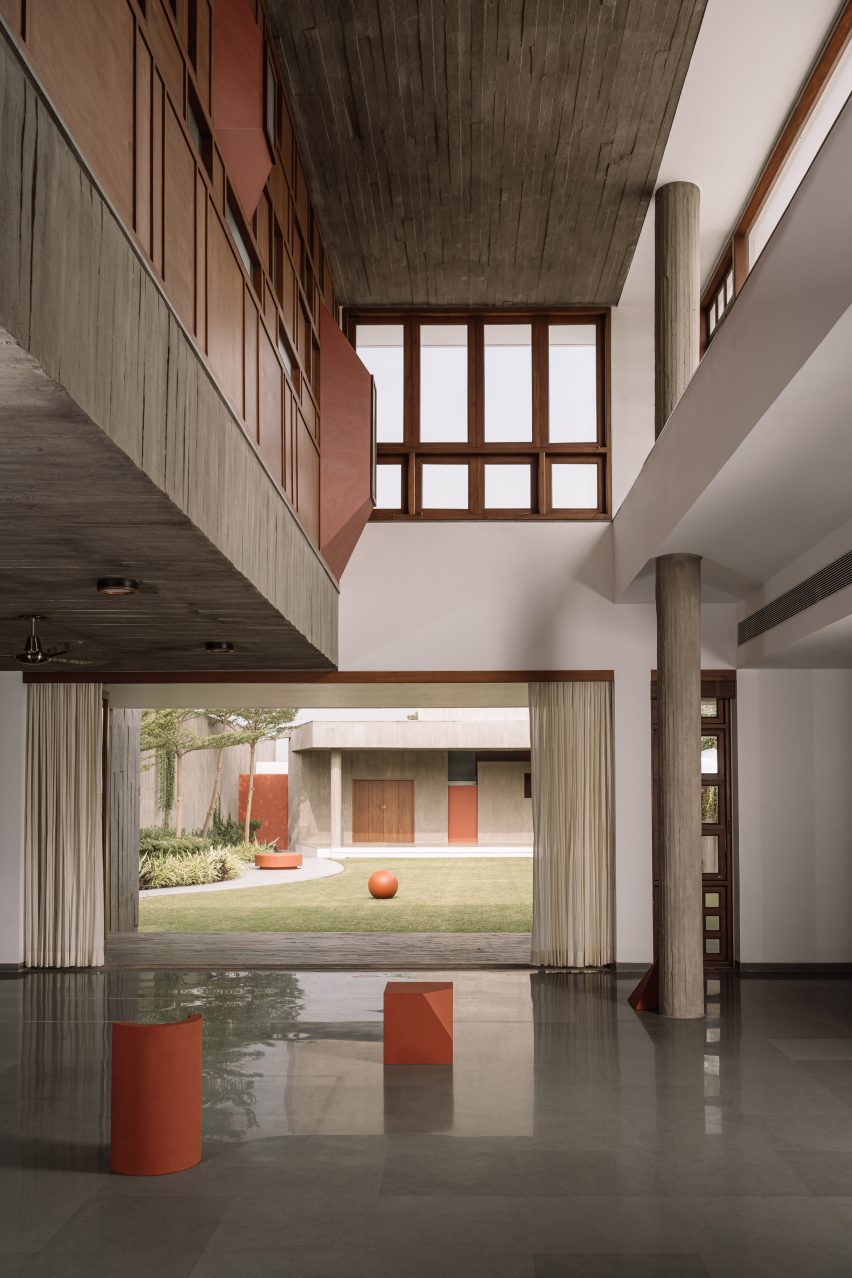
Double-height living space with concrete walls, wooden-framed windows and and opening leading to a courtyard lawn
The central courtyard lets natural light into the home

The texture of the concrete walls was created by unbolted wooden formwork and the imperfections in its finish informed material choices elsewhere in the house.

“The unpredictable but beautiful texture caused by the shifting and warping of unbolted wooden formwork was fascinating,” said the studio.

“We decided to embrace these ‘anticipated imperfections’ as part of the construction process, even extending this choice to the use of other materials such as the flooring in the corridors, which utilises strips of leftover stone from the interiors to mimic the pattern of the concrete walls.”

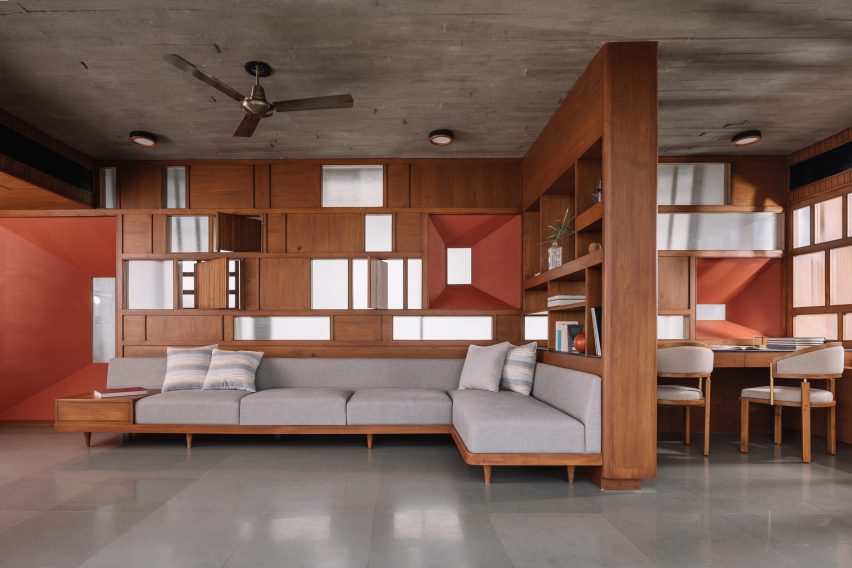
A living room with polished concrete floors, wood-panelled walls and a grey L-shaped sofa
The home was designed to entertain guests

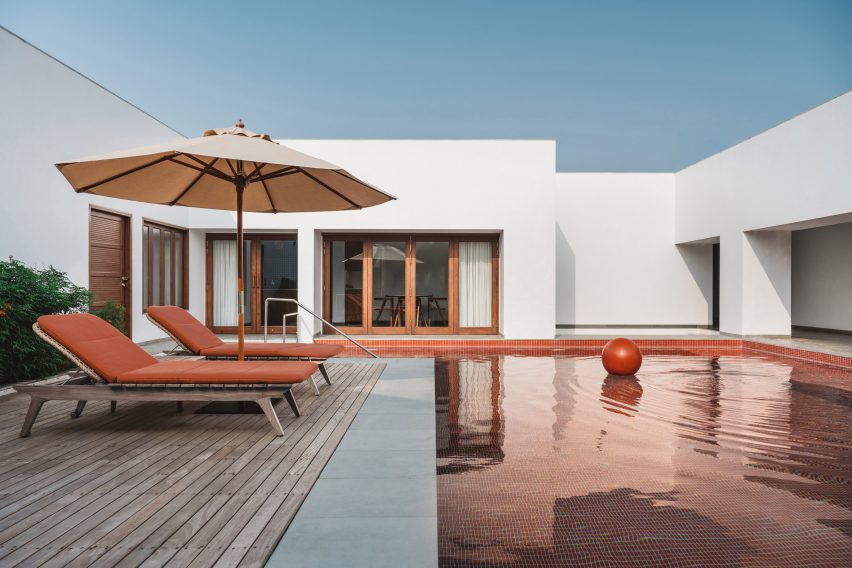
The neutral colours of the concrete, stone and white walls are punctuated by terracotta-coloured accents, including swimming pool tiles, seating and sculptural objects.

More playful colours were used in some of the bathrooms, which have monochrome green, blue or golden finishes.

Swimming pool with red pool tiles and timber decking in front of a white house
The studio added terracotta-coloured accents

The home was designed for the residents to entertain guests, with a formal lounge opening onto a lawn and a movie theatre in the basement. The house also has a mandir with a depiction of the deity Shreenathji engraved in black granite.

Other examples of concrete homes in India that use central courtyards to keep interior spaces cool in the hot summers include a house in Bharuch designed by Samira Rathod Design Atelier and a home in Chennai by Matharoo Associates.

The photography is by Ishita Sitwala, The Fishy Project.


Project credits:

Principal architect: Ar Veeram Shah
HVAC consultants: Anjaria associates
Structural consultants: Saunrachna Strucon Pvt
Contractor: Vastu Engineers

Reference

© treceuve
CategoriesArchitecture

A Look into the Design of 416 Memorial Park


416 Memorial Park – The purpose of the project is to design an optimal plan to create a cultural park consisting of a complex of exhibition and educational facilities and a columbarium to commemorate and share the pain of the victims of the Sewol ferry disaster. When the passenger ferry MV Sewol sank off the coast of South Korea in 2014, over three hundred people lost their lives, most of them schoolchildren. Years later, the victims’ families and survivors are still demanding justice from national authorities.

Architizer chatted with Sang Dae Lee, Assoc. AIA, LEED AP, and principal at UNITEDLAB Associates, to learn more about this collaborative project.

Architizer: What inspired the initial concept for your design?

Sang Dae Lee: As the form and space of ‘416 memorial park’ embody the moment of the sinking of the Sewol ferry, there were challenges as follows.

Spatial sequence: How to spatially implement emotional tension and sequence from the entrance to the enshrinement space? As a gradual and vertical entry into space, it was attempted to represent the space of the Sewol at the time of the accident. This gradual movement into space begins from the park to the entrance to the memorial. Since these internal and external ramps are on the same slope, vertical movement is hidden and horizontality is emphasized instead. Visitors walk from the entrance through the education space on the middle level, then reach the exhibition and AV theater. While walking down the path through a narrow, closed ramp corridor, visitors will ultimately arrive in an enshrinement space with emotional tension.
© treceuve

© treceuve

© treceuve

© treceuve

This project won in the 10th Annual A+Awards! What do you believe are the standout components that made your project win?

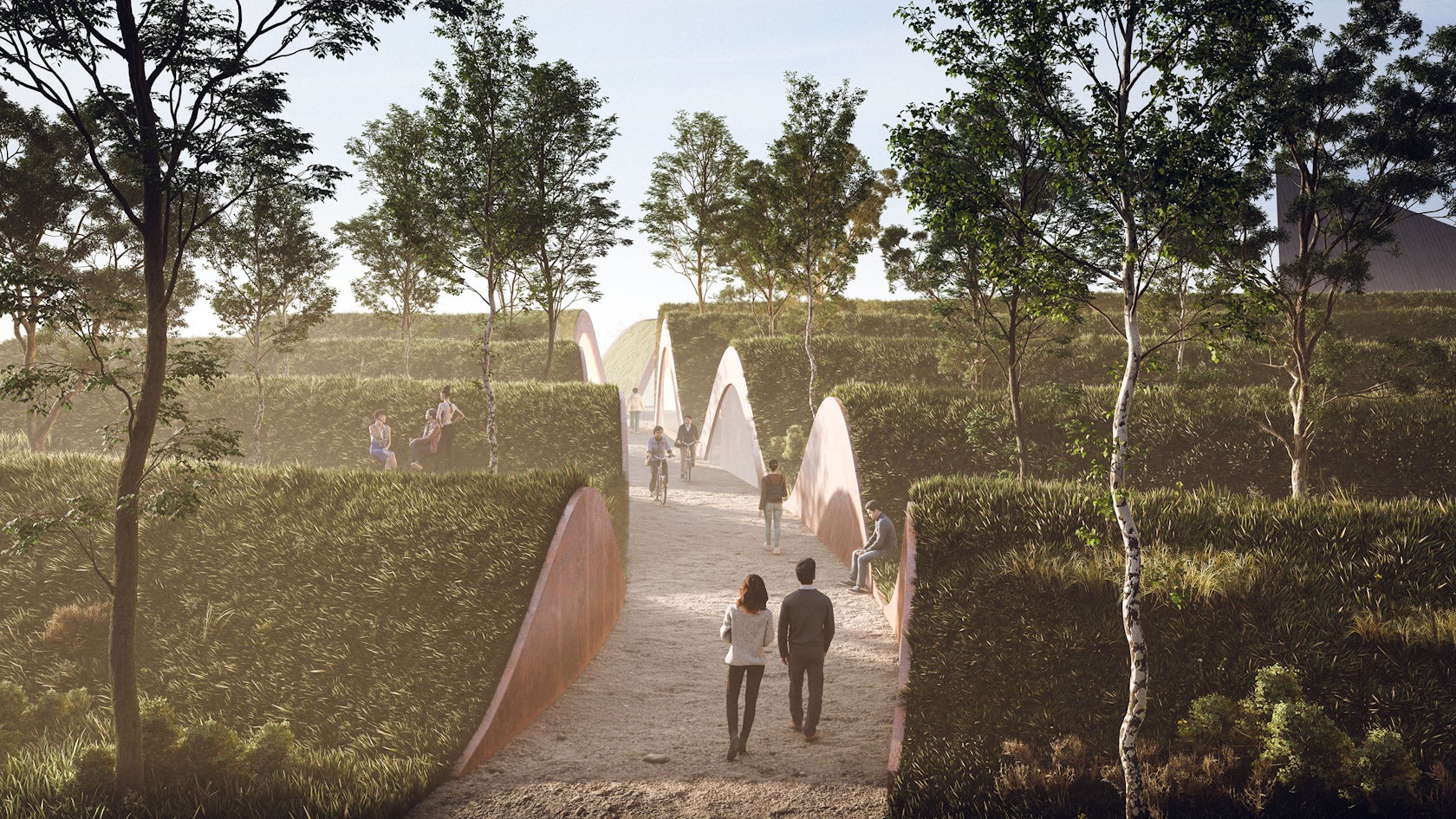
Architecture and landscaping as a figure-ground play a significant role in place-making. The architecture will invite visitors to programs such as education, cultural activities, enshrinement space, amenities, and a shop, and the landscape will serve social events, promenades, gardens, and memorial park. The 250 birch trees commemorate the victims with a metaphor for eternity.

Over time, the trees grow bigger, depicting the meaning of death leading to new life. In addition to the indoor memorial space, a memorial event can be held outdoors in the garden and each tree provides an individual memorial space around. The walkway in the garden can be closed depending on the event and is used as a performance space and amphitheater. The interface along the walkway is a connection between the space and the architecture, receiving natural light, meaning that architecture and landscape are united.
© treceuve
© treceuve

© treceuve

© treceuve

What was the greatest design challenge you faced during the project, and how did you navigate it?

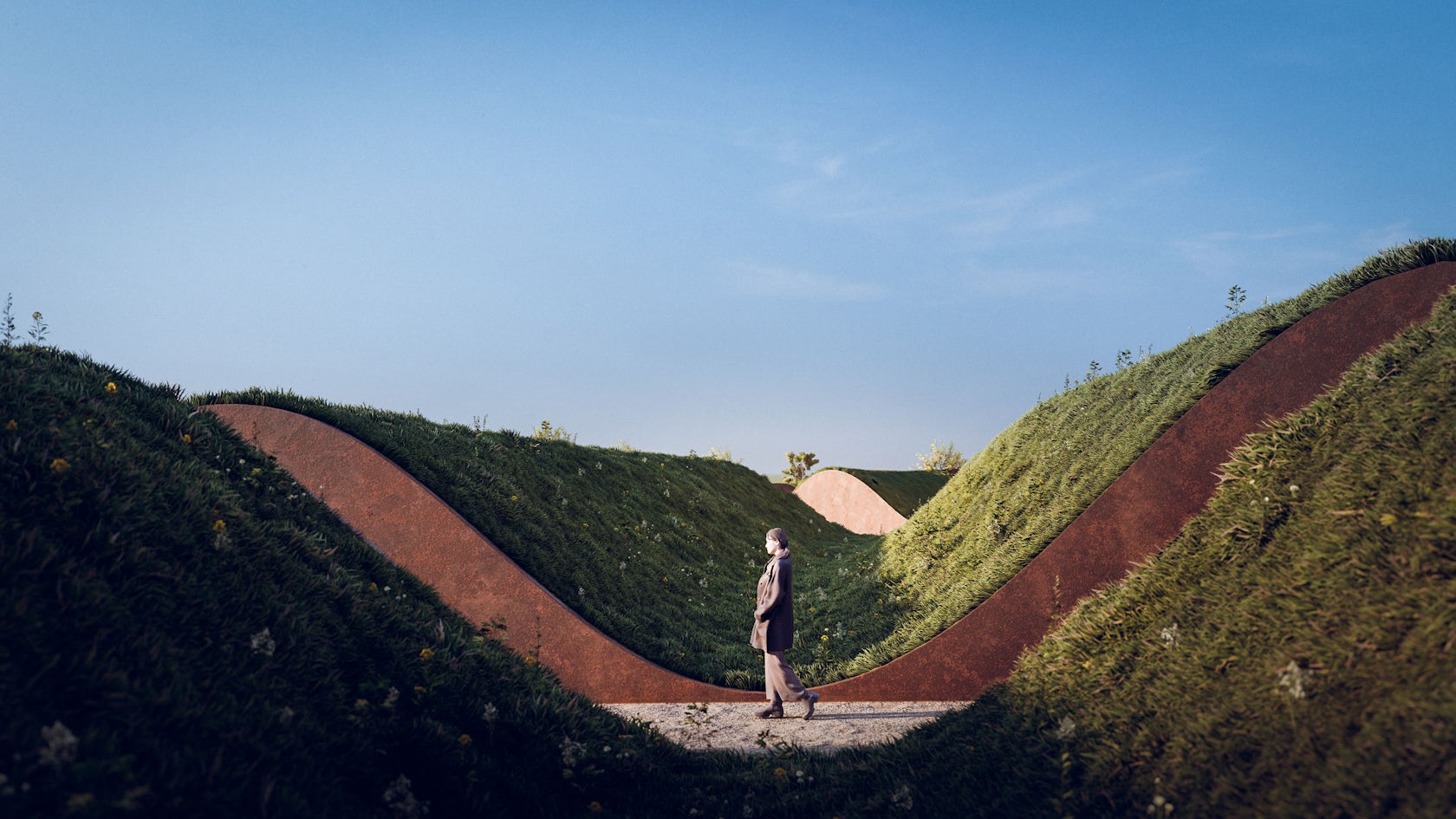
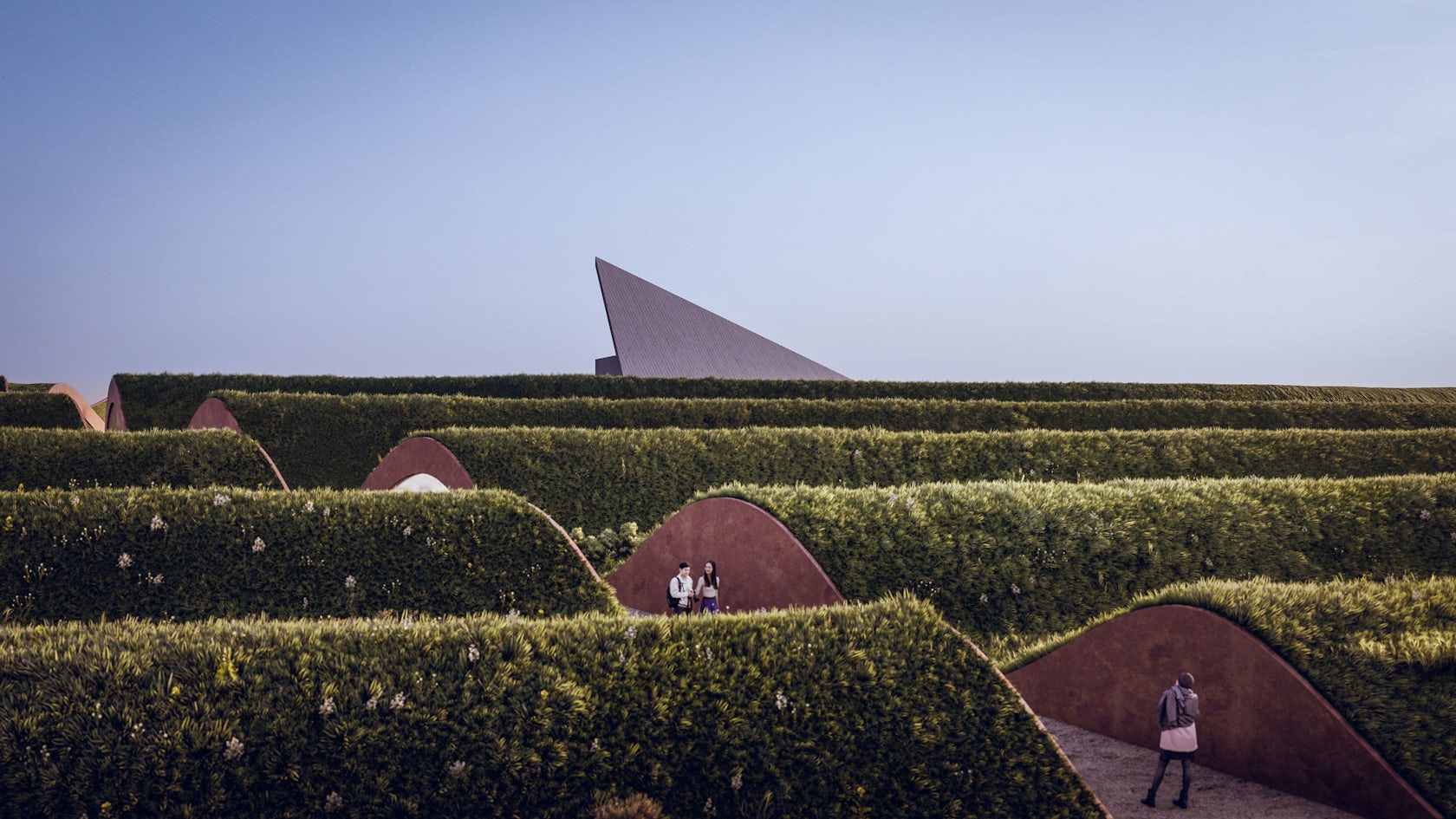
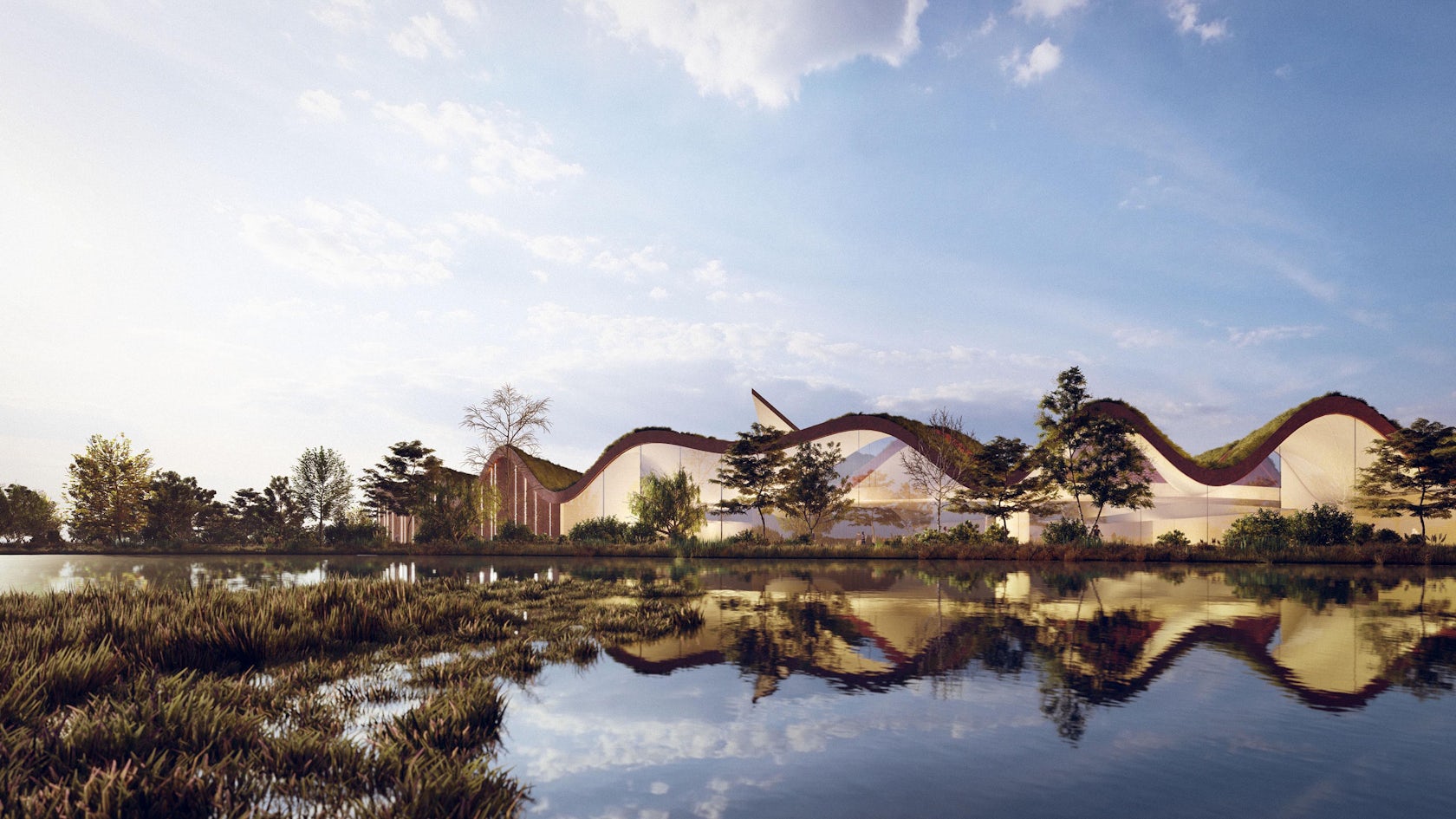
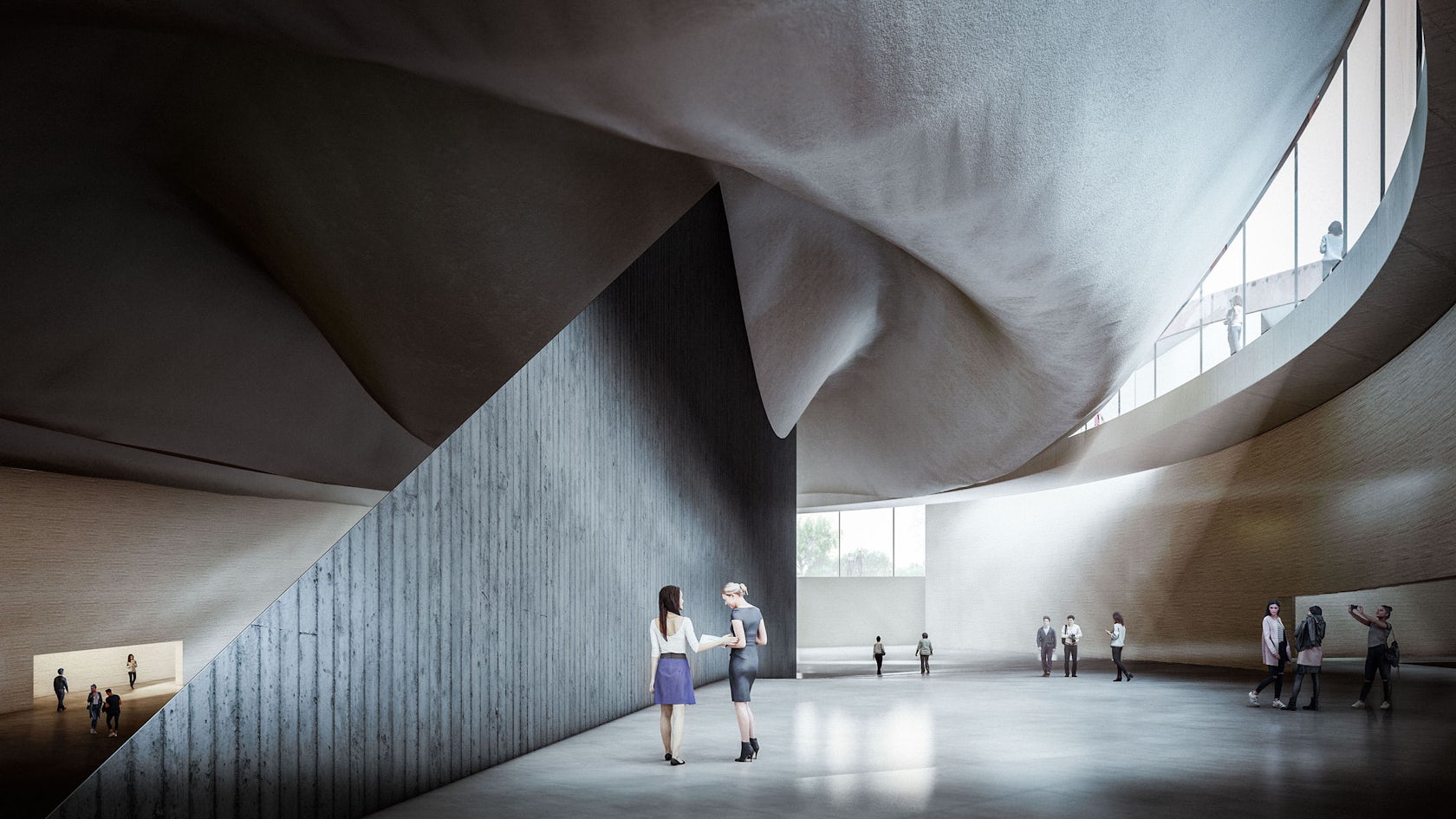
As the 416 memorial park embody the wave of the sea, there were structural challenges to support the wavy landform. If visitors walk along the promenade that crosses the waves of the roof garden, they would ultimately pass through the elevated and huge waves. The tension peaks when the pedestrian reaches the pyramid-shaped ship. By gradually increasing the level of the terrain around the enshrinement pyramid, we have space below maximized for the implementation of educational, cultural, and event programs. The upper terrain allows visitors to contemplate the surrounding park as an observatory deck and to gaze into the interior space below since the terrain is torn. A column-free structure was pursued to maximize the sense of space under this terrain. Therefore, the space is formed in accordance with the shape of the waves, and the shear walls are placed along the waves.
© treceuve
© treceuve

© treceuve

© treceuve

How did the context of your project — environmental, social or cultural — influence your design?

There are various urban cultural and commercial facilities concentrated around the project site, and as such, it has good accessibility by the public due to its large population residing around.
In order to apply the meaning of ‘memorial in everyday life,’ the architecture was designed as memorial, educational, and cultural facilities, and the landscape above was designed as a park—a new typology combining a plaza with a park. The plaza hosts social and cultural events, and provides a good public space for people. A memorial park was designed along the roof garden where visitors can stroll around while looking out at the surrounding area. In particular, the memorial garden on the roof and the enshrinement space on the basement is used as a place to commemorate the victims of the Sewol ferry disaster. This is a mixed type of architecture combined with a park as a figure-ground.

© treceuve

© treceuve

© treceuve

© treceuve

What is your favorite detail in the project and why?

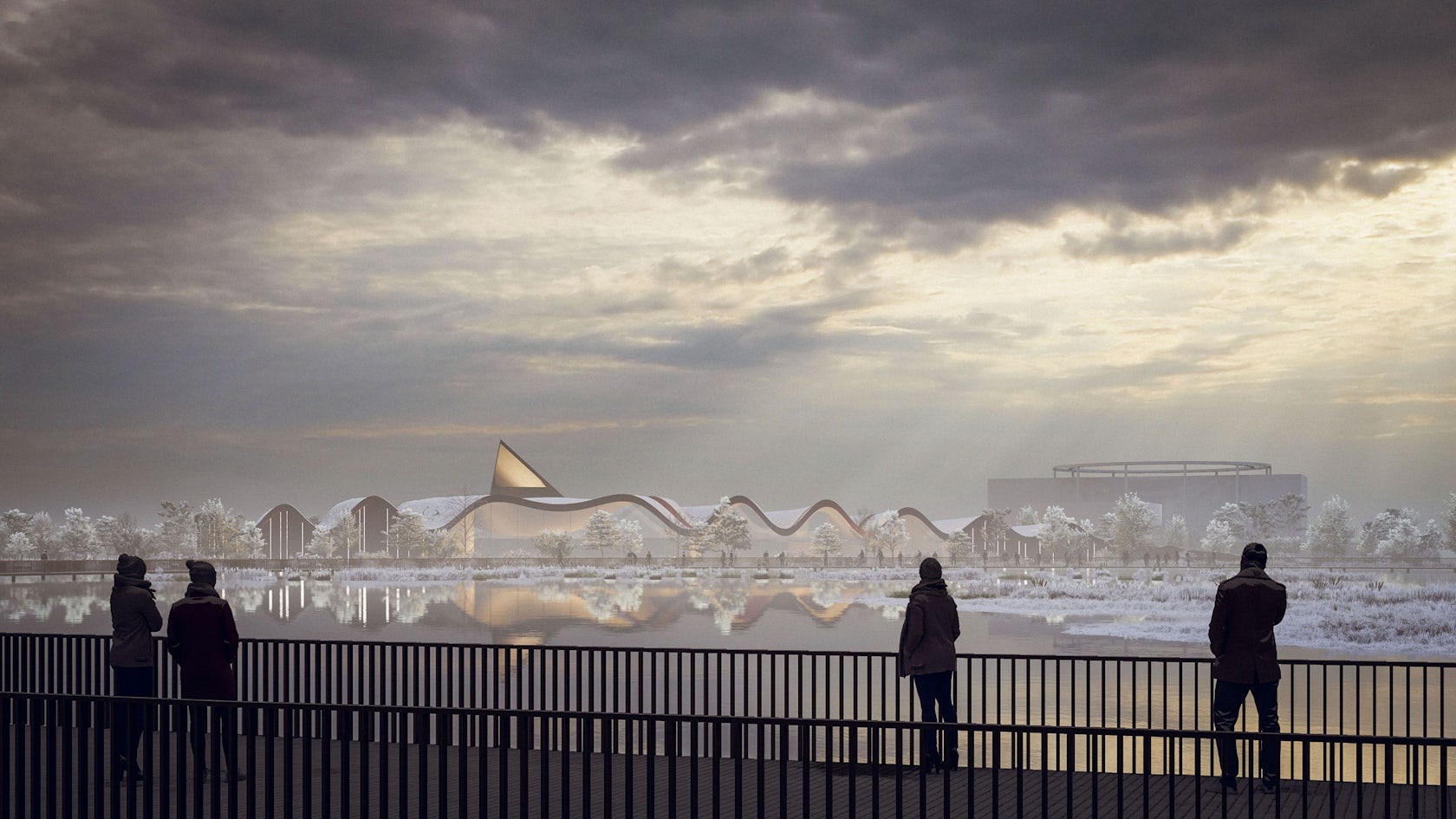
416 memorial park seeks to overcome the pain and sorrow, and furthermore to sublimate and regenerate it ecologically and culturally rather than a mere memorial space of sadness. The 250 birch trees planted in the garden of the memorial park will grow and form a forest over time, and the enshrinement space under the pyramid is open to the outside air allowing visitors to experience a sublime sense of season, space, and time of the disaster. The educational program provides opportunities for engagement and discussion with visitors. The AV theater and exhibition space simulates the disaster scenes and provides exhibitions and education programs tailored to the theme. The park above and the building embrace sustainability by applying new technologies and systems to symbolize the metaphor of the regeneration of the memorial space.
© treceuve

© treceuve

© UNITEDLAB Associates / Vtrilloarquitectos

© UNITEDLAB Associates / Vtrilloarquitectos

In what ways did you collaborate with others, and were there any team members or skills that were essential in bringing this Award winning project to life?

UNITEDLAB Associates has collaborated with Vtrilloarquitectos, an architecture firm specializing in theater in Spain. Due to physical distance and the Pandemic of COVID-19, we mutually met via zoom to discuss the main concept of what memorial park plays in the new age of time. While brainstorming, they developed great alternatives and quickly simulate the scheme into 3D models which helps for us to develop and decide the final options. They have strong technical skills and presentation skills to support our studio in leading the projects. i.e. Computer 3D simulation technics, architecture details, exhibition concept, and its AV theater technical analysis.

© UNITEDLAB Associates / Vtrilloarquitectos

© UNITEDLAB Associates / Vtrilloarquitectos

© UNITEDLAB Associates / Vtrilloarquitectos

© UNITEDLAB Associates / Vtrilloarquitectos

How do you believe this project represents you or your firm as a whole?

We try to balance practical projects and experimental ones for managing studio works. 416 Memorial Park is rather a new way of architecture well united with another discipline of landscape architecture. It was a meaningful hybrid not only in the discipline but at the same time architecturally program use inside and landscape garden above but exemplary sustainability engaged to the memorial park. Of course, it was not easy for us to critically consider diminishing the budget by designing a kind of simple or rectangular building as this project pursues a parametric form of architecture. but as always, we pursue designing a new typology by experimenting with innovation.

© UNITEDLAB Associates / Vtrilloarquitectos

© UNITEDLAB Associates / Vtrilloarquitectos

© UNITEDLAB Associates / Vtrilloarquitectos

© UNITEDLAB Associates / Vtrilloarquitectos

Team Members

Design Firm: UNITEDLAB Associates / Vtrilloarquitectos, Principal in Charge: Sang Dae Lee, Architect: Valentín Trillo Martínez, Designer: Kitae Kim, Siying Chen, Client: City of Ansan, 3D Rendering: treceuve

For more on 416 Memorial Park, please visit the in-depth project page on Architizer.

416 Memorial Park Gallery

Reference

Psychedelia's Architectural Reverberations: The Mind-Bending Legacy of 1960s Countercultural Design
CategoriesArchitecture

Psychedelia’s Architectural Reverberations: The Mind-Bending Legacy of 1960s Countercultural Design

Architects: Want to have your project featured? Showcase your work through Architizer and sign up for our inspirational newsletter. 

Architecture and design have many faces, and the kaleidoscopic world of psychedelia is a fascinating one. Entrancing sinuous curves, vibrant hues, and boundless imagination alongside a connection between mind, body and the natural world are the key elements in this energetic aesthetic. Born initially from revolutionary 1960s counterculture, this surreal realm of artistic expression profoundly influenced architecture and interior design during its short reign, with daring architects pushing beyond conventional boundaries to create new, unprecedented environments.

As the reemergence of this enigmatic movement in today’s design landscape unfolds, it’s exciting and informative to delve into the past to understand its enduring allure.

A journey into the psychedelic movement’s history reveals that at its origin, the trend was heavily influenced by the widespread consumption of mind-altering substances and as the 1960s counterculture redefined the boundaries of art, politics, and social norms, a renaissance in artistic expression took hold, with architecture swept up in the beguiling influence.

One early example of psychedelic architecture is in Hamburg, Germany, at the Spiegel Publishing House. In 1969, Danish designer Verner Panton, a pioneer of psychedelic design, unveiled his magnificent office space. His avant-garde vision featured undulating contours, amorphous furnishings, and a riot of colors harmonizing into a symphony of visual delight. This space encapsulated the essence of the movement, defying traditional design’s rigidity and embracing a new world of imagination.

Around the same time, the groundbreaking architectural collective Ant Farm designed the House of the Century, an exemplary psychedelic edifice. This residential project is situated in Texas and boasts a distinctive, futuristic design with a curvilinear exterior and a luminous, open-plan interior. The structure’s seamless integration with its natural surroundings demonstrated the psychedelic movement’s affinity for the organic, a feature that would become a hallmark of the style.

In London, the 1967 opening of the UFO Club, designed by Michael English and Nigel Waymouth, heralded a new era for countercultural gatherings and developed a space that would not only reflect their way of thinking but encourage others to think and experience in new ways. The club’s interior, resplendent with otherworldly patterns and shimmering lights, provided an immersive experience, transporting visitors to a realm of hallucinatory euphoria. As a haven for artists, musicians and intellectuals, the UFO Club became and remains synonymous with the 1960s counterculture and the psychedelic aesthetic.

There are many examples of psychedelic design and our list would be incomplete without mentioning the influence of Austrian artist and architect Friedensreich Hundertwasser. Hundertwasserhaus is an apartment building in Vienna, was completed in 1985 and showcased his penchant for fluid forms, vibrant colors, and ecological awareness. With uneven floors, meandering corridors, and lush rooftop gardens, the Hundertwasserhaus defied conventional architectural norms, embodying the psychedelic spirit of freedom and individuality.

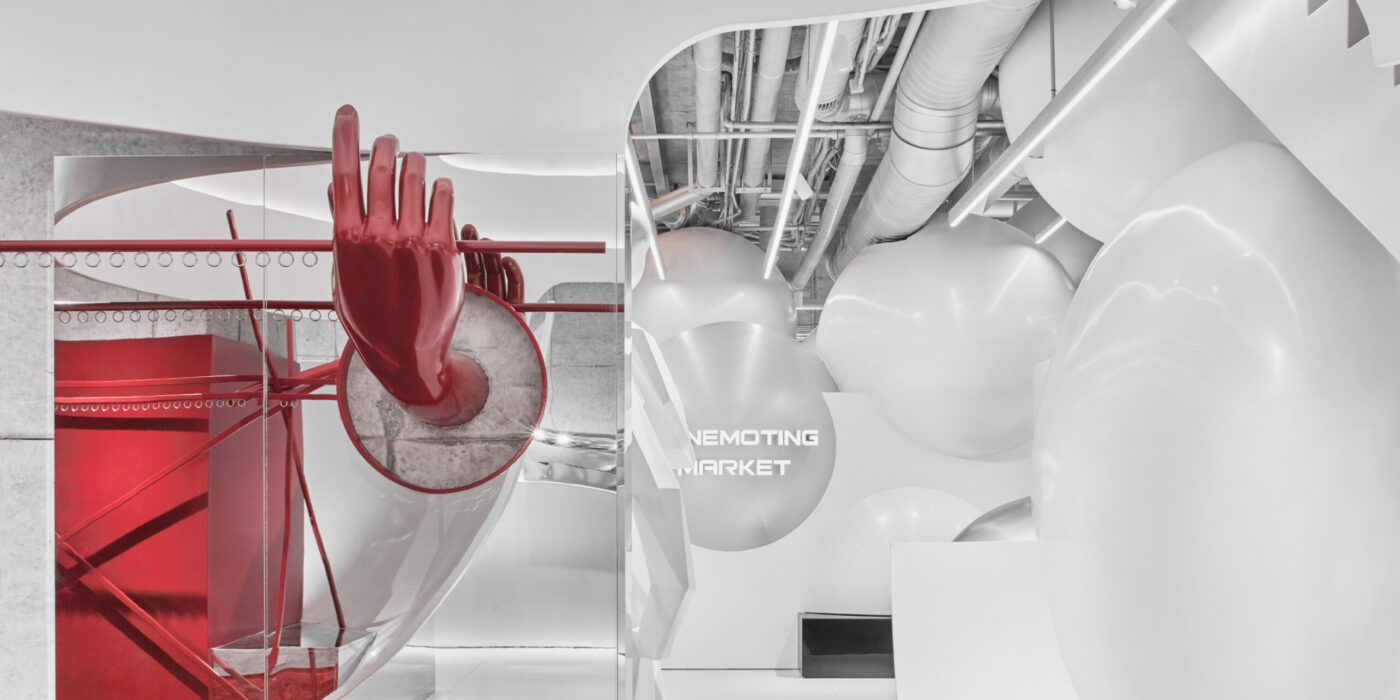
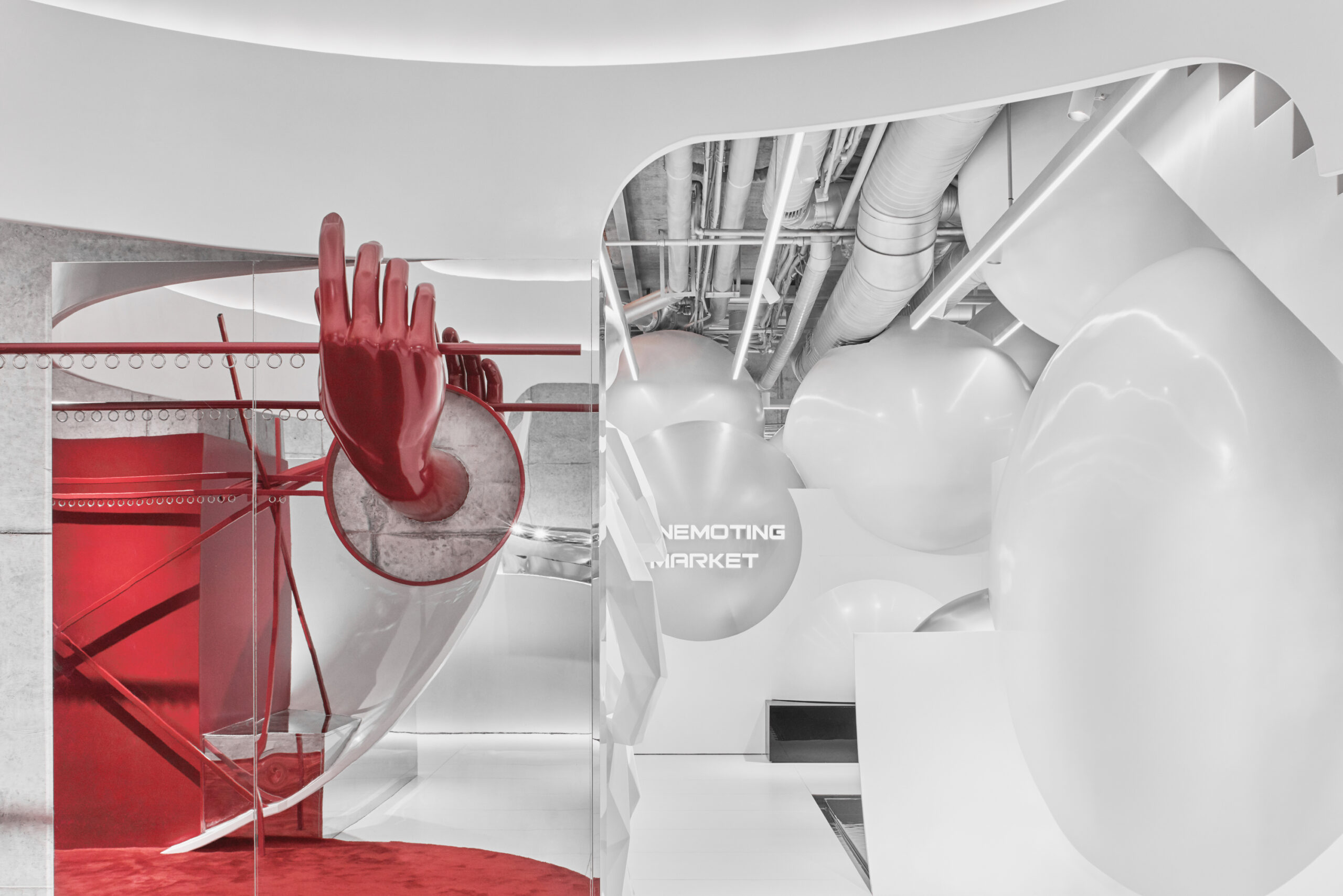
Conemoting Market by Yebin Design, Shenzhen, China Photograph by Xiaoyun

Ordinance of the Subconscious Treatment by Atelier Duyi Han, China Photograph by Atelier Duyi Han

Fast forward to the present, and the reemergence of psychedelic design is evident across various contemporary projects. This resurgence can be attributed to several factors, including a renewed interest in alternative spirituality, eco-conscious design, and a desire to break free from the monotony of minimalist aesthetics. While historically, psychedelia meant the use of vibrant colors and contrasting materiality, today’s refined and developed architectural style has led to architects and designers primarily adopting the movement’s core principles into their own explorations, emphasizing fluidity, form, and connectivity with nature over simply vivid color.

Hafary Gallery by Park + Associates, Singapore Photograph by Khoo Guo Jie
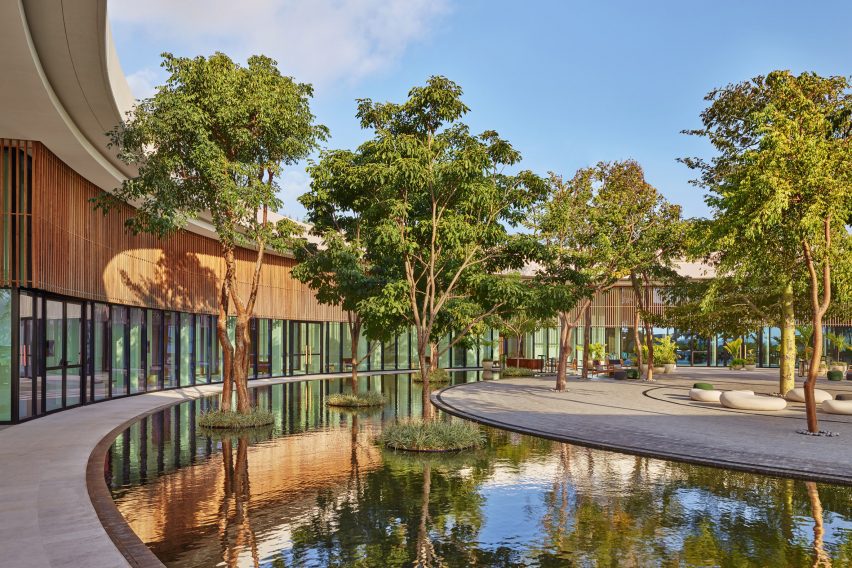
Some critics have suggested that the reemergence of psychedelic architecture directly correlates with the resurgence of interest in psychedelics for mental health and well-being, a field that has undoubtedly risen to the forefront of both healthcare and design as a key focus point. As research into the therapeutic potential of various substances gains momentum and research space, so does the notion that the psychedelic architecture of the past may have had unlocked an essential insight when considering and developing spaces that support our emotional and physical health.

A recognizable cultural shift towards introspection, creativity, and self-expression is widely observed in todays society and this shift dovetails with the core principles of psychedelic design, encouraging architects and designers to revisit and reinterpret the movement’s legacy. Even if today’s architects aren’t necessarily taking the psychedelics themselves, the aesthetics of 1960s have impressed themselves on cultural memory, and it seems that firms dabbling in formal experimentation on this legacy — whether it is consciously or unconsciously.

Serpentine Pavilion by BIG – Bjarke Ingels Group, London, United Kingdom Photograph by Iwan Baan

Notable examples of modern psychedelic-inspired architecture include the Bjarke Ingels Group’s (BIG) Serpentine Pavilion that stood in London in 2016 or the Blur Building by Diller Scofidio + Renfro in Switzerland. The Serpentine Pavilion, completed in 2016, featured an undulating, translucent structure that invites visitors to explore its labyrinthine pathways.

A masterful use of form and light transform the pavilion into an immersive experience, echoing the psychedelic principles of the past. Meanwhile, the Blur Building is an ethereal cloud-like structure on Lake Neuchâtel. A fine mist generated by water jets envelops the structure, creating a dreamlike atmosphere that harkens back to the mystique of psychedelic design and the importance of experience within the movement.

Without question, the 1960s counterculture’s psychedelic movement left an indelible mark on the architectural and design world, pushing the boundaries of conventional architecture. Today it becomes evident that the psychedelic spirit continues reverberating through the world of design. As architects and designers find inspiration in the past and chart new territory, the allure of psychedelic design endures. As humans continue to explore alternative forms of spirituality, eco-conscious design, and the therapeutic potential of psychedelics, the vibrant and innovative legacy of psychedelic architecture remains a powerful source of inspiration.

Architects: Want to have your project featured? Showcase your work through Architizer and sign up for our inspirational newsletter. 

Reference

St Regis Kanai
CategoriesArchitecture

Constellations and mangroves inform design of St. Regis Resort Kanai

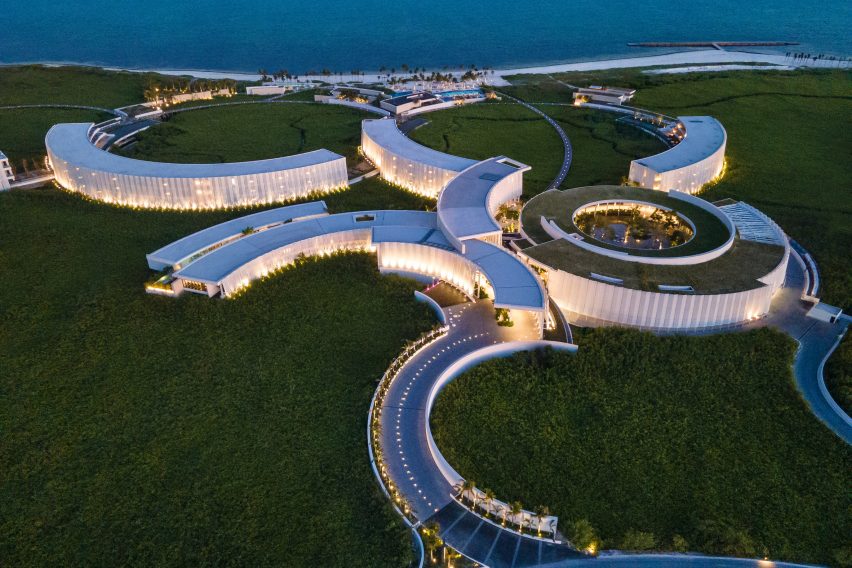
Architecture studio Edmonds International has created a hotel near Playa del Carmen in Mexico that comprises a series of interlocking circular forms embedded in a mangrove forest.

Made up of a series of pavilions, the hotel is sited near the Sian Ka’an Reserve on the Yucatán coast near the vacation towns of Playa del Carmen and Cancún.

In order to tread lightly on the delicate mangrove swamp during construction, Edmonds International utilised prefabricated elements and worked closely with the local environmental authorities.

St Regis Kanai
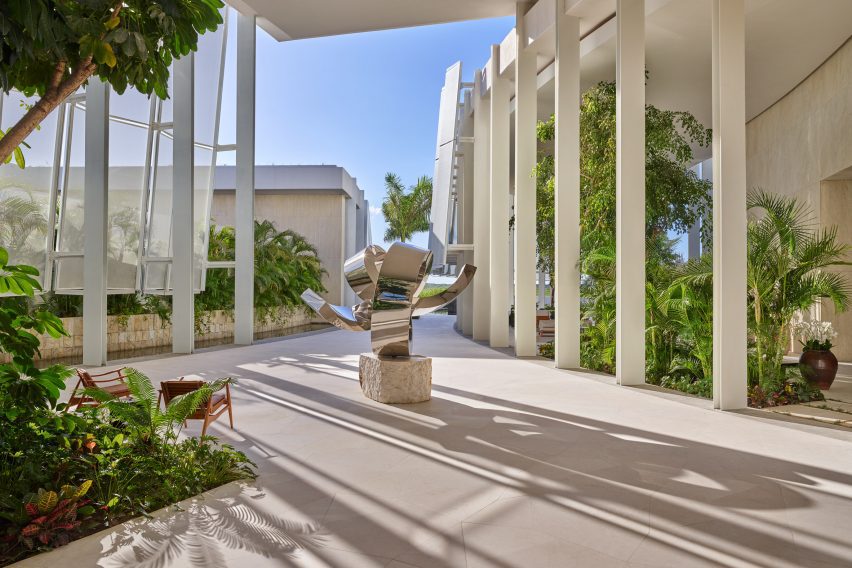
Edmonds International created a resort on the Mayan Riviera near a nature reserve

The result was a series of circular and semi-circular pavilions that were raised above the mangrove, while the orientation of the facades was designed to open the resort up to the natural surroundings, and to the sea.

“Surrounding natural landscape was physically protected during construction while assuring constant natural water flow to surrounding mangrove under the constant guidance and supervision of the governmental environmental protection agency,” studio founder Michael Edmonds told Dezeen.

“The extensive use of prefabricated elements and precast concrete foundations together with above-grade steel structure was used to avoid excessive onsite concrete pours during construction.”

Water and wood siding with trees
It comprises a series of circular and semi-circular forms

A series of white translucent panels line the sides of the structures that face away from the sea. Giving the structure an airy appearance, the panels were made from Teflon-coated Ferrari textile stretched over powder-coated steel frames.

The residential areas of the resort are semi-circular, while the public areas are circular with courtyards in the middle that hold amenities.

Metallic sculpture with white collumns
Open-air terraces and spaces are found throughout the resort

According to the studio, the circular program was influenced by Mayan cosmology.

“Its architecture stems from organic integration within the geometry of the mangrove where it’s situated and the Mayan idea of ​​following the Pleiades formation centering its structures,” said Edmonds International.

“The design comes forth as two intersected circles that contain public areas, the BOH and three semicircles of larger radius that open towards the mangrove and in a second plane to the ocean.”

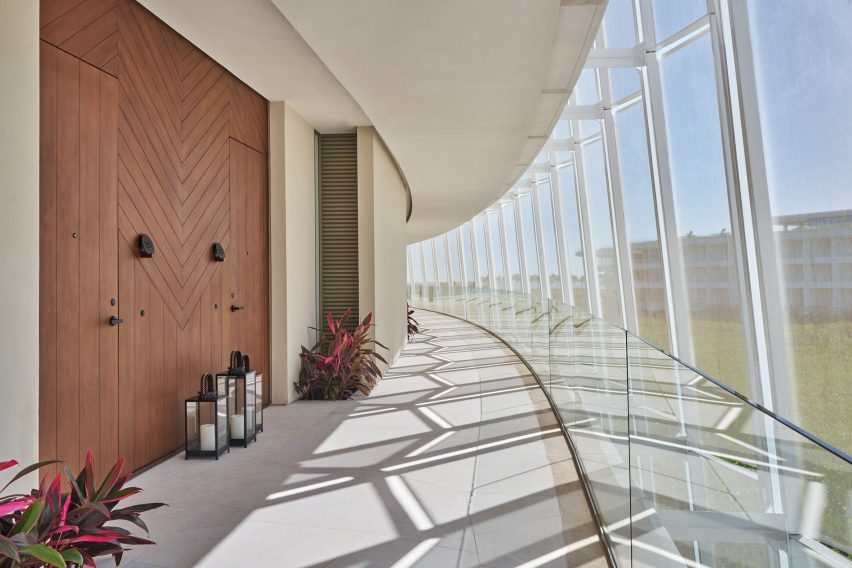
Throughout, a series of elevated walkways connect the different programs and, when viewed from above, complement geometrically the semi-circular residential envelopes.

In the courtyards and walkways, gardens, pools and other water features weave in and out of lounge areas and amenity spaces, including a spa and eight separate restaurants.

Hallway with glass and fabric shades
The residential units are located in the semi-circular structures

A driveway leads up to an entryway below a cantilevered terrace, leading into the lobby area, which sits at the conjunction of multiple programs.

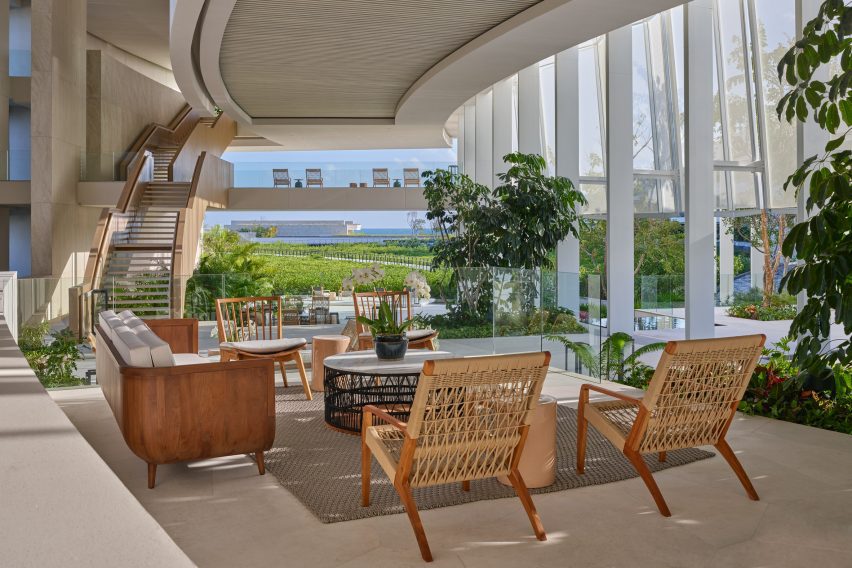
The lobby is a three-storey, partially open-air space, characterised by the limestone, walnut and textiles that interior designer Chapi Chapo Design carried through the entirety of the resort.

Three-storey lobby interior
The interiors were designed by Chapi Chapo

The Mayan Riviera is known for a profusion of similar resorts, and in 2019 Italian architect Stefano Boeri even proposed building a smart city in the region to mitigate the environmental effects of development.

Other recent projects in the area include an apartment block built in the city of Cancún that was designed to break down the boundaries between tourists and the local workers who maintain the tourism industry.

Photography is courtesy of Courtesy of St. Regis Hotels & Resorts.

Reference

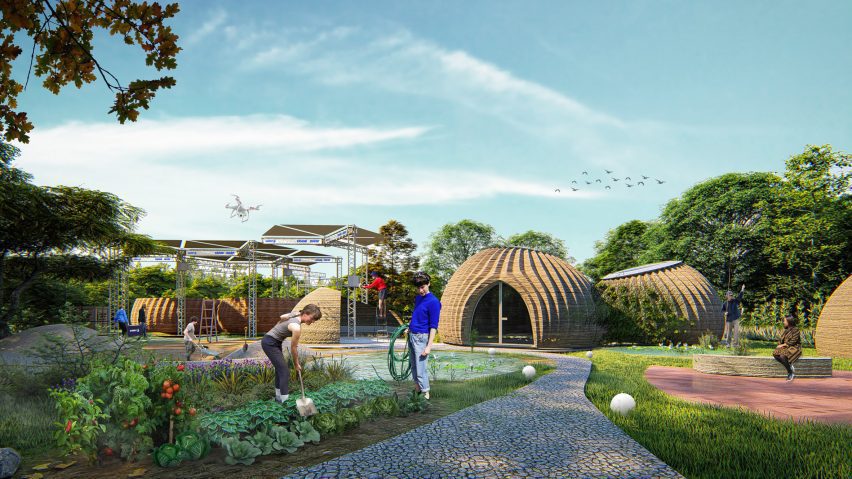
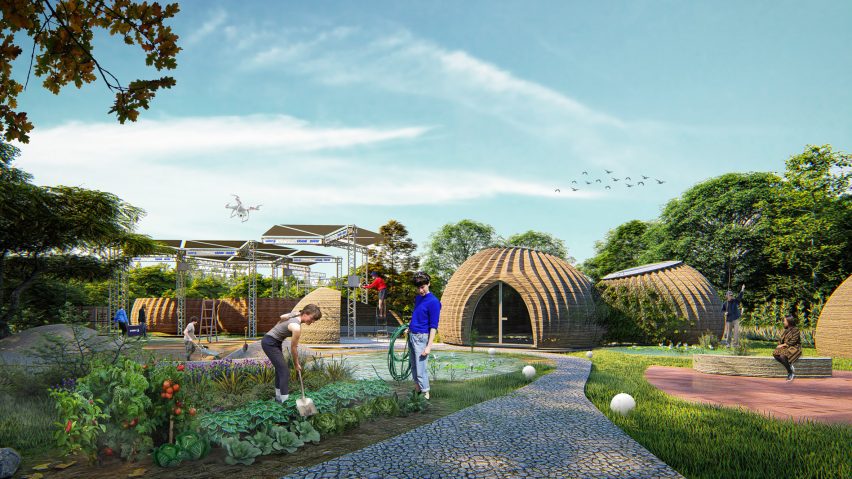
Render of a communal garden with people tending to the plants and wooden hut structures
CategoriesSustainable News

Five sustainable architecture and design courses on Dezeen Courses

Dezeen Courses: in the latest roundup of programmes listed on Dezeen Courses, we’ve selected five architecture and design courses that specialise in sustainability.

Based at institutions in the UK, USA and Italy, the courses aim to challenge students to create design solutions that respond to the global climate crisis.

The selection of courses includes undergraduate and postgraduate degrees that provide specialised training in addition to online short courses that intend to give students an insight into sustainable design or careers in the field.

Here are five sustainable architecture and design courses on Dezeen Courses:


Render of a communal garden with people tending to the plants and wooden hut structures

Master’s Program in Sustainable Architecture and Design at SOS School of Sustainability

The Master’s Program in Sustainable Architecture and Design at SOS School of Sustainability in Milan, Italy, trains students with backgrounds in architecture, engineering or design to become sustainability experts in the building profession.

Find out more about the course ›


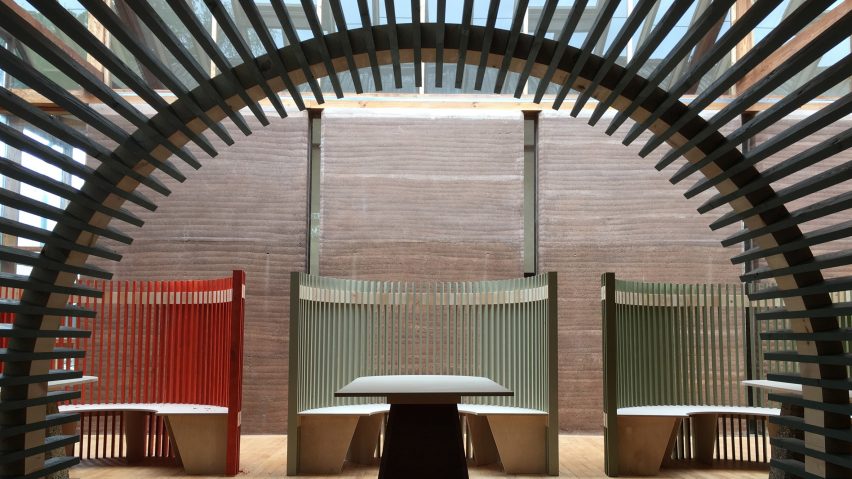
Co-working booths under an archway

Sustainable Architecture MArch (Part 2) course at Centre for Alternative Technology

The Sustainable Architecture MArch (Part 2) course at the Centre for Alternative Technology in Machynlleth, Wales, teaches students the core principles of sustainable architecture to respond to environmental problems.

Find out more about the course ›


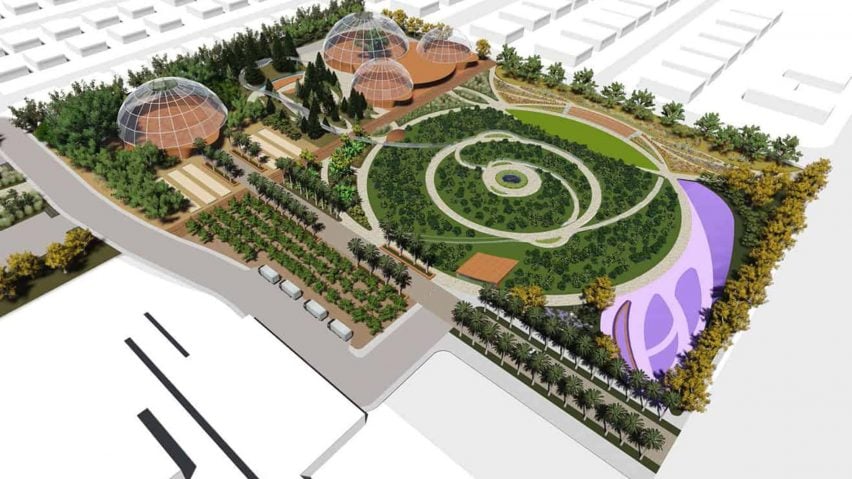
Render of an architectural landscape student project with a large circular garden

The Natural World at Academy of Art University

The Natural World undergraduate course at the Academy of Art University in San Francisco, USA, offers students site visits and fieldwork to learn the principles of sustainability, ecology and environmental conservation to apply to their landscape architecture designs.

Find out more about the course ›


Graphic image by Kingston University

Sustainable Design MA at Kingston University

The Sustainable Design MA course at Kingston University in London, UK, provides designers from all backgrounds the opportunity to narrow and specialise their creative practice in sustainability.

Find out more about the course ›


Sustainable Product Design Online Short Course at University of the Arts London

Sustainable Product Design Online Short Course at University of the Arts London

The Sustainable Product Design Online Short Course at the University of the Arts London teaches students to incorporate sustainability into the development of their product designs.

Find out more about the course ›

Dezeen Courses

Dezeen Courses is a service from Dezeen that provides details of architecture, interiors and design courses around the world. Click here for more information.

Reference

Retrofitted Jacksons Lane community centre
CategoriesInterior Design

Citizens Design Bureau retrofits Jacksons Lane arts space in London

UK studio Citizens Design Bureau has given a colourful retrofit to Jacksons Lane, an arts and circus centre in an old church in London, with the aim of decluttering and simplifying its interior.

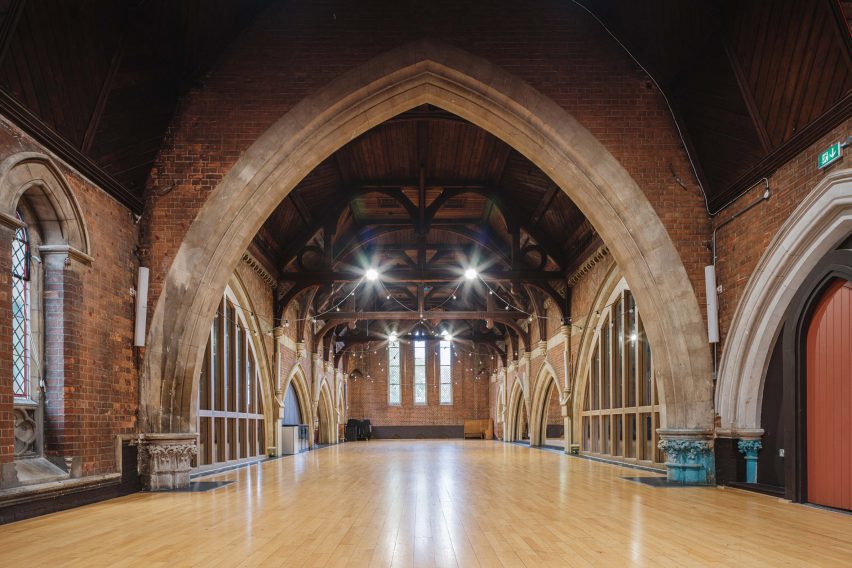
The studio aimed to improve the functionality of the grade II-listed building, which used to be a church but has been a community hub and “leading centre in contemporary circus arts” since the 1980s, Citizens Design Bureau said.

Retrofitted Jacksons Lane community centre
The Jacksons Lane building has a colourful interior

“The previous layout was a real jumble of spaces that didn’t work from a functional perspective,” the studio’s director Katy Marks told Dezeen.

“Our approach was to declutter the old church building, so that the original structure was more visible, giving a sense of the symmetrical cruciform of the original plan and using the drama of those spaces to full effect, improving acoustic separation, functionality as well as making the building fully accessible,” she added.

Interior of community u=hub by Citizens Design Bureau
Spaces were rearranged to create a more functional interior

The venue in Highgate, London, had a dated interior with more than 20 different levels.

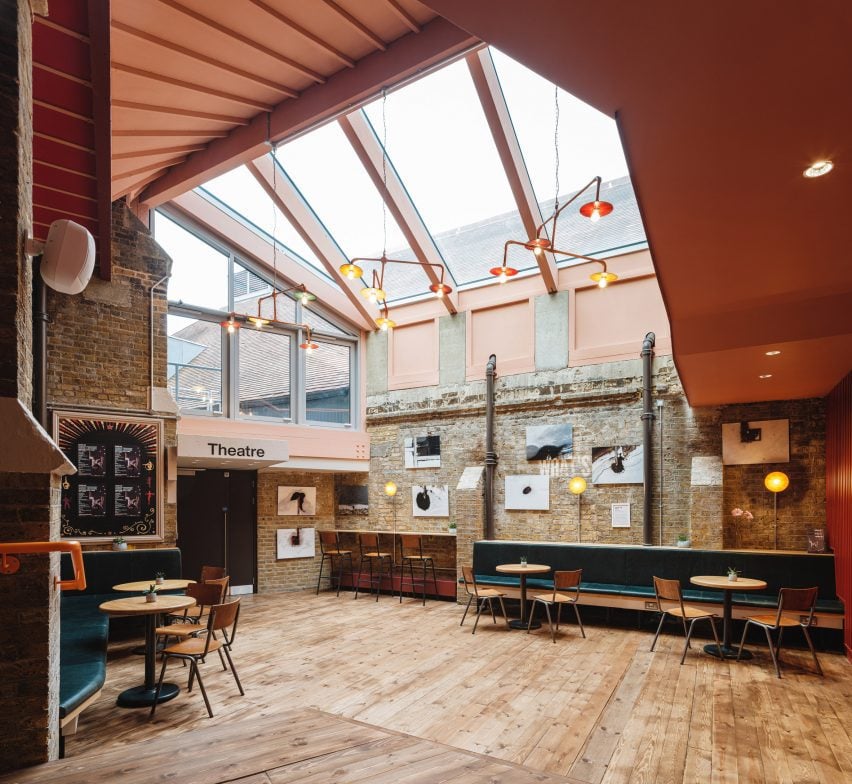
While reconfiguring its spaces to make them more functional, Citizens Design Bureau added a cafe and hireable studios in the former church’s double-height transept.

Red walls in Jacksons Lane in London
Red and teal colours brighten up the space

New details that make Jacksons Lane more functional include acoustic windows, as well as ramps and lifts that create easier access to the different spaces.

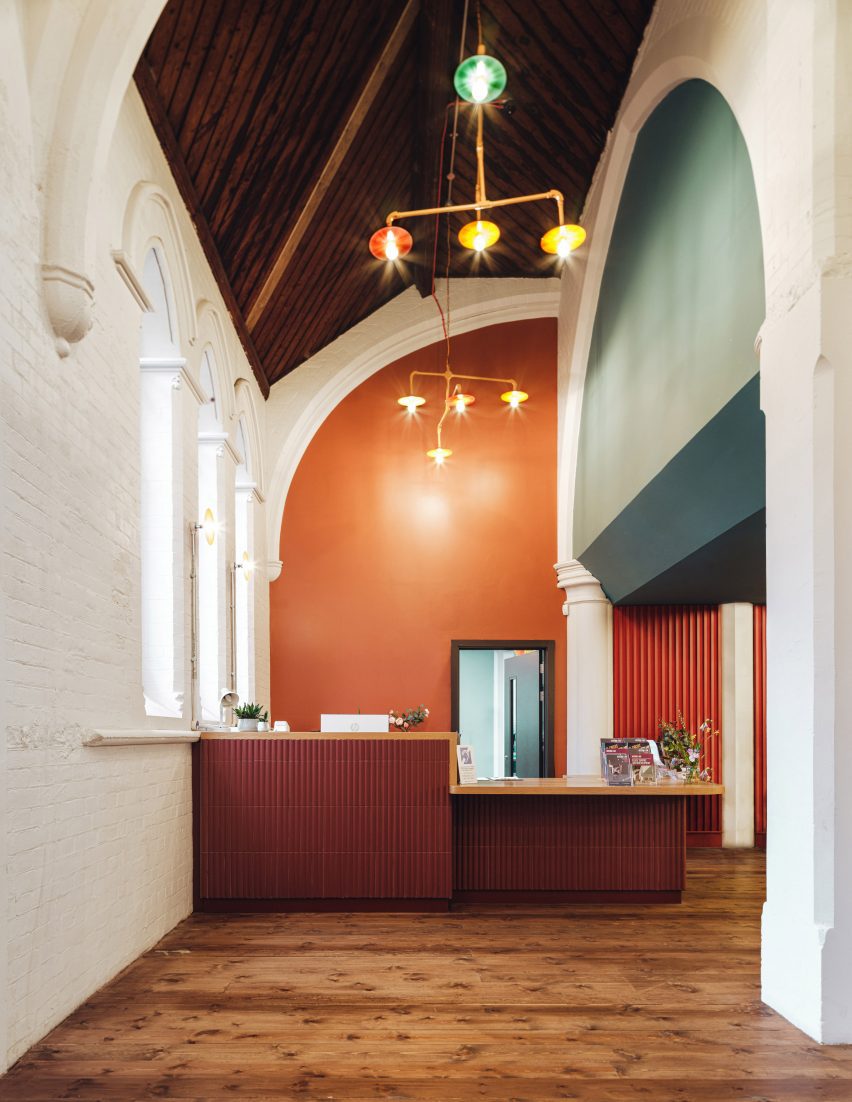
It also restored some parts of the church that had been hidden under more recent interventions. This included reinstating the main entrance of the building to the original church porch, which had been boarded up.

“You would often see people still climbing the steps up to the original, boarded-up door, trying to push it open,” Marks said.

“In a grade II-listed building, we had limited scope to make big changes to the exterior, so we felt that opening up the original and intuitively obvious entrance was the most impactful move we could make, to make the building much more legible and welcoming to everyone,” she added.

Orange wall and teal details inside community centre by Citizens Design Bureau
Citizens Design Bureau retrofitted the arts centre in Highgate

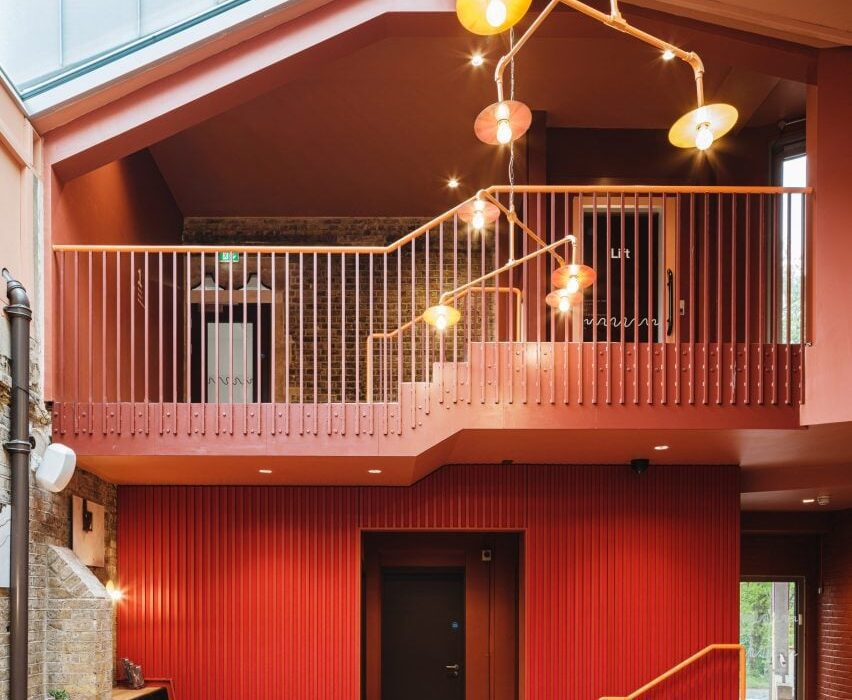
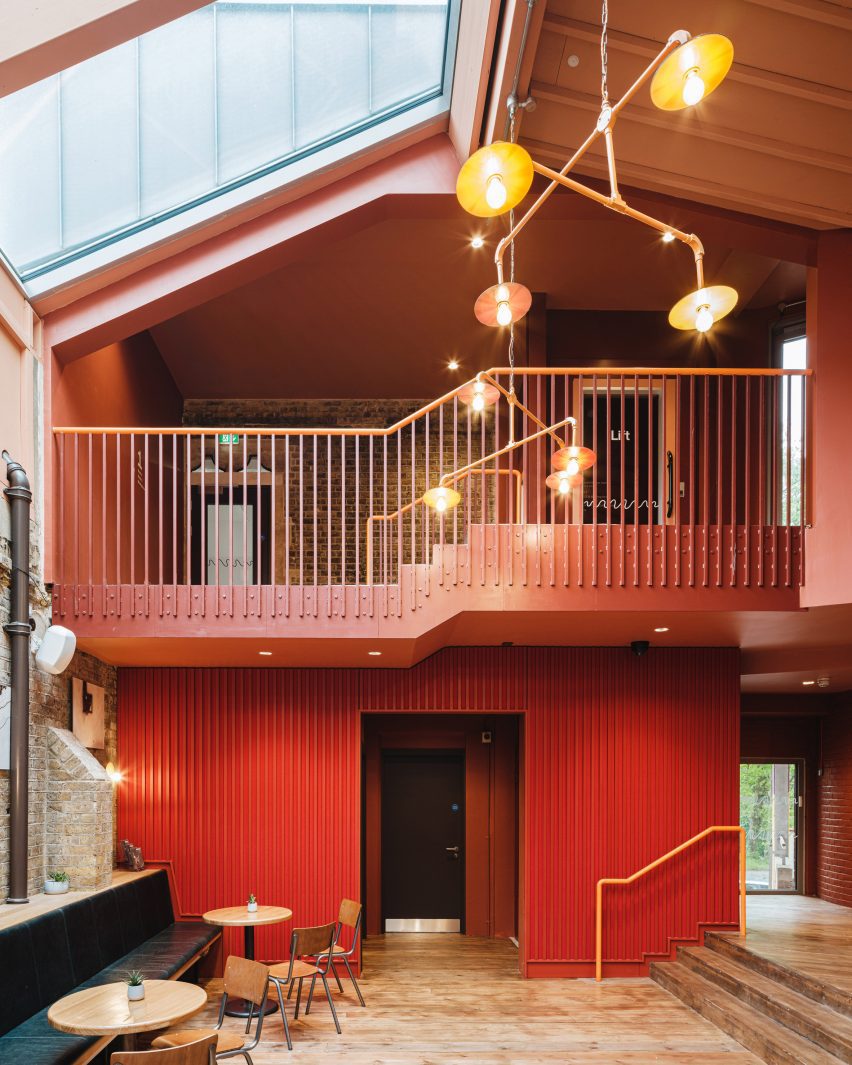
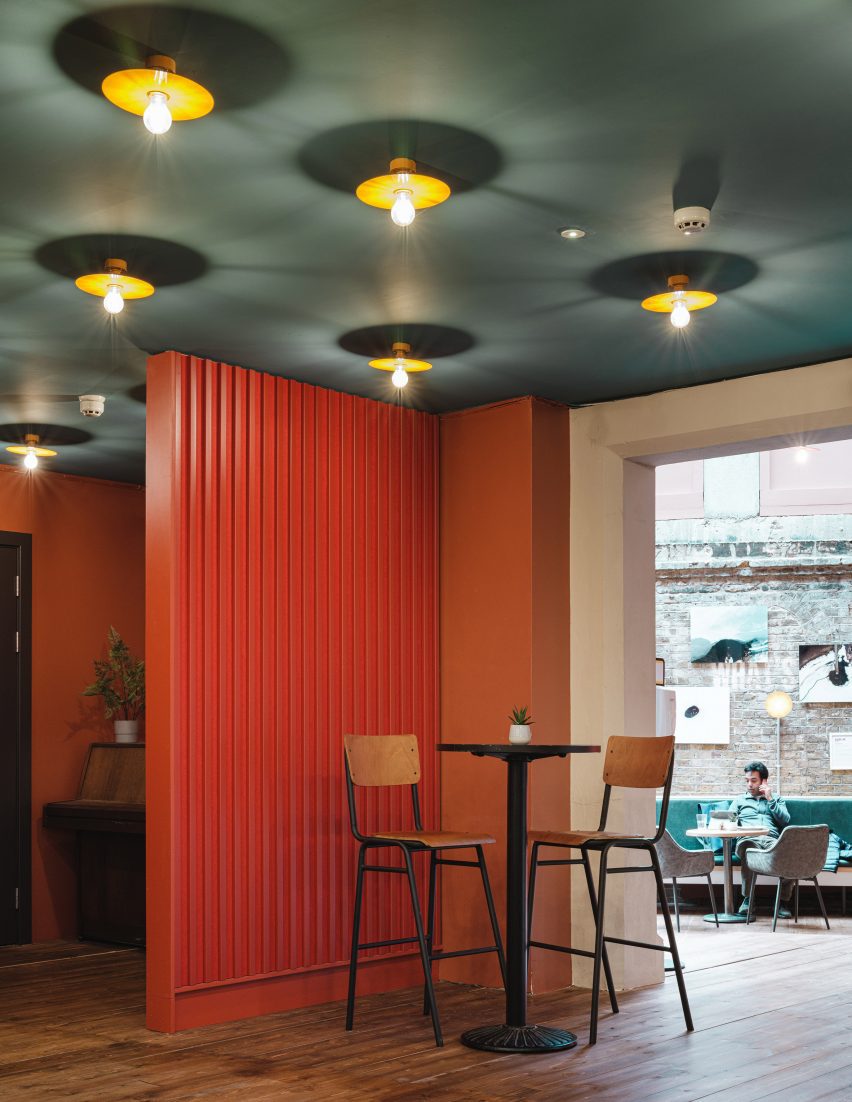
Inside the centre, Citizens Design Bureau introduced a warm colour palette of deep reds and oranges with teal accents, which complements the existing brick, stone and dark-wood details.

“The building has undergone many changes over decades of use, so the internal fabric in particular has a layered history,” Marks said.

“We have used colour to express those layers – white for the church structure, a teal blue for elements that were added in the 70s, and then volcanic oranges, reds and purples for completely new insertions with pops of other colours in the lighting, reflecting the playfulness of its current function as a creative space, specialising in circus arts.”

Room inside Jacksons Lane in London
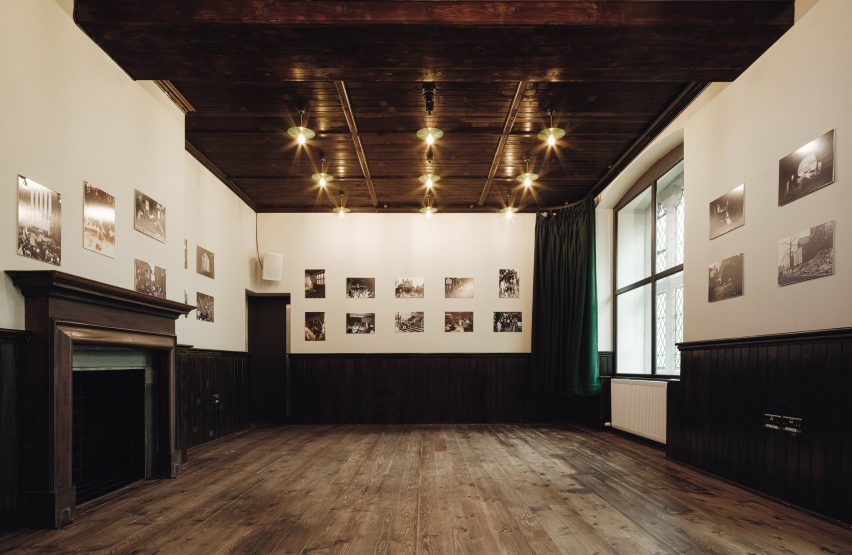
Whitewashed walls contrast dark-wood floors

The studio clad some of Jacksons Lane’s ceilings with a pale-green concertina form that improves acoustics.

Lamps with bright orange cables add another colourful touch to the space.

View of community centre by Citizens Design Bureau
The former church is now used as an arts and circus hub

Jacksons Lane is used by a lot of people in the local area and Marks said the feedback so far has been “wonderful”.

“We hope that what we have done really expresses the ethos and character of Jacksons Lane with clarity and a bit of joy, raises a smile and is the kind of place that people really want to hang out in,” she said.

Citizens Design Bureau has previously added a “delicately perforated” Corten extension to Manchester Jewish Museum, for which the studio was longlisted for a Dezeen Award in 2021.

The photography is by Fred Howarth.

Reference

Brave New World: How Real-Time Rendering Can Lead Architectural Design Into the Future
CategoriesArchitecture

Brave New World: How Real-Time Rendering Can Lead Architectural Design Into the Future

New technologies breed new behaviors, so it’s no surprise that real-time rendering software is being harnessed by some architects to create whole new design processes. Two such firms, Intelligent City and Viewport Studio, are using the real-time rendering capabilities of Enscape to produce high-quality building designs in a fraction of the time it takes with traditional working methods. Basing their workflows on AI-enabled algorithms and the experiential capabilities of virtual reality, they’ve created design processes that are more efficient, more productive, and arguably more effective than today’s typical design practices.


The Key to Low-Cost, High-Quality Urban Housing

Animation courtesy of Intelligent City

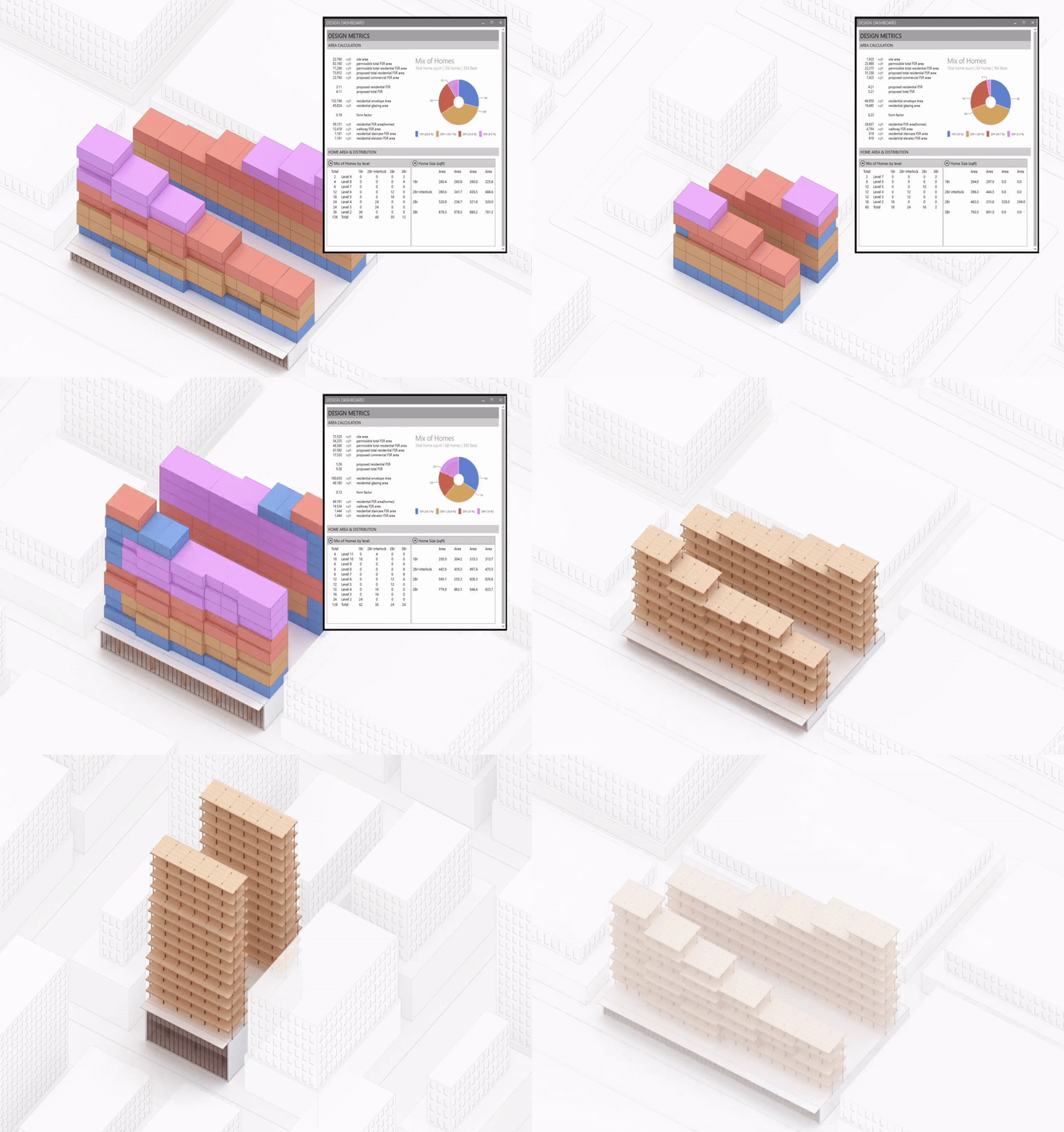
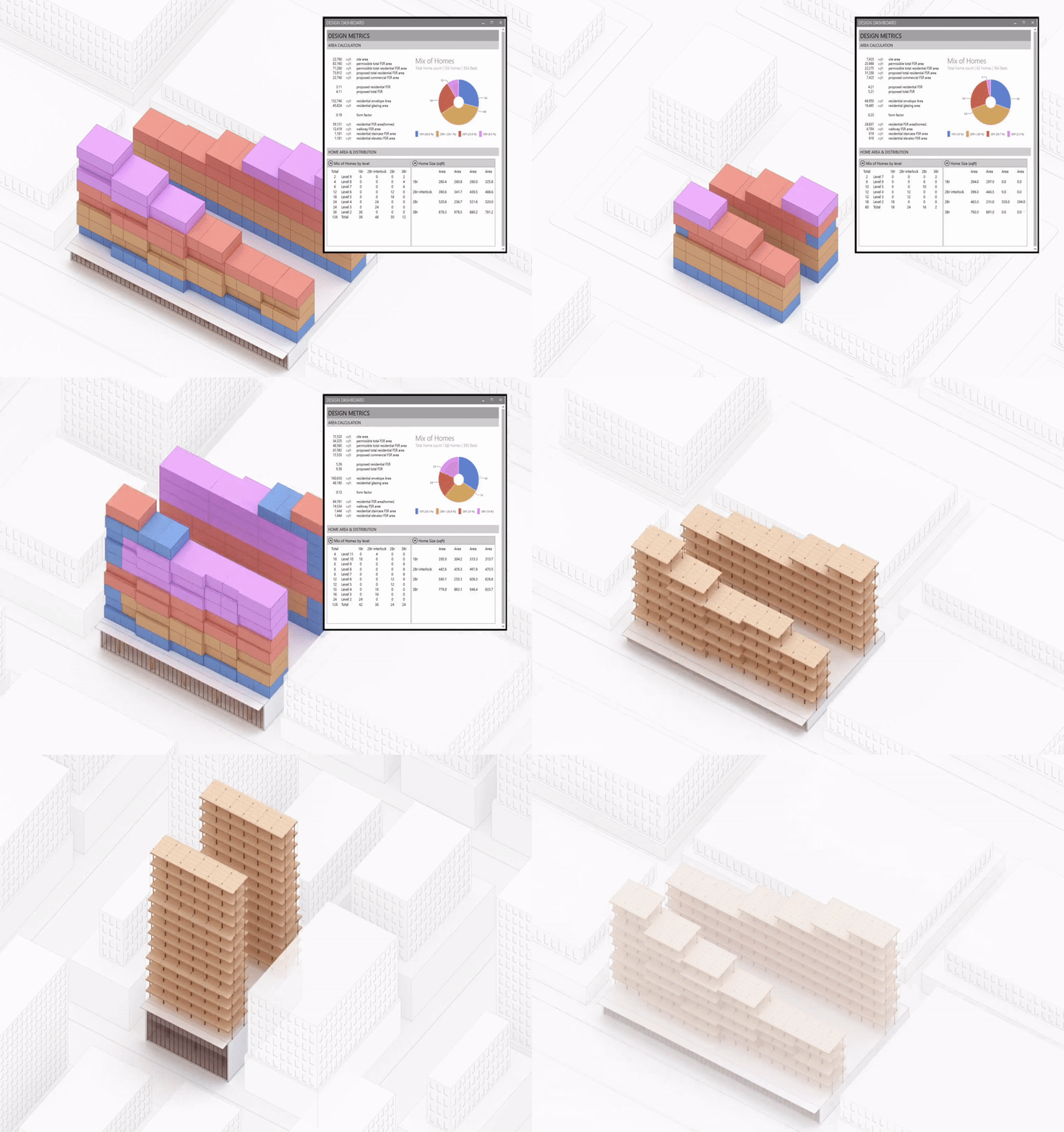
Intelligent City, a design-build firm based in Vancouver, has created a proprietary design process called Platforms for Life to develop high-quality, sustainable urban housing at low cost. Taking a tech-forward approach to architecture, Platforms for Life employs algorithms to create fully fleshed out iterations for the design of an entire building. Modifying an individual property on one iteration automatically updates all associated parameters to incorporate the change, allowing an infinite number of fully detailed design options to be generated instantaneously. When the desired iteration is reached, all required construction documentation and manufacturing instructions are created with the push of a button.

Platforms for Life achieves even greater cost and time savings by prefabricating the primary components of their buildings in a factory. Employing the precision and speed offered by the latest automated manufacturing techniques, on-site construction time of their buildings can be reduced up to 50% over fully on-site methods. Relying heavily on mass timber as a structural material and the principles of Passive House to guide their design algorithms, the Platforms for Life process results in low-cost, energy efficient buildings with minimal carbon footprint.

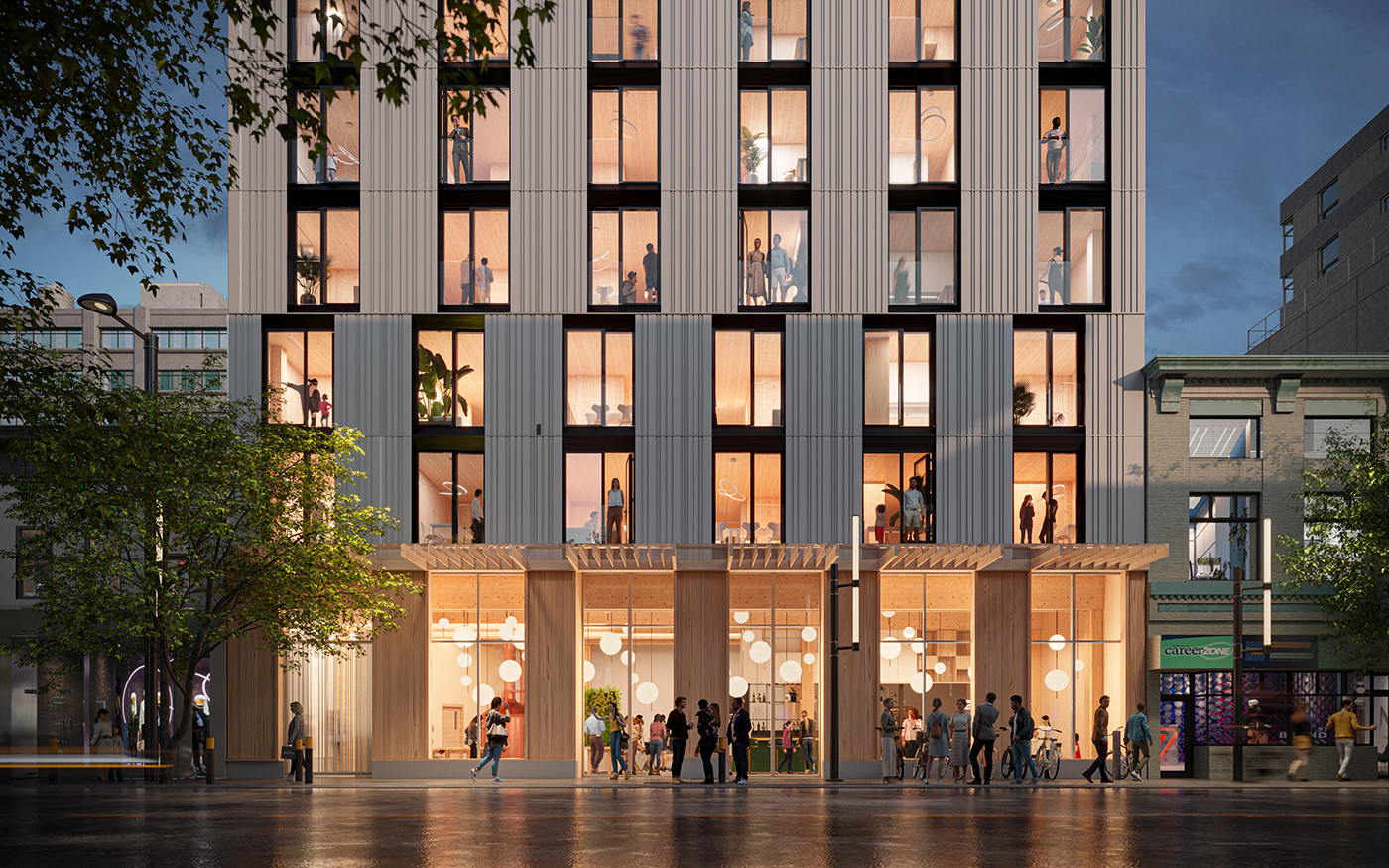
Monad Granville, Vancouver (concept); image courtesy of Intelligent City

Intelligent City brings Enscape into the Platforms for Life process to fine-tune their designs in real-time when collaborating with clients. “We were looking for a way to visualize the buildings quickly,” explains Intelligent City’s Computational Design Architect, Timo Tsui. “If we couldn’t keep up with the iterations of the generated designs, then we wouldn’t be able to visualize them properly for our clients.”

A simple way to do this in a collaborative working session is to pin the Enscape rendering window alongside whatever software is being used to design a building, such as Revit or Rhino. This allows a fully rendered view to be updated automatically as design modifications are being made. If something more portable is needed for a client to evaluate on their own time, then Enscape can generate an easily shareable, read-only 3D model rendered in a web browser, in addition to 360-degree panoramas, videos or still images.


Forging New Frontiers in Interior Design

Image courtesy of Viewport Studio

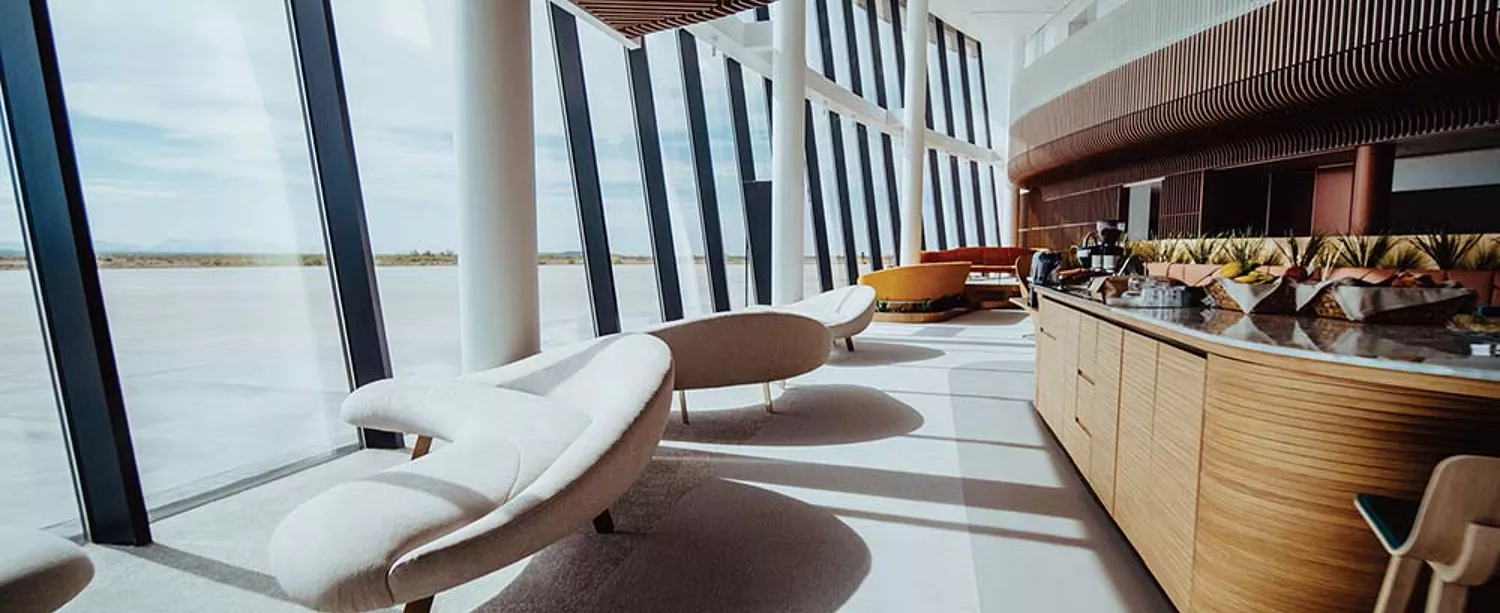
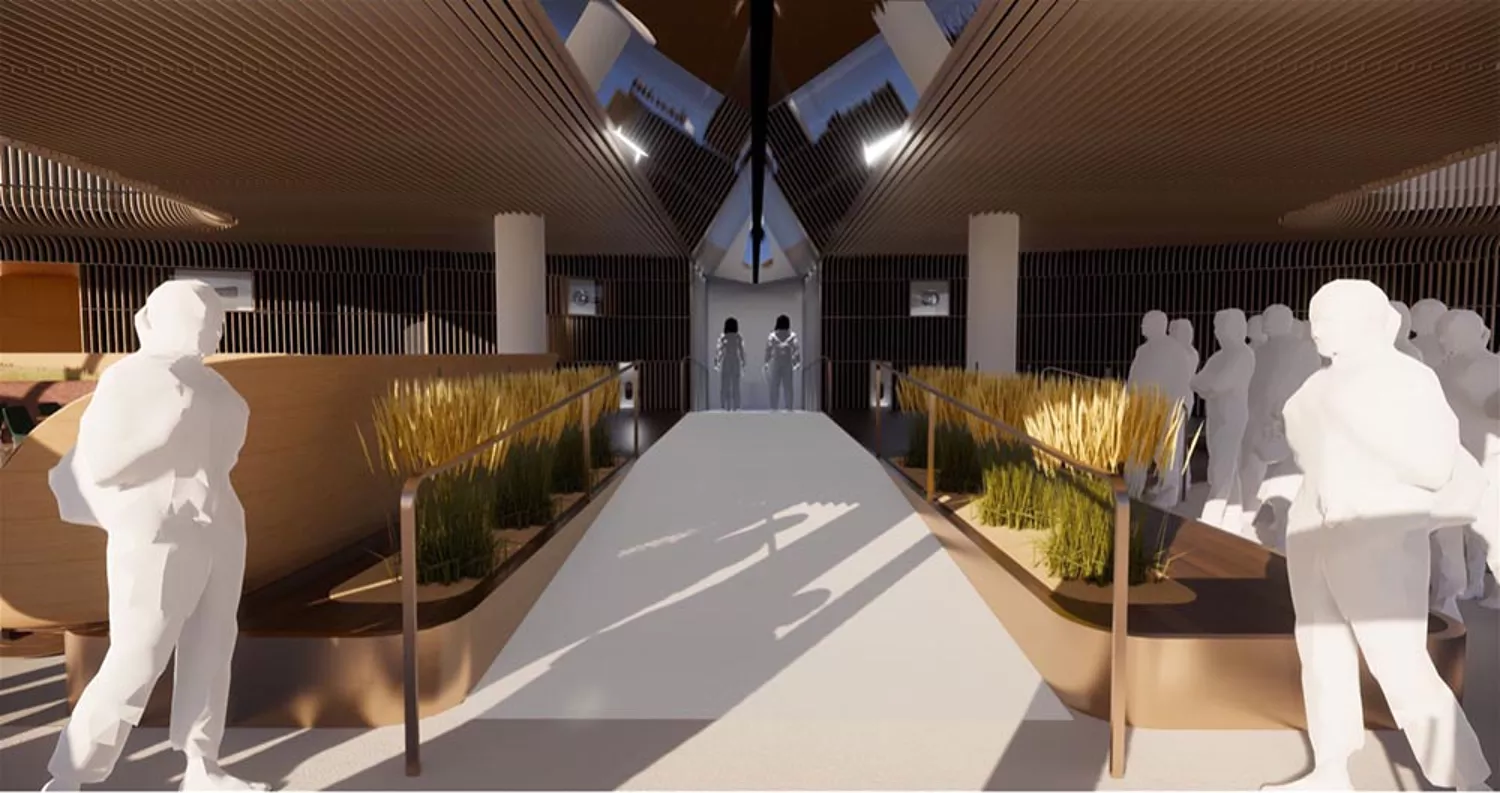
Viewport Studio employs Enscape’s next-generation virtual reality capabilities to take an innovative approach to creating highly detailed interior designs. Recently tasked with designing the interior of Virgin Galactic’s Spaceport America, the first commercial spaceflight facility in the world, Viewport Studio’s design team knew they had to utilize a truly groundbreaking design process to satisfy the client’s aspirations for an equally groundbreaking space.

“We were tasked with designing something that had never been designed before,” says Viewport Studio director Gautier Pelegrin. To meet the challenge, they used Enscape’s virtual reality feature as a primary design tool, conducting live sessions to view and change design elements in real-time. This workflow resulted in the design of the spaceport’s “Astrowalk”, where astronaut passengers are given a celebratory send-off by their friends and families before embarking on their journeys. A showcase experience enhanced by a mirrored ceiling covered with LED screens, Enscape’s virtual reality feature helped the design team determine if spectators could see the Astrowalk from their seats.

Image courtesy of Viewport Studio

Enscape was additionally used to determine the exact dimensions of a barista station, as well as the amount of natural light that would reach certain planters, guiding the choice of plants used in specific locations. “The virtual reality function quickly became a staple in all our meetings,” explains Pelegrin. “It helped to reduce testing iterations by at least 20 percent. It also allowed us to check the simple ergonomics of the bespoke furniture we designed, and we were confident with what we gave to the manufacturers.”

Able to integrate directly into all major design software, including Revit, SketchUp, Rhino, Archicad, and Vectorworks, the possibilities for creating your own pioneering design process with Enscape are endless. Head over to Enscape to see all its capabilities and start your free 14-day trial today.

Reference

Mycelium and hemp chair on display at Designmuseum Denmark
CategoriesInterior Design

Designmuseum Denmark exhibition questions future of design

Designmuseum Denmark has looked at how design can shape the future through its The Future is Present exhibition, which features projects including a tubular chandelier made from cow intestines.

Presented at Copenhagen’s recently renovated Designmuseum, the exhibition showcases a range of “speculative and suggestive” works that examine four themes titled Human, Society, Planet+ and Imagining the Future.

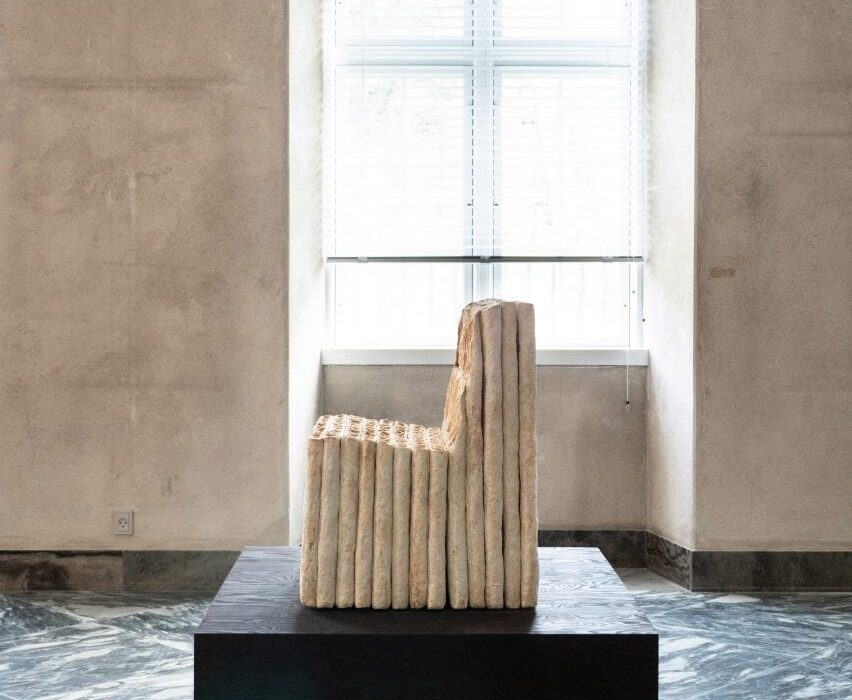
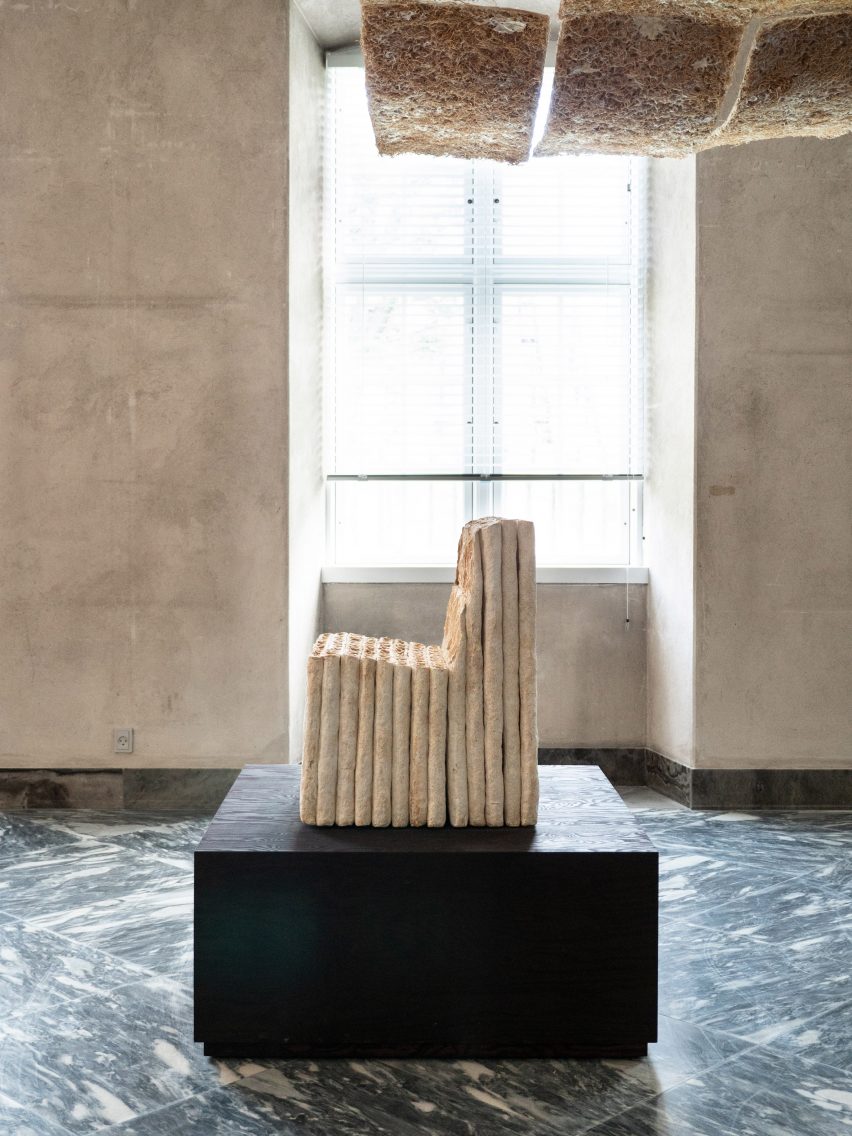
Mycelium and hemp chair on display at Designmuseum Denmark
The MYX Chair is a mycelium and hemp chair that has “grown” itself

“Design is very much a forward-looking profession,” said exhibition curator Pernille Stockmarr. “It’s about changing the existing into something better – and what we do in the present creates the future.”
“Living in a time with major global challenges, this exhibition wants to invite people to see and reflect on the different potentials of design in this transformation and encourage them to think about what kind of future we want,” she told Dezeen.

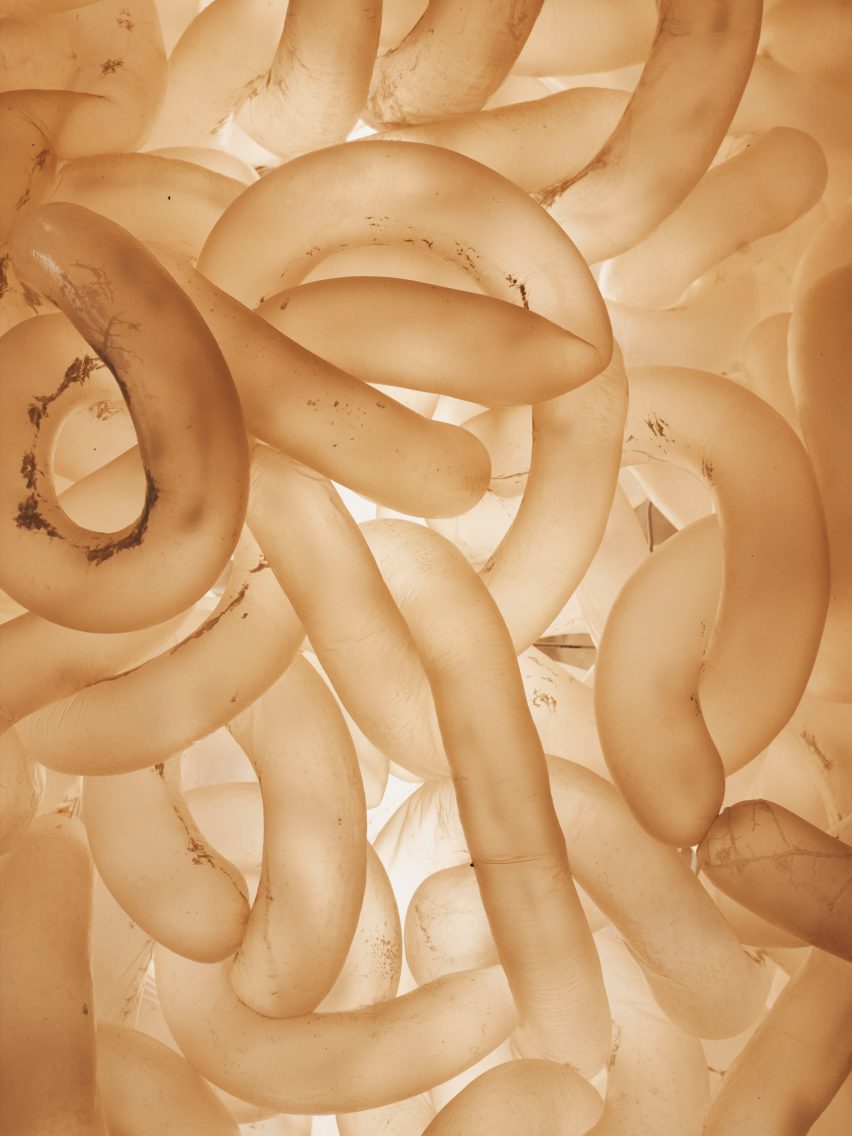
Close up of a tubular lamp made from cow intenstines
100 metres of cow intestines were used to make the Inside Out chandelier

Among the pieces on show is Inside Out, a chandelier-style lamp made from 100 metres of knotted cow intestines extracted from eight cows. Designer Kathrine Barbro Bendixen aimed to explore how byproducts can be used to rethink patterns of material consumption.

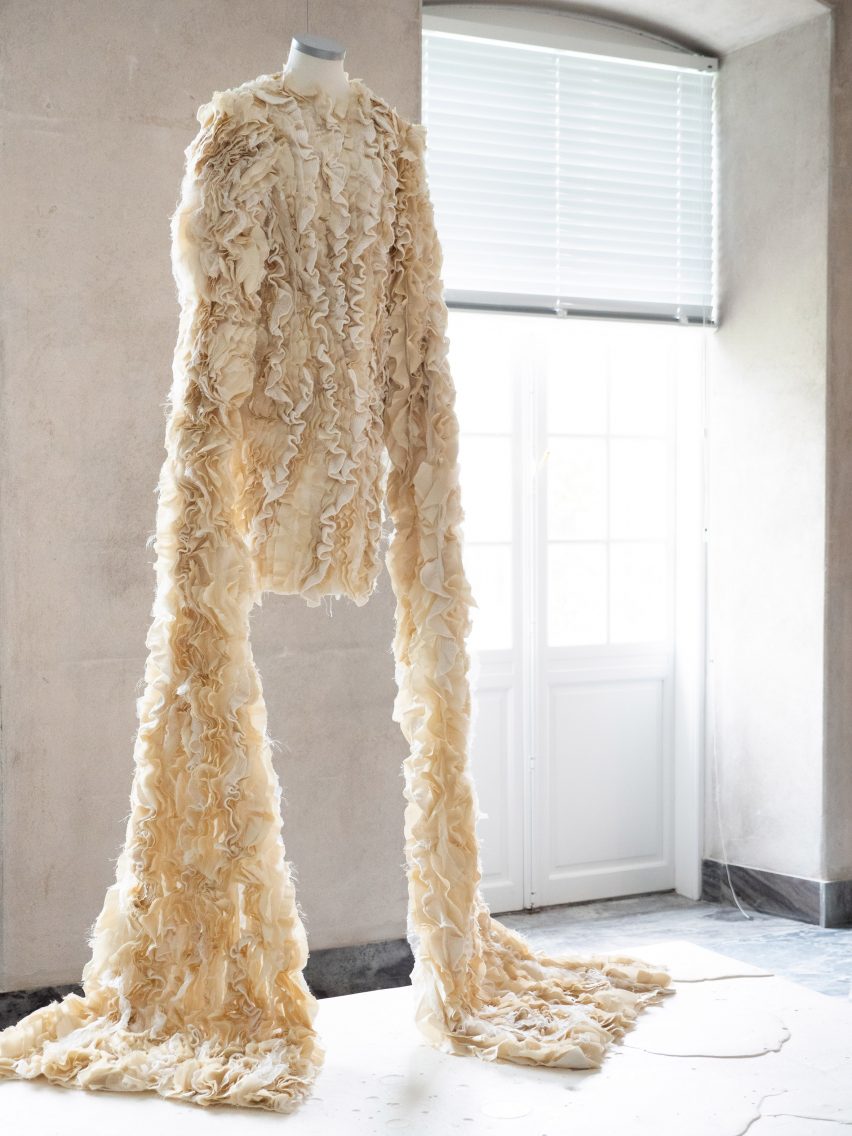
Faroe Islands-based fashion brand Guðrun & Guðrun created Vindur, a ruffled dress with exaggerated bell sleeves made of woven silk and machine-knitted milk yarn sourced from dairy production waste.
The brand worked with textile designers Amalie Ege and Charlotte Christensen and Lifestyle & Design Clusters to create the garment, which was made using a “traditional technique used during the inter-war period when resources were in short supply and waste was transformed into value,” according to the Designmuseum.
Ruffled dress made from dairy waste with bell sleeves on display at Designmuseum Denmark
A group of designers created a dress made from dairy waste

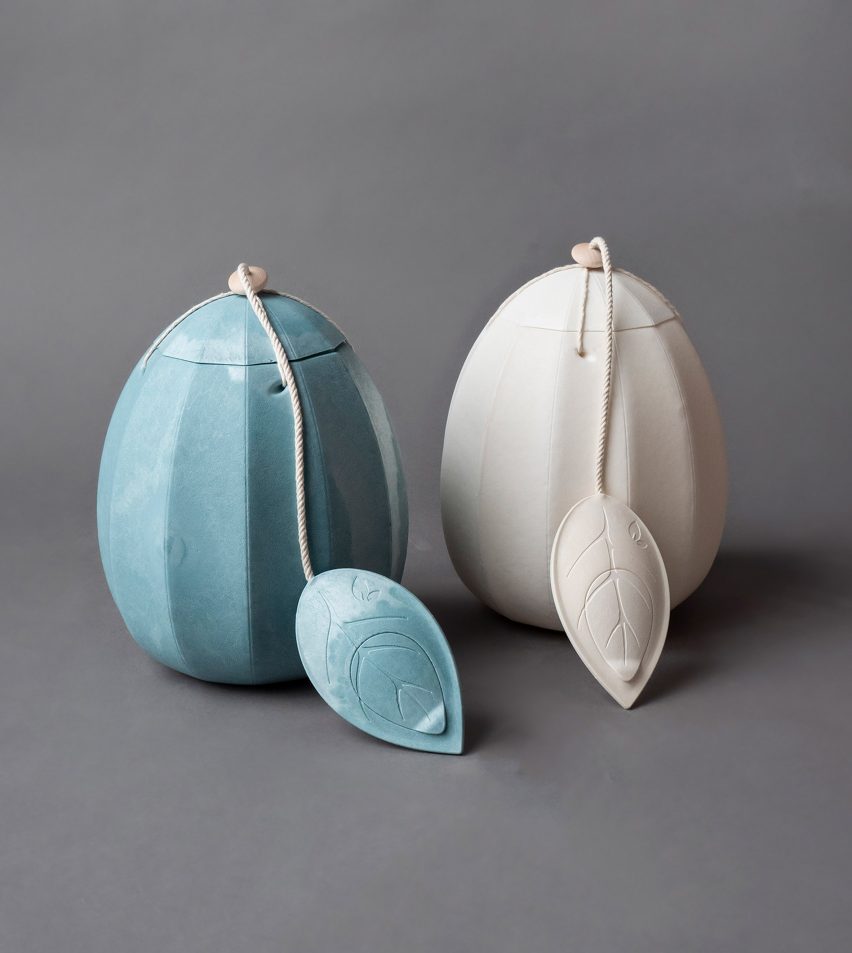
More conceptual works include Beyond Life, a collection of biodegradable paper foam urns by designer Pia Galschiødt Bentzen with detachable pendants containing seeds that can be grown.

“Beyond Life unites death, loss, and remembrance with the awareness that we humans are part of nature’s endless circle of life,” said Stockmarr.

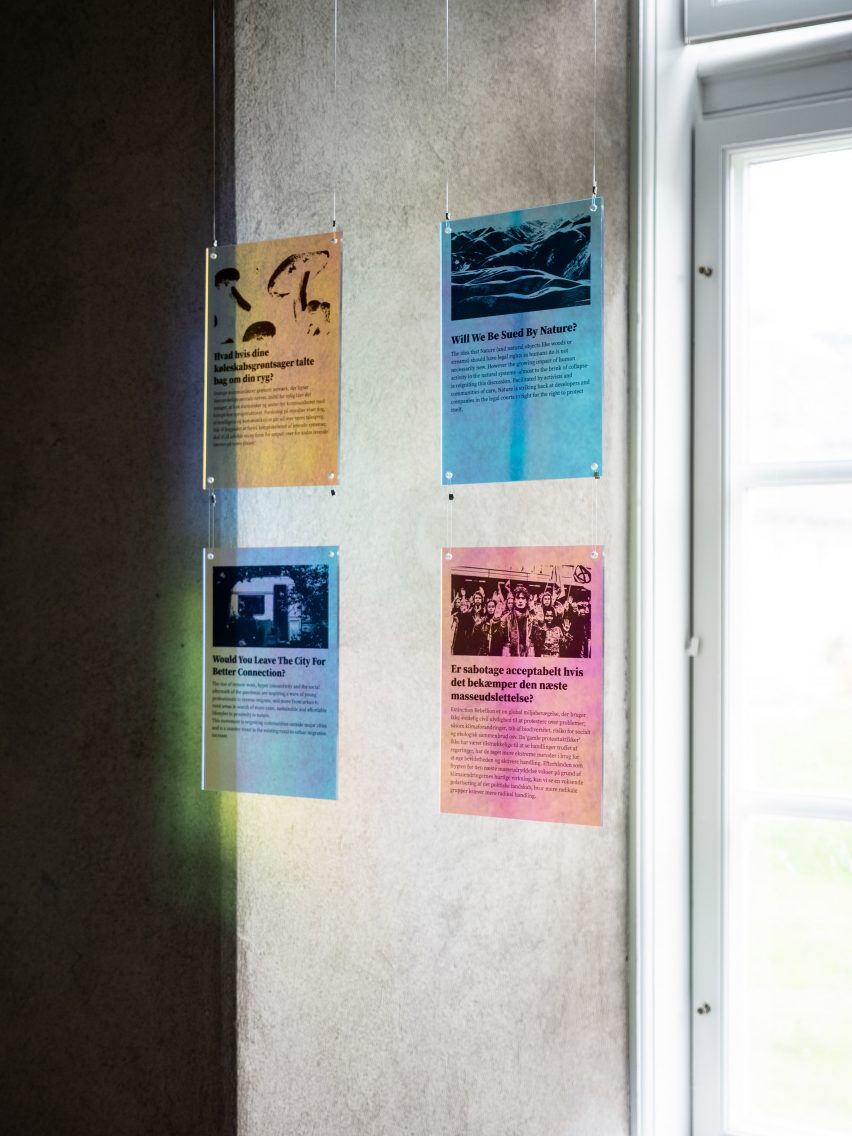
Also on show is Library of Change, a “map” of dangling acrylic foil cards charting current trends and technologies, inscribed with questions for visitors such as “would you leave the city for better connection?”

Biodegradable paper foam urns in blue and white at the Designmuseum in Demark
Beyond Life is a collection of biodegradable paper foam urns

Stockmarr explained that the exhibition aims to communicate “the breadth of design” by including works that vary in scale, purpose and medium.

“Their ability to inspire, start conversations and make visitors reflect was a priority,” she said.

“I didn’t want the works to be too-defined solutions for the future, extreme sci-fi visions, utopias or dystopias, but exploratory works. Some are collaborative research projects and others provide foresight into design methods, handicrafts and creative experiments.”

Acrylic foil cards featuring questions about the future
Library of Change is a project that encourages visitors to question the future of design

Alongside the various projects in the exhibition, artefacts from the Designmuseum’s own archive that highlight past ideas for the future are also on display.

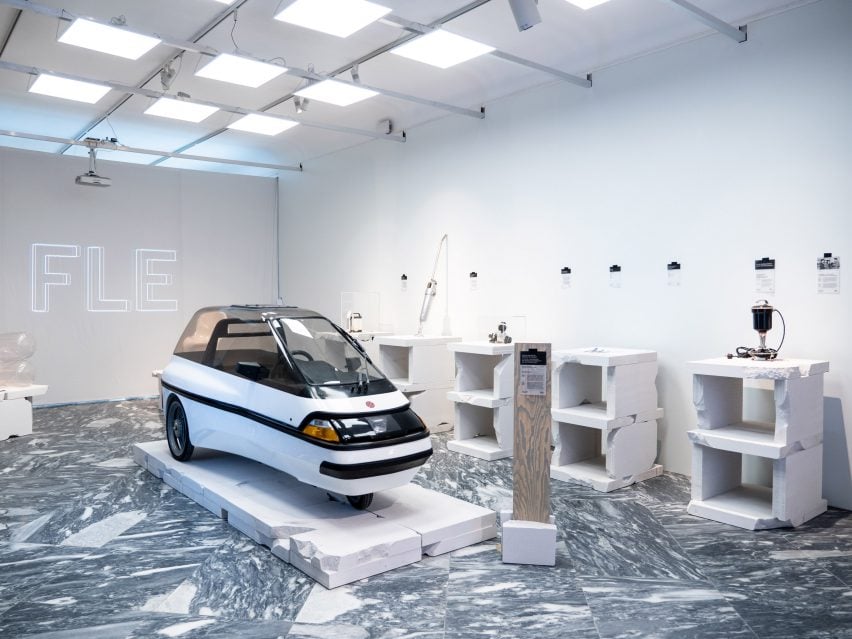
One of these designs is the three-wheeled vehicle Ellert, Denmark’s first electric car developed in the 1980s by engineer Steen Volmer Jensen.

Three-wheeled electric car called Ellert on display at Designmuseum Demark
Ellert was Denmark’s first electric car

Local studio Spacon & X created the exhibition design for The Future is Present with the aim of reflecting its themes.

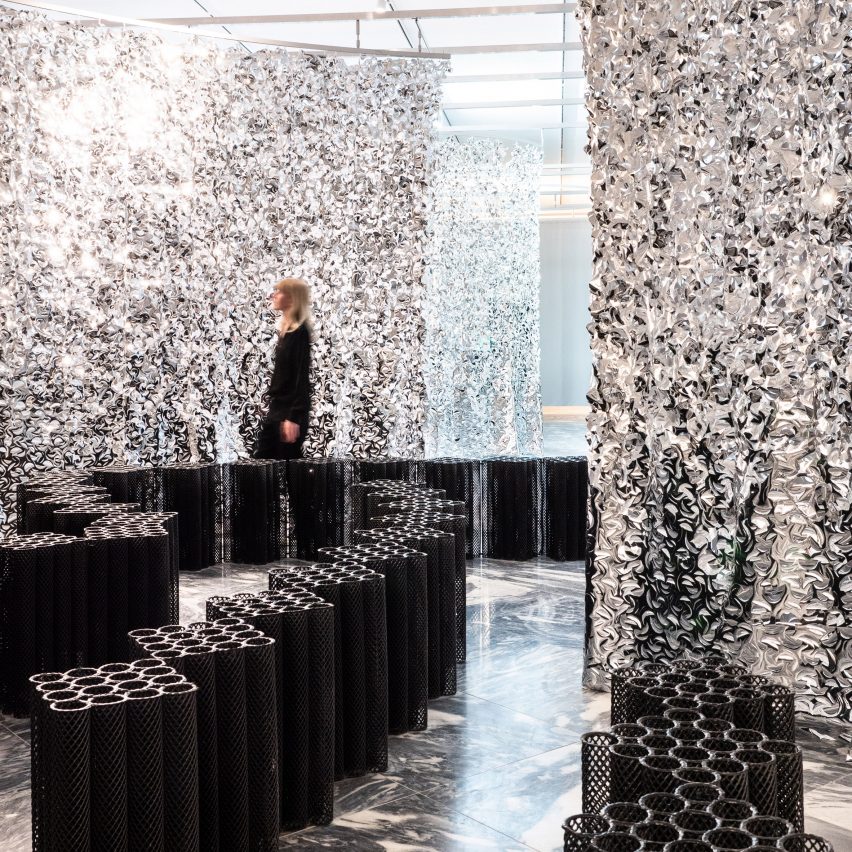
The studio delineated the show’s various zones using modular bioplastic dividers that snake through the exhibition space and worked with natural materials including eelgrass, which was used to create acoustic mats to manage noise in the museum.

Objects are arranged on custom tables and plinths made in collaboration with sustainable material manufacturer Søuld, while Natural Material Studio created a mycelium daybed for the show.

Stockmarr explained that the show is meant to be a call to action and empower people to reflect on their individual roles in determining the future of design.

“By asking more questions than giving answers the exhibition wants to inspire visitors,” reflected the curator.

“The show acknowledges that it is not only designers, architects, craftspeople and experts, but all of us who are participating in shaping and designing the future by the questions we ask and the choices and actions we take today.”

Hanging objects within the Designmuseum Denmark, arranged by Spacon & X
The Future is Present was designed by Spacon & X to be an immersive experience

Similar recent exhibitions that explored the climate impact of materials include a show at Stockholm Furniture Fair that visualised the carbon emissions of common materials such as concrete and The Waste Age – a London exhibition that addressed how design has contributed to the rise of throwaway culture.

The Future is Present is on display at Designmuseum Denmark from 19 June 2022 to 1 June 2023. See Dezeen Events Guide for an up-to-date list of architecture and design events taking place around the world.


Reference