
Bou bag by Ganni made using plant-based BioFluff fake fur in pink
CategoriesSustainable News

The allure of the ‘bio’ prefix must be taken with some healthy scrutiny

Biomaterials have the potential to significantly cut carbon emissions but designers should approach them with caution to avoid creating a whole new set of problems, warns Sioban Imms.


The vision of a civilisation based on biomaterials is compelling: products, clothes and buildings made from materials that have been “grown”, rather than derived from polluting, extractive fossil industries. The promise is not only lower emissions, but products that are more in tune with the environment – manufactured objects that are part of the natural cycle of life. And consumers are willing to pay a premium for such ostensibly “sustainable” products – 12 per cent more, according to a recent study by Bain.

However, in a bid to gain competitive advantage, marketing narratives surrounding biomaterials are regularly inflated or gloss over important details. Prefixing “bio” to a material name conjures a sense of being natural, compostable, and better all round for personal and environmental health.

Marketing narratives surrounding biomaterials are regularly inflated

But these claims can unravel, or at least become complicated, when researching a little deeper than the material classification, product name and strapline. A report from RepRisk found a 70 per cent increase in incidents of greenwashing between 2022 and 2023. Incoming legislation in the EU is specifically targeting this issue.

The definition and terminology around biomaterials is still evolving. For clarity, we’re not talking here about biomaterial designed for implanting into the body, but biologically derived materials used in product, fashion and architecture.

Often grown using living micro-organisms like yeast, bacteria, cellulose and mycelium, they can be finely tuned at the nanoscale by engineering DNA sequences to produce specific properties. For example, UK company Colorfix tweaks the DNA of bacteria so that they excrete coloured pigments for dyeing textiles. Microbial manufacturing organisms like these tend to be fed, fermented and modified in controlled environments.

The substitution of fossil-derived, high-carbon materials for biomaterials is urgently important. A recently published study by Radboud Universiteit in the Netherlands concluded that biomaterials reduce greenhouse-gas emissions by an average of 45 per cent compared to fossil-based materials.

But biomaterials are not a magic bullet to the multi-faceted nature crisis industrial civilisation is causing. Especially important is avoiding what are sometimes called “regrettable substitutions” – whereby one material is replaced with another that merely introduces a new set of problems.

For example, BioCane disposable food packaging is an alternative to plastic food packaging made from bagasse – pulped sugarcane-fibre, a waste product from the sugar industry. The design is geared to express its natural origins and circularity, from the subtly flecked, neutral colour and matte finish to the embossed logomark featuring a plant within a gradated circle.

Biomaterials are not a magic bullet to the multi-faceted nature crisis

However, for BioCane to be grease repellant (so it doesn’t fall apart before you’ve consumed the contents) it needs an oleophobic coating, unlike plastic packaging. BioCane uses a polyfluoroalkyl substance (PFAS) for this coating. PFAS are termed “forever chemicals” due to their damaging long-term persistence and accumulation in the environment – not to mention our own bodies.

BioPak, which produces BioCane, transparently publishes information about this on its website, highlighting it as an industry-wide problem. The company also includes a timely pledge to phase out PFAS-containing packaging by June 2024, which happens to coincide with a move to phase out PFAS by the Environmental Protection Agency in the US.

Not all manufacturers are as responsible; it’s common to find unlisted additives – or perhaps a fossil-based lamination to improve a material’s durability – under a headline claim of biological origins.

Bioplastic is another material experiencing significant growth, partly driven by high oil prices making fossil-fuel-derived plastic less competitive. Most bioplastic is made from ethanol, commonly sourced from corn, wheat or sugarcane. Sugarcane, for example, is planted in monocultures in tropical and sub-tropical countries like Brazil. The sugar is extracted, fermented and distilled to produce precursor chemicals for bioplastics.

But to assess the environmental value of using this bioplastic, we need to know about how the crops are managed – for example, the pesticides and synthetic fertilisers used to increase crop yield, the land-clearance practices, and the effect on food prices if the bioplastic became widely adopted. At the end of the product’s life, specialised infrastructure for disposal will need to be in place, further complicating the picture.

Biodegradable bioplastic would seem to offer a solution to the worst ravages of plastic – the alarming buildup of microplastic pollution across the world. How much better if the material could be absorbed back into the environment?

Biodegradable doesn’t mean a material will break down in the environment over useful timescales

The market opportunity for biodegradable plastics is alluring, and forecasts predict that they will account for the majority of the bioplastics market – 62 per cent, by 2028. This opportunity is attracting investment and also the potential for greenwashing as companies vie for a competitive advantage over others.

But biodegradable doesn’t mean a material will break down in the environment over useful timescales. A 2022 UCL study of supposedly “home compostable” bioplastics revealed that 60 per cent did not fully degrade within the tested timespans – a finding that unravels the whole purpose for investing in compostable packaging.

Claims relating to bioplastics were at the crux of a recent legal case brought against US biotech firm Danimer Scientific Inc. The manufacturer of biodegradable products had claimed that its proprietary plastic material Nodax PHA is able to biodegrade not only in industrial composting facilities but in landfill and in the ocean.

Danimer’s share prices rocketed, sparking an investigative report in the Wall Street Journal, which stated that “many claims about Nodax are exaggerated and misleading, according to several experts on biodegradable plastics”. Danimer refutes this statement, but what came out in court was that the company performed biodegradability tests on Nodax in a powdered form, which doesn’t relate to real-world product formats like bottles that have variable thickness.

The legal case was eventually dismissed, but nonetheless the alleged greenwashing spiked Danimer’s share price, shaking investors’ trust in the company and having knock-on effects for the wider industry.

Going forward, manufacturers will need to be transparent about what goes into their products. In the EU, legislation tackling greenwashing in product labelling will come into effect in 2026. The new law is a direct response to the rise in misleading claims that companies use.

When specifying a biomaterial, it’s important to dig into its provenance

It comes after a study commissioned by the bloc found that 53 per cent of green claims on products and services are vague, misleading or unfounded, and 40 per cent have no supporting evidence. In the UK, the Competition and Markets Authority has published the​​ Green Claims Code – a six-point guide to help businesses ensure they are not unwittingly misleading customers.

These two initiatives highlight the importance of using the right language when promoting products and materials, and as the impact of the EU’s legislation ripples through the industry, there will be a natural calibration to more transparency.

The takeaway for designers is that, as ever, the picture is complex. When specifying a biomaterial, it’s important to dig into its provenance, as well as to look at the material use and disposal. The allure of the “bio” prefix from an ethical – and marketing – perspective may be strong, but must be taken along with some healthy scrutiny.

Sioban Imms is a colour, material and finish (CMF) and sustainability strategist with a background in design and manufacturing. She is co-founder of consulting agency Substance and a contributing editor at trend forecasters Stylus and WGSN.

The photo, of MarinaTex designed by Lucy Hughes, is courtesy of the University of Sussex.

Dezeen In Depth
If you enjoy reading Dezeen’s interviews, opinions and features, subscribe to Dezeen In Depth. Sent on the last Friday of each month, this newsletter provides a single place to read about the design and architecture stories behind the headlines.



Reference

alt="DALL·E_2023-10-08"
CategoriesArchitecture

The Rise of AI in Architectural Design: A Comprehensive Overview

Architizer’s Tech Directory is a database of tech tools for architects — from the latest generative design and AI to rendering and visualization, 3D modeling, project management and many more. Explore the complete library of categories here.

For the past couple of years, Artificial Intelligence (AI) tools have been dominating the architectural industry. From simple text-based image generators to more advanced software that “draws” architectural plans or calculates CO2 emissions, AI has been methodically transforming the architect’s workflows. Still, to comprehensively explore how AI is revolutionizing architectural processes, it is crucial to break down the various stages that constitute architectural design.

The process of making architecture is a balance between creative — almost instinctive — explorations and artistic endeavors and considering an array of information, such as program and function, building codes, material specifications etc. Ideation and concept design, for example, vary significantly compared to drawing technical details or conducting site analysis. Respectively, AI software has been developed to revolutionize the imaginative and data-driven aspects of architectural design.

alt="DALL·E_2023-10-08"

DALL·E with GPT-4, DALL·E 2023-10-08

Midjourney, DALL-E and Stable Diffusion are a few of the AI tools that aid the conceptualization and representation of architectural designs. More specifically, they are primarily text-to-image models that generate digital images through prompts. By defining the desired subject, tone, color and resolution of the image these AI tools can produce countless compositions that can act as a starting point for an architectural concept or become a series of representations of an already conceived idea. Stable Diffusion also has the ability to animate a concept through prompts, offering a more immersive spatial experience.

Nevertheless, their applications are not limited to text-based imagery. Architects can also upload their own image, for example an initial sketch or render, and modify it through additional prompts. This hybrid workflow essentially accelerates the design process, producing multiple iterations in a short amount of time, without “sacrificing” the most archetypal role of architectural drawing: thinking and problem solving. At the same time, it helps architects communicate their work more effectively to their clients, often pushing the boundaries of traditional architectural drawing and inventing new methods of representation. One example is architect Hamza Shaikh, who used his hand sketches and AI to create “Kinonic” (kinetic and sonic) drawings to express concept and narrative more effectively.

Moving beyond the conceptual phase, architects are required to make several design decisions that are based on site conditions, building codes, sustainability requirements and program specifications. AI software such as Aino and SiteAnalysis.ai are tools that produce highly detailed data for specific contexts. Climate conditions, historic building data, circulation maps and even crime densities can be easily reconfigured and mapped to provide a foundation for architectural planning. At the same time, a range of architectural planning AI tools enhance the more standardized aspects of design.

Software such as, Autodesk Forma, Finch and TestFit have the ability to produce highly optimized plans, both in terms of space division within a pre-established building shell as well as to achieve the desired conditions within the space, such as daylight or energy metrics. Architizer’s new Tech Directory aggregates tech tools for architects, allowing you to search, compare and review AI softwares before selecting which to you in your next project:

Explore Architizer’s Tech Directory

Naturally, architecture is closely interrelated with the construction industry. Often characterized as the most demanding stage of architectural design, construction drawings and specifications are crucial for the successful materialization of a project. The challenge lies in the effective collaboration between the different disciplines involved in the construction sector. Hypar is a cloud AI platform that brings structural, mechanical, electrical and plumbing systems together, all operating within a 3d model of the space. Its integration with BIM software as well as its web-based interface introduces a new, seamless workflow between raw architectural designs and technical construction drawings.

alt="General_plan_of_Volgograd_(2007)_-_transport_01"

Волгоградская городская Дума, General plan of Volgograd (2007) – transport 01

Even though there have been countless debates on whether AI technology will diminish the architectural profession, the way architects currently use such tools suggests otherwise. They acknowledge and utilize AI’s immense real-time analysis and strategic thinking capabilities, while being aware of its limitation for true, original innovation. Whether AI tools produce intricate floor plans or breathtaking fictional imageries in seconds, this technology is fundamentally based on past data, thus becoming only a part of the architect’s workflow, rather than replacing it altogether.

From concept to construction, the rise of AI in architectural design signifies a paradigm shift in the industry. In fact, Neil Leach, author of the book Architecture in the Age of Artificial Intelligence writes:

“The most revolutionary change is in the less sexy area: the automation of the entire design package, from developing initial options right through to construction.”

Admittedly, architects have barely scratched the surface of AI technology. They are, however, constantly inventing new ways to use these tools to prioritize design creativity and sustainability over standardized tasks and endless drawing loops.

Architizer’s Tech Directory is a database of tech tools for architects — from the latest generative design and AI to rendering and visualization, 3D modeling, project management and many more. Explore the complete library of categories here.


Reference

Take Our Survey on AI in Architectural Design and Win a $500 Amazon Gift Card!
CategoriesArchitecture

Take Our Survey on AI in Architectural Design and Win a $500 Amazon Gift Card!

For architects looking to stay at the forefront of their profession, embracing cutting-edge technologies is key. Arguably the hottest topic in this realm is artificial intelligence (AI), with emerging AI-powered tools promising to revolutionize creative workflows and practice as a whole. However, the rapid evolution of these tools and their implementation makes it challenging to uncover the true state of AI in architecture today — and understand how AI might shape the future of the industry.

To this end, Architizer has partnered with AEC software developer Chaos to launch a new global survey in an effort to gain valuable insights into the present and future possibilities of AI in architectural design. This survey has been created primarily to gather perspectives of architects and other designers who have begun experimenting with AI in their daily workflow.

As a token of appreciation, one lucky respondent will win a $500 Amazon gift card courtesy of Chaos! (Terms and conditions apply). The survey is open until February 9, and should take no longer than 10 minutes for participants to complete. Hit the button below to get started:

Take the Survey

Help Us Measure the Impact of AI in Architecture

In collaboration with Chaos, this industry survey aims to capture insights about how architectural firms are currently integrating AI into their design processes and their expectations for the future. Your participation will contribute to a comprehensive understanding of the industry, influencing the direction of AI implementation in architectural design.

The survey will delve into various aspects, including demographic details of you and your firm, the types of projects you specialize in, your experience with current AI tools and techniques in use, and which stages of the design process AI is impacting most.

Additionally, we seek your views on the future of AI in architectural design, exploring potential advancements in collaboration, design tools, cost-effectiveness, ethics and the impact of AI on creativity and innovation.

Share My Insights

Benefits of Participation

By participating in the survey, you not only contribute to the collective knowledge of the architectural community but also gain valuable insights into the present and future trends of AI in architectural design. The results will be summarized in a white paper, shared exclusively with survey respondents, providing benchmarks and information to enhance your firm’s approach to AI-driven design.

Moreover, your participation automatically enters you into a draw to win a $500 Amazon gift card, providing a fantastic opportunity to invest in tools, resources, or treat yourself to something special.

We encourage you to share this article with your colleagues and peers in the architectural community. The more responses we gather, the richer the data, and the better insights we can offer about the present and future of AI in architectural design!

Start Survey

How to Participate

Participating in Architizer and Chaos’s AI in Architectural Design Survey is easy. Simply click here to access the questionnaire. Endeavor to ensure that your responses accurately represent your firm’s practices and opinions, as far as possible.

Architizer and Chaos invites you to contribute your insights on AI to help move the profession forwards. Your responses have the potential to inform the trajectory of AI implementation in the industry, identifying areas for improvement and innovation.

We value your participation and appreciate your dedication to advancing architectural design with AI. Begin the survey today and be part of envisioning the future of architectural innovation!

Take the Survey

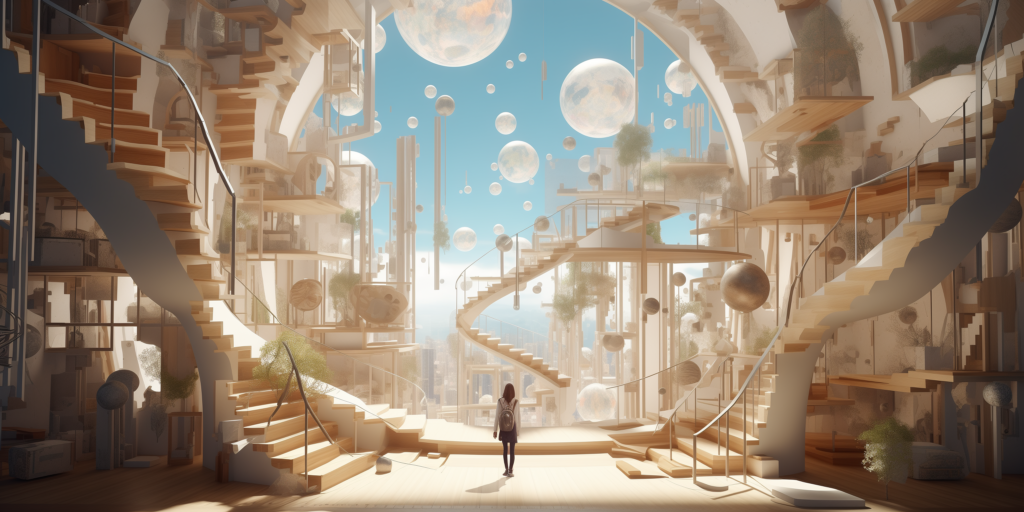
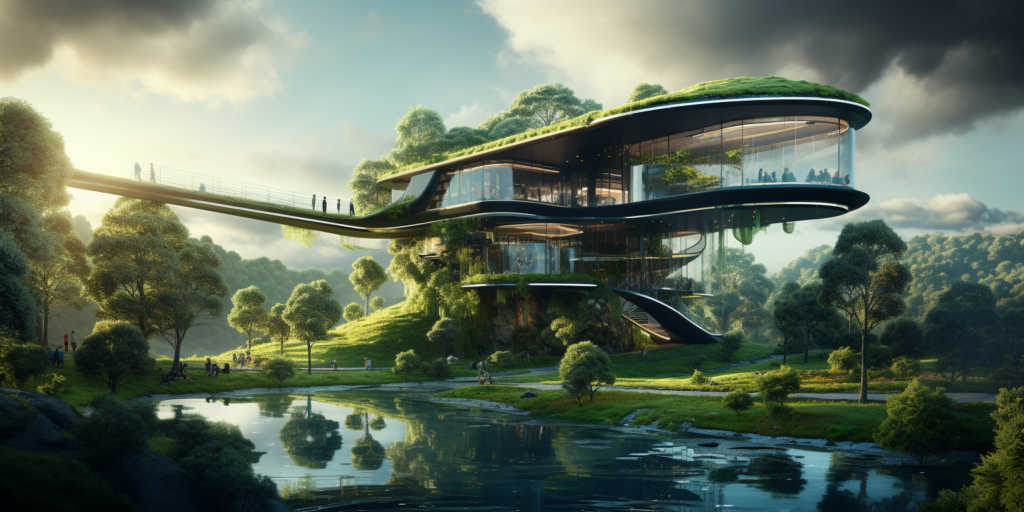
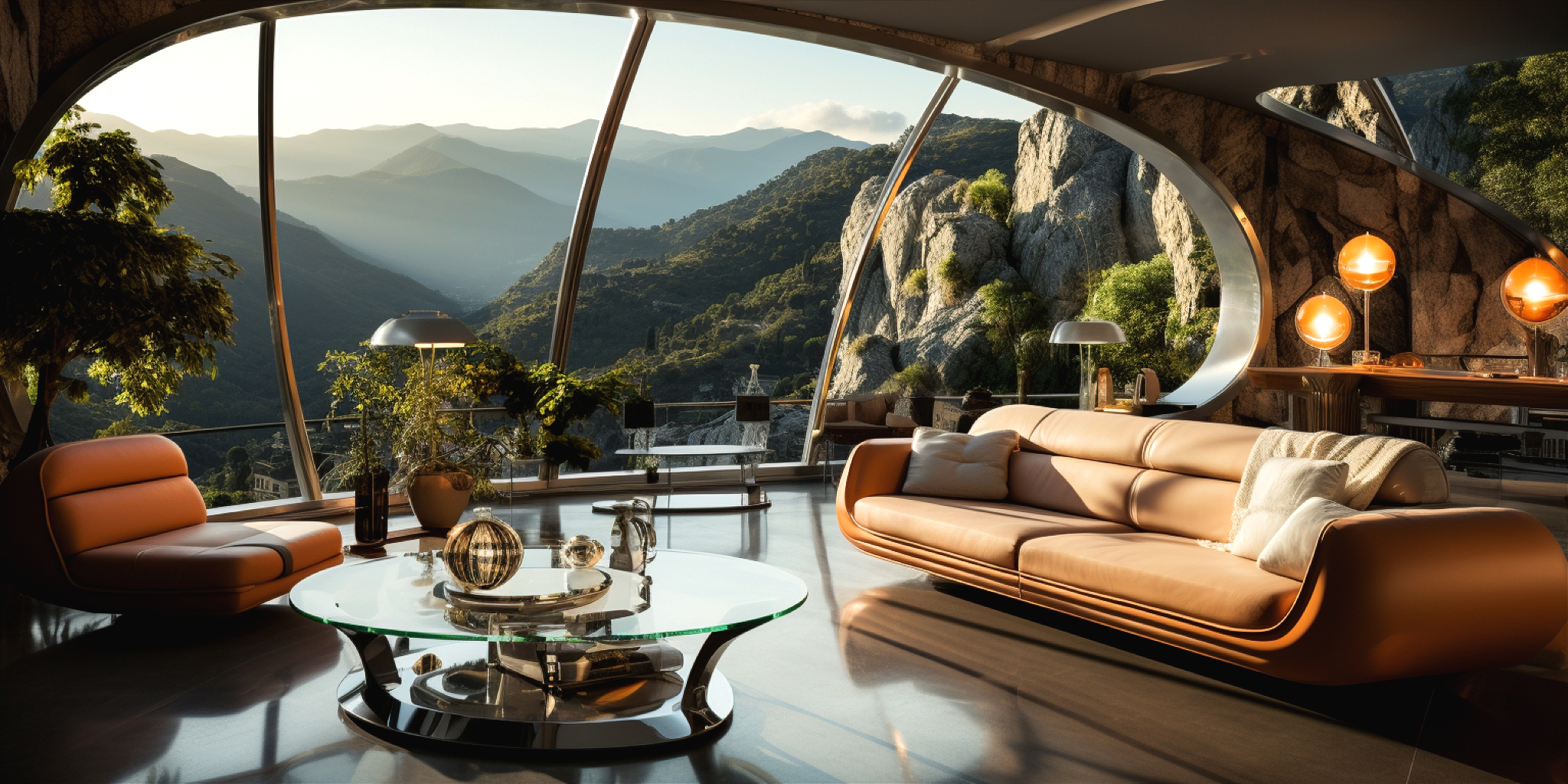
AI images generated using Midjourney.

Reference

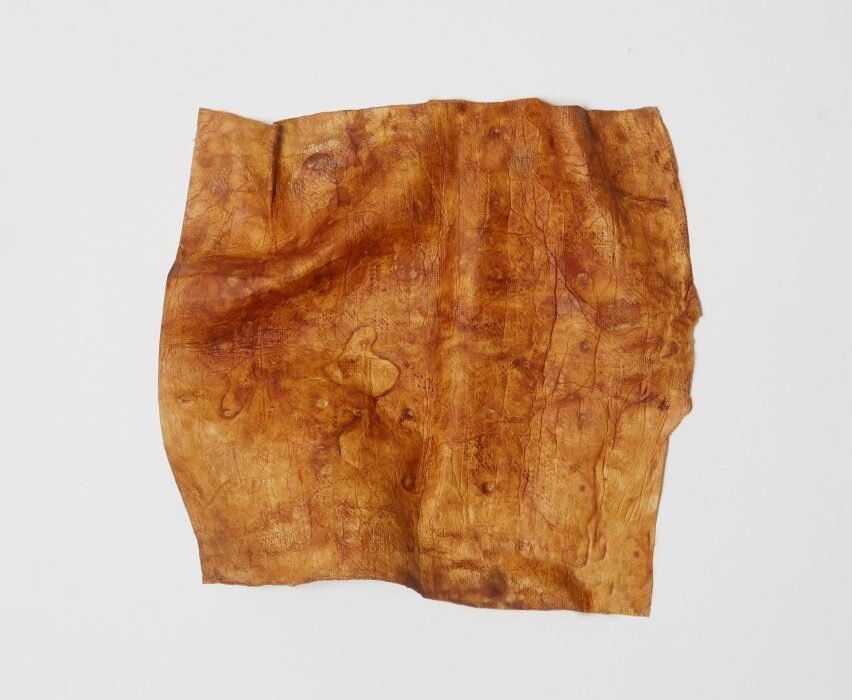
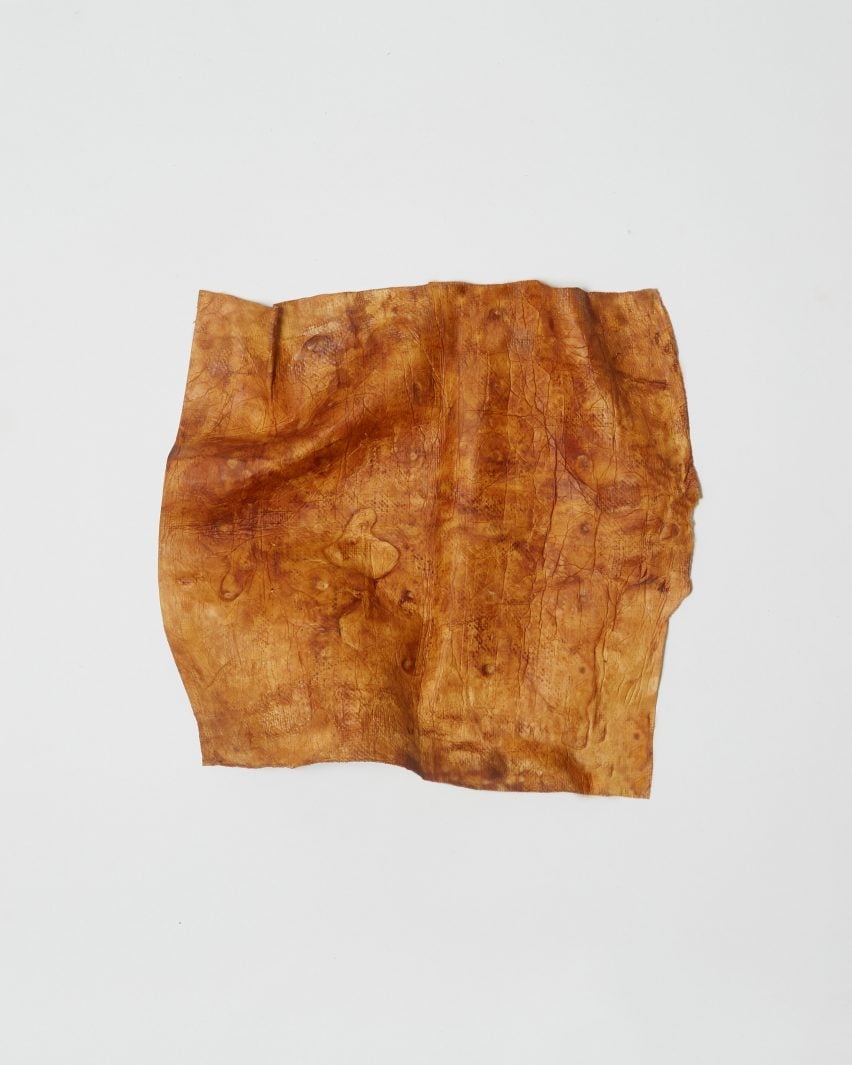
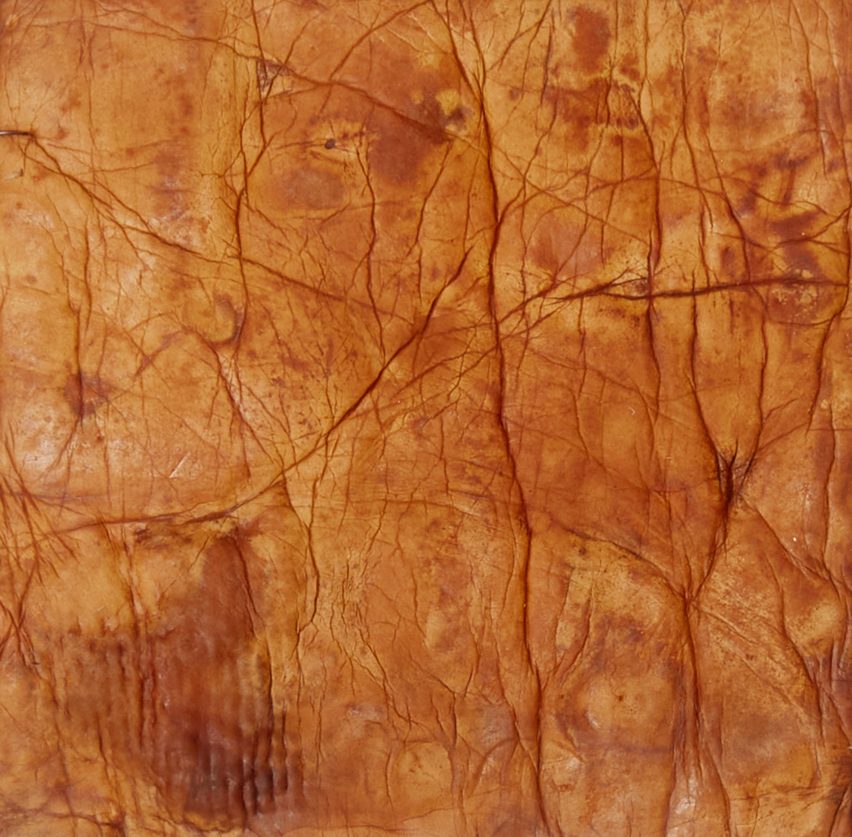
A small square piece of leather-like material, in a mottled hue of caramel brown
CategoriesSustainable News

Food-waste dyes bring colour to mycelium leather by Sages and Osmose

Two British materials companies, Sages and Osmose, have collaborated to dye sheets of mycelium with natural food waste, mimicking the appearance of tanned leather and suggesting a colourful future for the biomaterial.

Osmose is a company making a leather alternative from mycelium – the fibrous underground root network of mushrooms – while Sages makes natural dyes from food waste such as avocado pits, blueberries, red cabbages and onion skins, which are normally applied to textiles.

The two believe they’ve achieved a world first with their collaboration, combining two emerging areas of sustainable material development to colour mycelium without resorting to petroleum-based synthetic dyes, thereby keeping the product non-toxic and able to biodegrade safely in soil.

A small square piece of leather-like material, in a mottled hue of caramel brown A small square piece of leather-like material, in a mottled hue of caramel brown
Sages and Osmose have developed a natural dying process for mycelium leather

“There are lots of different types of vegan leather alternatives to traditional leather but the majority of them use either synthetic colourations or they use plasticisers, so they’re non-biodegradable,” said Sages CEO Emily Taylor.

“We wanted to explore an option where we could have a fully biodegradable leather that has also been coloured in a biodegradable and sustainable manner,” she continued.

Companies that prioritise biodegradability have offered mycelium in its natural shades of white and brown or black, which Osmose CEO Aurelie Fontan says is much easier to achieve naturally.

“I think the challenge for mycelium leather was that the offering just wasn’t there in terms of aesthetic,” she said. “When you’re presenting for brands and you’re like ‘we can only do brown’, it’s a little bit boring for them.”

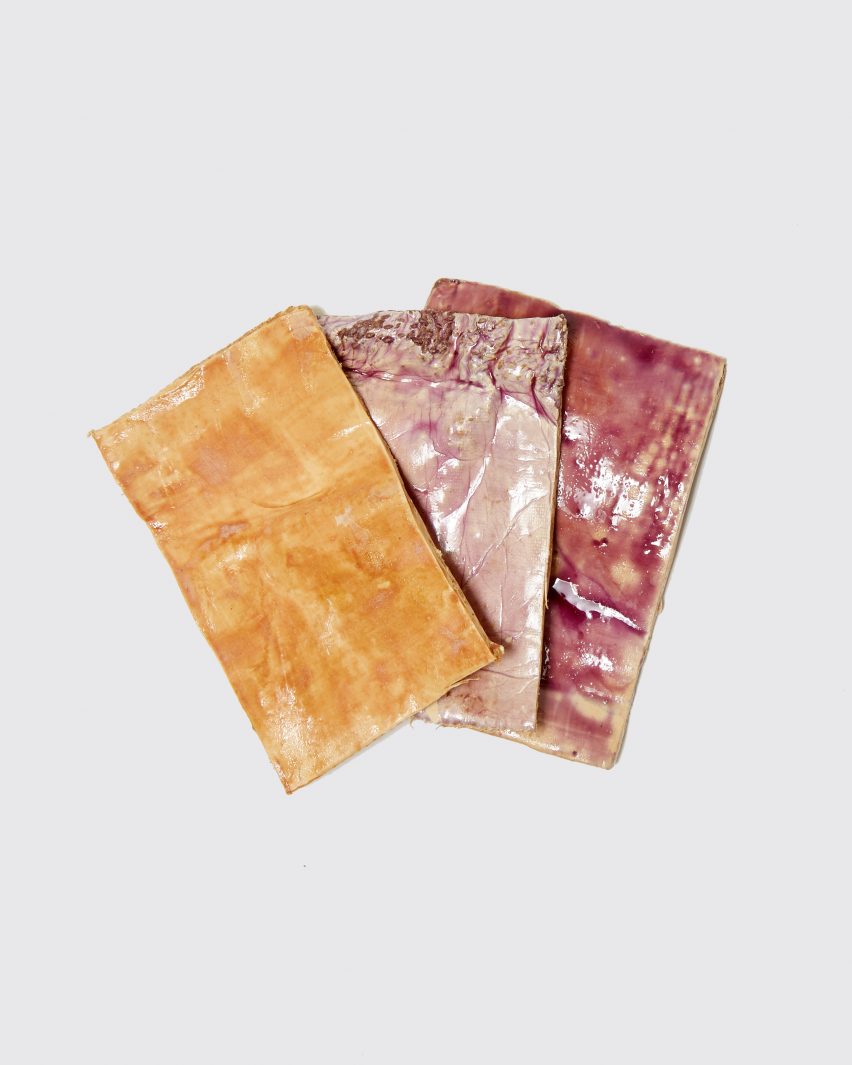
Photo of swatches of mycelium dyed in different shades of tan, pale violet and mulberryPhoto of swatches of mycelium dyed in different shades of tan, pale violet and mulberry
The companies experimented with different food wastes in the dyeing process

“The colour sector is somewhere where you can develop your USP, essentially, which is why working with Sages is so interesting,” Fontan added.

Osmose and Sages have created tan-coloured mycelium sheets using avocado waste, which Sages sources from an importer and guacamole factory in Milton Keynes, where tens of tonnes of leftover pits and skins are produced each week.

It was a new area for both companies, as the food waste dye takes differently to mycelium leather than it does to the usually cellulose-based textiles that Sages has worked with.

The duo collaborated with materials science researchers at the UK’s Cranfield University on the project, for which the researchers focused on how to transfer and fix the dye to the material using “green chemistry” – an area of chemistry that aims to cut out hazardous substances.

In this case, the researchers sought to replace the formic acid and fluorinated acids that are often used in tanning to dissolve the polymers of the leather so it can be infused with dye. Instead, the team developed a method, which they say is significantly less toxic.

After working with Cranfield University, Sages and Osmose expanded the experiment and trialled other waste streams such as blueberries and onion skins to see what colours they could get, producing mycelium swatches in shades of violet and bordeaux.

Taylor and Fontan say they are trying to develop a process for mycelium that is akin to leather tanning, where both colour and durability properties are added in one or two steps. Their equivalent, they say, would be to dye and waterproof the material at the same time.

Close-up of vegan mycelium sheet showing its similarity to the texture of tanned leatherClose-up of vegan mycelium sheet showing its similarity to the texture of tanned leather
The tan colour was created by using waste avocado pits and skins

Osmose’s focus now is on developing a waterproof coating for their mycelium that, like the dye, is bio-based, non-toxic and able to biodegrade safely in soil. This is notoriously a challenge for plant-based leather alternatives, which almost always rely on a protective synthetic coating.

“It’s really hard to design a solution that fits all materials, which is basically what everyone is struggling with,” said Fontan. “Someone might have pineapple leather and they have their own coating but it doesn’t mean it’s going to work on mushroom and so on.”

Unlike some companies, however, Osmose says it does not want to bring a product with a non-biodegradable coating to market.

“If you’re doing a composite, it will not biodegrade at the end of life, which is compromising all the good work that you’ve been doing before that step,” Fontan said.

Mycelium is one of the most popular emerging leather alternatives. It has already appeared in luxury goods such as a bag by Hermes, clothing by Stella McCartney and trainers by Adidas.

Reference

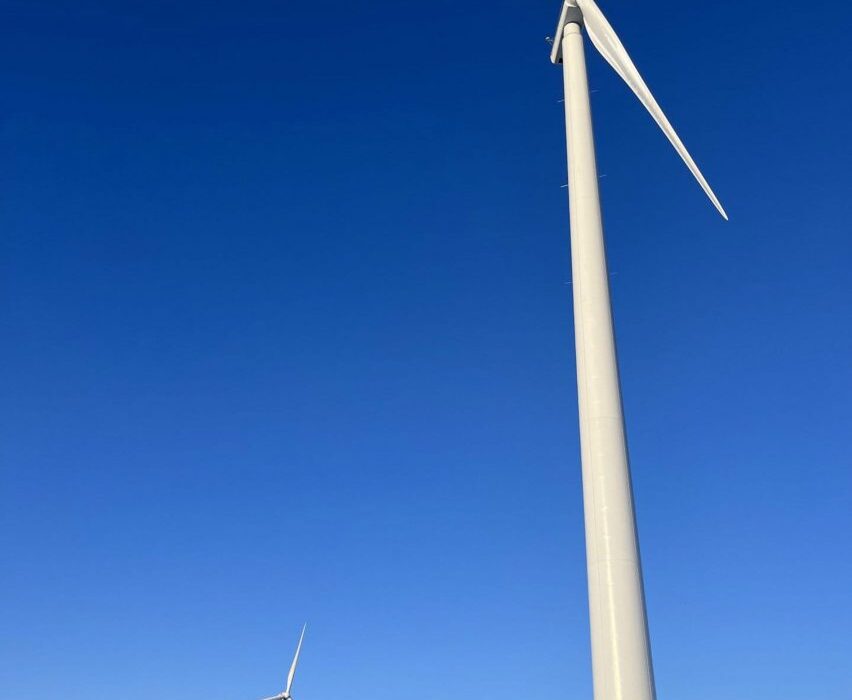
Portrait photograph of a tall wind turbine against a bright blue sky
CategoriesArchitecture

First full-height timber wind turbine opens in Sweden

The world’s first full-scale timber wind turbine has started turning in Sweden, with a tower built by wood technology company Modvion.

The 105-metre-tall tower, located in the region of Skara, is Modvion‘s first commercial wind turbine tower, and follows on from a smaller 30-metre-high demonstration project the company completed in 2020.

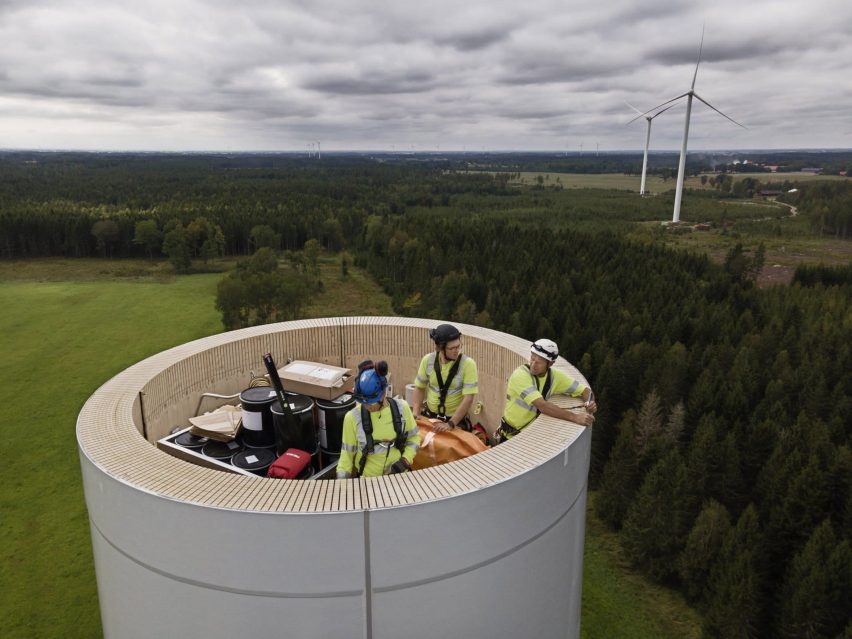
While its rotor blades and generator hub are made of conventional materials, the tower is made of laminated veneer lumber (LVL), a type of engineered wood made of thin veneer strips glued together and often used for beams and load-bearing building structures.

Portrait photograph of a tall wind turbine against a bright blue skyPortrait photograph of a tall wind turbine against a bright blue sky
The tower of a wind turbine in Skara is made of engineered wood

The company says that this type of wood is not only strong enough to withstand the forces of a turning turbine, it is much more environmentally sustainable to build with than the currently used steel.

While wind power plays an important role in providing the world with green renewable energy, there are still ample carbon emissions created during their construction — in part because of the steel towers.

Modvion describes its wood towers as reducing the carbon emissions from wind turbine construction by over 100 per cent, due to the combination of a less emissions-heavy production process and the carbon storage provided by trees.

“Our towers, just in the production of them, they emit 90 per cent less than a steel tower that will do carry the same work,” Modvion chief financial officer Maria-Lina Hedlund told Dezeen. “And then if you add the carbon sequestration, then you actually end up with a minus — so a carbon sink. This is great if we want to reach net zero energy production, and we need to.”

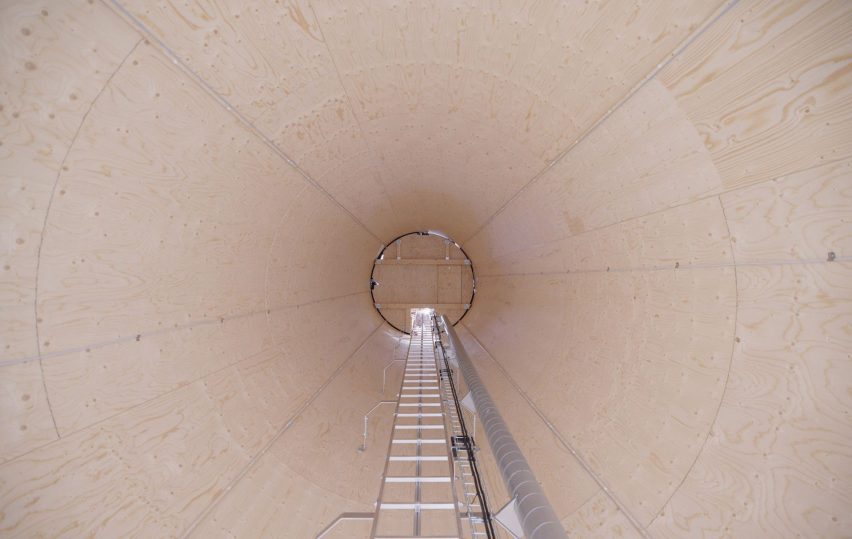
Photo of the inside of a large timber cylinder, with a ladder going up the middlePhoto of the inside of a large timber cylinder, with a ladder going up the middle
The type of wood used is laminated veneer lumber

Hedlund, who is also an engineer, describes LVL as having a construction “similar to carbon fibre”, with strips of veneer just three millimetres thick sandwiched and glued together, giving it a high strength-to-weight ratio.

This lightness is a benefit, reducing the amount of material needed overall. With a heavy material, there is a “bad design spiral”, says Hedlund, as the weight of the tower itself adds to the load that it needs to carry.

And while some LVL has all their veneer strips facing in the same direction, Modvion uses its “own recipe” specifying the directions of the fibres, improving the material’s performance even more.

Photo of three people in work gear on top of an incomplete wooden towerPhoto of three people in work gear on top of an incomplete wooden tower
The turbine tower is the tallest so far built by Swedish company Modvion. Photo by Paul Wennerholm

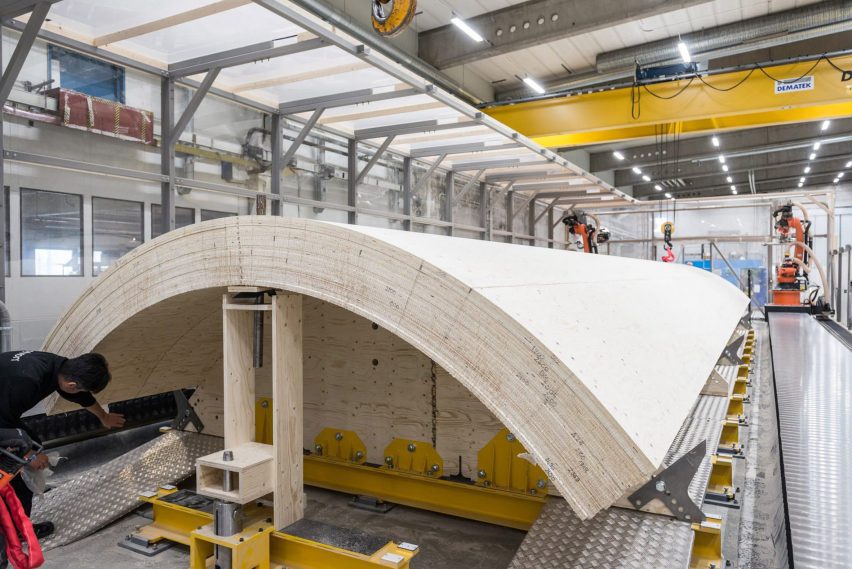
The production process involves timber boards being made to order in a standard LVL plant and then delivered to Modvion’s factory. There, they are glued together into larger modules and bent into a rounded form in a step called lamination, and then very precisely machined to fine-tune the shape.

“In the wood industry, you usually see centimetre tolerances, while we are in the sub-millimetre scale,” said Hedlund.

The modular nature of LVL construction addresses another problem Modvion has observed with steel: that with turbines getting ever bigger to give more power, it’s becoming impossible to transport steel towers to site.

They are built as essentially large cylinders and transported by truck, but the base diameter desired for the tallest towers is getting to be taller than some bridges and roads can allow.

Photo of a giant module of curved laminated veneer lumber being engineered in a factoryPhoto of a giant module of curved laminated veneer lumber being engineered in a factory
The timber is laminated into modules at Modvion’s factory

“We’re now reaching a point where they will not get through anymore,” said Hedlund. “So we will see a transition in the wind power industry to modular construction, because this is the way to get them there. And one of the big advantages of building in the material we do is that it’s naturally built modular.”

While steel could also be built modular, it would require bolts rather than glue to join it together on site, which Hedlund says is a disadvantage.

“Bolts are not very nice when you have so much dynamic loading, because it will loosen over time,” she said. “So first of all, you have to have to put them in place which is a lot of work, and then you have to also service them over the lifetime.”

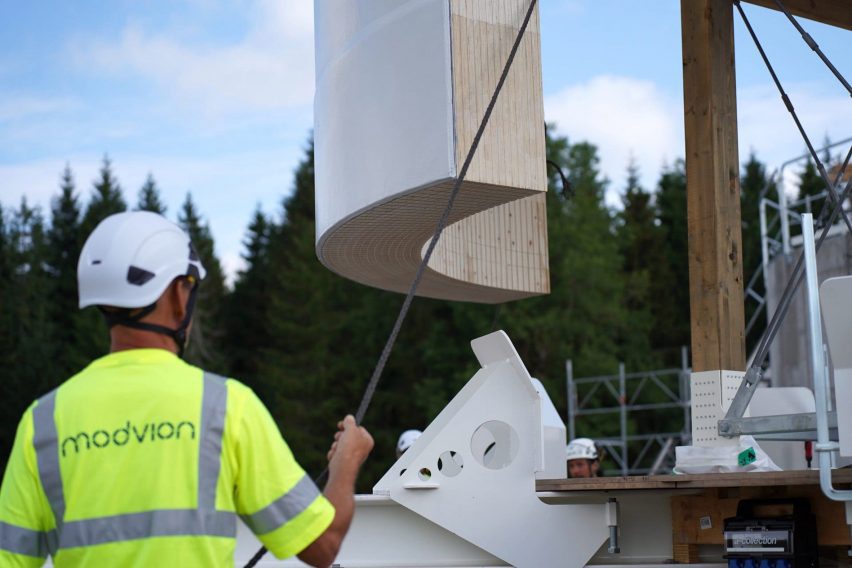
Photo of a worksite with a man in hi-vis operating machinery in the foreground and a large curved module being lowered into place in front of himPhoto of a worksite with a man in hi-vis operating machinery in the foreground and a large curved module being lowered into place in front of him
The modules were assembled and glued together on site

The Skara turbine has a capacity of two megawatts, which represents the maximum power output the turbine can achieve under ideal conditions. This is a bit lower than the average capacity for new turbines built in Europe.

On the outside, the tower has a thick white coating that makes it look similar to steel, and it’s rotor blades and generator hub, which are not supplied by Modvion, are made of conventional materials like fibreglass. This may change in the future, however, with another company, Voodin Blades, working on the technology for wooden blades.

Modvion was founded in 2016 by university peers David Olivegren and Otto Lundman. While its current focus is wind turbines, it is dedicated to wooden technology more broadly, and Hedlund told Dezeen that the team believes it has “the world’s strongest joint for timber construction”, which could also be put to other uses.

Another recent milestone for wind power came in the form of a wind-powered cargo ship, which had been retrofitted with two 37.5-metre-tall sails.

Reference

A cluster of houses in The Sims 1
CategoriesInterior Design

The Sims is a key part of why I ended up in interior design

The Sims has been allowing players to act out their architecture and interior design fantasies for more than two decades. Jane Englefield finds out how the makers of the iconic life-simulation video game keep up with shifting trends.

“People laugh when I mention playing The Sims, but it was hugely significant in terms of spatial planning and was a key part of how and why I have ended up in the line of interior design work that I have,” interiors stylist and editor Rory Robertson told Dezeen.

“The Sims offered people the opportunity to get a feel for design,” he reflected. “You could be as extravagant and outrageous, or as briefed and restricted as you liked.”

A cluster of houses in The Sims 1A cluster of houses in The Sims 1
The Sims was first released in 2000 with three sequels since developed

Created in 2000 by American game designer Will Wright, The Sims is a video game where players make human characters – or “sims” – and build their virtual houses and lives from scratch, catering to their needs and desires.

With four iterations of the main game and dozens of themed expansion packs focussing on topics such as university, parenthood and cottage living, The Sims is one of the best-selling video-game franchises of all time.

“It’s really accessible”

Architecture and interior design has been a major part of The Sims experience from the very beginning.

Having previously created the city-building game SimCity in 1989 – which itself has been credited with inspiring a generation of urban planners – Wright was originally motivated to develop The Sims after losing his home in the Oakland firestorm of 1991 in California.

In fact, early designs were for an architecture game, with the shift to focus on people a relatively late addition to the concept, according to one of the game’s first art directors, Charles London.

Design remained a core part of the offering, however, and the interface features tools that allow players to instantly build structures and decorate and furnish them from an extensive inventory of items.

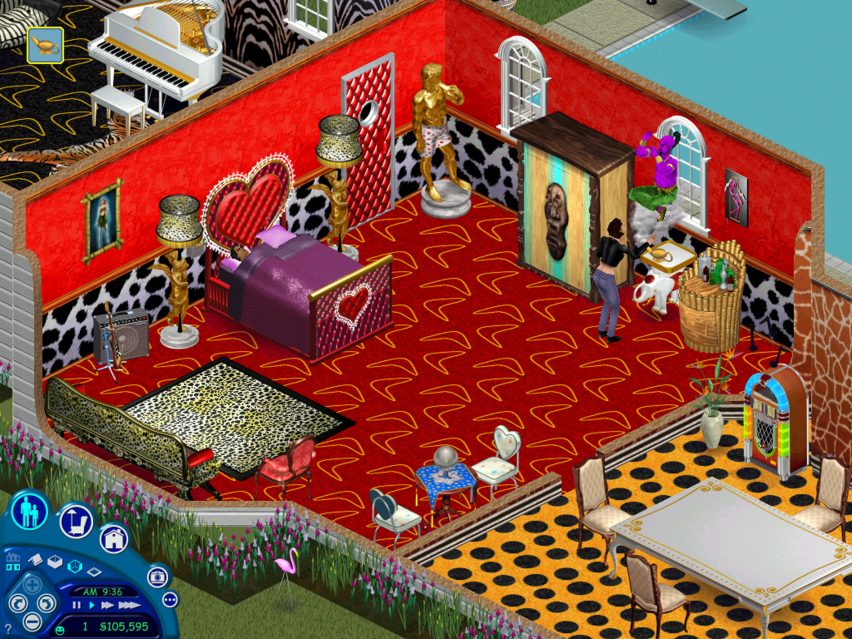
Decorated bedroom in a house in The Sims 1Decorated bedroom in a house in The Sims 1
Players can choose from a wide inventory of decor and furnishing options

“It’s really accessible, so I think a lot of people get into it without even realising that they’re playing with architecture and playing with space,” said video-games expert and historian Holly Nielsen.

“While it was like catnip for design budding minds, it was also just a wonderful opportunity for procrastination and frivolity for people who aren’t particularly confident or tuned in to interiors or architecture,” echoed Robertson.

Since the original The Sims, a broad set of options has been available for players to suit their tastes and imaginations.

Possibilities have ranged from minimalist bungalows filled with neutral furniture to more outlandish dwellings, such as castles defined by Dalmatian-print wallpaper or hot tubs parked in the middle of multiple living rooms.

“We’ll take any source”

The team behind these possibilities described how they ensure that the architecture and interior design options stay feeling fresh and contemporary with each new game in the series.

“Since we’re a game about real life, anytime we step outside our door we have inspiration by just looking at what’s in our immediate environment,” game designer Jessica Croft told Dezeen.

Art director Mike O’Connor added that he and his team scour the real world and the web for up-to-date references.

“We’ll take any source,” he said. “We’re looking for patterns. If we start to see round furniture, or bouclé, or whatever the trend is, [we ask] has it already gone?”

“The internet doesn’t scrub old ideas. So you know, it’s seeing if there’s a trend, is it sticking, does it apply to what we’re doing now?”

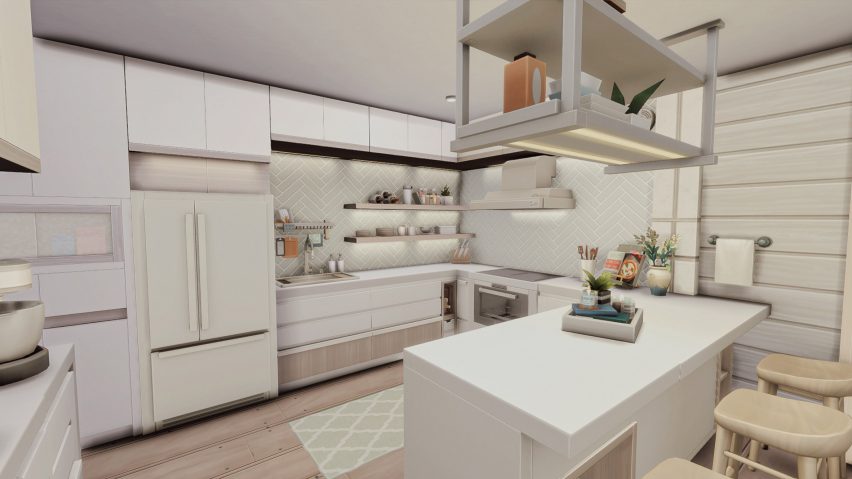
Minimal Sims kitchenMinimal Sims kitchen
The in-game design possibilities have evolved over time to keep up with trends

Furniture and appliances within the game are regularly revised over time to reflect cultural and technological progression in the real world, Croft explained.

“In Sims 2 [released in 2004] I would not be surprised if there was a landline phone – and there definitely isn’t a landline phone in my own house, or Sims 4,” she said.

“Even things like VR [virtual reality] didn’t really exist back in The Sims 2 days, so things like VR consoles, computers – we just added dual-monitor computers, and LEDs are now in most households,” she continued.

That in turn sees the team take a surprisingly deep dive into how interiors are changing, O’Connor acknowledged.

“Over the life of this game, you see an evolution,” he said. “Electronics are probably the biggest category [of change]. Even just how people use TVs, how they place them, has changed.”

The idea, says Croft, is to ensure that The Sims players feel a close connection to the world they are building for their sims.

“The most fun thing for me is being able to allow players to craft stories that are relatable to them,” she said. “So, looking for opportunities to make players feel seen.”

“An element of freedom and fantasy-building”

But, as Nielsen points out, there is an additional aspect to the game’s architecture and design possibilities that is central to its appeal.

“In one sense, it’s reflective of society, but in another way, it’s aspirational,” she said.

“There’s an element of freedom and fantasy-building to playing The Sims,” she continued. “Homeownership is a thing that a lot of us will not get to do.”

As in real life, everything you build or buy in The Sims has a cost.

However, unlike in real life, punching “motherlode” into The Sims cheat-code bar will immediately add a healthy 50,000 simoleons to your sim’s bank account, putting that luxury sofa easily within reach.

Low-lit house within The Sims 4Low-lit house within The Sims 4
The game offers people “the opportunity to get a feel for design”

That possibility remains central to Robertson’s nostalgia for playing The Sims as a young would-be interior designer.

“Once you double-clicked The Sims graphic on your Microsoft desktop, a multi-roomed mansion cost nothing to design,” he said.

This aspirational element has become an increasingly large part of The Sims’ commercial model over the years.

The Sims 4, as an example, is accompanied by 19 purchasable “Stuff Packs” that expand the options of items available to buy, including “Perfect Patio”, “Cool Kitchen” and one based on the products of Milan fashion label Moschino.

And the latest of the more extensive expansion packs is For Rent, which allows players to build rental houses where some sims are landlords and others are tenants.

Within the game, landlords encounter various true-to-life issues, including the potential for toxic mould build-up in their properties – although, unlike in the real world, the mould feature can be toggled on and off.

Inclusivity has also become an increasing focus of The Sims, with integral features now including options to choose sims’ sexual orientation, for instance.

For Nielsen, that traces back to a significant foundational element of the game’s widespread appeal – as well as being one of the reasons it has had such strong interior-design influence.

“It didn’t feel like it was aiming for anyone,” she explained. “One of the things that people bring up a lot is that it has a very female player base.”

“For me, it was a big turning point – it was getting to create the spaces but also play around with the people inside them. It felt like a socially acceptable way to play dollhouses.”

The images are courtesy of Electronic Arts.

Dezeen In Depth
If you enjoy reading Dezeen’s interviews, opinions and features, subscribe to Dezeen In Depth. Sent on the last Friday of each month, this newsletter provides a single place to read about the design and architecture stories behind the headlines.



Reference

Photo of plastic bottles
CategoriesSustainable News

We need to design for human behaviour to get rid of single-use plastics

Packaging designs aimed at boosting recycling rates and reducing the prevalence of single-use plastics are destined to fail unless they help to change people’s behaviour, writes Matt Millington.


No one is particularly happy when they find out there’s plastic waste on Mount Everest, or in the deep oceans, or in human blood. It’s not controversial to say that we need to stop churning the stuff out and throwing it away.

One way for businesses to tackle single-use plastics is to design their packaging to be reusable, but so far efforts have not succeeded at scale.

For example, reusable McDonald’s cups are only getting a 40 per cent return rate from customers in Germany, despite consumers paying a €2 deposit. When Starbucks trialled reusable cups in the closed environment of its Seattle HQ, where returning them is presumably straightforward, the return rate still didn’t exceed 80 per cent.

We weren’t exactly succumbing to dehydration on the streets before coffee shops designed takeaway cups

It’s not that we don’t care: research suggests consumer motivation towards environmentally positive behaviour is high. It’s that as a society we have developed an expectation of convenience: to have what we want, when we want it, without any consequences.

This is entirely unreasonable – we weren’t exactly succumbing to dehydration on the streets before coffee shops designed takeaway cups – but while it persists, consumers are very unlikely to switch to reusable alternatives if it puts them out. And without a high return-and-reuse rate, reusable packaging is usually worse for the environment, owing to the much higher quantities of plastic involved.

This is why we need to design for human behaviour if we’re ever to get rid of single-use plastics. You cannot control what people will do with packaging once it leaves your premises, but you can influence them by factoring behavioural psychology into the design of the packaging itself.

The first step is understanding how consumers interact with the pack, throughout its lifecycle. Where are they and what are they doing when they open it? What’s their headspace? How about when they’re finished with it? There’s a big difference between how someone interacts with a reusable plate after a meal in a cafeteria, and how they interact with the reusable salad bowl they’re gobbling from on the lunchtime rush back to the office.

Then it’s about understanding the levers you can pull to nudge people towards more planet-positive decisions. Behavioural psychology shows there are three factors that work together to drive behavioural change: increasing consumer motivation to recycle or reuse, raising their ability to do so, and providing a trigger to remind them.

Take plastic bags. While usage of single-use bags has dramatically decreased in the UK since legislation requiring retailers to charge for them came into force in 2015, reusable alternatives have had mixed success. According to a report by the Environmental Investigation Agency and Greenpeace, 57 “bags for life” were sold for each household in the country in 2019 – more than one a week.

It’s possible to go too far in signalling that a pack isn’t disposable

Online grocer Ocado uses recyclable bags instead, but it has had success in achieving returns because it pulls all three behavioural psychology levers. Consumers are happy to receive bonus reward points for each bag they give back (motivation).

The bags are straightforward to return and customers know not to throw them away because of their clear messaging and distinct off-grey colour, which follows from not using harmful bleaching agents (ability). And because the driver usually asks for old bags after delivery, they’re unlikely to forget (trigger).

Ability is the key consideration. If you wanted to return the packaging from a takeaway burger meal, it would mean washing and then carrying around a bulky burger box, fries box and cup, and either making a special trip to the restaurant or waiting until you happen upon another branch.

New Zealand start-up FOLDPROJECT has done some interesting work here, trying to make boxes more portable. It’s a simple idea: a machine-washable lunch kit that packs down to a flat sheet. The challenge is that because it is so minimal, its form and material make it look disposable.

One way to ensure a reusable design communicates its intended purpose is through material choice. For example, using explicitly post-consumer recycled plastic could be a visual shorthand to communicate a planet-positive intent, as could using longer-lasting materials like glass or stoneware.

Interestingly, it’s possible to go too far in signalling that a pack isn’t disposable. When McDonald’s introduced reusable packaging in its restaurants in France, it found the packaging kept disappearing, only to reappear on eBay. It looked reusable and on-brand, but was too novel for some, defeating the object.

So long as we have bins on every street that lead directly to landfill, we are going to struggle

Businesses cannot just switch to reusable packaging – even when intelligently designed – and expect results. So long as we have bins on every street that lead directly to landfill we are going to struggle.

We therefore need to think beyond just designing the packaging to be sustainable, and think about how we design systems to be sustainable. In a circular economy that means service and experience design, packaging, industrial design, marketing, data, artificial intelligence and logistics all working hand-in-hand to keep the pack “in the loop”. It will therefore need to be an ecosystem effort.

We’re already seeing innovations that can help make reuse and return viable in the age of convenience. For example, when is a bin not a bin? When it’s a Bjarke Ingels Group-designed TURN system – a remote, digitally connected, RFID-enabled, packaging-asset reclaim and sorting network, which rejects unwanted trash.

Similarly, we’re seeing nudge messaging along the pack journey, and even packs that communicate their status themselves. Scottish start-up Insignia has designed colour-changing labels that reveal how long a pack has been exposed to the environment. Imagine taking this further, with reusable packaging telling you what to do with it, and offering prompts or rewards to encourage you.

Reusability hasn’t hit scale yet, but we should be optimistic that it can, not least because we’ve been there before. Milk deliveries were once the norm, with bottles returned, not discarded.

There’s no reason that we can’t get back to this more sustainable approach across the board, without having to endure too much inconvenience. All that’s required is a little ingenuity, and a lot of collaboration.

The photography is by Jas Min via Unsplash.

Matt Millington is a sustainable-design strategist at PA Consulting.

Dezeen In Depth
If you enjoy reading Dezeen’s interviews, opinions and features, subscribe to Dezeen In Depth. Sent on the last Friday of each month, this newsletter provides a single place to read about the design and architecture stories behind the headlines.

Reference

From Float Glass to OLEDs: How Recent Advancements in Glass Technology Are Reshaping 21st Century Design
CategoriesArchitecture

From Float Glass to OLEDs: How Recent Advancements in Glass Technology Are Reshaping 21st Century Design

Architizer’s A+Product Awards celebrate the manufacturers at the forefront of material innovation. If your brand is innovating in product design for architects, consider entering today:

Enter the A+Product Awards

It might be hard to believe in today’s see-through society, but glass was once a scarce resource used sparingly in architecture. In the early years, glass was a medium for divine storytelling. The Sainte-Chapelle in Paris, a stunning structure completed in 1248, illustrates 1,113 scenes from the Old and New Testaments across a massive surface area of 6,888 square feet (640 square meters) of stained glass windows. Although beautiful, the windows were not decorative. They were an educational tool to teach religion to an illiterate population — 13th-century marketing at its very best.

By 1851, Joseph Paxton had designed and built The Crystal Palace for The Great Exhibition in London. With its vast expanse of plate glass panels and cast iron framework, the structure redefined the possibilities of architecture and design. As time and technology progressed, the float glass process (pouring the molten glass from a furnace into a chamber that contains a bed of molten tin), conceived by Sir Alastair Pilkington in 1959, was groundbreaking. It enabled the creation of large, uniform glass sheets that were less time-consuming to manufacture and more stable. The new process allowed glass to be seen as a structural element rather than a decorative addition.

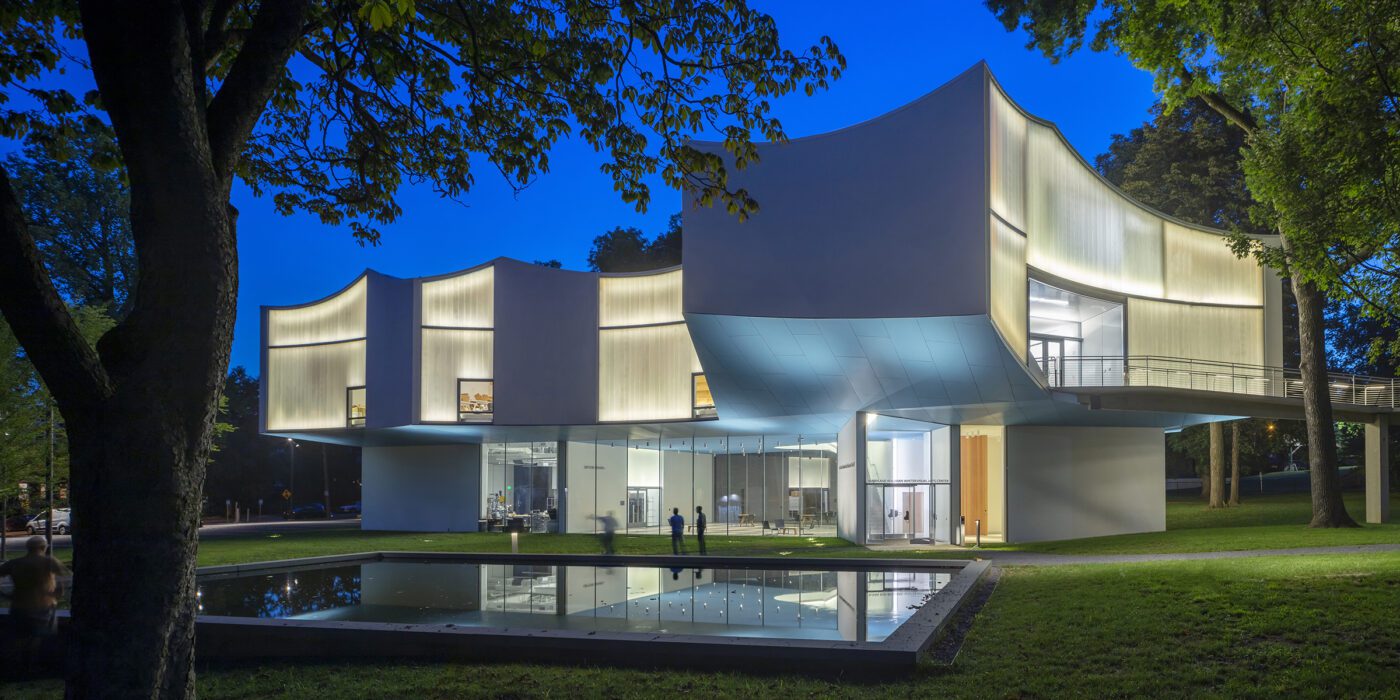
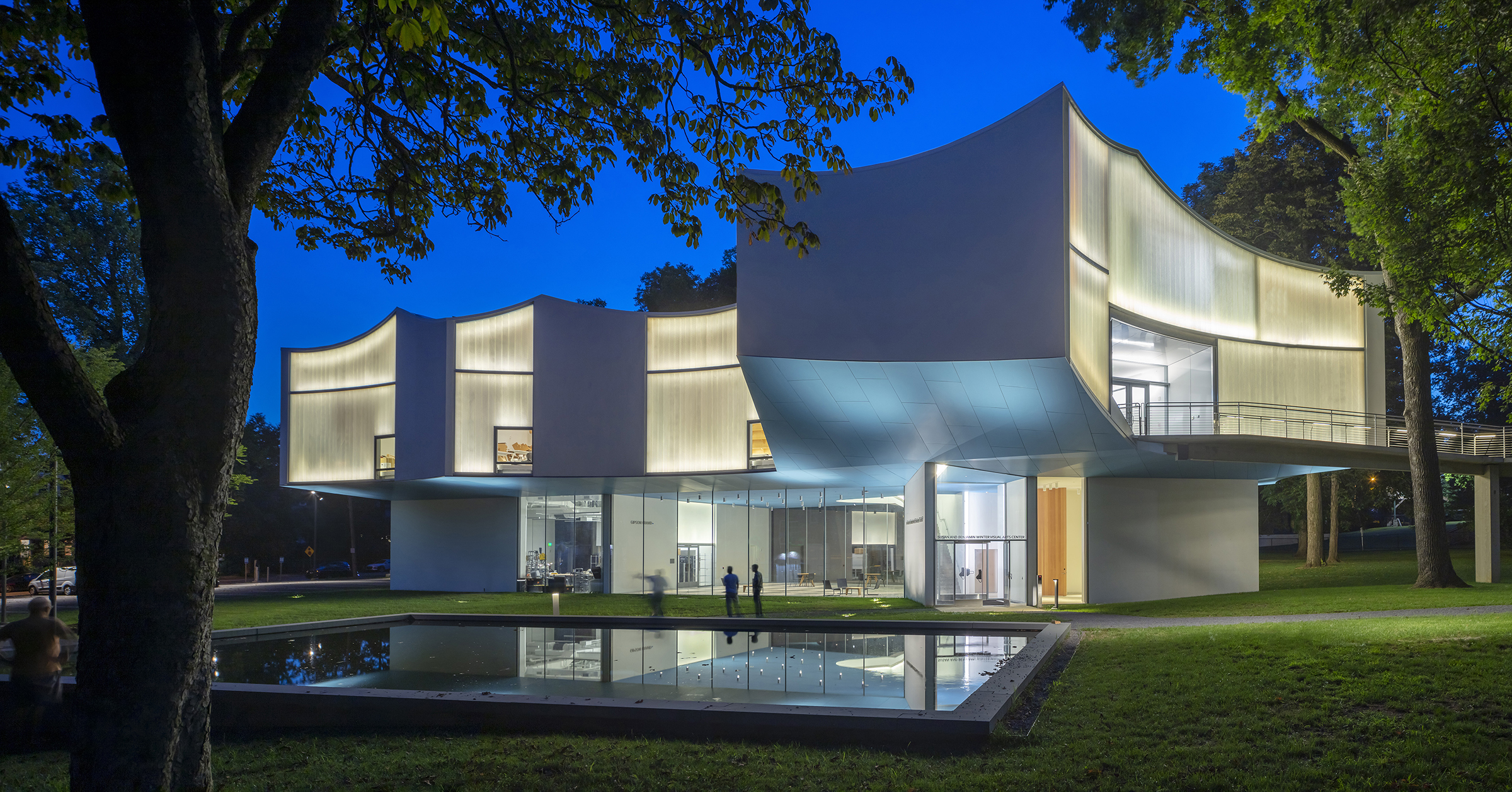
Double-Curved Channel Glass Walls by Bendheim. Finalist, 2022 A+Product Awards, Best of the Year, Architectural Design 

By the time Modernism came into its own, a new vision of glazing was well underway — influenced mainly by the ever-experimental Ludwig Mies van der Rohe. Mies’s philosophy of “less is more” led to a minimalist aesthetic where glazing allowed architects to move away from the solid, enclosed walls of traditional design to a language of openness and fluidity. This work laid the foundation for the modern skyscraper and encouraged a shift towards integrating buildings with their environment, emphasizing nature and light. It was a pinnacle time for glazing advancement, and now, 100 years on, we are entering a new phase of glazing innovation.

The market for advanced glazing technologies is robust and expanding. Industry analyses, such as those conducted by Grand View Research, indicate that the global smart glass market, valued at USD 4.22 billion in 2020, is anticipated to grow at a compound annual growth rate (CAGR) of 6.8% from 2021 to 2028. This growth trajectory is propelled by the escalating demand for energy-efficient and technologically sophisticated building solutions. The market expansion reflects a broader architectural trend toward buildings that are not just structures but adaptive, energy-efficient systems.

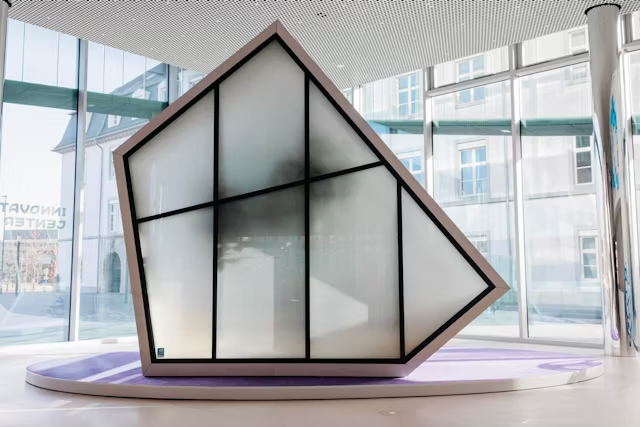
eyrise i350 Invisible Privacy Glazing by Merck KGaA. Jury Winner, 2022 A+Product Awards, Best of the Year, Health & Wellness 

Smart glass technologies, like electrochromic glass, are at the forefront of such innovation. Using a minimal electrical charge, electrochromic glass can transition between transparent and opaque states, offering dynamic control over both natural lighting and privacy while significantly impacting energy efficiency. For instance, in its opaque state, electrochromic glass can block solar radiation, substantially reducing the need for air conditioning in buildings. According to a U.S. Department of Energy report, smart windows have the potential to save up to 20% in annual energy costs, marking a substantial stride in building energy efficiency through one of the most used materials in construction.

Enter the A+Product Awards

Sustainability is one of the key drivers in the evolution of glazing technologies, with an emphasis on integrating recycled materials into the production process being a priority. The use of cullet, or recycled glass, in glass manufacturing has been bolstered by new sorting and cleaning technologies that efficiently prepare the recycled glass for melting, causing less waste and using less energy.

SunGuard SNR 50 coated glass by Guardian Glass. Popular Choice Winner, 2022 A+Product Awards, Façades & Openings, Glass & Glazing

Thanks to these new recycling techniques, coatings derived from recycled glass are being used more frequently. Low-emissivity (Low-E) coatings featuring microscopic layers of metallic oxides are becoming ever more popular. These glasses effectively minimize thermal transmittance while maintaining high levels of light transmittance. As do solar control coatings that selectively reflect infrared solar radiation, reducing heat gain and glare. In the context of urban design, these technologies lower heat absorption, thereby lowering ambient temperatures throughout our warming cities and reducing the urban heat island effect, a growing concern in densely populated cities.

Yet it’s not all about sustainability and climate. Multifunctional glazing solutions are reshaping the role of glass in architecture. These advanced solutions, integrating features like LED displays and touch-screen capabilities, are transforming windows from passive elements into interactive, multifaceted platforms. This transformation is underpinned by advances in optoelectronic engineering, enabling the integration of Organic Light Emitting Diodes (OLEDs) directly onto glass surfaces. These OLEDs provide energy-efficient, high-quality displays. Touch-screen functionality is achieved through the application of transparent conductive oxides (TCOs), which offer capacitive touch recognition without compromising the transparency of the glass.

Experts in the industry are highly optimistic about the potential of such technologies. With a simple touch, users can control lighting and privacy and have immediate access to information, making buildings more functional and adaptable.

Enter the A+Product Awards

Digital display glass provides a platform for real-time information dissemination; things like weather updates, service information, local points of interest, or even emergency alerts can be shown on the building itself. From a commercial perspective, digital display glass holds great potential, with it being used for advertising or showcasing products, offering business opportunities, and reaching broader audiences. Although advertising is a popular function, architects and designers have an opportunity to utilize this technology as a space for artistic expression, integrating digital art, animations, or dynamic visuals that can contribute to the aesthetic language of buildings.

Similarly, the integration of augmented reality (AR) and interactive features in smart glass technologies are pushing digital imaging and sensor technology. AR functionalities can be embedded in glass through the use of micro-projectors and transparent photovoltaic cells, allowing buildings to communicate and engage with occupants in unprecedented. This integration signifies a leap in the application of photonics and digital interactivity in architectural design, pointing towards a future where buildings offer not just shelter but dynamic, responsive environments.

In educational or public spaces, digital display glass and AR features can be used as a dynamic learning tool, displaying educational content, interactive exhibits, or historical information, enriching the learning experience and promoting knowledge while providing opportunities to increase accessibility in buildings, ensuring that everyone can benefit from the technology in a surreal revisiting of glazing’s original purpose from the 13th Century.

In essence, like much of our industry, glazing is witnessing a revolution marked by innovation, a commitment to sustainability, and a focus on enhancing human experiences. The enthusiastic embrace of these technologies by industry experts and leading architects underscores a shared commitment to innovating for a better, more sustainable, and aesthetically enriching future.

Enter the A+Product Awards

Architizer’s A+Product Awards celebrate the manufacturers at the forefront of material innovation. If your brand is innovating in product design for architects, consider entering today.

Reference

Image of an army green bed
CategoriesSustainable News

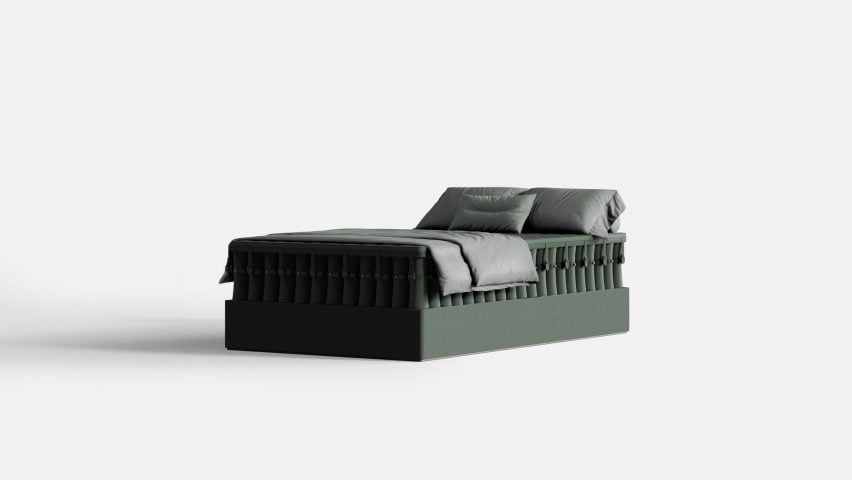
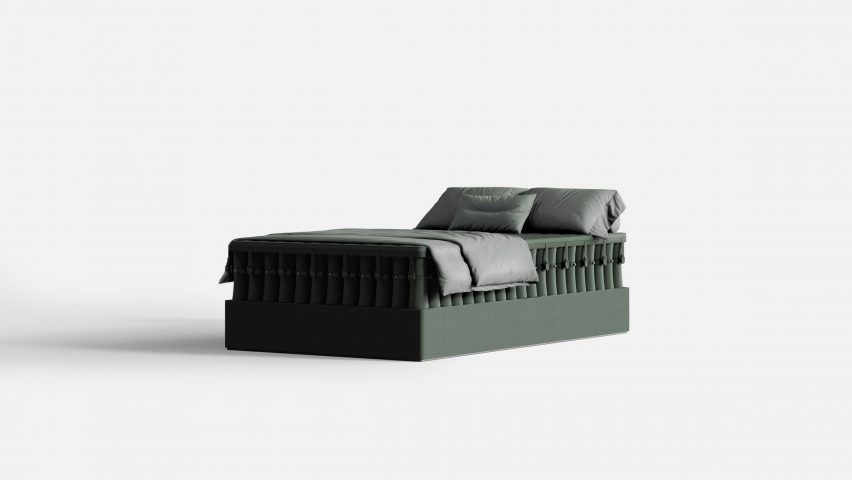
Layer rethinks bed design with Mazzu disassemblable mattress

British design studio Layer has aimed to bring sustainability to mattress design in a collaboration with Chinese start-up Mazzu, creating a modular, foamless product made up of textile-covered springs.

The Mazzu Open mattress was designed to have the comfort of a traditional sprung mattress while being adaptable, repairable and easy to pack down when moving house, so as to prolong the product’s life.

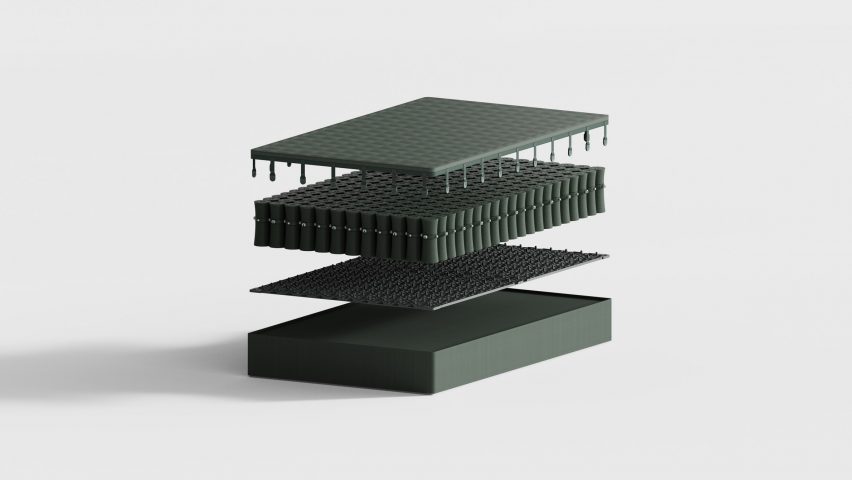
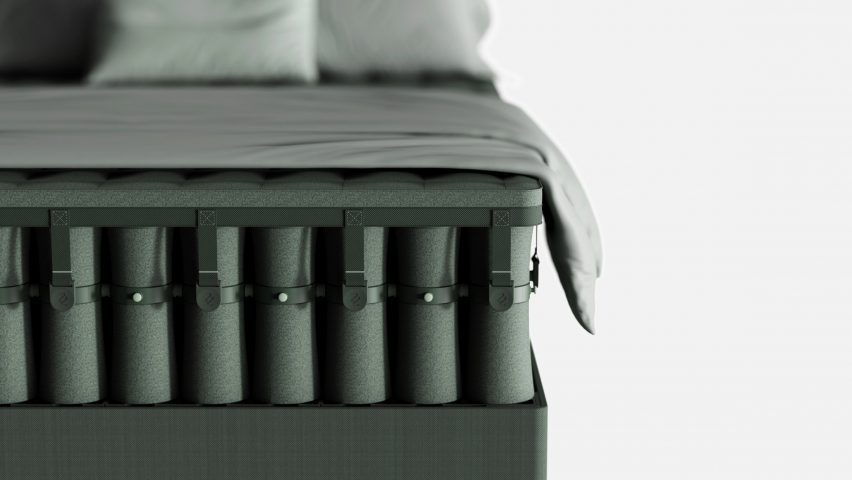
The design features row upon row of individually textile-wrapped pocket springs, which sit sandwiched between a base “matrix” and a cushioned topper to hold them in place.

Image of an army green bedImage of an army green bed
The Mazzu Open mattress is foamless and made up of modular, textile-covered springs

All its components are either recyclable or biodegradable, and no glue was used in the construction of the mattress.

The structure — left open at the sides for a distinctive, utilitarian look — also has the benefit of being hygienic, according to the studio, as users can check the inside of the mattress and take it apart to clean every element.

The modular design of the mattress means buyers can treat the springs like “pixels”, choosing between three levels of firmness for each point in the matrix to create a support pattern of their choosing. This also allows couples to customise their own side of the bed.

Exploded image of the Mazzu Open mattress, showing a base layer, a matrix layer, a layer of springs stacked into a mattress shape and a cushioned top layerExploded image of the Mazzu Open mattress, showing a base layer, a matrix layer, a layer of springs stacked into a mattress shape and a cushioned top layer
The springs are held in place by a grid layer

Additional spring modules and a different base and topper can be added to change the size of the mattress, and the whole kit can compress down to around 80 per cent of its size when disassembled.

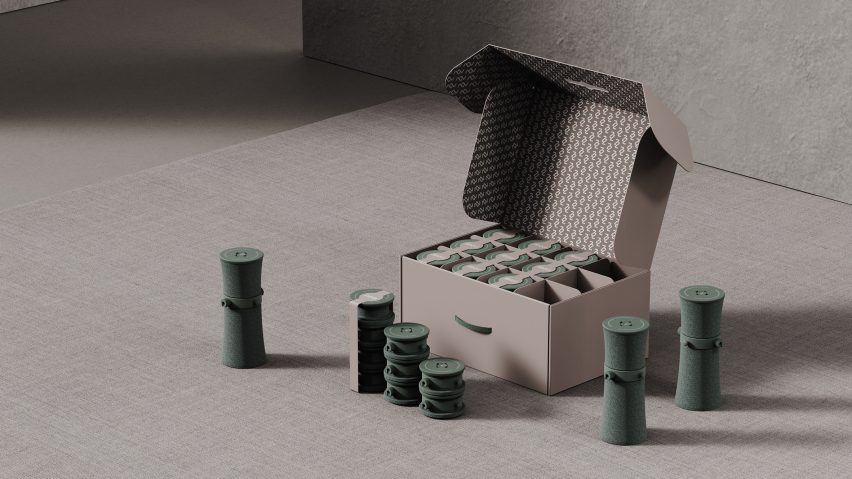
The mattress comes in a reusable packaging system, also designed by Layer, that sees it divided into small components and split across several cartons, each weighing less than 10 kilograms. The spring modules compress from 250 millimetres to 50 millimetres in height as part of this.

Layer founder Benjamin Hubert told Dezeen that the studio tried to tackle multiple problems with current mattresses in one go with Mazzu, ranging from the impracticability of transporting them to the lack of customisation.

Close-up of a bed with an open mattress made of textile-covered springs stacked densely togetherClose-up of a bed with an open mattress made of textile-covered springs stacked densely together
The mattress has an open structure that gives it a unique aesthetic

“They are too bulky once you unpack them and they ‘inflate’ from their compressed shipped form,” said Hubert. “They contain huge amounts of foam, which is next to impossible to recycle, and for the most part you can’t pack them down again for storage or transport.”

The studio wanted to avoid using polyurethane foam, a common mattress material, because as well as being difficult to recycle, it is energy intensive to produce and generates volatile organic compounds (VOCs) that are harmful to health.

The material is technically recyclable, but most mattresses do not reach the scarce recycling facilities, and they are often discarded before their time. In the UK, for instance, around 6.4 million mattresses are thrown away each year — about one for every ten people — and only around 14 per cent of them are recycled.

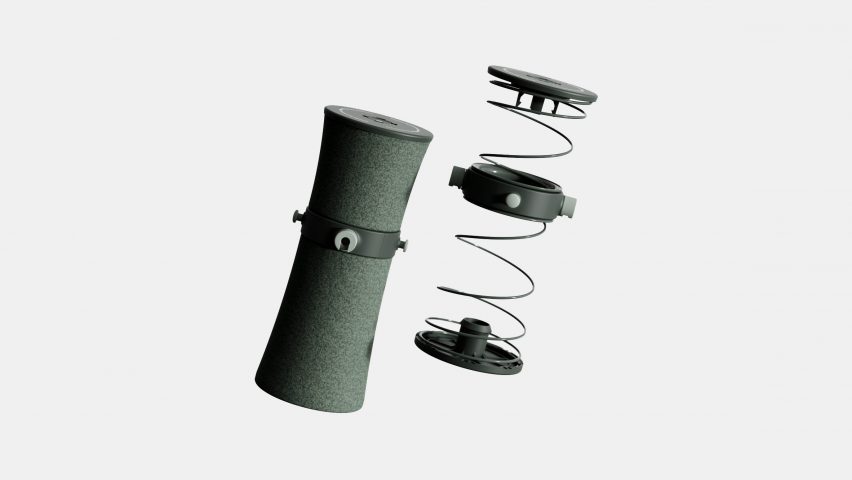
Instead of foam, the Mazzu Open mattress’s hourglass-shaped springs are shrouded in a two-tone 3D-knit polyester sleeve. The other materials used are steel for the springs, ABS plastic for the connection system and wool for the topper. The wool is biodegradable, while all the other materials are recyclable.

Image of a spring with plastic connectors, and on the left-hand side of it, a textile-covered cylinder in the same size and shapeImage of a spring with plastic connectors, and on the left-hand side of it, a textile-covered cylinder in the same size and shape
The metal springs are wrapped in a 3D-knit textile

Hubert describes Mazzu as “leading the way” in delivering sustainable, high-performance bedding, and says the companies worked together for three years through the pandemic.

They went through many iterations of the mattress design in that time, as the studio tried to find a connection solution that would be both simple and comfortable.

“We must have tried about 20 different connection techniques,” said Hubert. “We had to find an optimum size that could be calibrated to fit all the standard mattress sizes too — not easy given there are a lot of international sizes.”

Image of an open carton storing a number of green coloured discs, which are shown in their popped-up, slightly hourglass-shaped cylindrical form outside of the boxImage of an open carton storing a number of green coloured discs, which are shown in their popped-up, slightly hourglass-shaped cylindrical form outside of the box
The springs compress to one-fifth of their full height for transport and storage

“The system needed to be highly cost-effective by using the least amount of parts and the simplest connection feature,” he continued. “The design of the connection systems changed dozens of times as we tested strength, ease of use, noise and comfort — we had hundreds of springs in the studio at times!”

Other recent designs from the London-based design studio have included sustainable dog toys for Canadian company Earth Rated and a green hydrogen vehicle retrofitting system for US start-up Croft.

Mazzu and Layer launched the Mazzu Open mattress at the German furniture fair IMM Cologne, which was held from 14 to 18 January. See Dezeen Events Guide for an up-to-date list of architecture and design events taking place around the world.

Reference

Liam Young Planetary Redesign interview
CategoriesSustainable News

Our biggest climate challenge is no longer denial, but despair

Climate fatalism stands in the way of a sustainable future but designers and architects are in an ideal position to overcome it, writes Katie Treggiden.


The mainstream media is finally waking up to the realities of climate change. As wildfires, floods and storms wreak havoc across the world, journalists and activists far braver than me are speaking truth to power to make sure we all know just how serious this thing is. And that is vital and right and proper.

However, fear doesn’t motivate action. The biggest obstacle for the environmental movement is no longer climate-change deniers – the evidence is incontrovertible to all but conspiracy theorists. It is those who are fully on board with the fact that humans are the root cause of some very real problems, but just don’t believe that we have what it takes to solve them. Our biggest climate challenge is no longer denial, but despair.

Fear doesn’t motivate action

To spark meaningful change, we need hope. We need to believe not only that a better world is possible, but that we each have the power to help bring it about.

I’m not talking about blind faith or passive optimism. I’m talking about active hope. I’m talking about waking up every morning and making a choice to believe that we can solve this wicked problem, and then choosing to act accordingly. And in today’s climate – political, economic and social as well as environmental – hope is an act of defiance.

So, how can architects and designers inspire defiant hope?

The Berkana Institute’s “two loops” model of systems change proposes multiple roles that people and institutions can play in the transition from a declining system to an emerging one. As the dominant system begins its decline, “stabilisers” keep what is required in place until something better is ready, while “hospice workers” support the process of decline, minimising harm to those still within it.

In turn, the emergent system gathers pace as “pioneers” come up with new ideas, products and systems and they are joined together into networks by “connectors”. Together, they form supportive “communities of practice” that enable them to grow their influence and, eventually, rise up to replace the old system.

In the transition from the declining linear take-make-waste economy to an emerging regenerative and circular economy, we might cast architects and designers in the role of “pioneers” – problem-solvers who can create pragmatic ways to move society towards a better world.

And that is valid; if architecture and design solve problems, then surely they should contribute genuine, impactful, and replicable solutions to arguably the biggest problem ever to have faced humanity.

In today’s climate – political, economic and social as well as environmental – hope is an act of defiance

However, I believe they can also play another part. On the emerging-system loop, there is a role for “illuminators”: people who paint a picture of what a better world might look like.

You see, there is no point in the model where the two loops touch, no simple juncture where people can step off one system and onto the next – they must take a leap of faith. Illuminators are the people who can give them the courage to do that.

One of the questions I get asked most often when I speak at conferences about craft and design in the transition to a circular economy is: “Okay, but how does it scale?”

Firstly, I would contend that scalability is what got us into this mess, and what we need instead are locally replicable solutions, but increasingly I am questioning whether everything we propose as an industry even needs to do that. Perhaps part of our role is simply to inspire hope – defiant, stubborn, active hope.

Kyloe Design’s kelp chair, showcased recently as part of Green Grads at the London Design Festival, may never make it into production and it’s highly unlikely that it will drive the wholesale replacement of leather across the furniture industry. But it does showcase the potential of this incredibly renewable, climate-positive, underutilised material, while provoking the curiosity to learn more.

From responsible material sourcing and advocating for worker welfare to using smartphone components anyone can switch out, Fairphone is offering real-world solutions. But its founder, Bas Van Abel, was realistic about what he could achieve directly, so launched the company with the stated aim of motivating the rest of the industry.

There is little doubt that his efforts have had a hand in both the incoming EU legislation that will require smartphone batteries to be “easily replaceable” and the recent launch of a repairable Nokia phone.

Part of our role is simply to inspire hope – defiant, stubborn, active hope

Zaha Hadid Architects principal Patrik Schumacher might have criticised the “lack of architecture” at last year’s Venice Architecture Biennale, but what if contributions such as the German pavilion (pictured), which he described as nothing more than “piles of construction material”, are exactly what we need to inspire alternative ways of working? Entitled Open for Maintenance, the exhibition was billed as “an action framework for a new building culture” and collated materials recovered from previous installations to be used for repairing and upgrading buildings and public spaces all over Venice.

One of my favourite quotes about hope is from the author Arundhati Roy, who says: “Another world is not only possible, she is on her way. On a quiet day, I can hear her breathing.” The question I would like to pose is: how can we, as an industry, help everyone to hear the sound of her breath?

Katie Treggiden is the founder and director of Making Design Circular, a membership community and online-learning platform for sustainable designers and makers, and the author of Broken: Mending and Repair in a Throwaway World (Ludion, 2023).

Dezeen In Depth
If you enjoy reading Dezeen’s interviews, opinions and features, subscribe to Dezeen In Depth. Sent on the last Friday of each month, this newsletter provides a single place to read about the design and architecture stories behind the headlines.

Reference