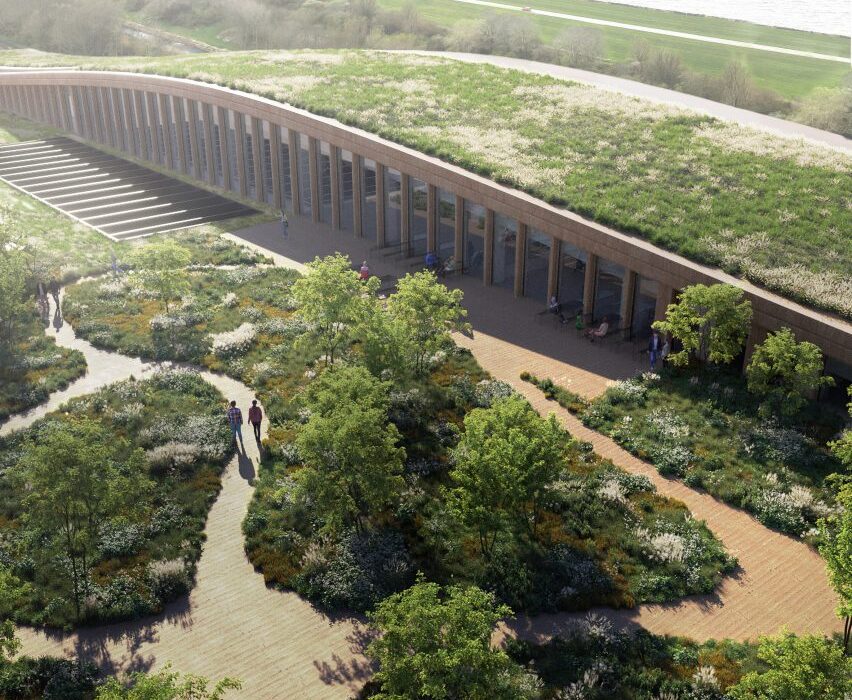
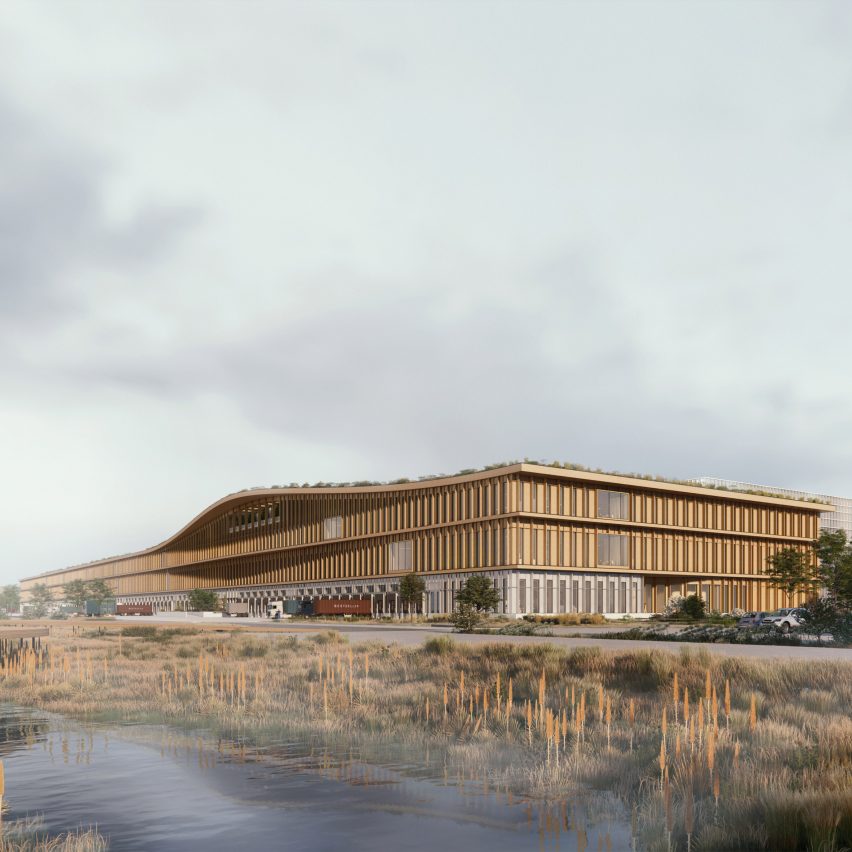
Danish architecture studio Henning Larsen has revealed plans for a mass-timber logistics hub on Flevopolder island, the Netherlands, that will be the largest of its kind in the world.
Designed by Henning Larsen, the 155,000-square-metre hub will contain offices, shuttle storage and pallet shuttle, as well as a restaurant and roof garden.
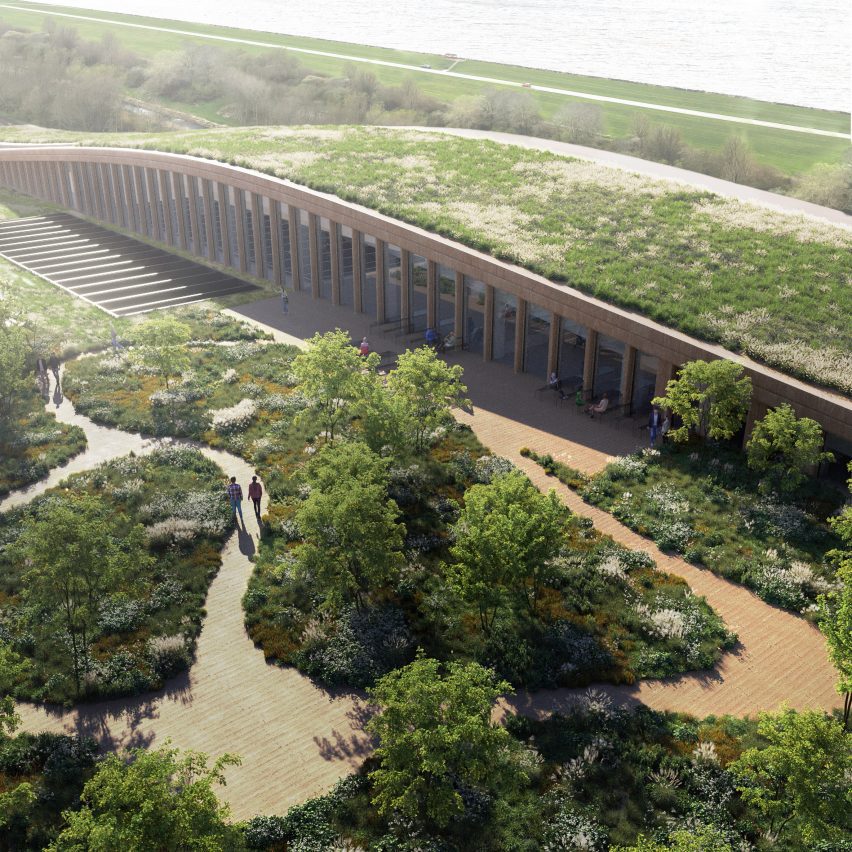
Trees will provide shaded seating on the roof
Expected to be completed by 2026, the Logistics Center West will be built largely from glued laminated timber (glulam) and cross-laminated timber (CLT) along with other biogenic materials.
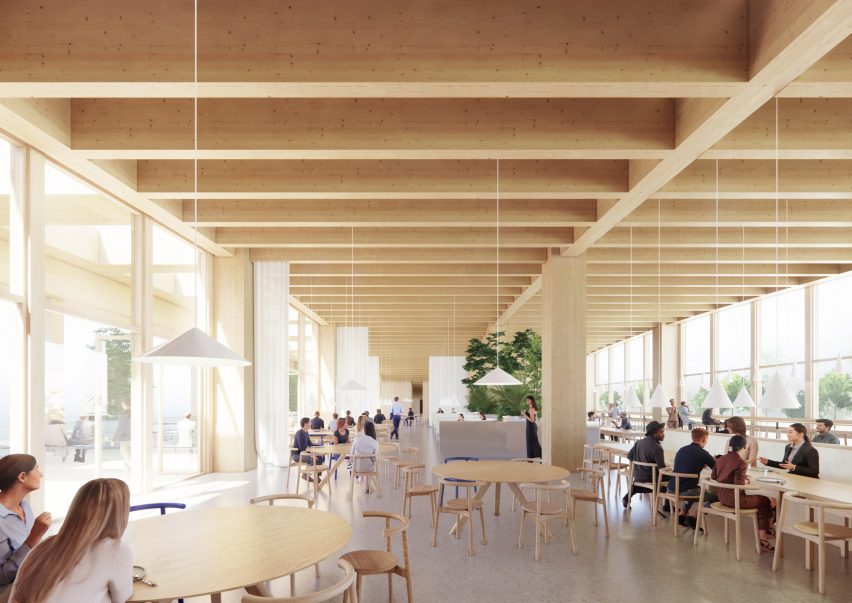
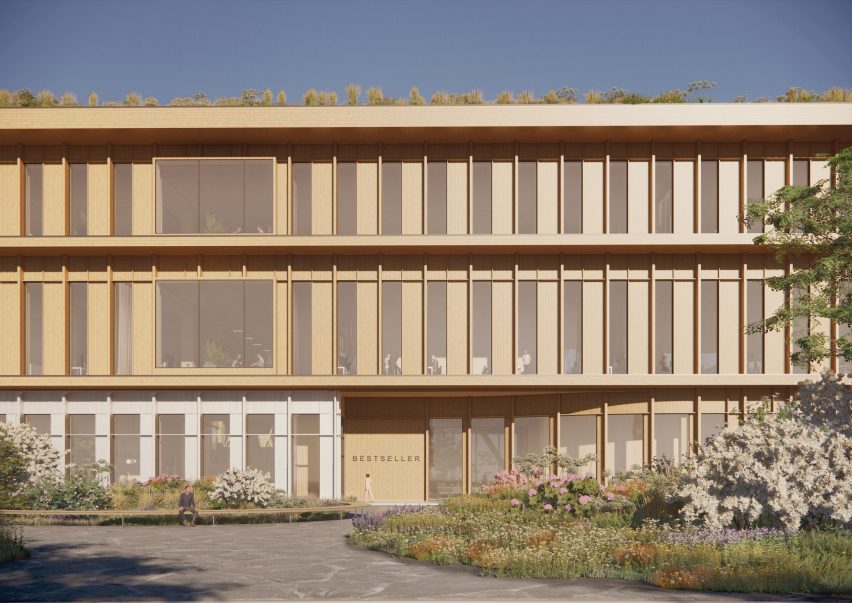
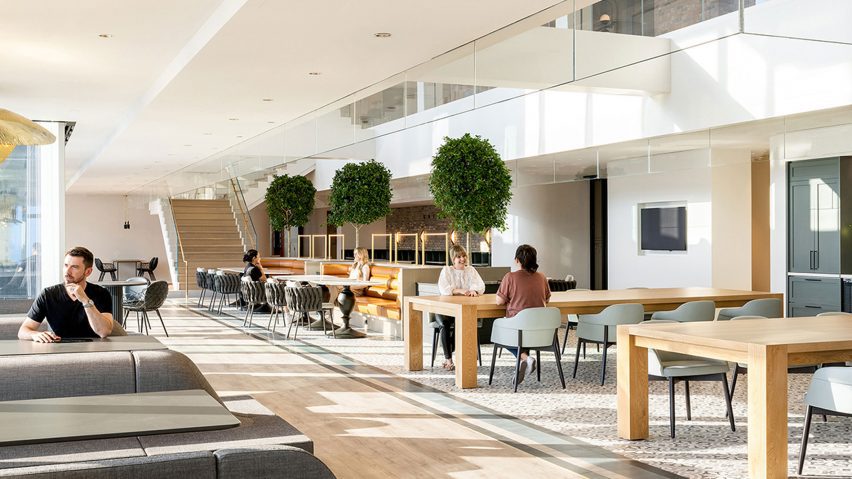
Internally, the timber structure will have oversized columns and exposed beams complimented by light-coloured floors and furniture. Externally, the facade will be divided by rhythmic timber fins and regular openings.
Timber interiors flooded by natural daylight
The building will be surrounded by a wetland habitat and forest with a 30,000-square-metre meadow placed on its roof to increase the site biodiversity.
Planting beds, fruit trees and bushes on the building’s rooftop will provide a green outdoor space for the employees, as well as attract local species.
Regular timber fins decorate the facade
A boardwalk will serve as a scenic route across the wetland, while also providing educational tools for the employees, reinforcing the integration of nature into the workplace.
With just over 40 per cent of the site to be dedicated to greenery, access to certain areas of the site will be restricted to reduce human impact and promote wildlife growth.
According to the studio, the project’s biodiversity will work to absorb CO2, filter air pollutants and mitigate heat absorption to create “a more comfortable and sustainable environment”.
Rainwater from the rooftop will be collected and stored for sustainable reuse around the building.
The mass-timber proposal will feature a constructed wetland
According to the studio the project will be the world’s largest timber logistics centre. The design will aim to create an atmosphere that prioritises employee well-being through the integration of nature into the workplace. Natural light, green spaces and clean air will work to “invigorate the space and enhance focus”.
Henning Larsen is an international studio for architecture, landscape, and urbanism. Other projects set to be completed by the studio include a ferry terminal in Faroe Islands that draws on traditional Viking boats and a wooden Ørestad church with trapezoidal roofs.
A hotel overlooking a Japanese castle and a neurodiversity-friendly office building are among the winners of Shaw Contract’s 2023 Design Awards, revealed in this video produced for the brand by Dezeen.
Global flooring company Shaw Contract recognised five winners in the 18th edition of its Design Awards, which celebrate impactful living, working, learning and healing interior spaces around the world.
In total, five Best of Globe winners were chosen by a panel of design professionals from 39 regional winners, which had been narrowed down from over 650 project submissions from 40 countries.
The winners include architecture studio Tatsuro Sasaki, which won an award for its OMO5 Kumamoto by Hoshino Resorts hotel built on Mount Chausu in Kumamoto City, Japan.
The hotel is located in the city centre overlooking Kumamoto Castle and is nestled in amongst the landscape to blend in with its surroundings.
Shaw Contract reveals Naelofar Office by Swot Design Group as one of the winners of its 2023 Design Awards.
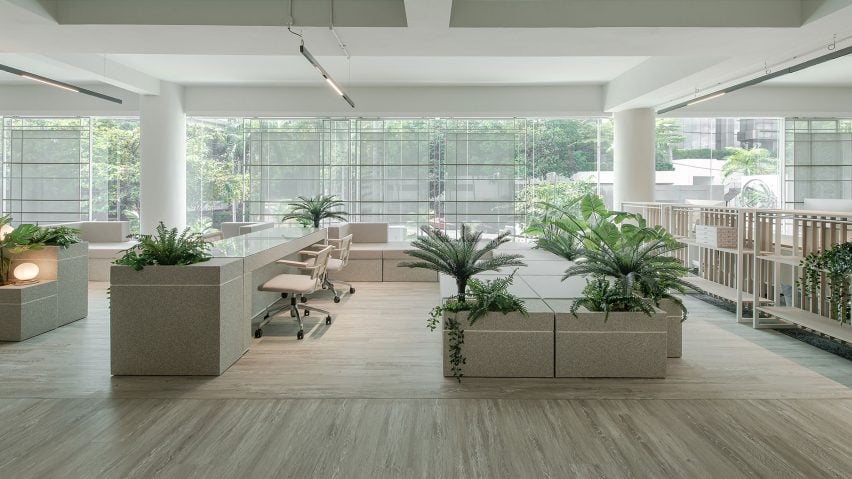
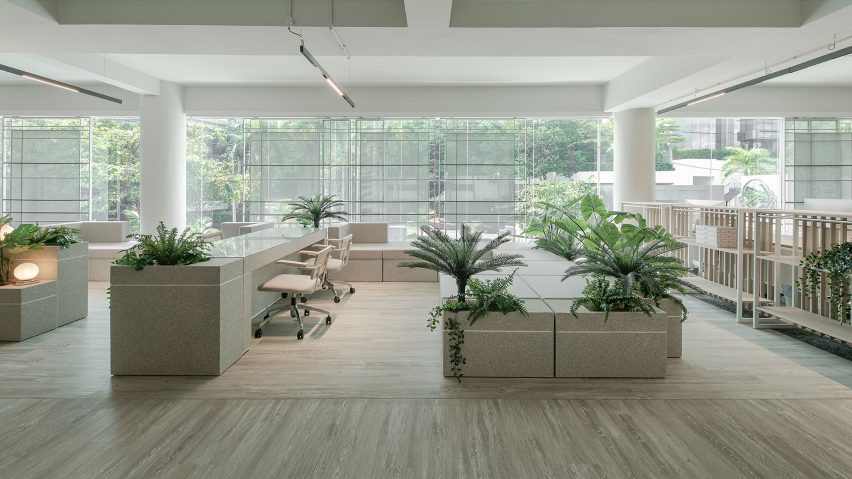
The office features ample open spaces to flood it with natural light and is equipped with circadian lighting to follow people’s natural rhythms and improve productivity.
Another winner was the 345 North Morgan office design by Eckenhoff Saunders, which is located adjacent to Chicago’s metro tracks. The design of the office was informed by classic railway stations and draws from the neighbourhood’s rich industrial history.
Shaw Contract reveals Boston Consulting Group Canadian Headquarter by HOK as one of the winners of its 2023 Design Awards.
Other winners include Swot Design Group’s Naelofar Office in Petaling Jaya, Malaysia, which was designed to foster relationships and collaboration in the workplace.
It features meeting rooms with operable glass panels that can be rearranged to open up spaces for functions such as training sessions or events.
Rezen Studio’s Newmont office in Subiaco, Australia also received an award, which Shaw Contract described as an example of “the rapidly evolving office typology which responds to the changes in which businesses are operating”.
Shaw Contract reveals Newmont by Rezen Studio as one of the winners of its 2023 Design Awards.
“We believe that design has the power to shape the world around us and create a better future for both people and the planet,” said Shaw Contract.
“That’s why the Shaw Contract Design Awards programme is so important to us. It allows celebration of the designers who share our commitment to creating a positive impact in all interior spaces.”
Each winner was awarded a £2,000 USD charitable donation in the name of their studio to an organisation of their choice. They also received a trophy designed by Singapore-based artist Kelly Limerick using recyclable Shaw Contract’s recycled yarn.
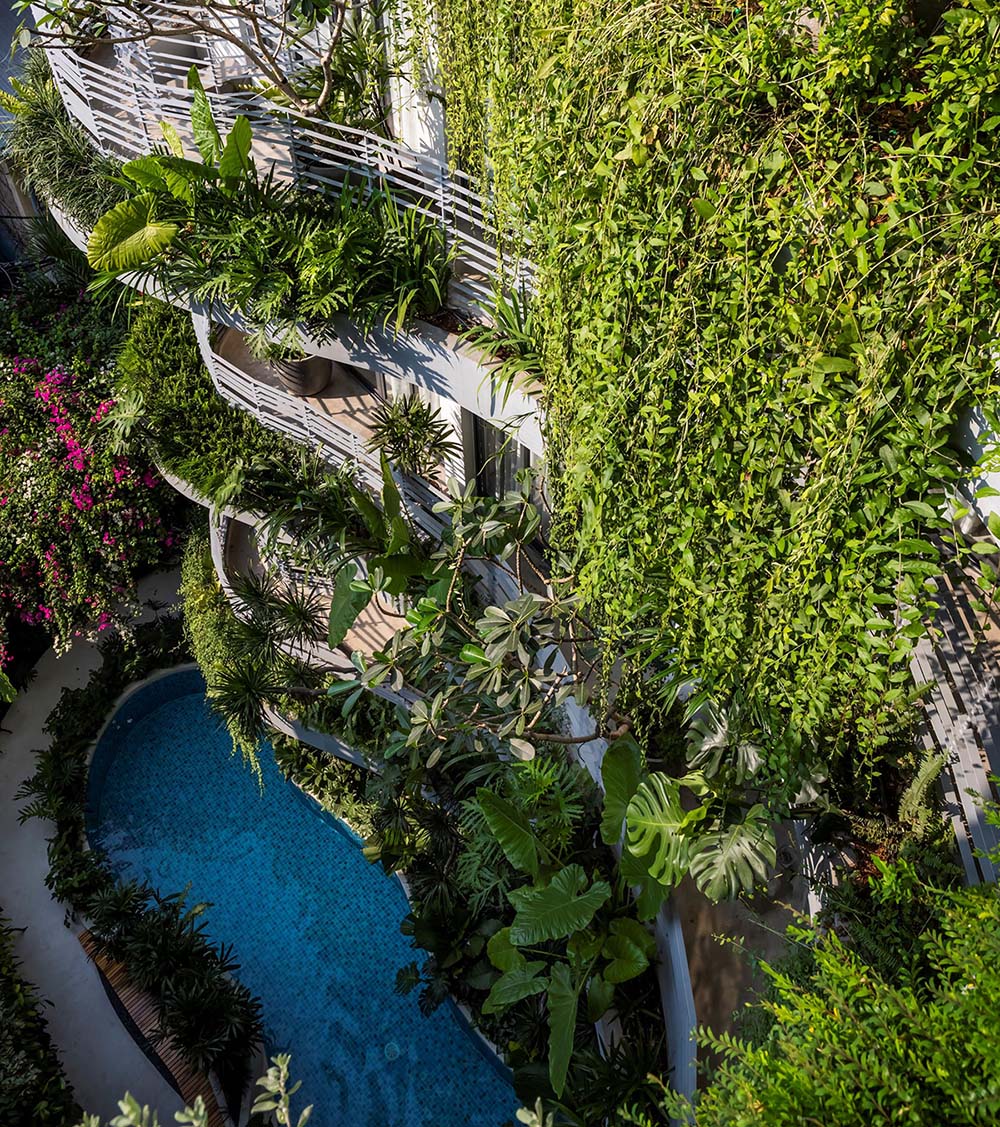
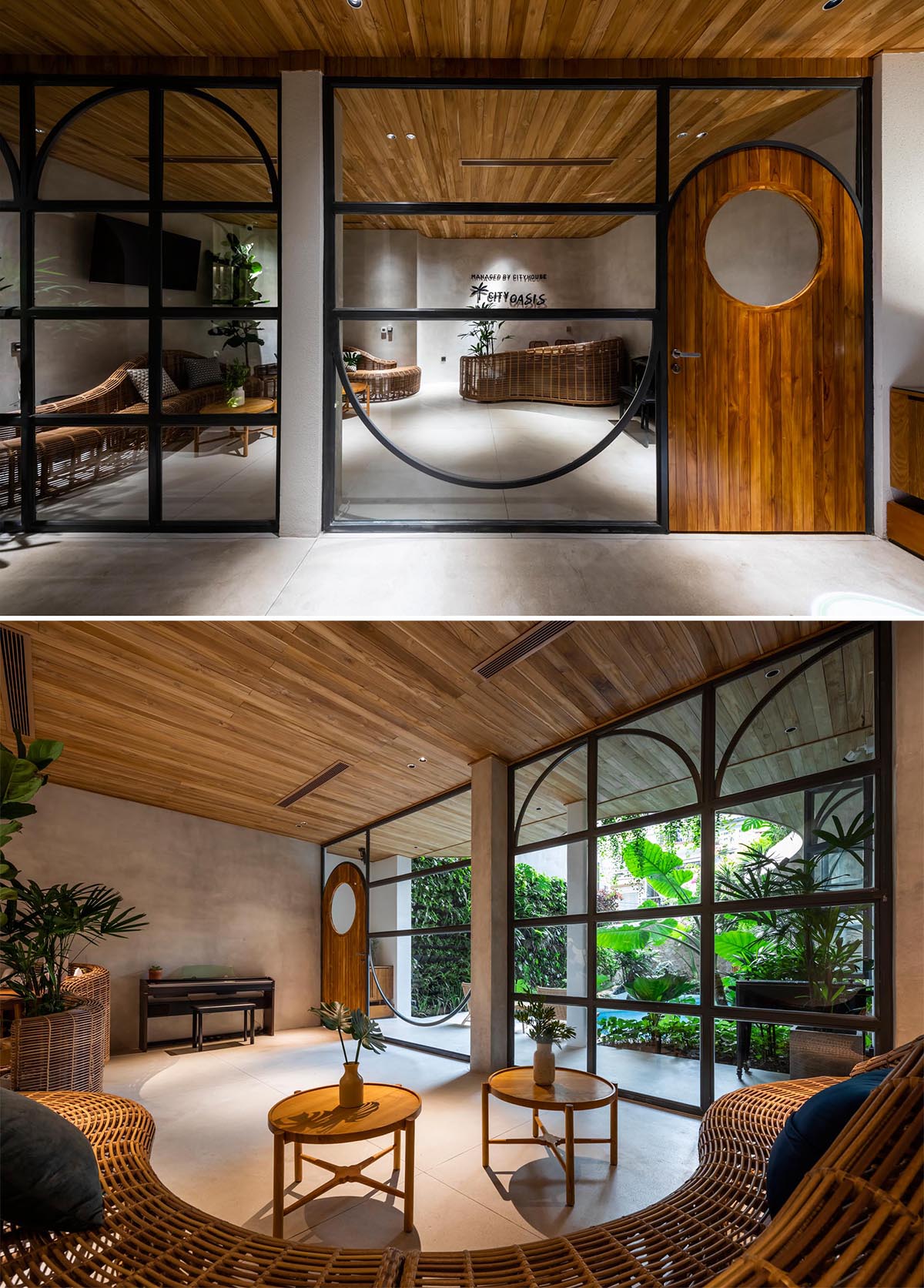
Architecture firm K.A Studio has designed the remodel of an apartment building in Ho Chi Minh City, Vietnam, that included the addition of green space.
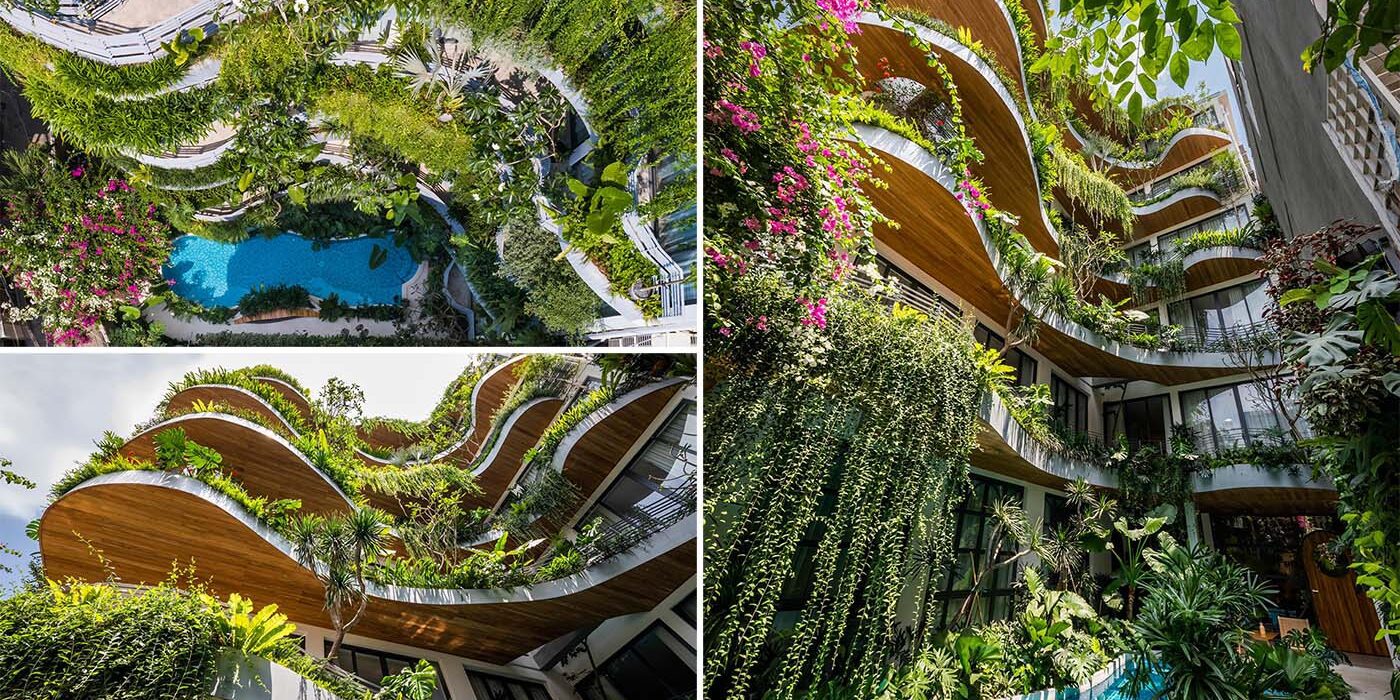
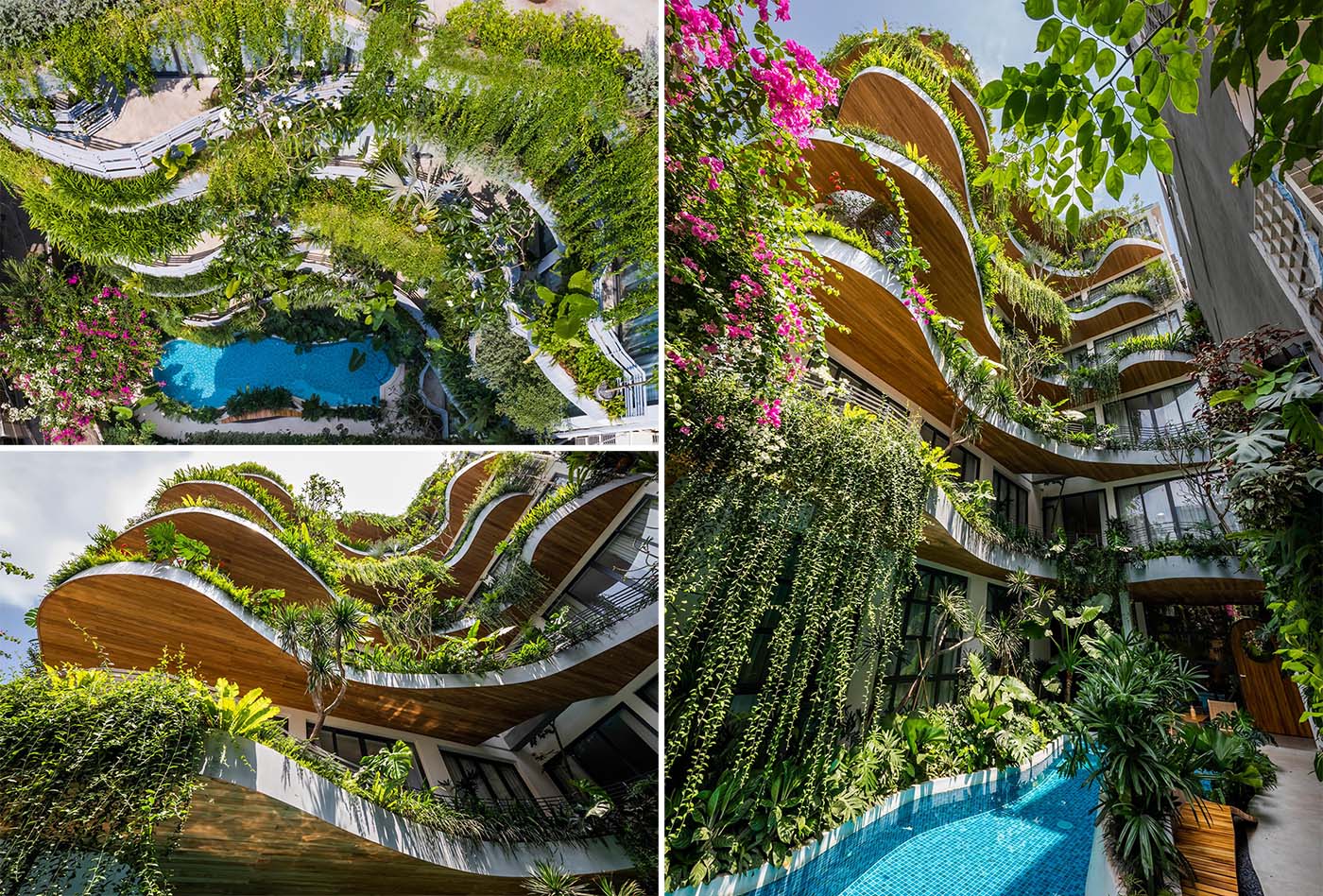
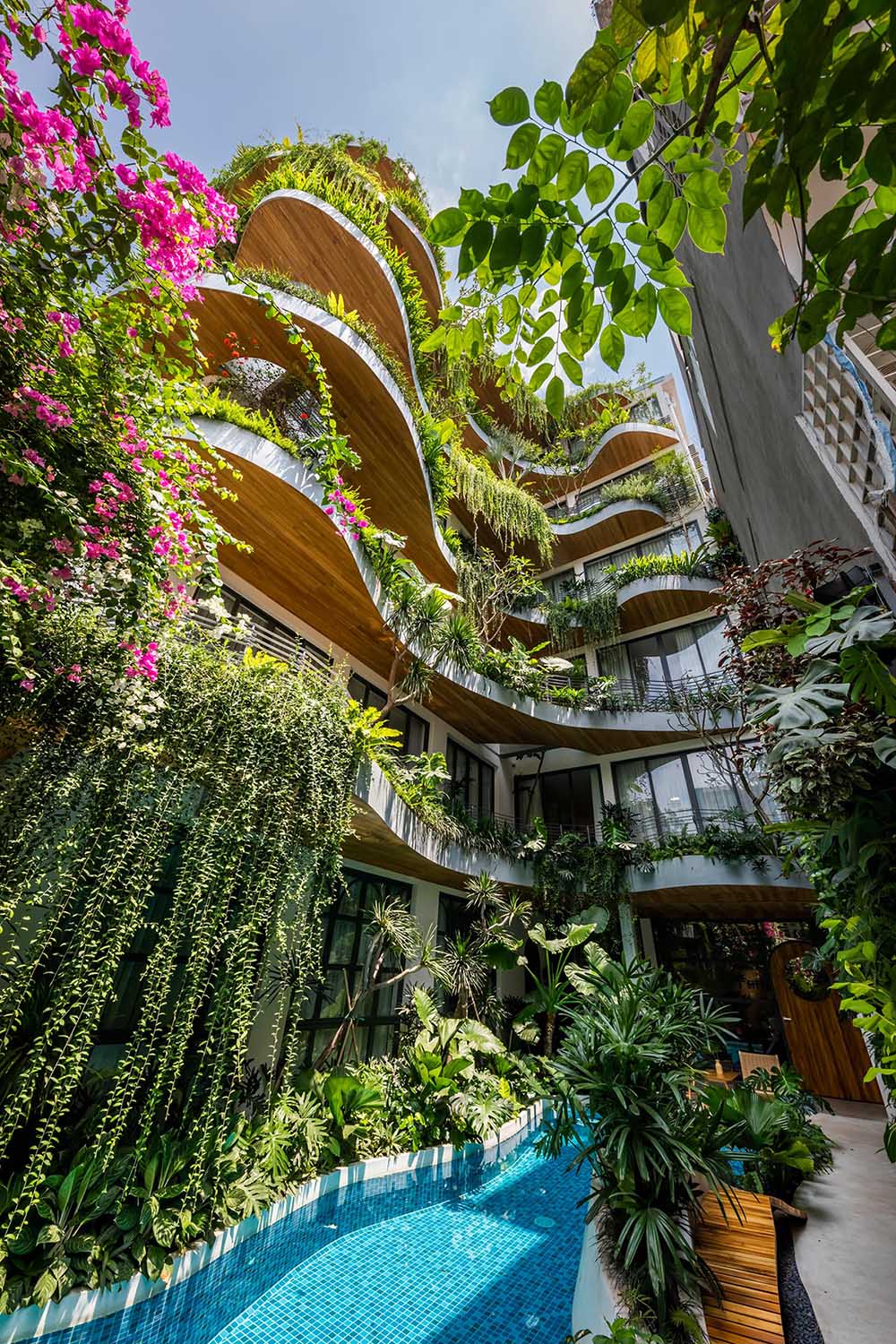
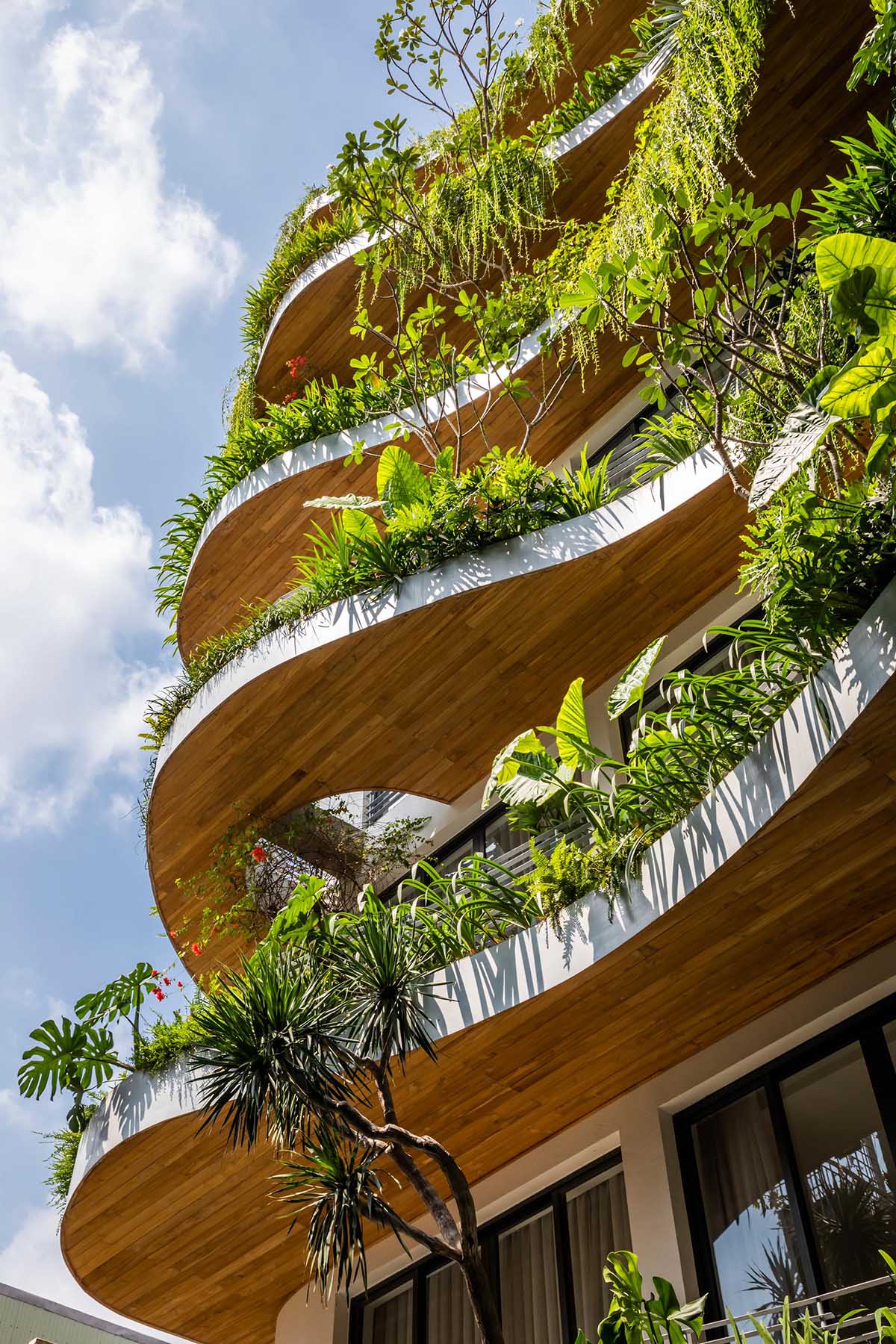
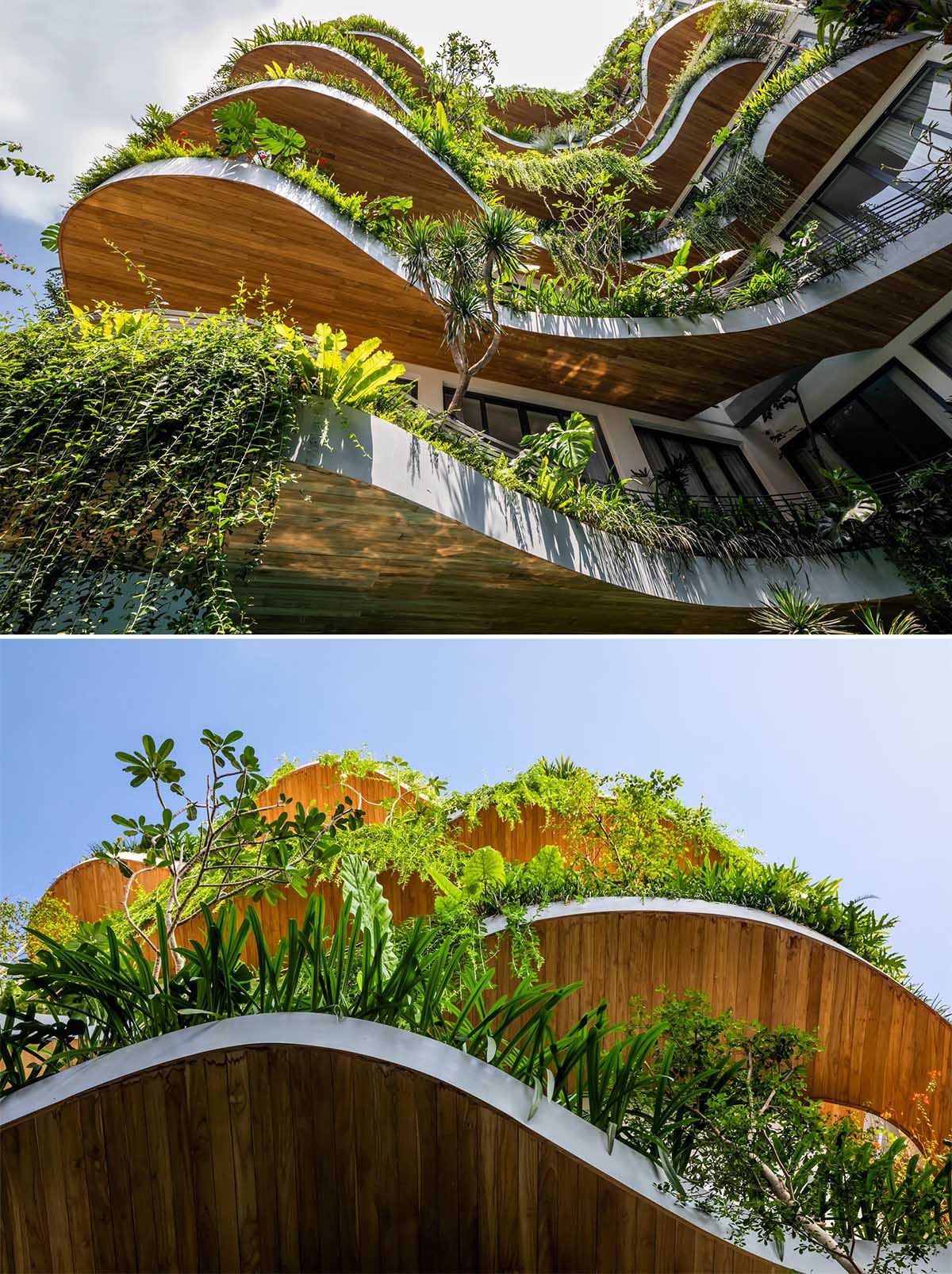
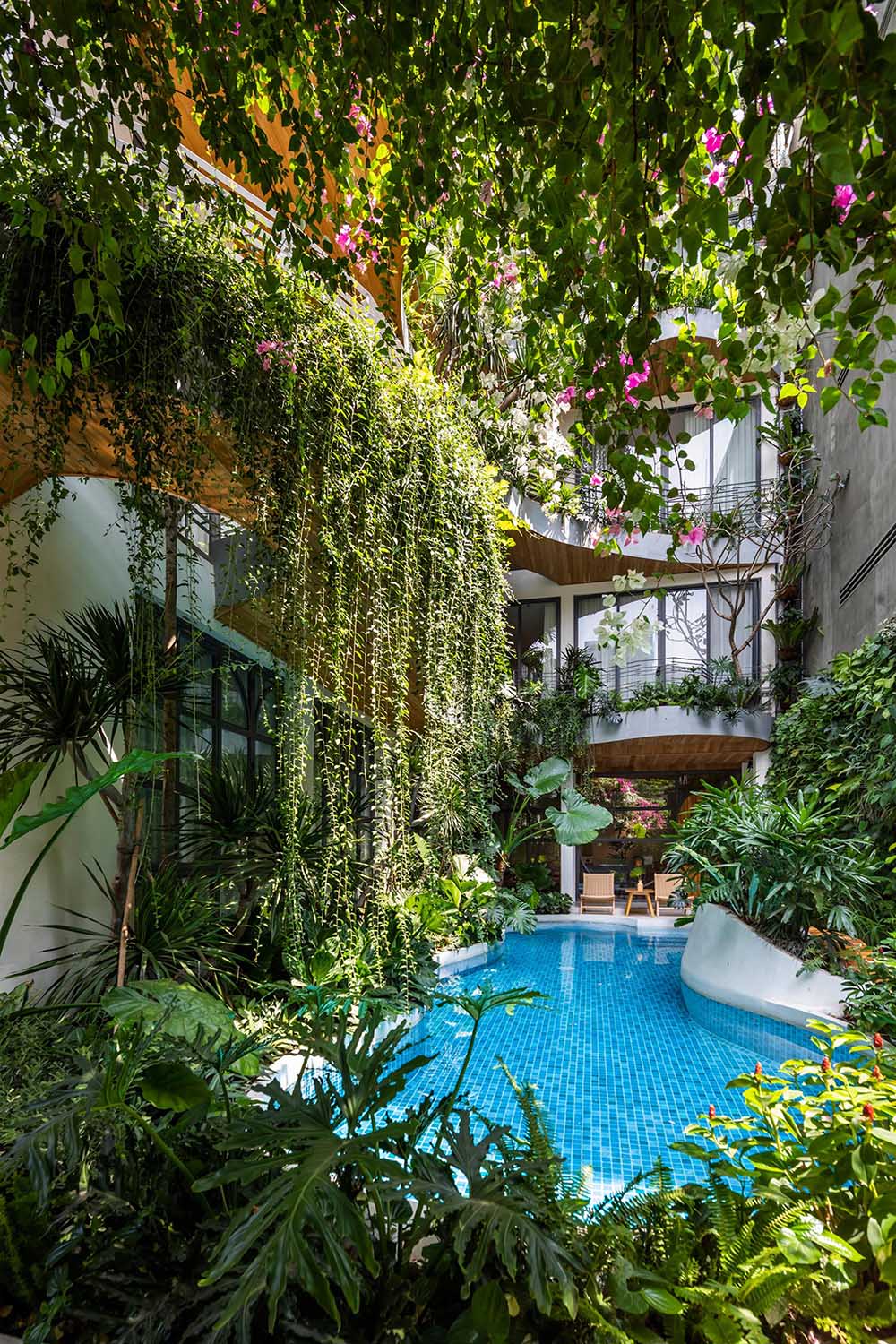
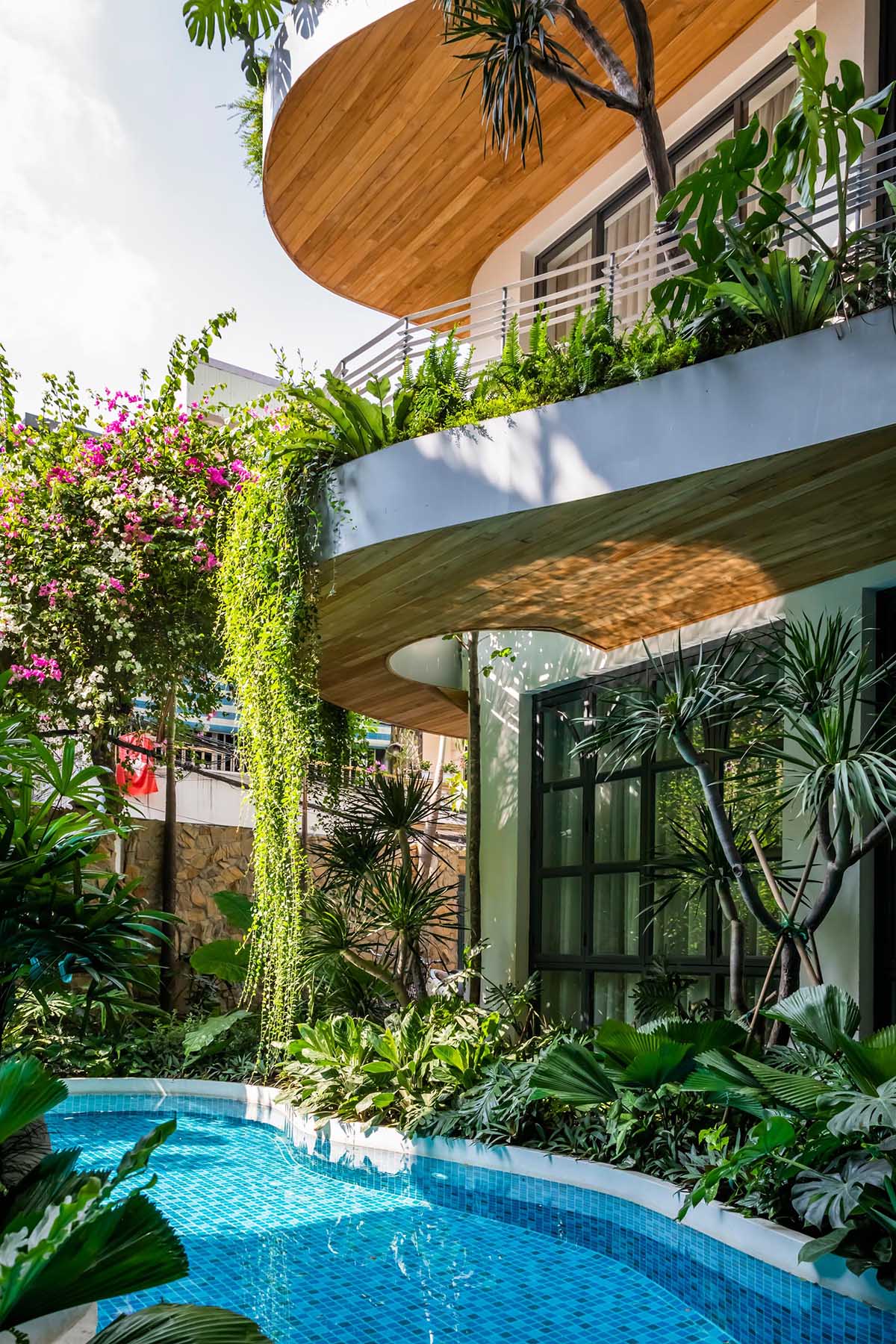
In an area filled with concrete and hard lines, this updated apartment building, which is now used for staycations, has been designed as an oasis in the city, with the curved balconies creating a soft edge on the facade.
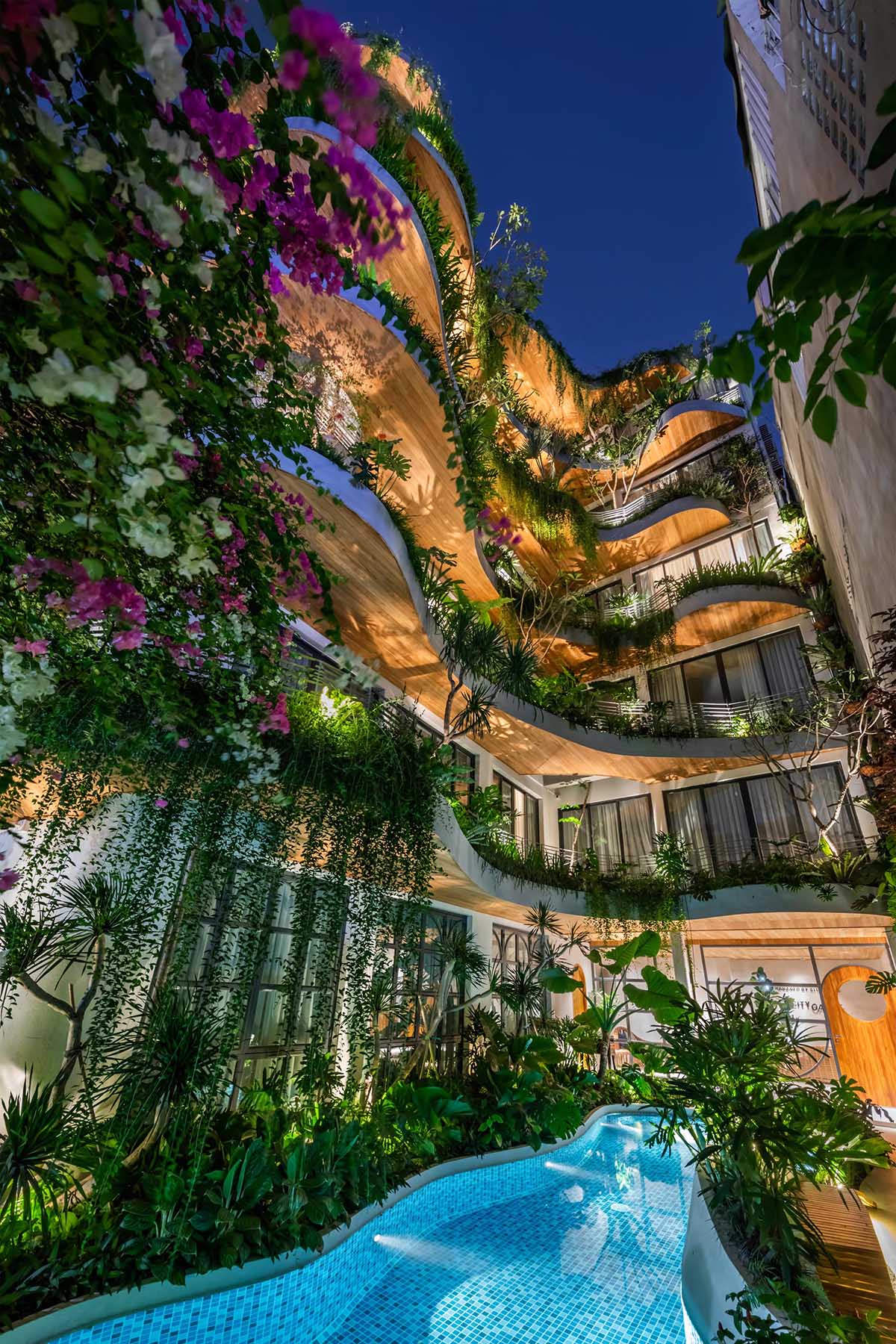
Overhanging plants cascade down the side of the building, while taller plants add different layers and grow up between the voids created by the balconies.
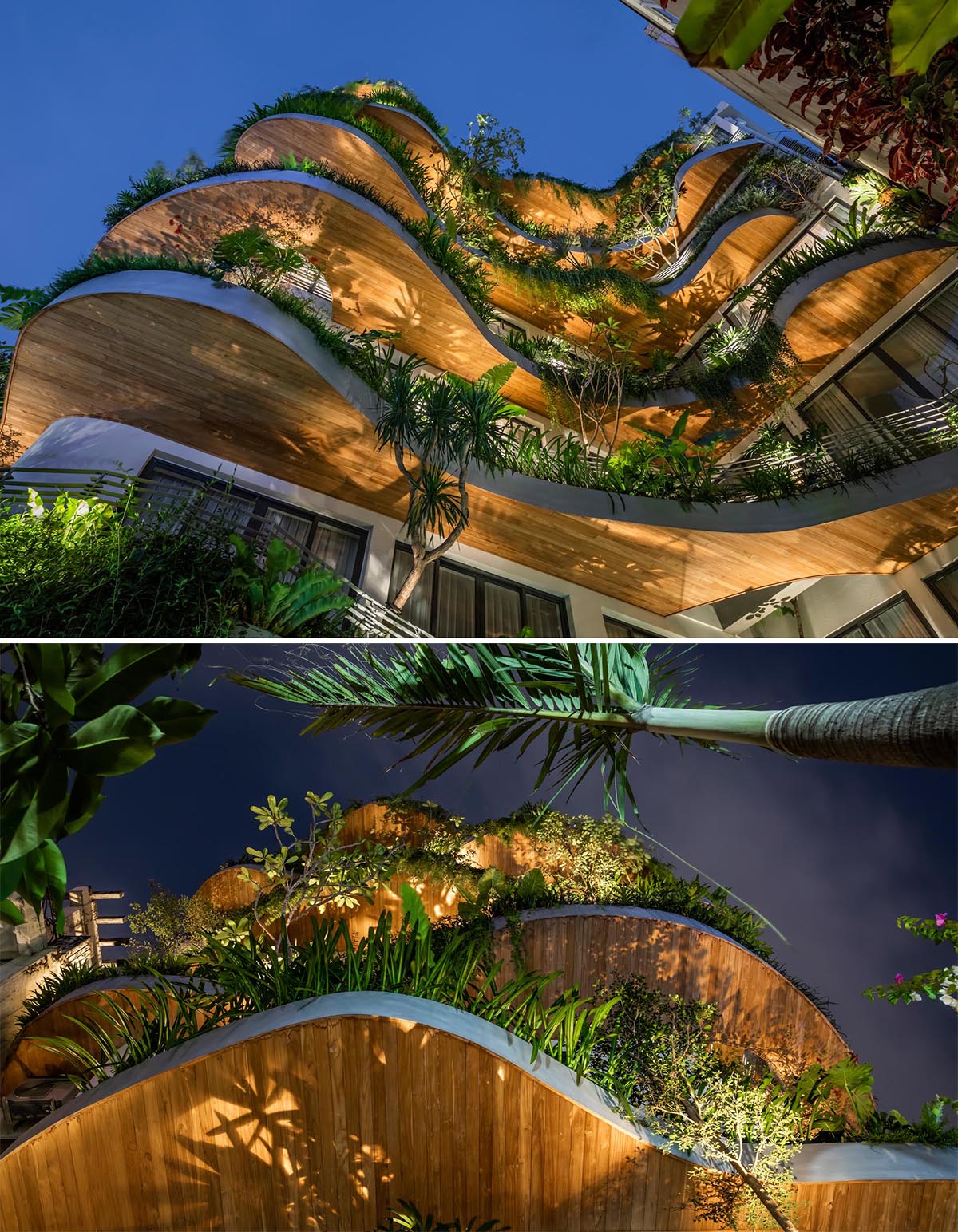
The underside of the balconies is lined with wood, adding to the natural look of the building.
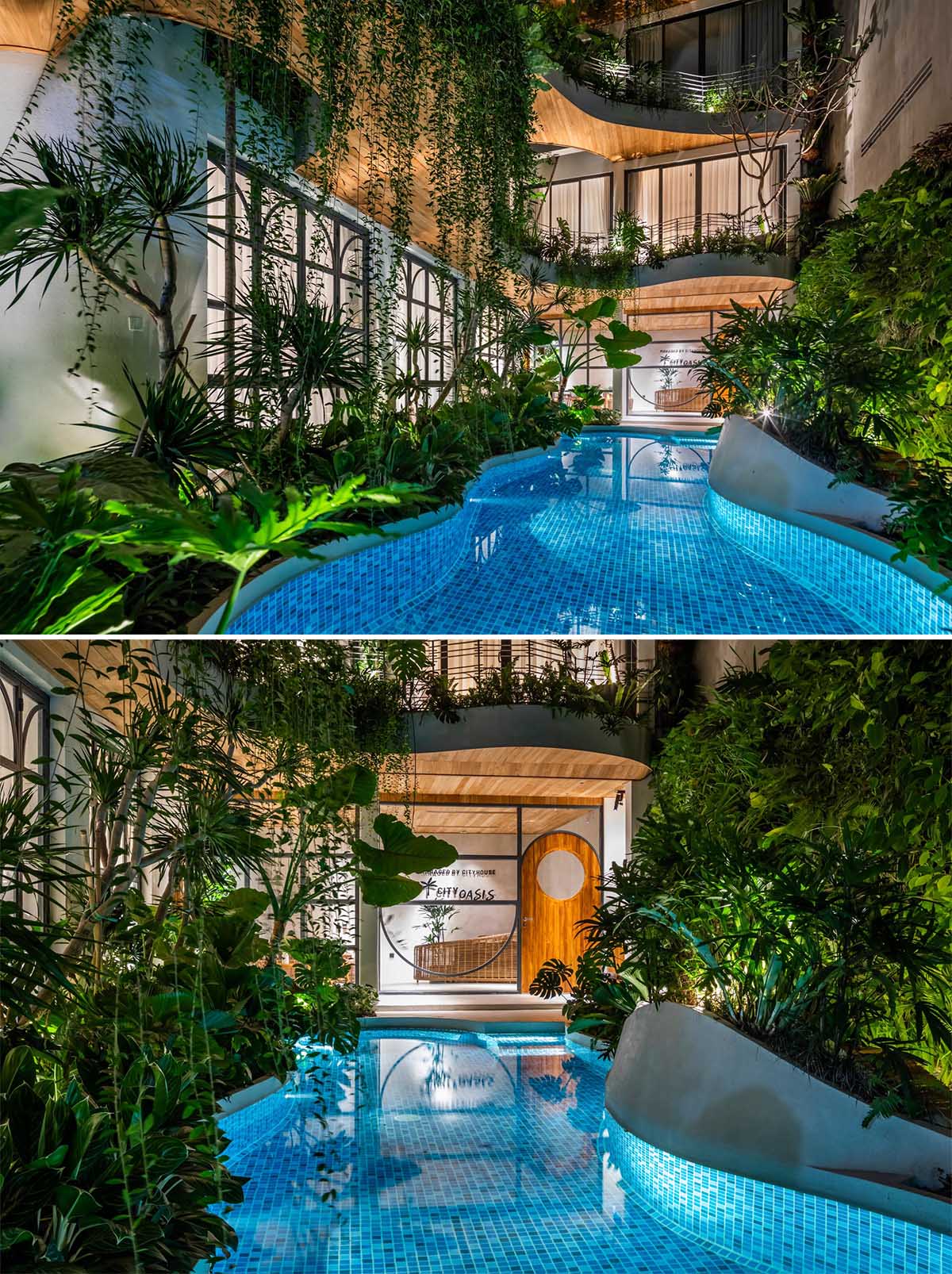
At night, uplighting creates shadows on the balconies above.
The balconies overlook a pool that’s located on the ground floor and has curves that mimic the exterior of the building.
Throughout the building materials like woods, local split stones, concrete, terrazzo, and rattan are featured.
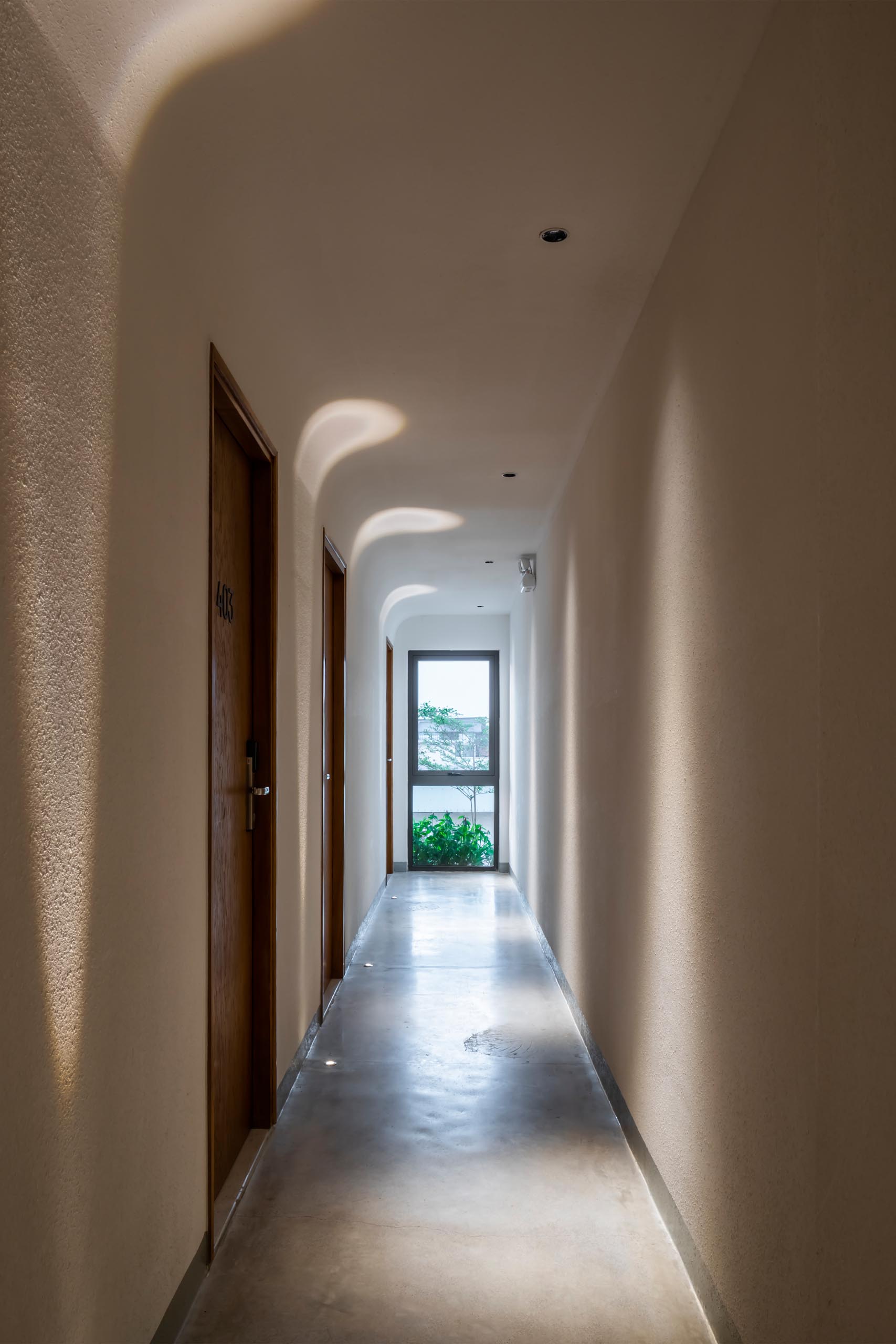
Bright hallways with lighting embedded in the concrete floors, and in the ceiling, guide guests to their private apartments.
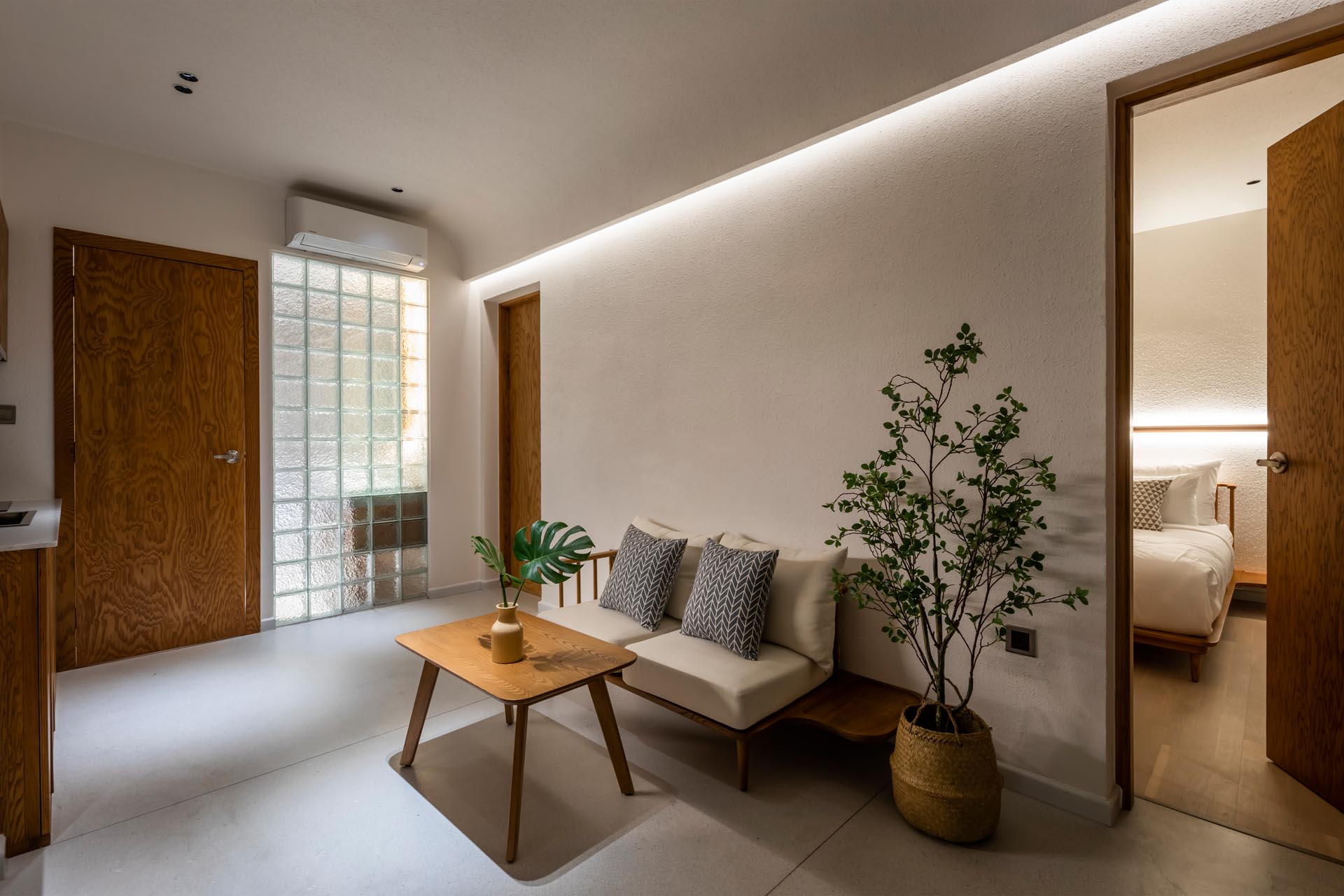
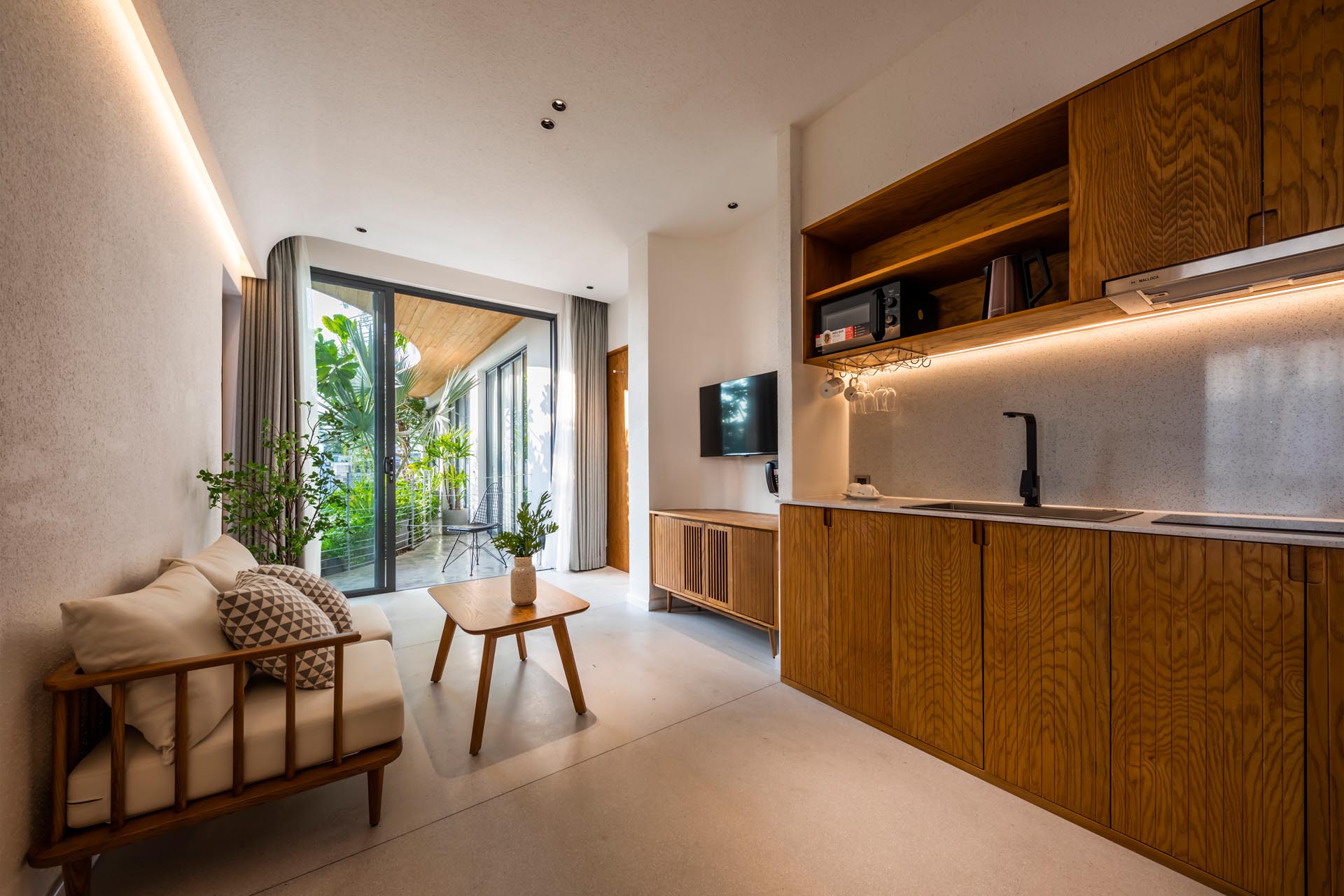
The apartments are minimal in their design, with simple wood furniture in the living room, and a kitchenette.
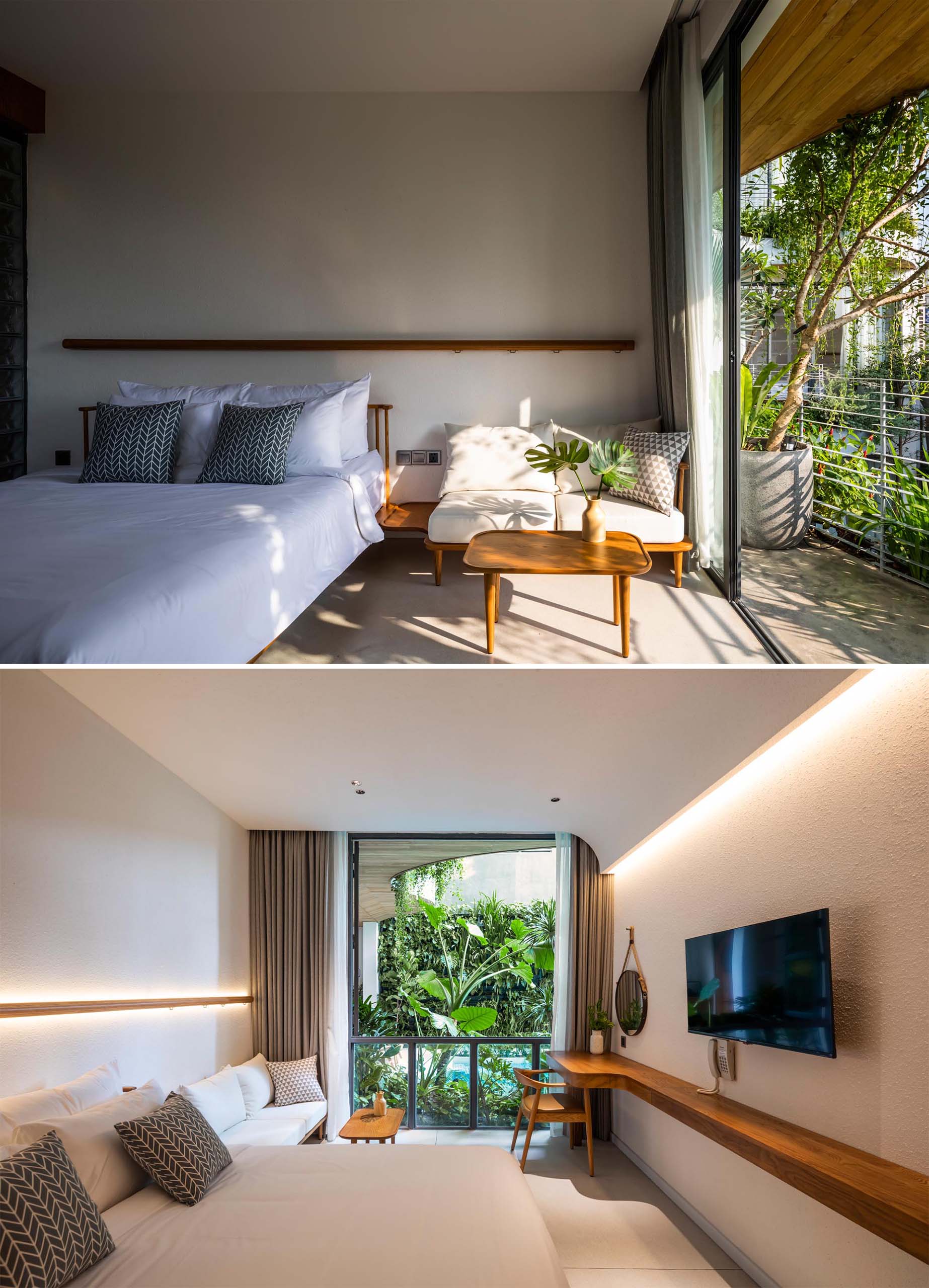
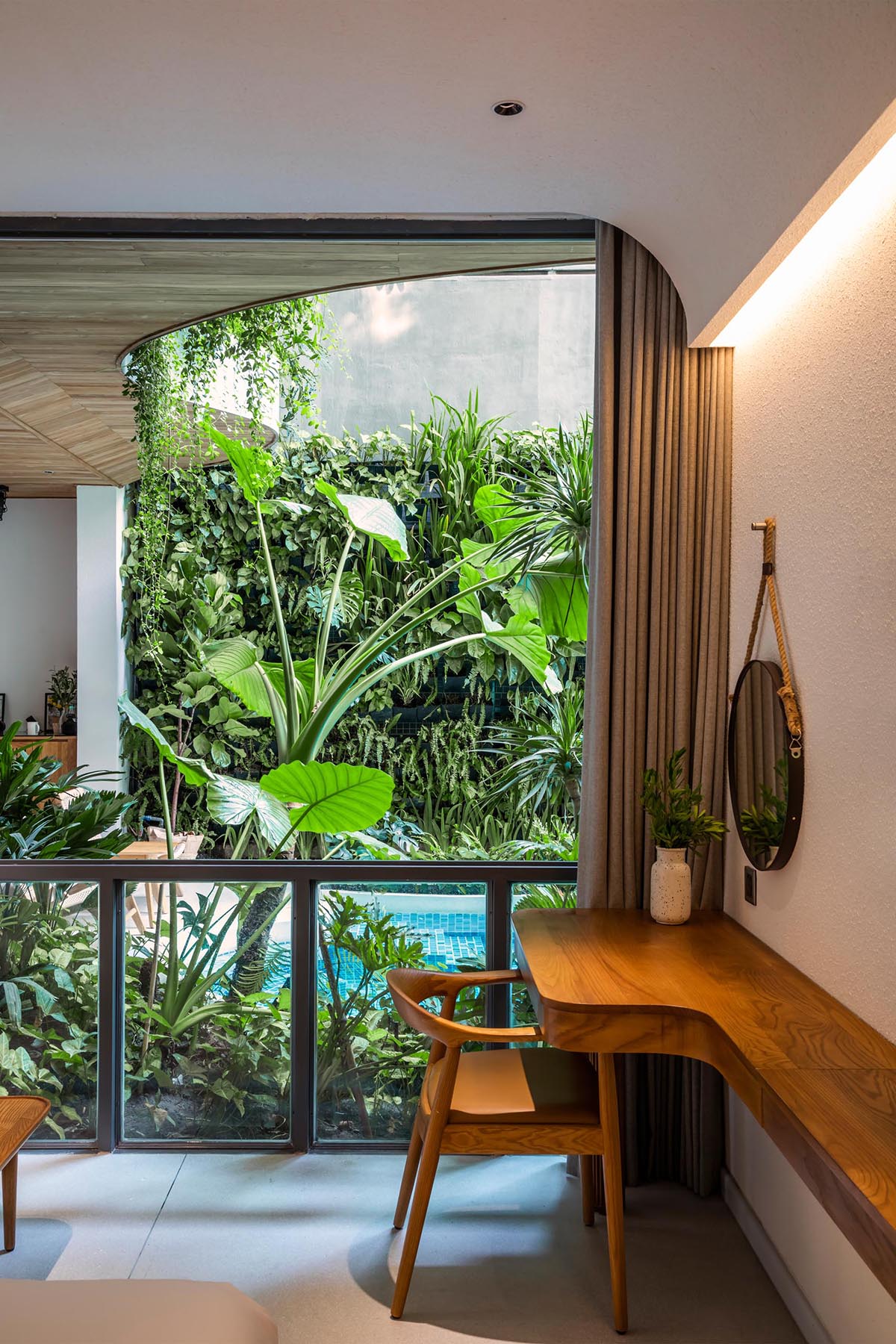
In the bedroom, a horizontal wood accent above the bed hides LED Lighting, which also complements the lighting on the opposite wall. There’s also a floating wood desk that lines the wall, and a sliding door opens to a balcony.
Photograph: Hiroyuki Oki | Architects: K.A Studio | Lead Architects: Doan Quoc Khanh | Design team: Dang Anh Khoa, Hoang Anh Dung, Tran Quoc Nhat, Le Duc Duy | Construction: La Maison Du K
Spotted: Global macroeconomic activity is putting pressure on the world’s construction industry, with growth in many regions slowing and in other areas, reversing. One method contractors and owners can use to mitigate the volatility of markets and rising costs of supplies is to reduce the amount of materials used in a build.
Many in the construction industry believe that concrete structures are frequently ‘over-designed’, meaning too much concrete is used for the purpose of the building. Constraints on time are one of the main reasons that this happens, as architects and builders would rather overdesign for safety than not use enough.
Israeli construction technology company Structure Pal has an intelligent solution. An artificial-intelligence-powered (AI) software tool provides structural engineers, project managers and designers with a range of options for the use of concrete in a project. From the type of concrete to placement and volume needed, the tool helps to reduce costs and the amount of concrete used by around 15 per cent. Use of the tool can cut design time in half, and by the end of a build, the tool can reduce construction carbon emissions by up to 30 per cent.
Designers integrate the tool into their usual building information modelling (BIM) platforms, and the AI analyses the many different configurations possible. Structure Pal’s system provides options for different loads on different levels, recommends the minimum number of columns for the required slab thickness, and ensures that each iteration of a design includes and meets local building code requirements. The Structure Pal team estimates that the software can do in one hour what it would take a civil engineer to do in four weeks.
Structure Pal offers four levels of access to the tool. There is a pay-per-project option that costs $2 (around €1.88) per square metre of a floor plan, and for larger businesses, companies can pay per 100,000 square metres, with the option to pay in advance for future projects to receive the largest discount.
Other recent innovations in concrete Springwise as spotted in the database include a light-sensitive concrete that cleans the air in road tunnels and an AI tool that optimises concrete use based on what other materials will be used in a build.
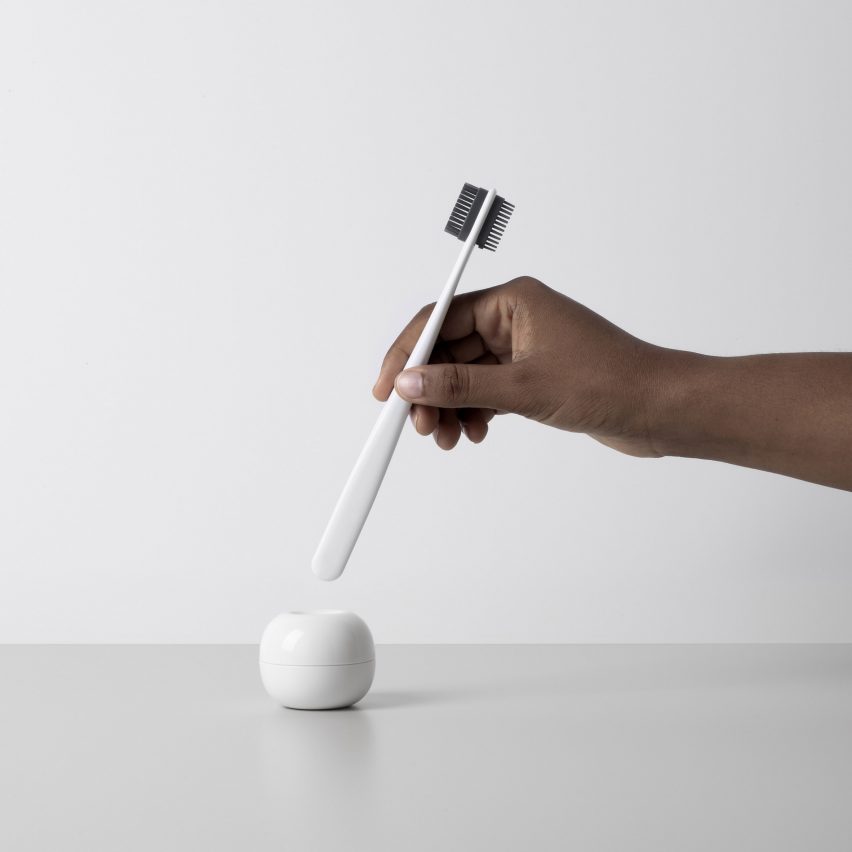
London agency Blond has designed Edge Slick, a comb-style device for styling hair with a reusable handle that doubles as a hands-free applicator for hair gel.
Edge Slick is a neutral-hued edge styler created by Blond for Ruka, a UK Black women-owned business that creates hair extensions and accessories.
Edge Slick was designed by Blond for Ruka
Edge stylers are tools specifically designed to treat baby hairs, also known as edges – shorter hairs positioned at the hairline.
The product, which has been longlisted for a Dezeen Award, features a double-sided, detachable comb with soft bristles for swooping, shaping and layering and firm bristles for combing and detangling hair.
The detachable, two-sided comb comes in a range of colours
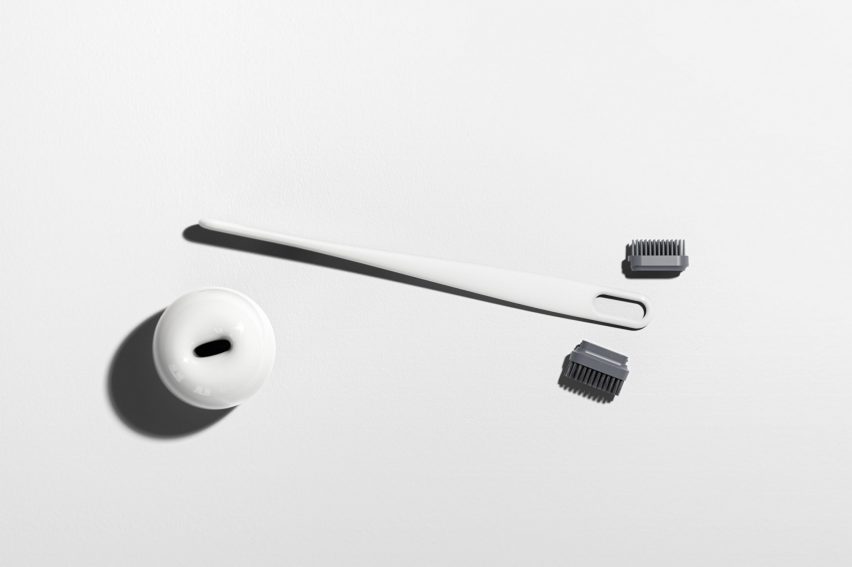
Designed to be disassembled, the comb is clipped onto an “ergonomic” paddle-shaped reusable handle.
The reusable handle also doubles as an applicator for hair gel that can be used to apply gel to the user’s wrist, saving them from using their fingers while they are styling their hair.
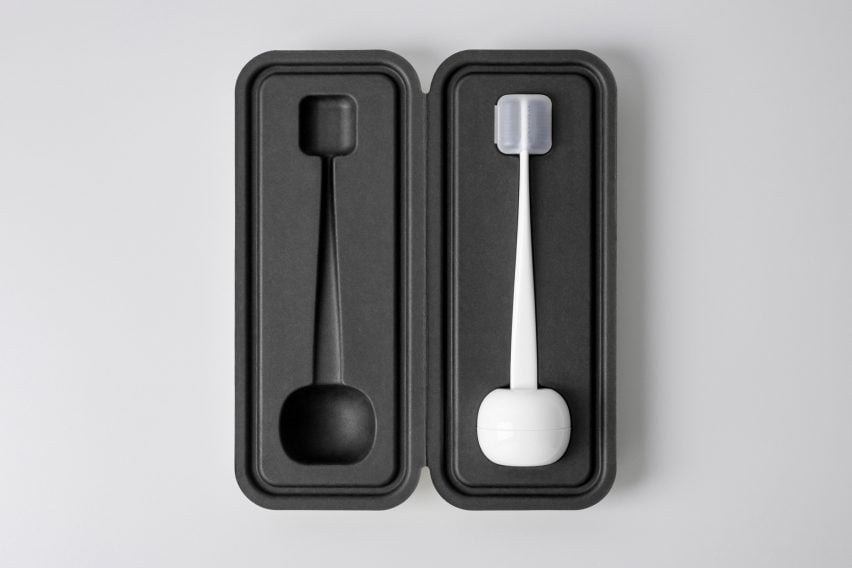
Edge Slick comes in recycled packaging
“When the relatively small comb reaches the end of its long lives it can be unclipped and disposed of, but crucially, the reusable handle is kept to extend the life of the product,” said Blond.
A minimalist, apple-shaped stand also comes with the edge styler, as well as packaging made from 100 per cent recycled paper pulp.
Users can also store their clip-on brushes inside a translucent sanitary protective case.
“Edge Slick addresses a gap in the hair industry for a product that caters specifically to Black afro hair, in an industry that has historically and disproportionately focussed on white aesthetics,” said Blond.
“It is the first refillable edge styler on the market, reducing plastic consumption by 86 per cent compared to its competitors,” added the agency.
It also features an apple-shaped stand
Previous hair products that were designed to push boundaries include a smart hairbrush by beauty brand L’Oréal and healthcare company Withings that tracks and scores the quality of hair.
Inventor James Dyson has created a hairdryer that is silent to human ears and controls its own temperature to protect hair from heat damage.
Melbourne studio Reef Design Lab has created a series of organically shaped modules from concrete blended with oyster shells to help reduce coastal erosion in Port Phillip Bay, Australia.
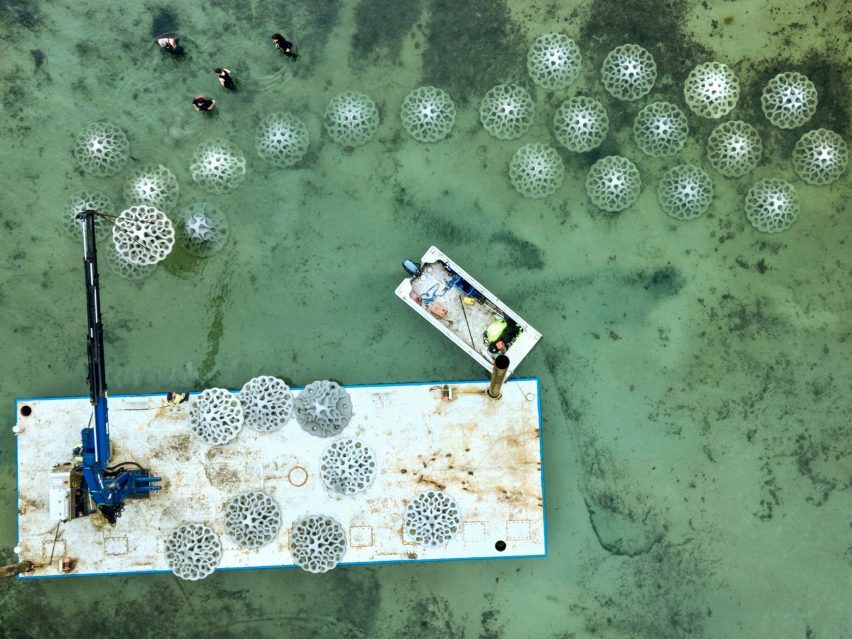
The Erosion Mitigation Units (EMU), which have been longlisted in the Dezeen Awards sustainable design category, were used to build a breakwater to reduce coastal erosion and designed to create a habitat for marine life.
Erosion Mitigation Units are semi-submerged modules
Designed for the City of Greater Geelong municipality by Port Phillip Bay, the two-metre-wide EMU modules form a permeable barrier 60 meters offshore, where the water depth ranges from 30 to 130 centimetres.
Reef Design Lab opted for an organic shape to minimise the material use and maintain structural integrity while creating refuges and colonies for ocean life.
The breakwater is a snorkelling destination
The design team used digital moulding analysis alongside traditional casting techniques to produce the precast reusable moulds in its Melbourne studio.
This saved a significant amount of cement compared to using 3D concrete printing, according to the studio.
Reef Design Lab also added locally sourced oyster shells, which it says makes for an ideal surface for shellfish, as aggregates in the concrete mix to manufacture the EMU modules.
The geometry of the modules was optimised to create the habitat conditions needed for marine species to live on them.
An overhang provides resting space for stingrays and pufferfish, while tunnels and caves on the module shelter fish, octopus and crustaceans from predators and provide shaded surfaces for sponges and cold water coral to grow on.
The module shelters fish from predators
The module’s surface was designed with one-centimetre-wide ridges and made rough on purpose to reveal the shell aggregate and attract reef-building species such as tube worms, mussels and oysters.
Designed to be covered in small pools, the modules retain water and shelter intertidal species at low tide.
Reef Design Lab installed 46 modules of EMU
In October 2022, Reef Design Lab installed 46 EMU modules in Port Phillip Bay. The breakwater is being monitored by the Melbourne Universities Centre for Coasts and Climate for the next five years.
Six months after the installation, species including shellfish, sponges and cold water corals were colonising the modules, the studio said.
Another breakwater project that aims to fulfil engineering and ecological requirements is the Buoyant Ecologies Float Lab in San Fransisco Bay by a team at the California College of the Arts.
Off the coast of Cannes in France, British sculptor Jason deCaires Taylor created the Underwater Museum of Cannes, a collection of six large underwater sculptures, to call for more care for ocean life.
If design is about solving problems we need to start questioning whether new products and furniture are always the answer, writes Katie Treggiden.
“What’s new?” is often the first question a journalist asks of a design brand when stepping onto their stand at a trade show or beginning an interview.
Annual stylistic tweaks have driven unnecessary upgrades to cars since the concept was introduced by General Motors in 1923. The emergence of pre-packaged food and disposable drinks bottles in the mid-20th century enabled people to buy instead of make, replace instead of repair, and reclassify objects and materials as waste, rather than holding on to them as resources. This made ordinary people feel rich, fuelling an insatiable desire for the new.
There has already been a real shift towards designers using waste or “second-life” materials
In her 1999 book Waste and Want: A Social History of Trash, Susan Strasser coined the term “the veneration of newness”. It is a phenomenon that emerged in 1950s America, ushering in the throwaway culture that came to define the second half of the 20th century and continues today with fast fashion, fast furniture and even fast tech.
It’s time for change. The design industry needs to let go of its obsession with the new and instead start venerating the patina of age, and lead the transition to a circular economy.
The second tenet of the circular economy, as defined by the Ellen MacArthur Foundation, is to “keep materials and objects in use”. There has already been a real shift towards designers using waste or “second-life” materials and talk of “design for disassembly”. We’ve started to get our heads around the idea of keeping materials in use, but what about the objects themselves?
Fashion might have led the design industry towards “fast furniture”, but it’s also leading the way back towards repair. British brand Toast now employs as many repair specialists as it does designers, and not only offers clothes-swapping events and repair services, but also Toast Renewed – a collection of repaired clothes and home accessories.
The pieces cost more than their original RRP, adding value to stock that would have once been destined for outlet stores and demonstrating a business model for repair. “As a matter of integrity, brands have a responsibility to incorporate repair, rental or resale into their business models,” said Toast’s Madeleine Michell. “These steps come with challenges, but they are essential for a transition towards a more circular system.”
We need to start questioning whether new products and furniture are always the answer
Raeburn is another fashion brand built on circular principles. It was launched in 2009 with a collection of eight garments made from a single pilot’s parachute and has continued the themes of reuse and repair to this day. “It’s apparent that repair and mending is becoming part of the mainstream again,” founder Christopher Raeburn told me. “I’d like to think that the future will see repair celebrated as it used to be, but it’s also important that this comes in tandem with better product design.”
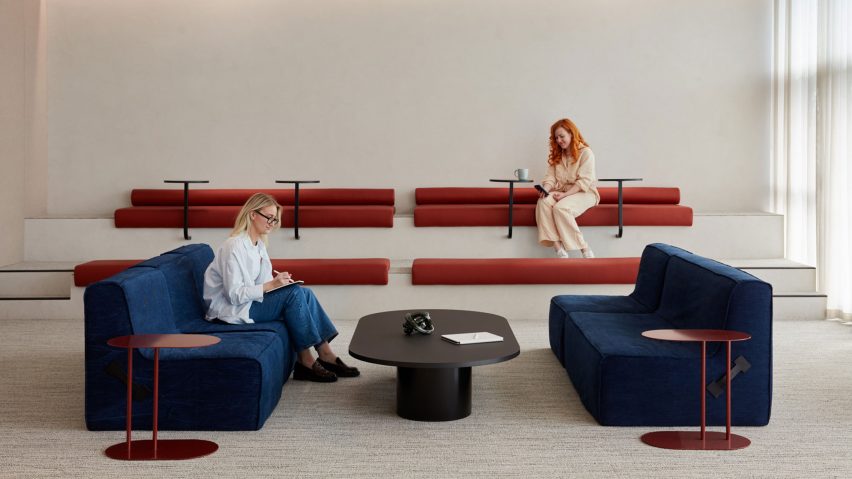
A handful of product and furniture brands are starting to take note. TAKT launched Spoke (pictured), a sofa that is designed for repair, during Copenhagen’s 3 Days of Design in June. “The change we need is to design products that have exposed, visible fixings that can be operated with simple, accessible tools – if tools are required at all,” said its designer Tørbjorn Anderssen. “We need to ensure that recyclable mono-materials are used wherever possible and we need to provide customers with spare parts that extend the life of products.”
If design is about solving problems, perhaps we need to start questioning whether new products and furniture are always the answer. “We don’t make lights, we find them” is the strapline of Skinflint – a certified B Corp that has saved more than 50,000 vintage lights from landfill.
The brand salvages lamps from the 1920s to the 1970s, restores them to modern safety standards and then offers a lifetime guarantee, repair service and buy-back scheme. “We’ve demonstrated that a fully circular approach to lighting is absolutely possible,” said founder Chris Miller. “And we hope that other leaders in the industry will follow suit, bringing change to the sector as a whole.”
If we can stop asking “what’s new?” and instead celebrate what isn’t, perhaps we can let go of a 20th-century model that is no longer serving us, and lead the way in the transition to a circular economy.
Dezeen In Depth If you enjoy reading Dezeen’s interviews, opinions and features, subscribe to Dezeen In Depth. Sent on the last Friday of each month, this newsletter provides a single place to read about the design and architecture stories behind the headlines.
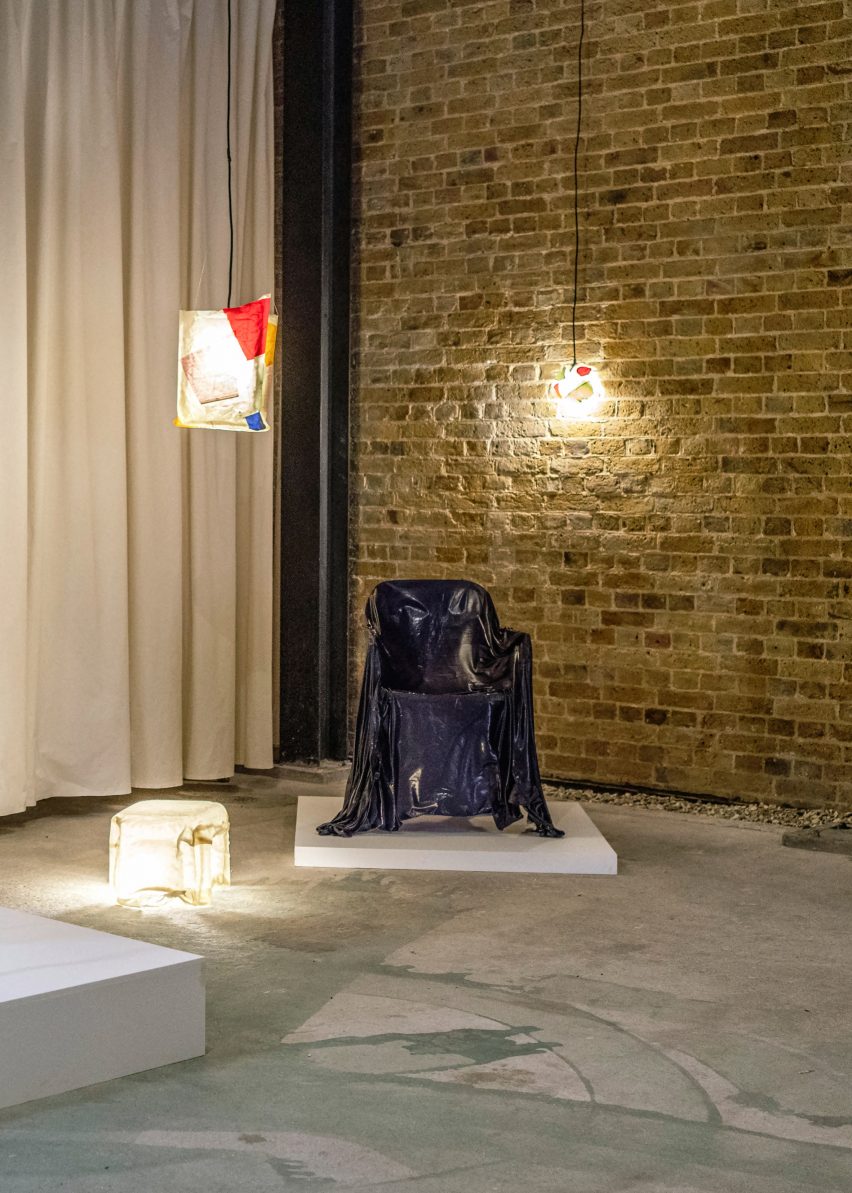
Digitally shrink-wrapped skin, armrests salvaged from parks and “frozen” resin featured in Prototype/In Process, an exhibition of seating presented by virtual magazine Chair of Virtue during London Design Festival.
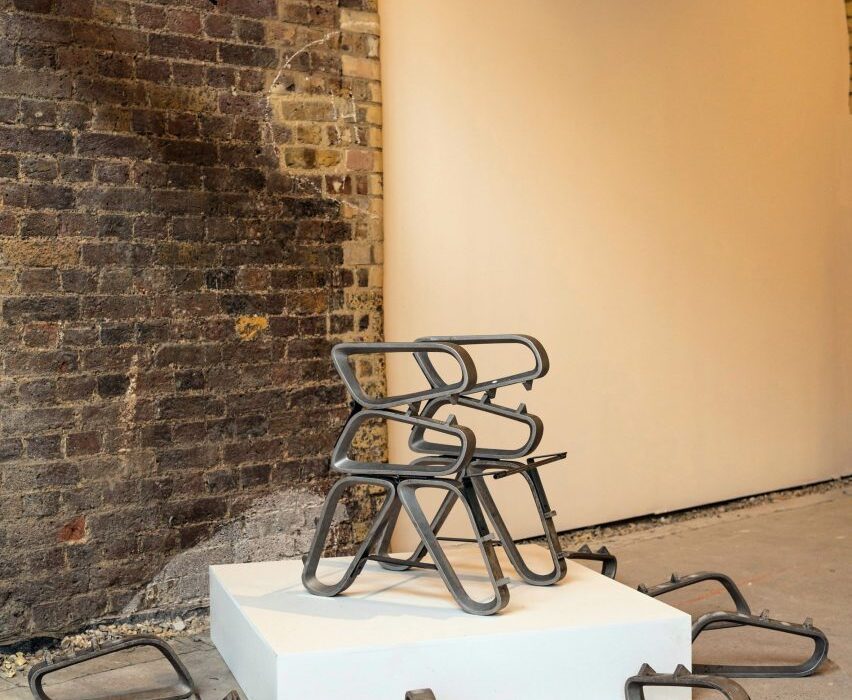
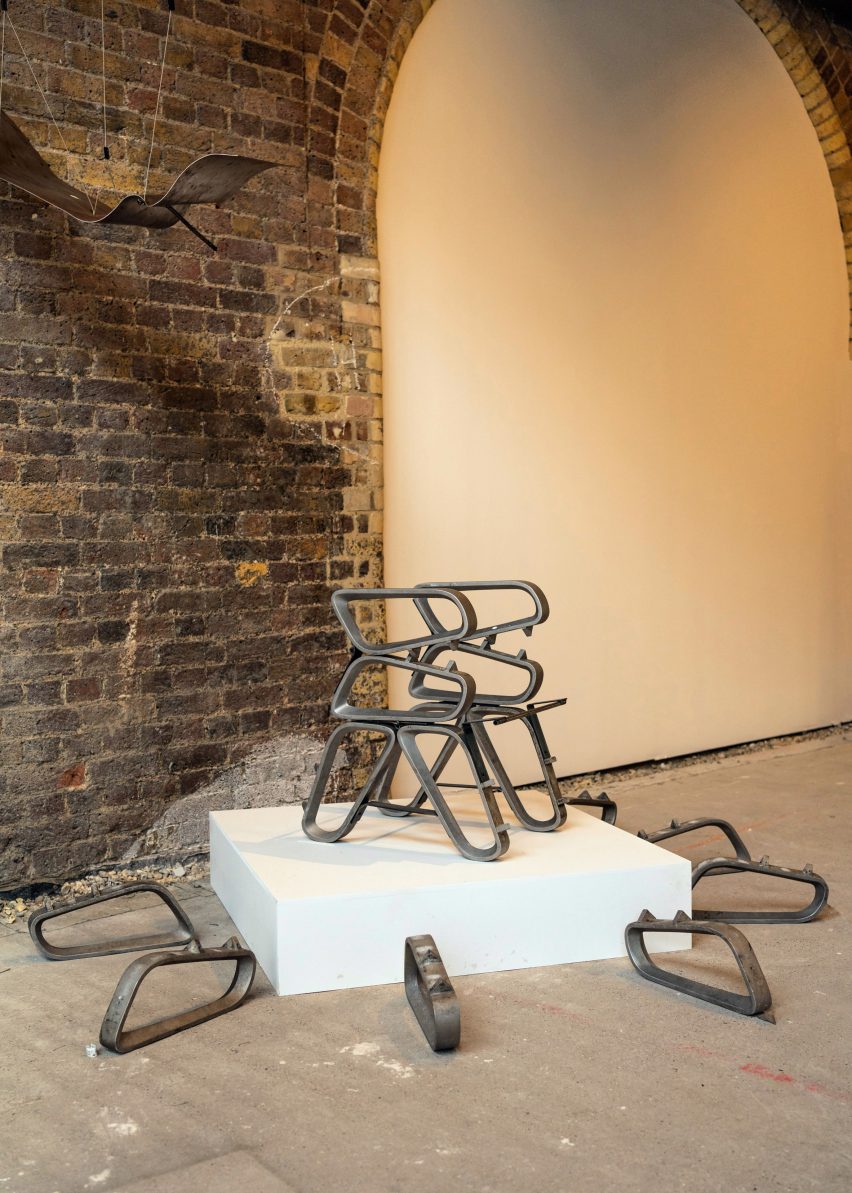
Displayed under a railway arch at Borough Yards, Prototype/In Process was made up of 1:1 scale prototypes of chairs, as well as chairs that are still works in progress, by 12 London-based designers who are either established or emerging in their field.
Prototype/In Process features a chair by Sara Afonso Sternberg
Sara Afonso Sternberg presented sculptural aluminium seating made of armrests salvaged from the middle of public benches in Camberwell. The armrests were originally created to make it difficult for homeless people to sleep or rest on the benches.
“These objects are given a new form and use, inviting the public to critically engage with control mechanisms such as hostile architecture that permeate the urban landscape,” said Afonso Sternberg.
Jesse Butterfield created a “frozen” resin piece
Another piece on display was by Jesse Butterfield. The designer used vacuum infusion, draping and papier-mâché to create a chair covered in resin that was intended to appear “frozen”.
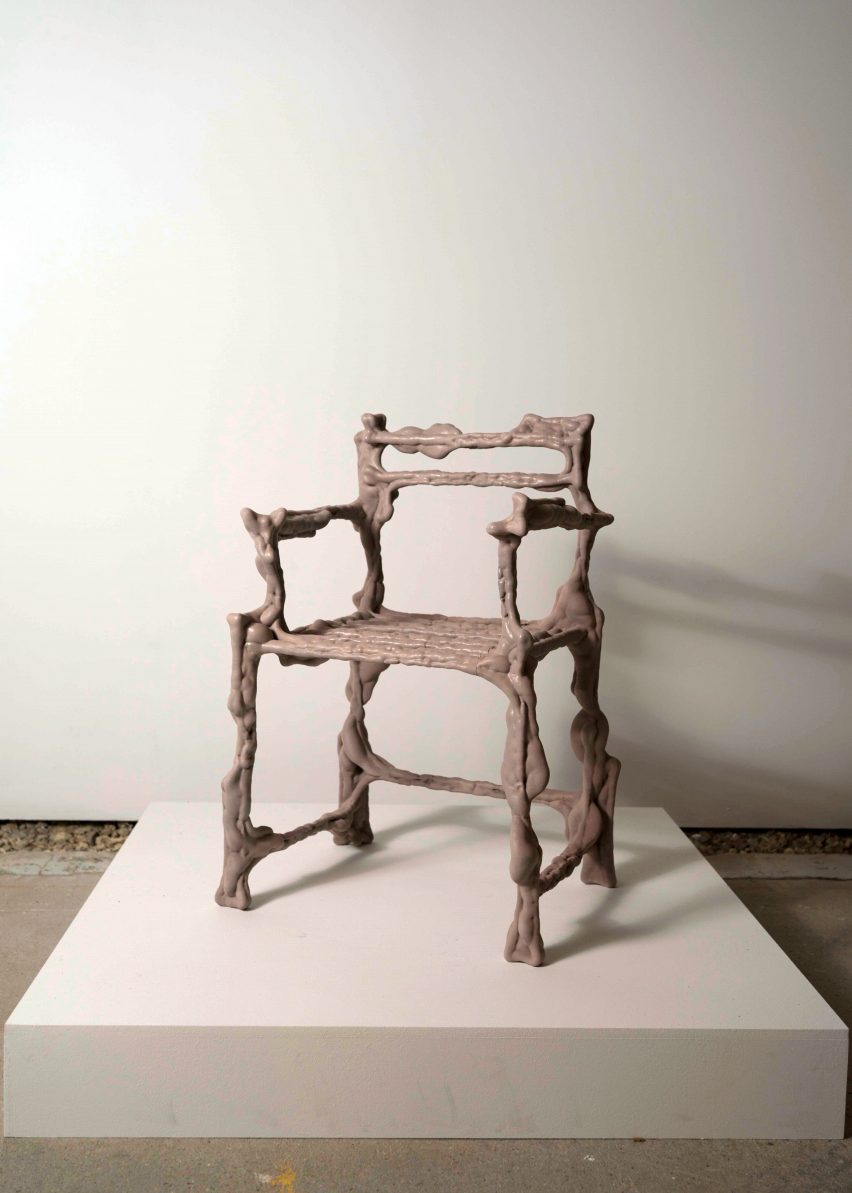
Various methods of production were showcasedthroughout the show. Daniel Widrig used 3D printing to digitally shrink-wrap a rectangular chair with polylactic acid, a starch-based bioplastic.
Daniel Widrig used 3D printing for his piece
The result is a grey-hued chair with an undulating form, which mirrors the shared style of previous blobby stools created by the designer.
“Its contours mimic the gentle curves and natural irregularities of body tissue, forming intricate folds and wrinkles,” explained Widrig.
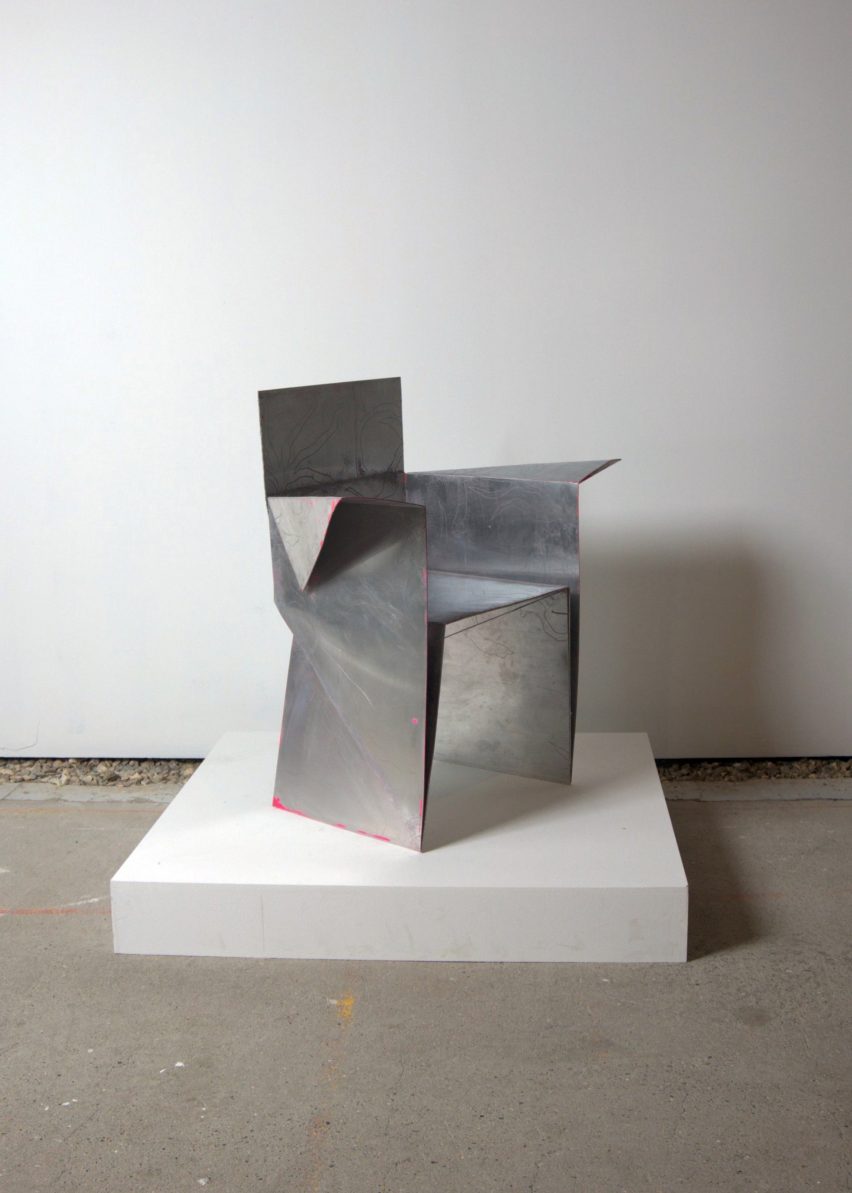
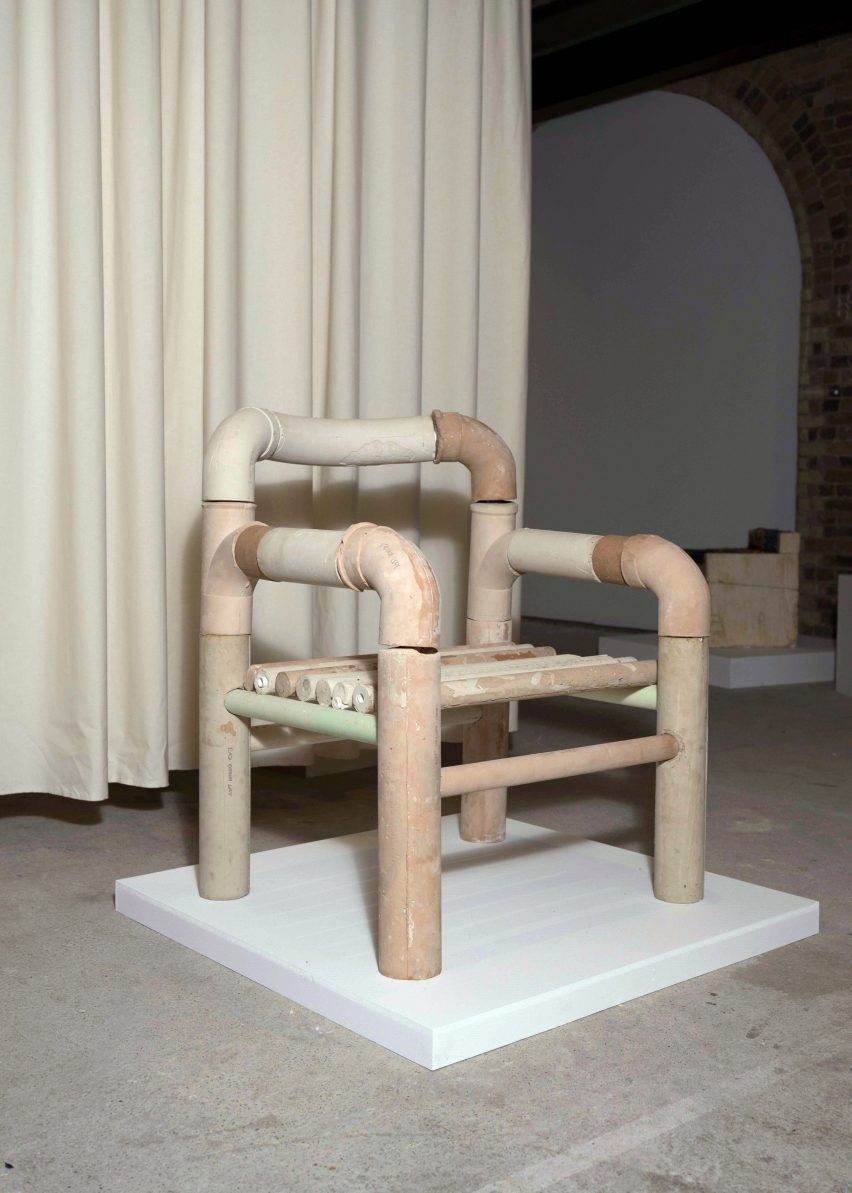
Thomas Wheller also used aluminium by folding a single piece of the material to create his chair, while Louis Gibson experimented with “regular” construction stock materials by creating casts from disused pipes.
“I was interested in imagining how these parts could be used unconventionally,” said the designer.
Thomas Wheller also worked with aluminium
“With such large volumes, I was curious to create casts, and then evaluate the internal forms in a new light, and finally address the problem of reassembly,” added Gibson.
“I chose plaster for the purpose of quick setting, I also felt it was in keeping with the world of builders’ merchants stock supplies.”
Louis Gibson experimented with salvaged construction materials
While the exhibition concluded at the end of London Design Festival (LDF), Chair of Virtue is an ongoing project curated by Adam Maryniak.
Prototype/In Process was on display on Dirty Lane as part of the annual festival’s Bankside Design District.
Furniture created from the remains of a single car and a modular display system by Zaha Hadid Design were among the many other projects featured during LDF.
Prototype/In Process was on show as part of London Design Festival 2023 from 16 to 24 September 2023. See our London Design Festival 2023 guide on Dezeen Events Guide for information about the many other exhibitions, installations and talks that took place throughout the week.
Promotion: aluminium and renewable energy company Hydro is exhibiting its collaboration with designer Lars Beller Fjetland at the London Design Festival, exploring how partnerships can help make the metals industry more sustainable.
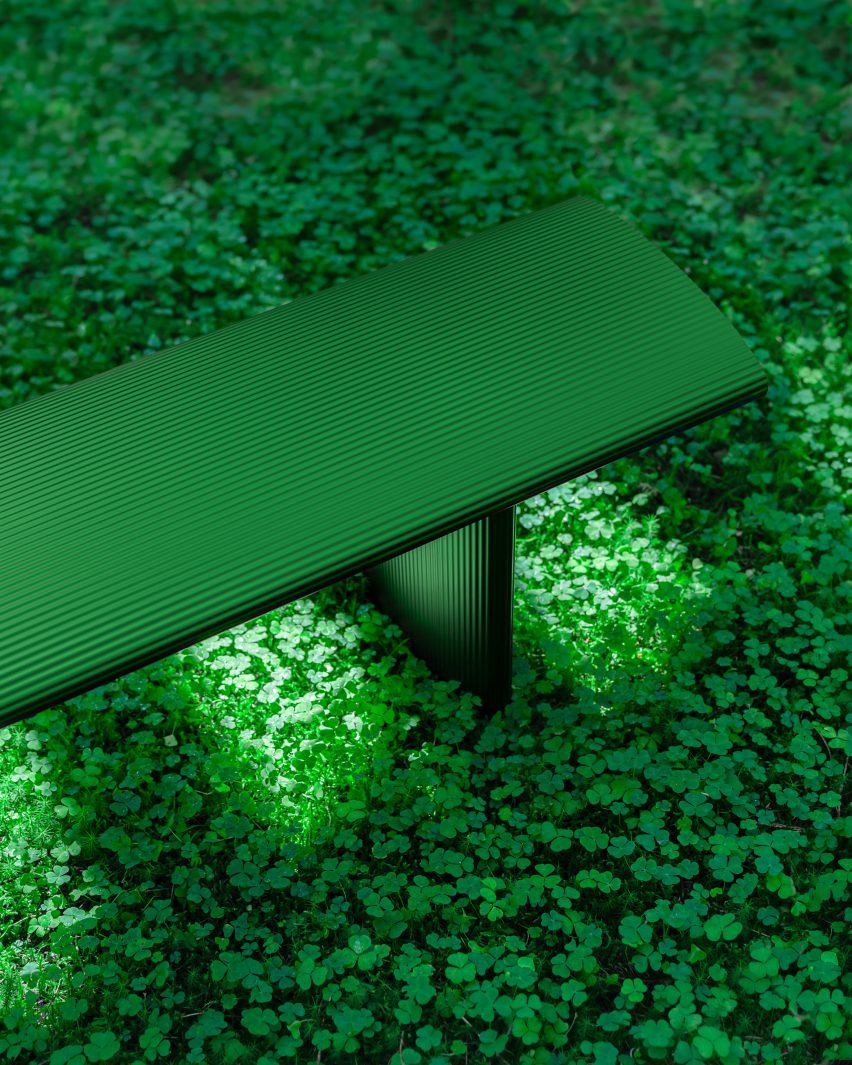
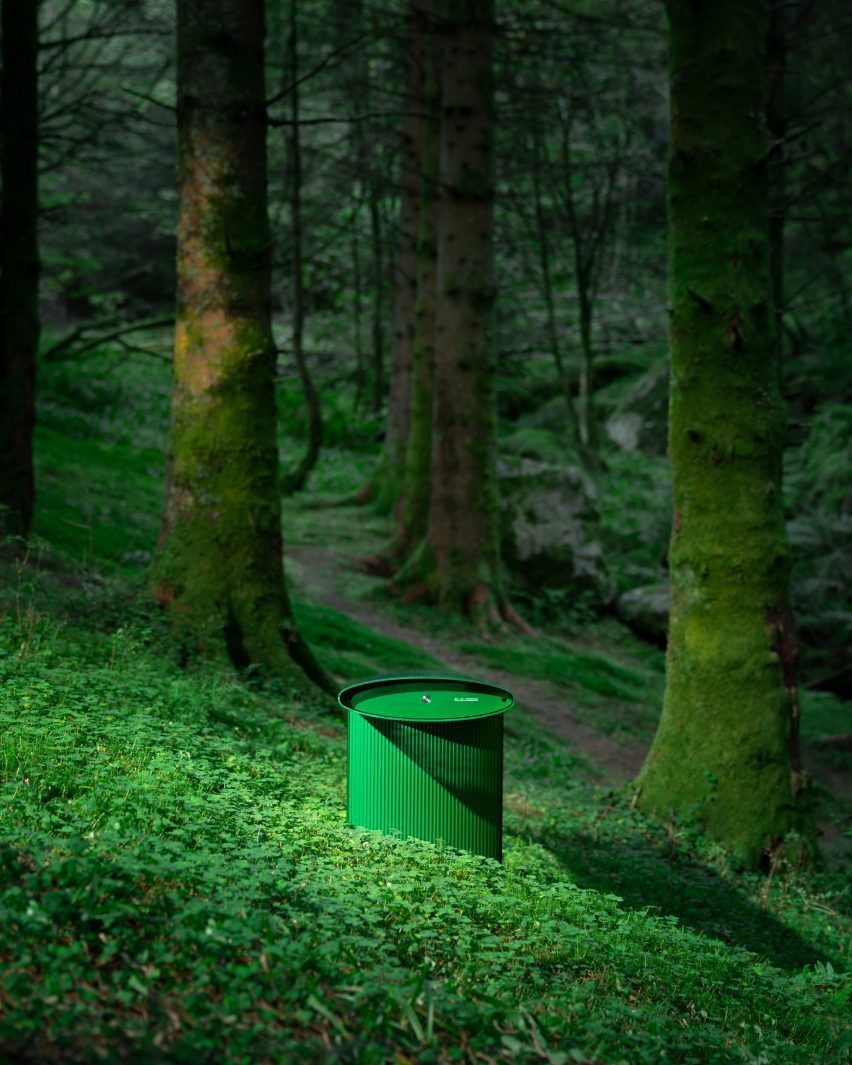
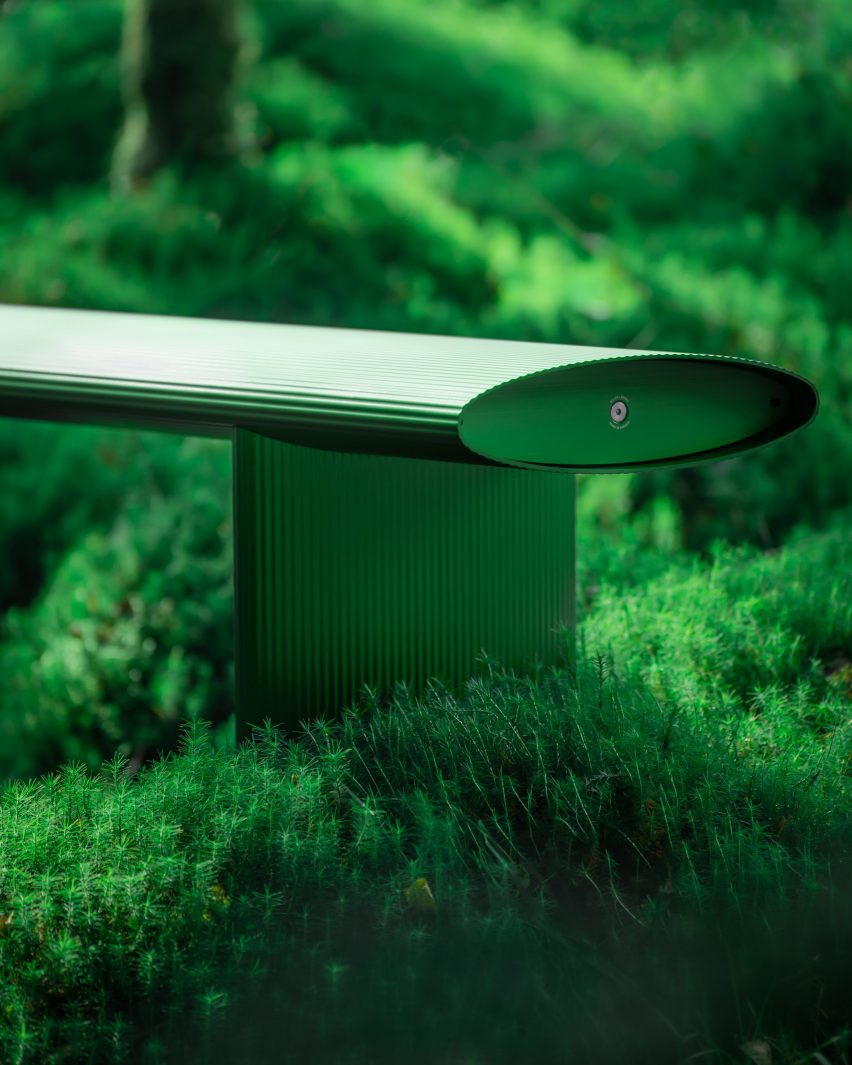
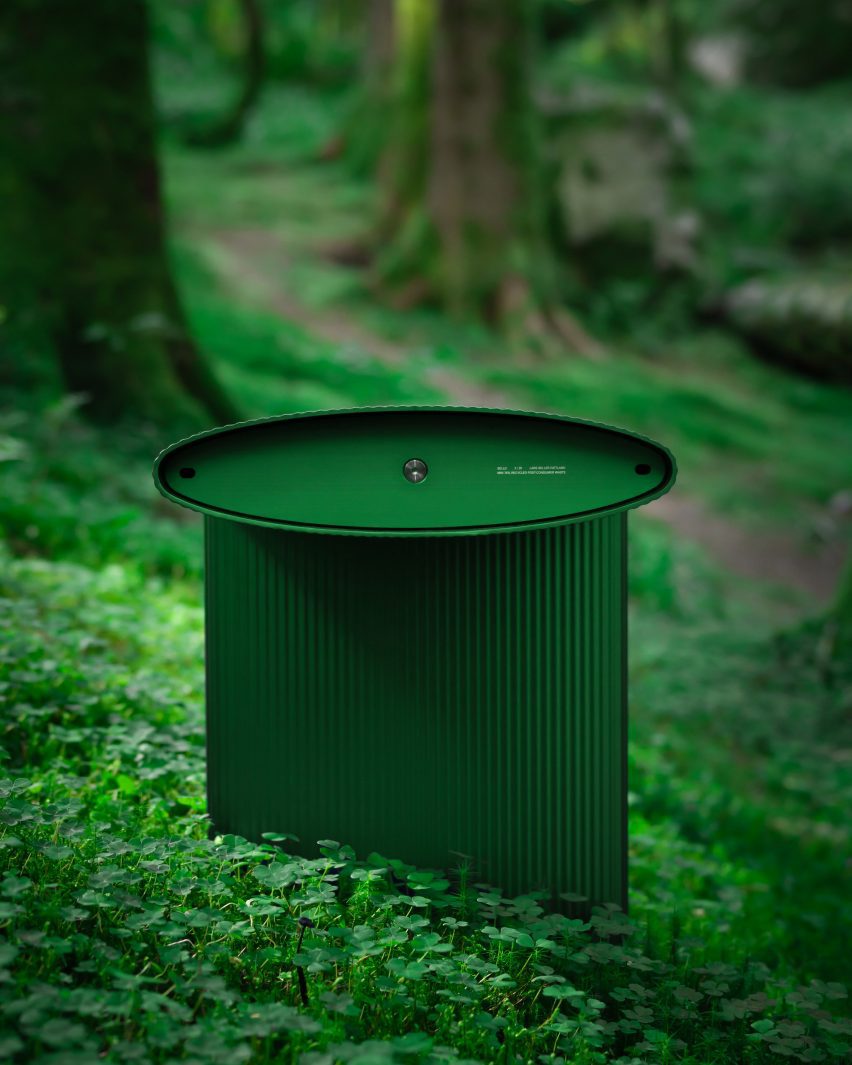
Earlier this year Hydro and Fjetland partnered to launch Bello! bench, a piece of outdoor seating made from extruded aluminium with 90 per cent recycled content.
Hydro is now exhibiting the bench at Material Matters at Oxo Tower, in a display that aims to communicate how the project advances the company’s ambition to decarbonise society.
The Bello! bench is the latest designer collaboration from Hydro
“Material and manufacturing literacy are key to creating truly sustainable products”, says Hydro’s marketing director, Asle Forsbak, noting an estimate that 80 per cent of a product’s environmental footprint is determined in the design phase.
The company aims to achieve net-zero emissions by 2050 and push the whole industry towards those goals as well.
This approach has guided the company into partnerships with designers and producers including Tom Dixon, Polestar, Porsche and Cake as it seeks to share knowledge about how to design with aluminium.
The collaboration explores how partnerships can help make the metals industry more sustainable
“As a designer the choices you make at the drawing board decide if the product can be taken apart and recycled again and again, which is why understanding material properties and manufacturing processes is key,” said Forsbak.
According to Forsbak, a deep understanding of engineering, material science and the realities of production all shaped the Bello! bench.
It is made from 90 per cent recycled aluminium, most of which is end-consumer scrap and can be recycled in its entirety.
The bench is made from extruded aluminium with 90 per cent recycled content
Fjetland based his design on penne rigate pasta, luxuriating in the ridged surface texture that could be created through extrusion.
As part of the exhibition, Fjetland is releasing Bello! in a new colour, a “striking, naturalesque green”, and says the design is “a practical example of how we are stronger when we work together”.
“At face value, Hydro might seem like an unlikely exhibitor at the London Design Festival,” said Forsbak. “But with the Bello! bench, we want to demonstrate how the industry and designers can work together to produce a practical and pretty product that can be mass produced, and also meet the society’s growing sustainability demands.”
The collaboration advances Hydro’s sustainability goals, according to the company
“At one hand, industrial mass production comes with a slew of challenges regarding environmental sustainability,” said Forsbak. “On the other hand, there needs to be a market pull for companies to produce sustainably.”
Forsbak explains that for “real, impactful change” it is necessary to have an amalgamation of perspectives, expertise and industries when designing products.
“The sustainability challenge of mass production isn’t solved in a vacuum; We need to work closely with our partners to help decarbonise society,” he said. “That is why collaboration is key.”
The Bello! bench can be seen at Hydro’s display at the Material Matters exhibition. The company’s stand will be made from reused structural components from past exhibitions.
To learn more about aluminium and design, visit Hydro’s aluminium knowledge hub, Shapes.
Partnership content
This article was written by Dezeen for Hydro as part of a partnership. Find out more about Dezeen partnership content here.
This is the last opportunity to be featured in the Dezeen Events Guide for London Design Festival 2023, which highlights the key events taking place in the UK’s capital city in September.
The guide includes a range of exhibitions, installations, talks, workshops, open showrooms, product launches, pop-up shops and design fairs taking place across London.
This year’s edition of London Design Festival takes place from 16 to 24 September 2023, with the 21st edition spanning across 13 districts in the city.
Dezeen Events Guide’s live digital guide showcases events that explore a variety of design mediums, including architecture, biodesign, furniture, lighting, interior accessories, fashion and materials and textiles design.
Last chance to get listed in Dezeen’s digital guide to London Design Festival
Get in touch with the Dezeen Events Guide team at [email protected] to book in your listing or to discuss a wider partnership with Dezeen. There are three types of listings:
Standard listing: for only £100, we can include the event name, date and location details plus a website link. These listings will also feature up to 50 words of text about the event. Standard listings are included at the discretion of the Dezeen Events Guide team.
Enhanced listing: for £150, you will receive all of the above plus an image at the top of the listing’s page and an image in the listing preview on the London Design Festival festival guide page. These listings will also feature up to 100 words of text about the event.
Featured listing: for £300, your listing will feature everything as part of an enhanced listing plus inclusion in the featured events carousel and social media posts on our @dezeenguide channels. This includes one post per channel: Instagram, Twitter and Facebook and up to 150 words of text about the event. This text can include commercial information such as ticket prices and offers, and can feature additional links to website pages such as ticket sales, newsletter signups etc.
About Dezeen Events Guide
Dezeen Events Guide is our guide to the best architecture and design events taking place across the world each year. The guide is updated weekly and includes virtual events, conferences, trade fairs, major exhibitions and design weeks.
Inclusion in the guide is free for basic listings, with events selected at Dezeen’s discretion. Organisers can get standard, enhanced or featured listings for their events, including images, additional text and links, by paying a modest fee.
In addition, events can ensure inclusion by partnering with Dezeen. For more details on inclusion in Dezeen Events Guide and media partnerships with Dezeen, email [email protected].