This week on Dezeen, we looked forward to the buildings set to be completed in 2024 and the architecture, design and interiors trends that will impact the upcoming year.
We rounded up 12 key buildings that will be completing over the next year – these include projects by Kéré Architecture, Sou Fujimoto, Zaha Hadid Architects and Foster + Partners.
We looked at the trends of 2024
We also looked at the architecture, design and interiors trends of 2024. Interior design will have a focus on individualism and see a backlash to the rise in AI design, while we will see less experimentation and more “safe spaces” this year in architecture.
Dezeen’s editorial director Max Fraser predicted that in design, we will see the rise of material intelligence and a rush for sustainable accreditation.
Mercedes-Benz is designing a skyscraper in Dubai
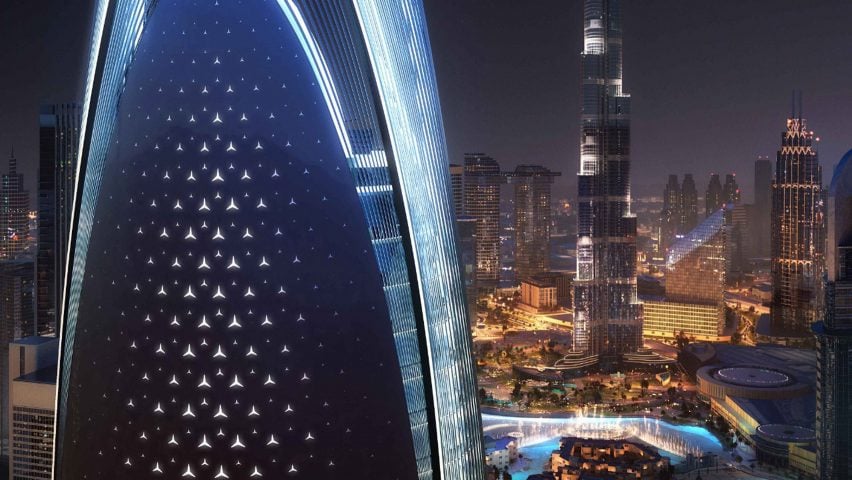
In architecture news, car brand Mercedes-Benz and developer Binghatti have revealed plans for a supertall skyscraper in central Dubai.
The car company’s first branded residential tower will reportedly be 341 meters high and located close to the Burj Khalifa.
“Our aim with our first branded real estate residential tower is to create new, desirable grounds that inherit our brand’s DNA and give our customers a place to arrive, unwind and come home to,” said Britta Seeger, a member of the management board for Mercedes-Benz Group AG.
The latest Neom region was revealed
In Saudi Arabia, the latest region of the Neom mega-development was revealed.
Named Norlana, the development designed by architecture studio 10 Design will be a town wrapped around a marina on the Gulf of Aqaba.
Catherine Slessor wrote an opinion on Carlo Ratti’s Venice appointment
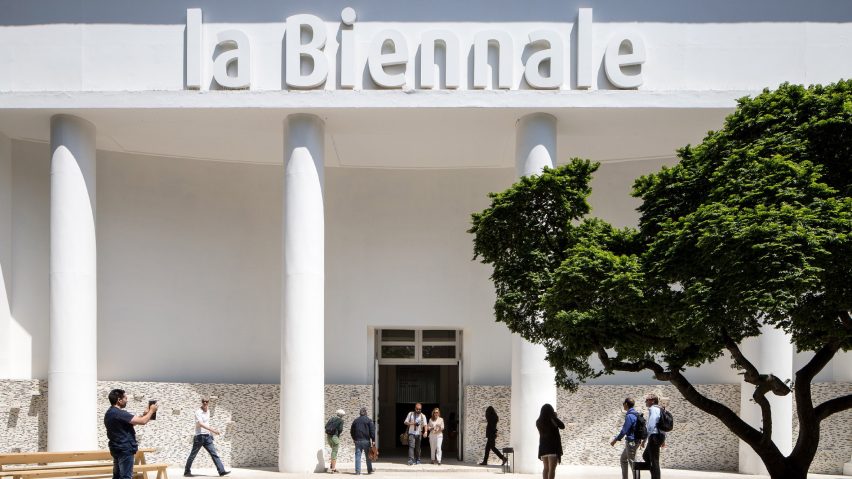
Following Carlo Ratti’s appointment as the curator of the next Venice Architecture Biennale, critic Catherine Slessor wrote an opinion piece that raises questions about how the event will be impacted by Italy’s far-right government.
“Viewed as a supposedly safe pair of Italian hands, Ratti’s appointment marks a screeching U-turn from [previous curator] Lesley Lokko, whose tenure was structured around narratives of decarbonisation and decolonisation,” she wrote.
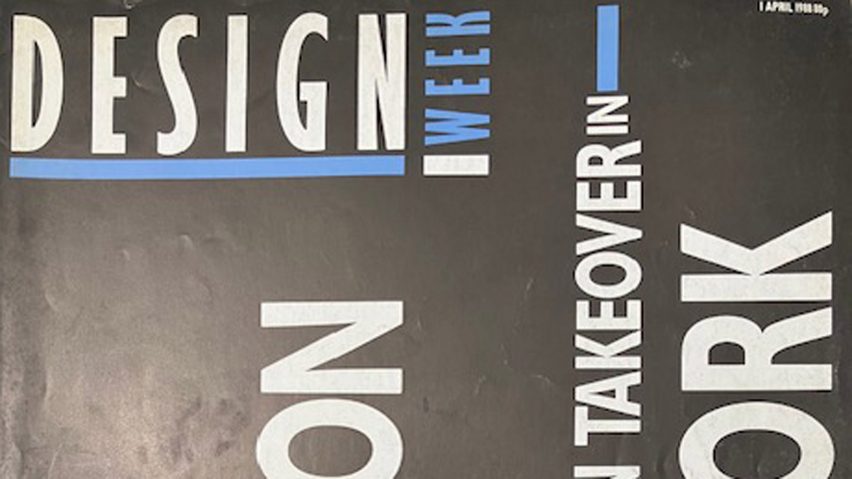
Design Week announced it was closing
In the UK, online design magazine Design Week announced that it had ceased publication and that its website will be taken offline later this month.
“Design Week is ceasing publication with immediate effect,” said a statement.
“Design Week’s parent company, Centaur, has made the decision to close the publication as its strategy shifts towards its ‘core audience of marketers, and focuses on training, information, and intelligence’.”
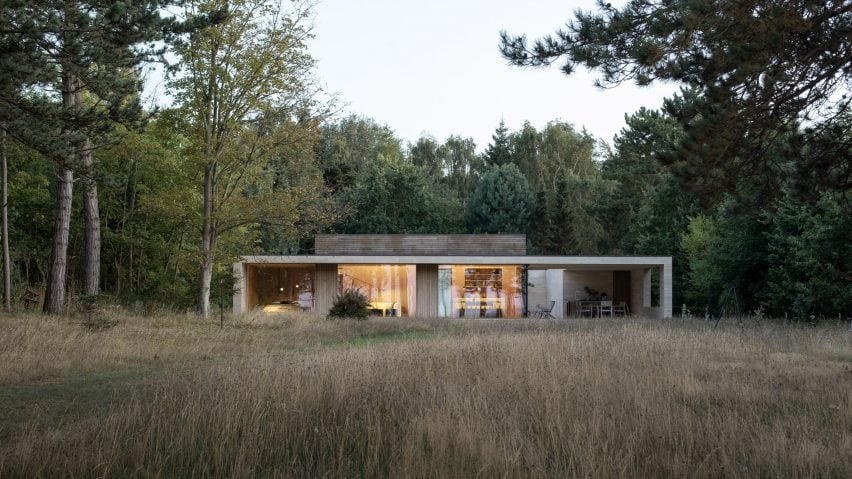
A Danish summerhouse was one of this week’s most-read projects
Popular projects this week included a monolithic summerhouse on the Danish coast, a pitched-roof house in Massachusetts and a store arranged around a conversation pit.
This week on Dezeen
This week on Dezeen is our regular roundup of the week’s top news stories. Subscribe to our newsletters to be sure you don’t miss anything.
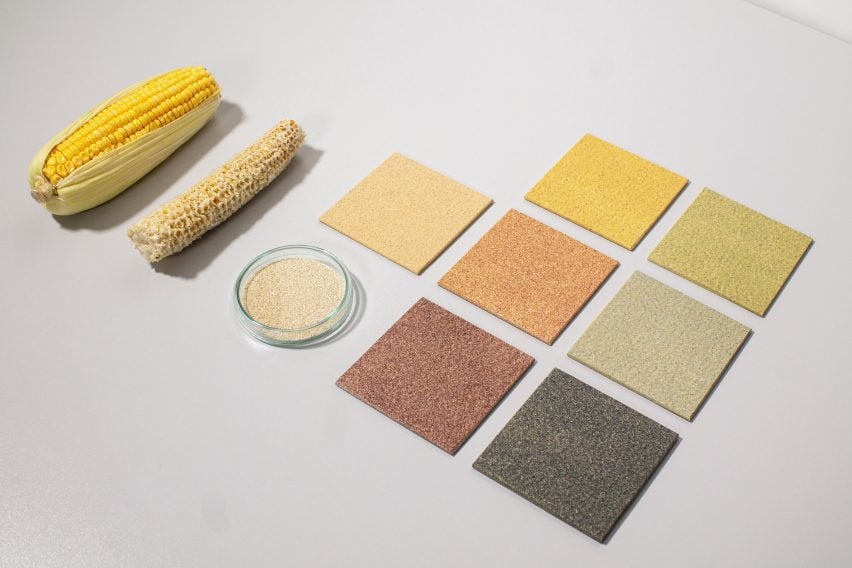
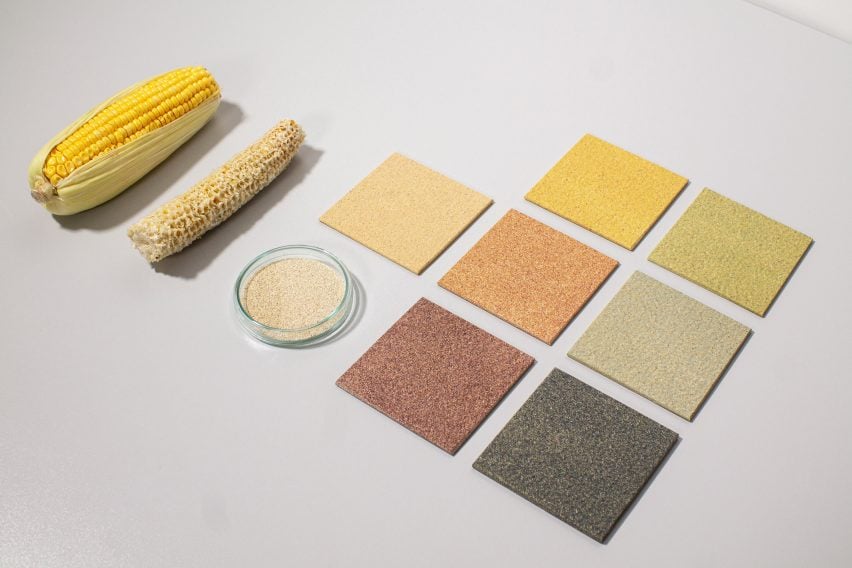
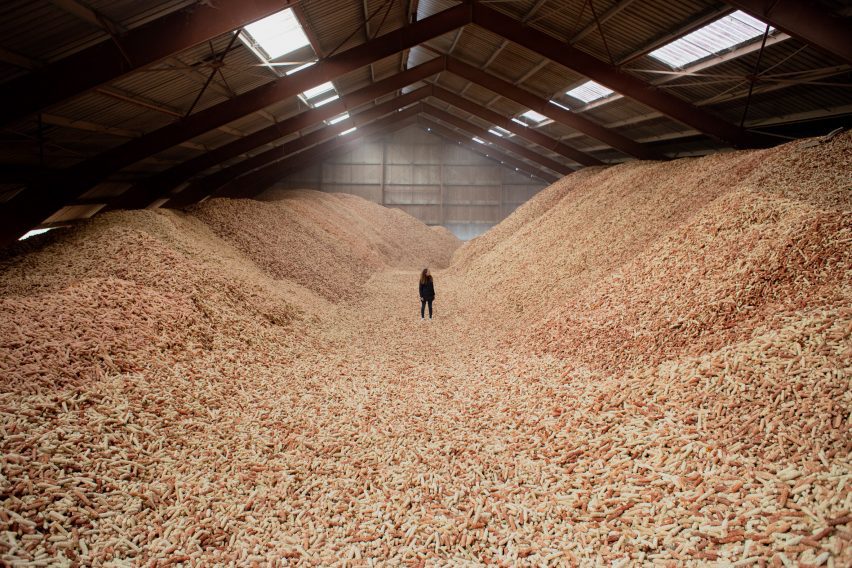
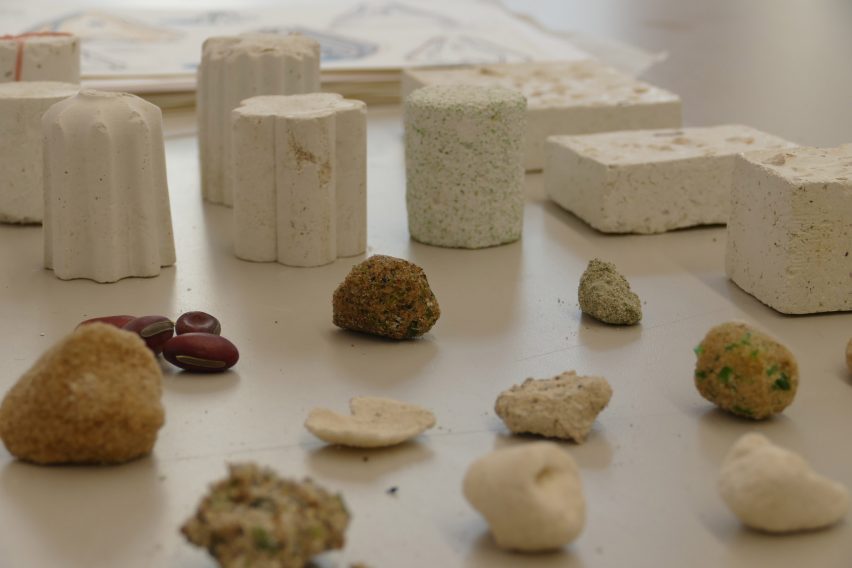
Materials companies Circular Matters and StoneCycling have used corn cobs – one of the world’s most plentiful agricultural waste materials – to make interior cladding that is biodegradable and almost entirely bio-based.
Available in the form of tiles and sheets, CornWall is intended as a more sustainable alternative to ceramic interior wall tiles or plastic laminate.
The material is derived from more than 99 per cent renewable, biological sources, is created at low temperatures using mainly solar power and emits less carbon dioxide in its production than was captured by the corn as it grew, the manufacturers claim.
CornWall is an interior cladding material that is 99 per cent bio-based
To give the products a long lifespan, Circular Matters and StoneCycling have produced the tiles with a mechanical fixing system, so they can be demounted and reused or given back to the company for cleaning and recycling.
The technology behind CornWall was invented by Circular Matters – a start-up spun out of a lab at Belgium’s KU Leuven University, where founder Pieter Dondeyne and his team found a way to process plants to enhance their natural biopolymers and create durable materials.
The team then partnered with Dutch company StoneCycling to channel their technology into a product.
Corn cobs make up most of the composition of the tiles
StoneCycling co-founder Ward Massa told Dezeen that the focus on corn came because it is one of the most grown crops on the planet and its waste is abundant.
“What happens when you grow corn for human consumption is when it’s ready to harvest, you take off the corn and the corn cob is a leftover material because it doesn’t hold any nutritious value,” he said.
“Usually, that means that these corn cobs remain on the field and rot away, or they are burned as biomass to generate energy,” he continued. “In both cases, you release the carbon that was stored in those fibres – it rots away and it gets released, or you burn it and it gets released.”
With CornWall, the carbon is locked away until the tiles reach the end of their life and are left to decompose.
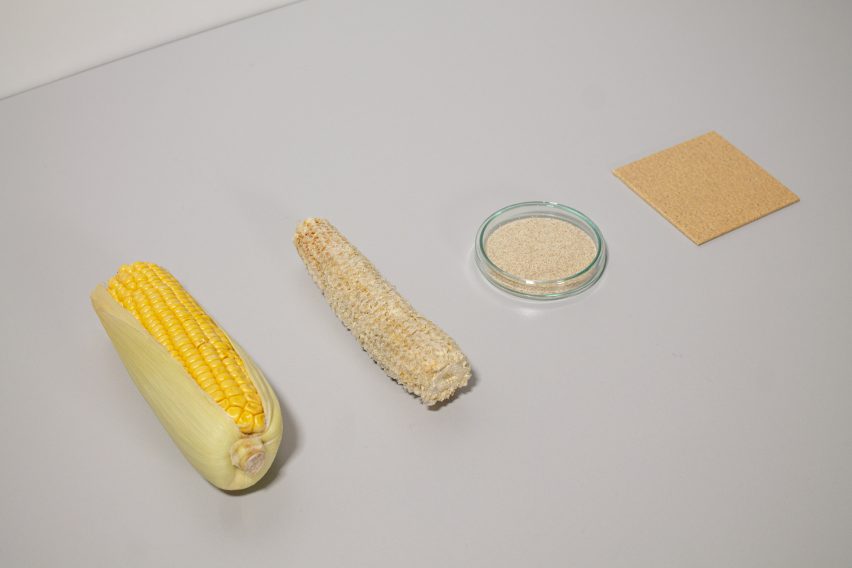
The production process begins with the discarded cobs being collected, dried and shredded into biomass.
This material is then mixed with other agricultural waste, binders and pigments and pressed into a plate material at a relatively low heat of 120 to 150 degrees. As a final step, the tiles are given a thin coating for water resistance.
All of the ingredients are derived from biomass apart from the pigment, which accounts for the 0.5 per cent of the product that is not bio-based – a very low percentage in a field where even products containing small amounts of materials of organic origin are sometimes labelled as bio-based.
The agricultural waste material was chosen because of its abundance
According to Massa, the companies were able to keep the product pure by focusing on interior wall applications only.
“If you want to create a product that can also be used on the exterior or as a flooring or in the shower, then you have to start adding chemicals to bind it, to make it more water resistant and stuff like that,” he said.
“We chose to start with this application because it’s relatively easy and the binder and the product is nothing else than the natural polymers that are already part of this biomass. Because of adding heat and pressure, these polymers are activated and bind together.”
The corn cobs are dried and shredded before being pressed into tiles
CornWall is also biodegradable according to official standards, with Massa saying it could be buried in a field and disintegrate in a couple of months.
The only thing that would remain is the water-resistant coating, which is not biodegradable but makes up less than 0,001 per cent of the total product meaning it does not affect its biodegradability overall, according to Massa.
“Unfortunately there are no 100 per cent biodegradable coatings on the market yet,” he said. “We’re working with our suppliers on this but it’ll take more time.”
Instead, the intent is to keep the product in use for as long as possible.
The companies wants to target retail and hospitality chains that frequently open and close locations – Starbucks is an example Massa gives – and work with them to make sure the tiles stay in a closed loop of material reuse.
He also believes CornWall offers good options for these kinds of businesses in the design stage, as it can be ordered in custom colours and embossed patterns to complement their branding.
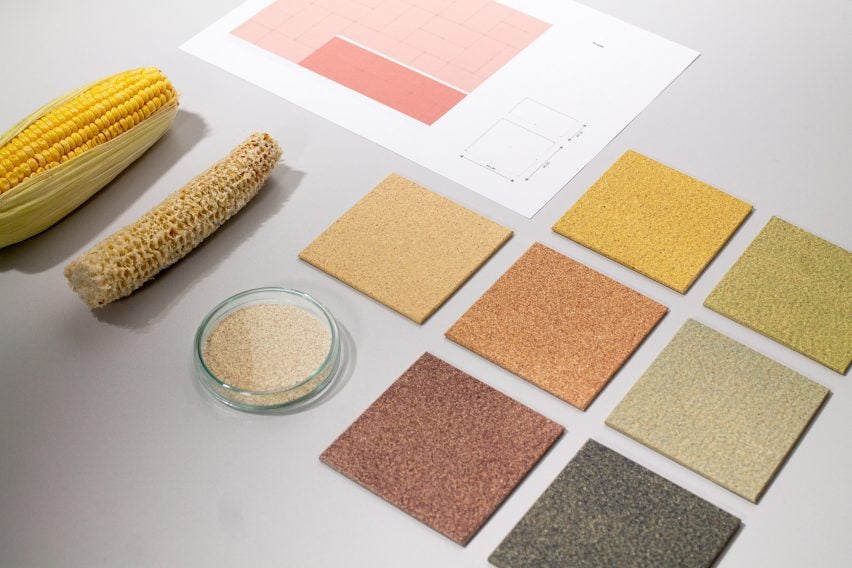
The tiles are available in a base range of six colours
“As far as we are concerned, this will become the new retail material,” said Massa. “Especially in those places in retail where they now use materials that are either glued or take a lot more energy to make or create a lot of waste when the shops are being renovated or demolished.”
“Production can also be done regionally because you don’t need a very complicated factory for it.”
CornWall is currently available in a base range of six colours and two sizes, developed in collaboration with Dutch design practice Studio Nina van Bart. Massa says additional textures will soon be added to the line.
CornWall is the fourth product from StoneCycling. The first was the WasteBasedBrick, which is made from 60 per cent waste and was used by Dutch architects Nina Aalbers and Ferry in ‘t Veld of Architectuur Maken to build their own house in Rotterdam.
Industrial designer Mary Lempres has created a bio-cement structure developed to mimic naturally occurring oyster reefs that tackle coastal flooding, filter seawater and promote biodiversity.
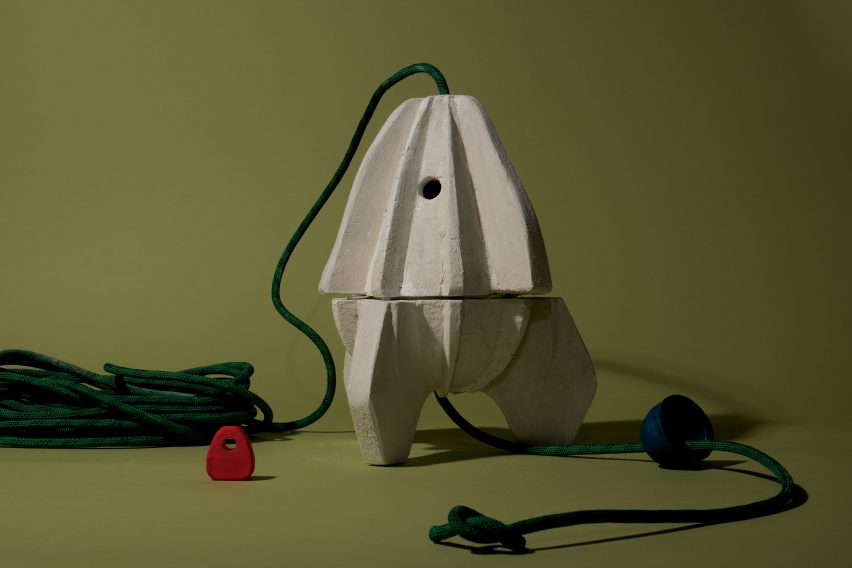
Called Reef Rocket, the structure comprises a duo of bio-cement modules with ridged surfaces that can be stacked in two directions and create a rocket-like shape when assembled.
Reef Rocket is a bio-cement structure formed from two modules
Norwegian-American designer Lempres drew on biomimicry for the project, a practice that looks to nature to solve human design challenges.
The ridged modules were created to be placed underwater and emulate coastal oyster reefs, which naturally filter algae from seawater as well as attract and provide shelter for other aquatic organisms.
Mary Lempres designed Reef Rocket to emulate oyster reefs
Oyster reefs also dissipate wave energy, mitigate storm surges and manage eroding coastlines, explained the designer.
Lempres collaborated with bio-geotechnical specialist Ahmed Miftah to develop a method for growing plant-derived cement that makes up the modules, which she described as “similar to the irrigation systems required for growing a plant”.
The designer drew on biomimicry for the project
The pair poured a bio-based, non-toxic solution containing a crude extract from globally grown plants over crushed aggregate.
Sourced in New York City, the aggregate was created from crushed glass and oyster shells salvaged from local restaurants and New York Harbour.
“The packed substrate grows similarly to a plant,” Lempres told Dezeen.
Reef Rocket was created to attract oysters
Saturated for three to nine days, the substance becomes natural concrete after the extracted biocatalyst causes minerals to form “mineral bridges” between the glass and shell waste.
“The resulting product is water-resistant, durable and comparable with standard concrete containing the same amount of aggregate,” explained the designer.
Lempres created the bio-cement with bio-geotechnical specialist Ahmed Miftah
“It can be grown in any environment without heat or otherwise burning fossil fuels and is derived from waste products, making it an affordable and scalable alternative to cement,” she continued.
“Bio-concrete is chemically identical to the material oysters produce to grow their reefs. The key difference is the bio-concrete we’ve developed grows in just several days, while oyster reefs take millennia to grow.”
This process closely mimics the natural processes that occur when oyster shells and coral reefs are grown, according to the designer.
“I was inspired by the ability of this reef-growing material to withstand extreme wave energy and corrosive saltwater,” she said.
The structure was designed to be placed underwater
When creating the modules, Lempres and her team made “hundreds” of prototypes.
Eventually, they settled on prefabricated moulds, which the bio-cement can be packed into and set – “like sand” – without the need for heat or chemicals.
Lempres and her team created “hundreds” of prototypes
Reef Rocket was deliberately developed to be small in size, lightweight and easy to assemble, making the design accessible to as many people as possible, according to the designer.
“Nature has the incredible ability to grow intricate and durable material, like shells and coral, without polluting its surrounding environment,” said Lempres.
“Reef Rocket harnesses the natural process of growing durable minerals to re-grow vital reef structures, benefiting humans and our ecology from the worsening effects of climate change,” she added.
“This paves the way for a future where hard and durable material can be grown like a crop, regenerating waste rather than polluting our environment.”
Previously, US design workshop Objects and Ideograms conducted a research project that involves 3D printing with calcium carbonate to create sustainable underwater “houses” for coral reefs and marine life to grow. Chinese materials company Yi Design developed a porous brick made from recycled ceramic waste that could be used to prevent flooding in urban areas.
After an unsteady 2023, Dezeen’s editorial director Max Fraser considers what 2024 might hold for design.
His predictions for what we will see when it comes to design next year range from the rise of material intelligence to the rush for sustainable accreditation.
Collective material intelligence
The pace of development in material innovation continues, in particular those made from supposedly sustainable resources as well as those salvaged from waste streams, such as fabrics made from bacterial fermentation and handcrafted biotextiles.
The appetite to use such creations in projects will increase in 2024 as designers strive to create products with greater material sensitivity. This goes hand-in-hand with a drive to lower the impact of our consumption on planetary systems as we continue to sharpen our focus on the climate crisis.
Above: Formafantasma’s Cambio exhibition focuses on wood. Photo is by Paavo Lehtonen Photography. Top image: brick textiles by Natural Material Studio
Increasingly informed clients and customers, together with (hopefully) heightened regulations, will demand ever-more transparency around the origin of the materials, seeking justification for their implementation, as well as assurances around traceability and a low full-life impact.
An increasing number of designers will respond by shortening supply chains, opting for regionally-appropriate materials, harvested or mined closer to the place of production.
This will likely become more of a prevalent expectation in 2024, buoyed by an already enterprising surge in new biomaterials and fabrication technologies. The challenge is scaling this from narrow experimental work into more mainstream channels.
Greater appreciation of aesthetic imperfection
Product uniformity works well for items such as TVs, phones and washing machines. But when it comes to the use of natural materials in mass-production systems, the mindset of uniformity and perfection also prevails. This means that the inconsistent nuances in colour, texture or grain that are inherent in the likes of wood, wool, leather or stone become a hurdle to overcome.
There is a growing concern that stripping out the quirks of a tree, the striations of a rock or the blemishes on an animal hide just creates unnecessary waste. This was highlighted by Formafantasma’s Cambio research project when the design studio investigated the global impact of the extraction, production and distribution of wood.
Working with Finnish furniture brand Artek, one of the outcomes of the study was for the manufacturer to reassess its strict timber selection criteria. Previously only using regularly grained local birchwood without any natural marks, the brand has loosened its criteria to embrace imperfections. In 2023, characteristics such as insect borelines, knots and even bark first appeared on the iconic Stool 60 by Alvar Aalto as part of an evolving Artek collection.
This approach from a reputable brand sends a signal to the rest of the furniture industry that an ‘imperfect’ aesthetic sensibility needs to be embraced if we’re to reduce processing and production waste. This is something that I suspect will become more evident in 2024, helped by the economic case that customers will want to buy into the unique characteristics of these items.
Raw and mono-material products
Designers will further endeavour to reduce the complex interplay between different kinds of materials used in production. The motivation is to create products where the component parts can be dissembled and separated more easily for repair or recyclability.
Such intentions will need to be communicated to users and the inevitable aesthetic change celebrated.
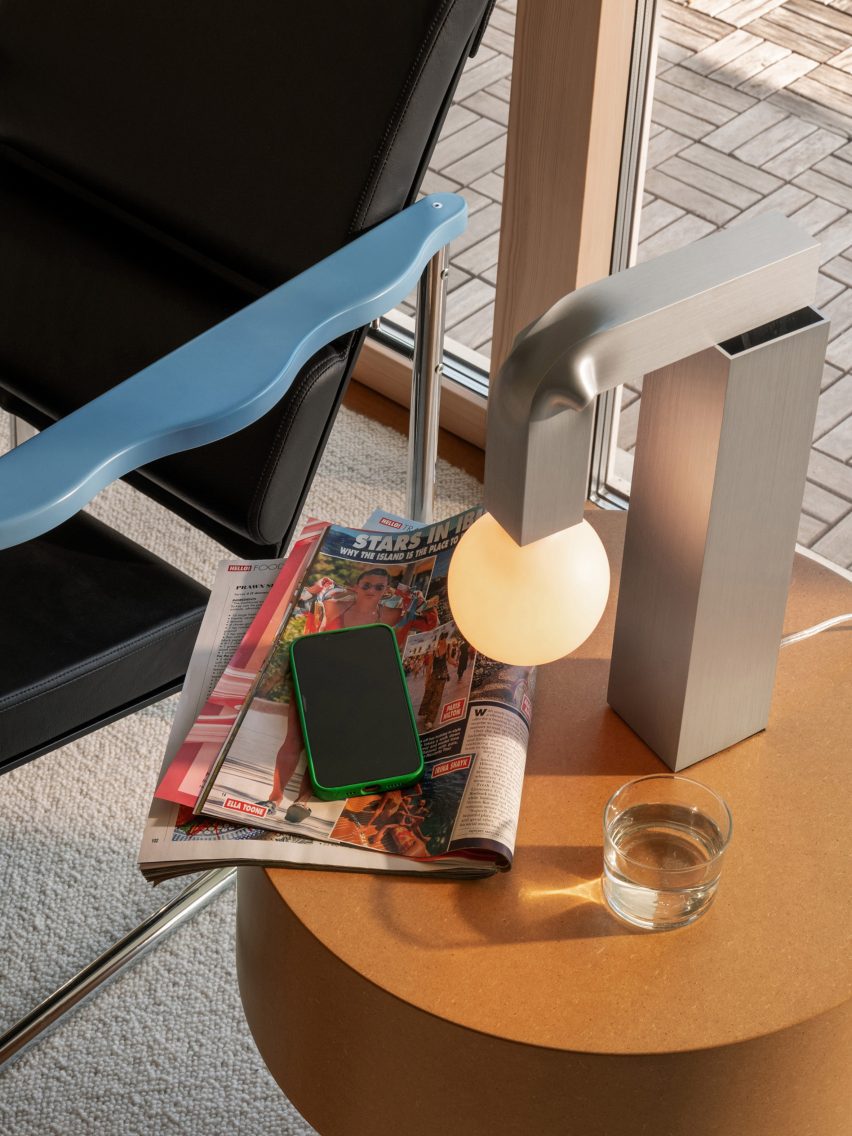
David Taylor’s Knuckle Light is made from aluminium
As circularity becomes expected, a ‘circular aesthetic’ will also emerge whereby products will be lauded for their efficient and singular use of materials, exposed fixings and true-to-material ‘raw’ finishes.
This was recently exemplified by the aluminium Knuckle light by David Taylor for Hem, an embodiment of raw, folded, uncoated aluminium and the winner of the lighting design of the year in the Dezeen Awards 2023.
Fifty shades of sustainable
For several years now, overuse of the word ‘sustainable’ across all areas of society has reached the point where its very meaning has become opaque. Take a trip to any trade fair or design week and you’ll leave with sustainability fatigue, so much is the word oversaid, overheard and overprinted.
Many smart brands recognise this and are eager to communicate the great lengths they go to to reduce their planetary burden, ensure reputable supply chains, create healthy work environments for all and deliver economic returns that benefit their communities as well as their shareholders. To that end, the B Corp rush is on.
B Corp Certification is one of the most rigorous and reputable certification schemes for any aspiring business, thoroughly assessing all of the aforementioned criteria and more. As one manufacturer joked to me, “It’s a tough process. Everything is opened, assessed and scored. It’s like letting a stranger look through your underwear.”
Manufacturers like Modus in the UK, Fredericia and Astep in Denmark and Andreu World in Spain all crossed the line in 2023 and I predict many more will pass the test in 2024: credibility from accreditation.
Trade fairs – a make-or-break year
It’s been another bumpy year for trade fairs, which have struggled to rebound to pre-pandemic glory. The considerable cost and enormous effort of exhibiting has brands questioning how often they can commit. The returns that fairs are expected to deliver for these exhibitors – namely via marketing, footfall and ultimately orders – is an increasing pressure when attendees have also become more discerning about which shows they choose to visit.
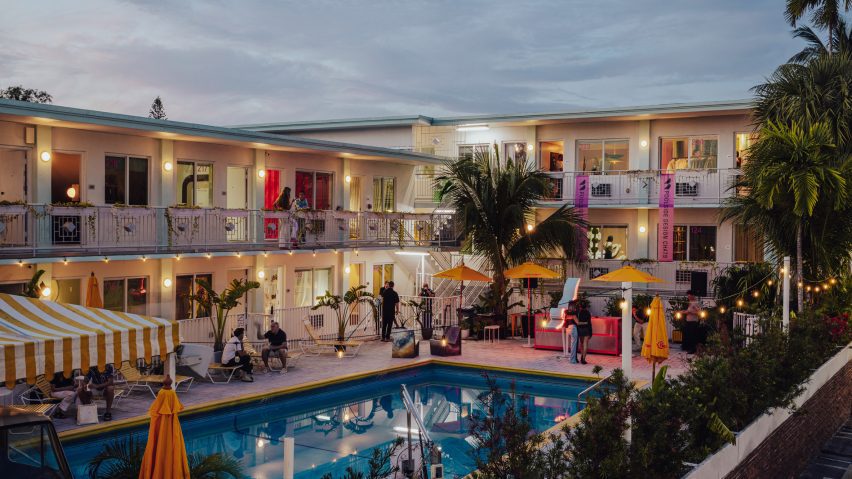
Milan’s Alcova showed in Miami this year. Photo by Piergiorgio Sorgetti
The excessive waste generated by stand construction continues to be a challenge to overcome. I’ve become so distracted by the endless use of virgin materials to construct brand-ego-sized displays that I barely notice the product anymore. I call for greater brand humility and am hoping the previously-mentioned circular aesthetic will find its place on stand design as fairs continue to evolve.
It remains a struggle to make rather grim exhibition centres pleasurable, while reducing the environmental burden. Smaller, more nimble shows like Alcova and Material Matters will likely gather pace, able to better attain the sweet spot between quality content and distinct experience. Those that succeed will need to marry timely inspiration with responsible aspiration.
AI – will it deliver on the hype?
While hype, speculation and doom-mongering around the impact of generative artificial intelligence continues across multiple industries and at government-level, I expect the dust will settle somewhat in 2024.
For all of the wonders that AI promises, including analyzing data to inform design decisions, automating repetitive tasks, and simulating and testing designs, maybe there will be more skepticism as to whether or not it will live up to the fanfare we’ve witnessed this year.
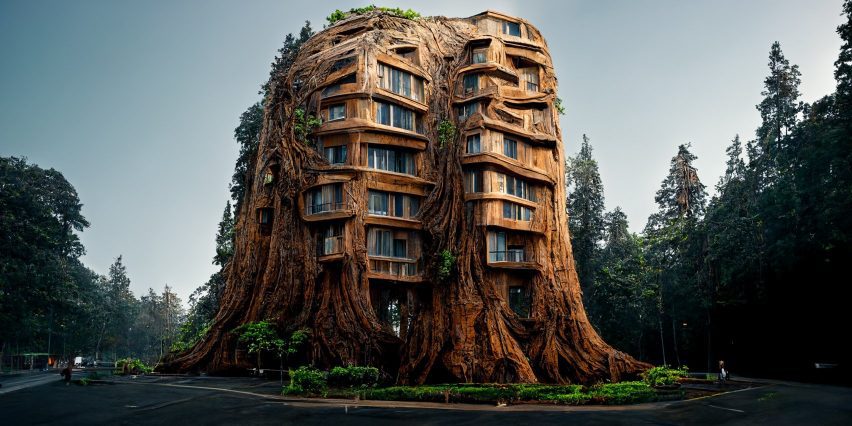
AI-designed projects created controversy. Image by Manah Bhata
One of the leading voices in AI, Gary Marcus, believes there are “many serious, unsolved problems” with the technology that could limit its usefulness. However, Airbnb co-founder Brian Chesky reckons designers should embrace AI otherwise the world “will be designed without them” as he stated in an interview with Dezeen in November. He added, “But, I am also wary of fetishization of technology” and, sharing this sentiment, I would caution the hype.
In off-the-record chats, I encounter plenty of individuals who are nonchalant about AI, so I would question the assumption that we must all want and need to use it. Within design, I wonder if we’ll see a revolution from artificial intelligence in 2024 – or perhaps its offerings will just become casually subsumed into the designer’s toolbox.
Polarising approaches to production will broaden
When it comes to fully scrutinising every action and proceeding with self-initiated care and integrity, many brands will find their mojo in 2024, particularly more nimble family-owned businesses with a clear eye on their legacy.
But I fear most won’t, as the pressures of increasing costs, stubborn inflation, volatile supply chains, debt repayments, shareholder expectations and hesitant citizen consumption trigger an urgent scramble to carve out new market segments. All of these touchpoints are and will continue to be directly or indirectly exacerbated by the desperate human conflicts and environmental disasters that we’ve witnessed globally in 2023.
Changing business models to circumnavigate these disruptions requires long-term vision and stability, two things seemingly in short supply right now. Those willing to evolve their enterprises deserve to succeed, however, I suspect many businesses will choose not to rock the boat.
Add to this the ongoing lacklustre governmental approaches to the climate crisis and it’s hard to envisage a world that can muster much excitement at the release of another new yet non-essential product. The time for the design industry to broaden its collaboration with other industries is now. The opportunities to work on game-changing solutions to some of our existential challenges are ripe for the picking.
Danish architecture studio BIG has created an experimental stage set for Danish pop trio WhoMadeWho’s world tour.
A suspended silver orb formed the centrepiece of the immersive audiovisual design, which was created for the tour that began in November. It is BIG‘s latest inflatable structure and was informed by the floating 26-metre-diameter, mirrored sphere it created for Burning Man in 2018.
BIG designs stage set with inflatable orb for WhoMadeWho’s world tour
“Our design for WhoMadeWho’s stage draws from our previous ventures into inflatable creations like SKUM and The Orb [at Burning Man],” BIG partner Jakob Lange explained.
“With maximum visual impact, the inflatable sphere serves as a canvas for captivating three-dimensional video projections, elevating the concert experience to a new level.”
The reflective sphere was designed to mirror the surrounding real-time visuals
The orb was integrated with controllable lights and visuals, but was also designed to reflect the surrounding scenography to give its presence a multimedia dimensionality.
Three futuristic silver pods were positioned below the sphere to be occupied by each band member and the stage was framed by an expansive LED screen background.
BIG’s stage was brought to life with immersive visuals from the creative teams of Flora&faunavisions, LA-based EyeMix Studio and animator Christopher Mulligan.
Using AI and other advanced visualisation tools, the artistic teams sought to combine BIG’s stage set with cutting-edge imagery that can respond in real-time to WhoMadeWho’s performances.
Three silver pods are occupied by WhoMadeWho below the hovering orb
The stage system will reach audiences across cities such as Paris, Los Angeles, London and New York City as WhoMadeWho – comprising of Tomas Høffding, Tomas Barfod and Jeppe Kjellberg – continue their world tour in 2024.
Founded in 2005 by Bjarke Ingels, BIG is one of the world’s most influential architecture studios with headquarters in both Copenhagen and New York. The studio recently unveiled its masterplan for a 1,000-square-kilometre development in Bhutan and its design for a cascading, luxury residential building near Athens.
Happy new year from Dezeen! We’ll be back tomorrow, but in the meantime, you can read about the biggest design and architecture stories of 2023 and our full review of the year.
The review looks at the most interesting architecture, design and interior stories from 2022. It includes roundups of the the year’s rebrands, innovative materials, restaurant and bar interiors, controversies, US architecture, cabins and more.
Australia has become the first country in the world to ban engineered stone, following rising cases of silicosis among workers who handle the material.
The ban was agreed at a meeting of Australian federal and state workplace ministers on Wednesday, and will come into place across the country from 1 July 2024.
The ban targets engineered stone, also known as agglomerated stone – a type of material made by mixing crushed stone with a resin binder.
“This is a dangerous product”
While it is valued as a durable and affordable alternative to natural stone for kitchen benchtops, the material can be dangerous while being cut because it releases a fine silica dust into the air.
Australia has recorded rising cases of the lung disease silicosis in stonemasons who have handled the product, leading it to be dubbed “the asbestos of the 2020s” by union leader Zach Smith.
“This is a dangerous product that’s known to cause the potentially fatal disease silicosis, and it has no place in our workplaces,” said Queensland industrial relations minister Grace Grace in a statement following the meeting.
“The rate of silicosis illness in Australia for those working with engineered stone is unacceptable,” said her Western Australian counterpart Simone McGurk. “This prohibition will ensure future generations of workers are protected from silicosis associated with working with engineered stone.”
Ban follows report finding no safe level of silica in engineered stone
The move comes nine months after an investigation by three Australian news outlets accused supplier Caesarstone of not doing enough to warn people of the dangers of working with the material and the country’s construction union launched a campaign calling for the ban.
A subsequent report by the national policy body Safe Work Australia found that engineered stone workers were significantly over-represented in silicosis cases and were being diagnosed with the disease at much younger ages than workers from other industries, with most being under the age of 35.
It also found that the risk from engineered stone was distinct from that of natural stone due to the material’s physical and chemical composition, and that this was likely contributing to more rapid and severe disease.
The report concluded that no level of silica was safe in engineered stone and that the material should be prohibited in its entirety.
Silicosis is caused by tiny particles of silica becoming embedded in the lining of the lungs and manifests in symptoms such as shortness of breath, cough, weakness and fatigue.
The condition is life-altering and potentially fatal, with many formerly healthy young sufferers describing being unable to work or play with their kids.
Caesarstone commits to supplying Australia with “alternative products”
In response to news of the ban, Caesarstone commented that while it disagreed with the decision, it is taking the necessary steps to ensure supply of alternative materials to Australian consumers.
“The Caesarstone brand is well known in Australia and its products have earned tremendous success over the years,” said Caesarstone CEO Yos Shiran. “We are already taking steps to supply our Australian market with alternative products while maintaining our strong market presence.”
It has previously argued that its material is safe if handled correctly and that the silicosis danger was the fault of employers and work safety bodies.
The ban will apply to the manufacturing, supplying, processing and installing of engineered stone but not its removal, repair, disposal or minor modifications.
Australia’s workplace ministers will meet again in March 2024 to finalise details of the ban, including the transition period for contracts that have already been implemented and the precise definition of engineered stone.
The country’s Model Work Health and Safety Regulations currently exclude concrete and cement products, bricks and pavers, porcelain, ceramic tiles, roof tiles, grout, mortar and render, and plasterboard from the definition of engineered stone, but ministers have indicated that additional products would be added to the exemptions.
This may allow future engineered stone products to be exempted from the ban if there is “compelling evidence” that they can be used safely.
If you’re hosting an event during Stockholm Design Week, you can get listed in Dezeen Events Guide’s digital guide, which highlights the key events taking place during the week.
Stockholm Design Week runs from 5 to 11 February 2024 and includes exhibitions, installations, talks, fairs and open showrooms.
One of the largest events taking place during the week is Stockholm Furniture Fair, which takes place from 6 to 10 February 2024, showcasing furniture, lighting, technology and textiles from over 150 brands.
The event welcomes designers, architects, journalists and purchasers, as well as design enthusiasts.
This year, Dezeen published digital guides to Stockholm Design Week, Milan design week, Salone del Mobile, NYCxDesign, 3 Days of Design, London Design Festival and Miami art week, contributing to Dezeen Events Guide’s success in generating 800,000 page views for the section.
Get listed in Dezeen’s digital Stockholm guide
Dezeen offers standard and enhanced listings in its Stockholm guide.
Standard listings cost £100 and include the event name, date and location details plus a website link. These listings will also feature up to 50 words of text about the event.
Enhanced listings cost £175 and include all of the above plus an image at the top of the listing’s page and an image in the listing preview on the Dezeen Events Guide homepage. These listings will also feature up to 100 words of text about the event.
For more information about partnering with us to help amplify your event, contact the team at [email protected].
About Dezeen Events Guide
Dezeen Events Guide is our guide to the best architecture and design events taking place across the world each year.
The guide is updated weekly and includes virtual events, conferences, trade fairs, major exhibitions and design weeks.
For more details on inclusion in the Dezeen Events Guide, including in our guide to Stockholm Design Week, email [email protected].
Architizer’s 12th Annual A+Awards are officially underway! Sign up for key program updates and prepare your submission ahead of the Main Entry Deadline on December 15th.
In 2023, terms like environmentalism and sustainability have a decidedly bleak emotional valence. Although the worst consequences of climate change are expected to arrive in future decades, the looming specter of this slow leviathan is having an emotional impact on people today. According to the Yale Program on Climate Communication, 3% of Americans regularly experience anxiety about climate change. The number is higher if you look at individual demographics. For instance, 5% of Americans under 35 suffer from climate anxiety, as do a shocking 10% of Hispanic Americans.
Fear. Depression. These are the emotions that the phrase climate change evokes. Morally, the term coincides with a demand for austerity, an idea of living with less. It is no surprise, then, that many climate activists, like countless religious movements of old, have a decidedly iconoclastic rhetorical bent. The notorious Just Stop Oil organization made headlines by throwing soup on famous paintings like Van Gogh’s Sunflowers. Like Girolamo Savonarola, who burned Renaissance masterpieces to protest sexual immorality, Just Stop Oil carries a grim and uncompromising sermon. They desecrate art, they say, to mirror the way industrial society desecrates nature.
Girolamo Savonarola leading a “Bonfire of the Vanities” in 15th century Florence, encouraging his followers to burn “immoral” painitngs. Painting by Ludwig von Langenmantel, 1879, via Wikimedia Commons.
But here is the problem with puritanical movements: they fizzle out. Some people are motivated by a call for austerity, but most are not. People want joy. They want beauty. They want to be told that there is a way for them to live well, today, in this life. They do not want to forsake the present for the world to come. Well intentioned or not, if the vision of a sustainable future is a vision of deprivation, it will not motivate people to change their behavior.
This has been my perspective for a while now. And it is why I enjoyed “Emerging Ecologies”, MoMA’s new exhibition on environmental design. Unlike another exhibition I recently visited on sustainability — “The Future is Present“ at the Design Museum in Denmark — “Emerging Ecologies” is not a dystopian lecture about the way our progeny will need to learn with less. To the contrary, the exhibition celebrates architects of the past who grappled with the question of how to design with the environment, taking their cues from the landscape. The show reveals how this approach is not only ethical, but has the potential to produce buildings that are beautiful, quirky, creative and stimulating. Drab this show is not.
“Emerging Ecologies” showcases a few contemporary projects, but the emphasis is on work from the 1960s and 70s, the period when the idea of ecology was still “emerging.” The first thing visitors to the exhibition see is a magnificent model of Frank Lloyd Wright’s Fallingwater, perhaps the only 20th century building that both modernists and traditionalists agree to be a masterpiece.
The centrality of Fallingwater is, I think, the most inspired curatorial choice in the exhibition. But what does it have to do with sustainability? Quite a bit, it seems. Frank Lloyd Wright’s building is designed to complement the landscape rather than dominate it. While the building might not have been created with the purpose of lowering carbon emissions, it does represent the type of attitude architects might come to embrace if they are serious about the ideal of sustainability. Working with nature, rather than against it, could lead us to a future where people live and work in buildings like Fallingwater — an attractive prospect indeed.
Other projects featured early on in the show include Malcom Wells’s design for subterranean suburban dwellings, an approach playfully known today as “hobbitecture.” Wells was interested in these types of dwellings in the early 1960s, but they really caught on in the 1970s, when the oil crisis led individuals to consider ways to reduce their consumption of fossil fuels. Wells’s view was a bit more ambitious than this. He hoped that subterranean architecture would allow “wilderness” to reclaim the American suburbs, quipping that it has the advantage of “millions of years of trial and error” over human civilization. On the surface, this quote seems to echo the misanthropy of Just Stop Oil, but the designs themselves belie this reading. Wells’s houses are cozy habitats for human flourishing.
“Emerging Ecologies” is the inaugural presentation by the Emilio Ambasz Institute for the Joint Study of the Built and Natural Environment. Many of Ambasz’s works are among the 150 projects on display, and the curation, handled masterfully by Carson Chan, speaks to Ambasz’s commitment to an imaginative, even utopian vision of sustainable architecture. As Matt Shaw notes in his review for e-flux, the show “traces the twentieth century of American idealism, from crank scientists like Buckminster Fuller to later hippie fever dreams, such as Anna and Lawrence Halprin’s sixties-era nude summer workshops, in a surrealist collection of alternative US futures.” Within the exhibition, low-tech back to nature fantasies exist alongside futuristic visions such as that of the Cambridge Seven Associates, who proposed a lush and self-sustaining rainforest enclosed in a geodesic dome for the Tsuruhama Rainforest Pavilion in 1995.
“Emerging Ecologies” is refreshing in its lack of pedantry. It does not propose to know the way forward. Rather, it looks back to a history of environmental architecture in order to highlight a number of potential pathways. If you are in New York this holiday season, I strongly recommend skipping the Rockettes and seeing this instead. The exhibition runs until 20 January.
Cover Image: Vincent Van Gogh, Sunflowers, 1888. Image via Wikimedia Commons.
Architizer’s 12th Annual A+Awards are officially underway! Sign up for key program updates and prepare your submission ahead of the Main Entry Deadline on December 15th.
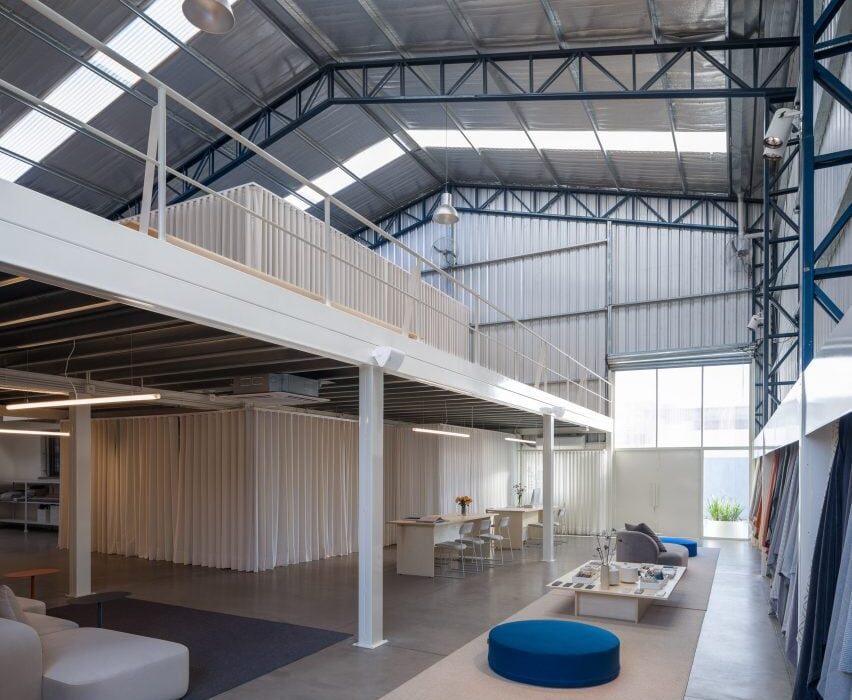
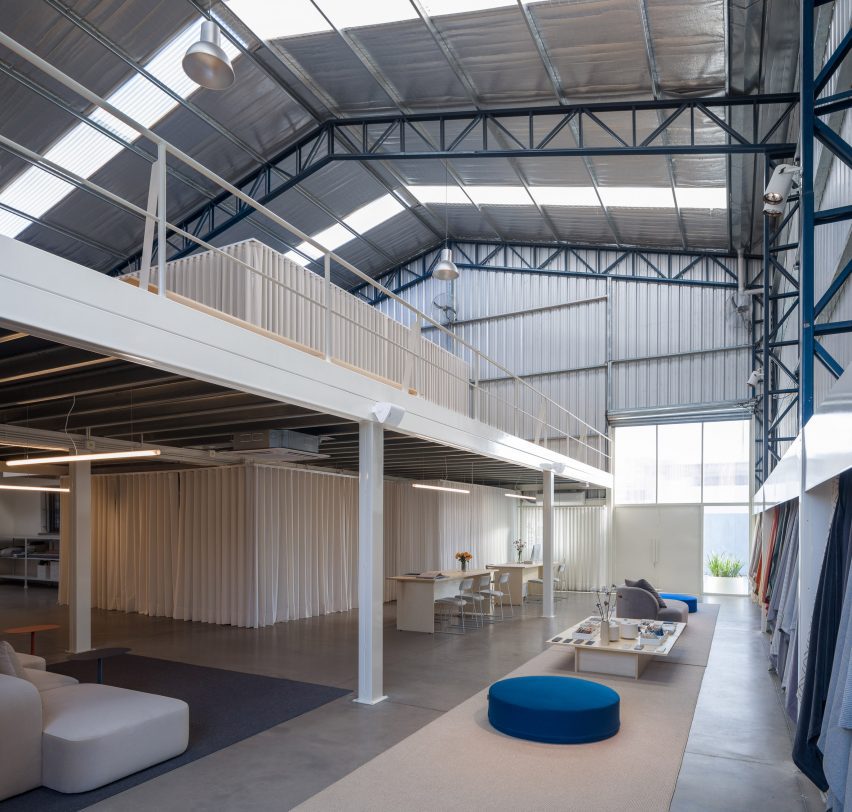
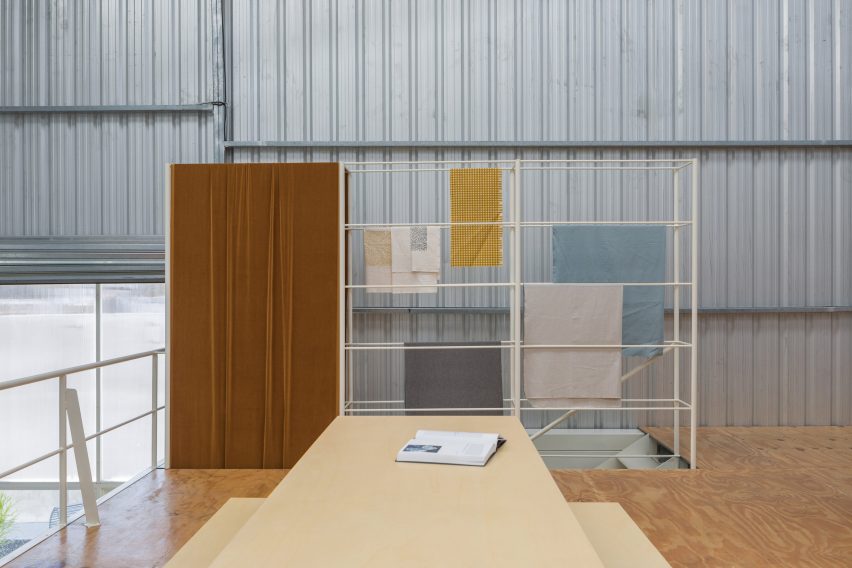
Local architect Florencia Rissotti has converted a warehouse into a textile shop in Buenos Aires, using fabric dividers to organise the space.
To house a retail location for fabric shop Tienda Mayor, Rissotti integrated textiles in several ways, lining the store with samples, draping colourful patches over a staircase and using curtains to conceal and create space.
Architect Florencia Rissotti has converted a warehouse into a fabric store in Buenos Aires
The interior is divided into two floors, with a mezzanine above used for storage and office space, and the store’s retail space and lounge areas below.
Cream-coloured curtains hang underneath the mezzanine and above to hide storage areas and create meeting spaces.
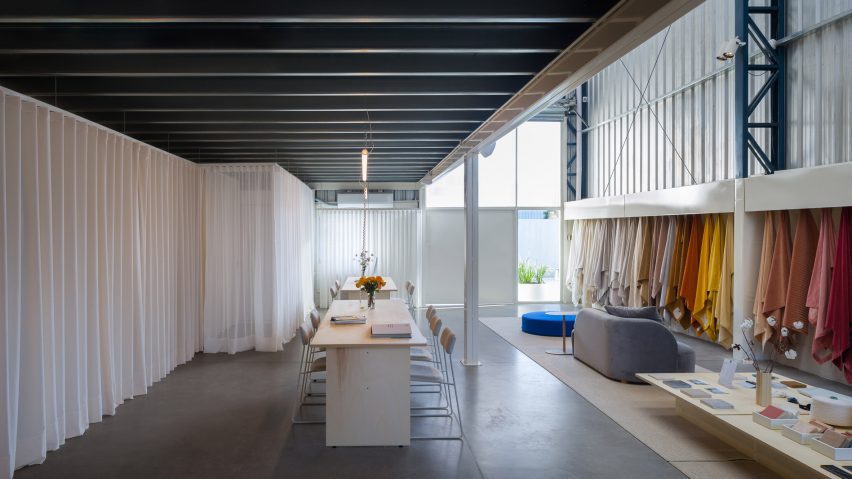
A catalogue of fabric hanging from hooks lines the space
“The space was assembled using the raw material of the place: fabric,” said the studio. “A series of curtains divide, set up a meeting room, hide shelves with orders and cover the storage area.”
Along the length of a wall, large material samples are draped from hooks, which will “mutate” over time as the catalogue changes.
The space was organized and divided using creme coloured curtains
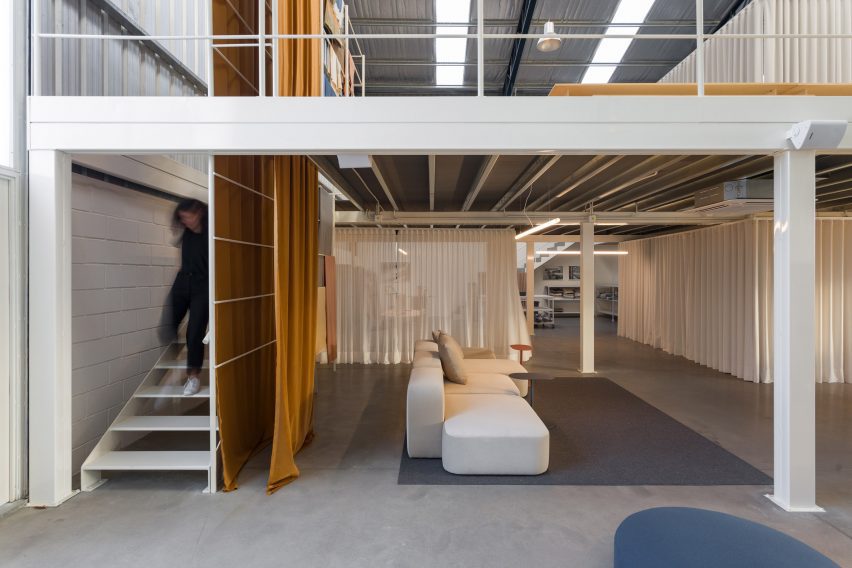
Similarly, fabric samples of various sizes were draped over the railings of a staircase that leads to the mezzanine, in part as a permanent installation and to display the shop’s selections.
“The ladder device was intended as an exhibition element, from which velvet falls and sews the two levels (the totem) together,” said the studio. “This ladder hanger is designed as an internal display window, where the selection/palette can be changed according to the season.”
Various creme tones dominate the space, with colour integrated from fabric samples and bright seating running in a straight line parallel to the fabric samples.
Alamo wood desks and large coffee tables were crafted for the space.
A staircase installation displays a rotating selection of textiles
Outside, a garden area contains a semi-circle metal bench and simple plantings.
Florencia Rissotti is a Buenos Aires-based architect who focuses on interiors and residential architecture.
Elsewhere in Buenos Aires, La Base Studio recently created a delicate wooden privacy screen for a 1970s home renovation and architects Julio Oropel and Jose Luis Zacarias Otiñano created a bio-art installation focused on fungi.